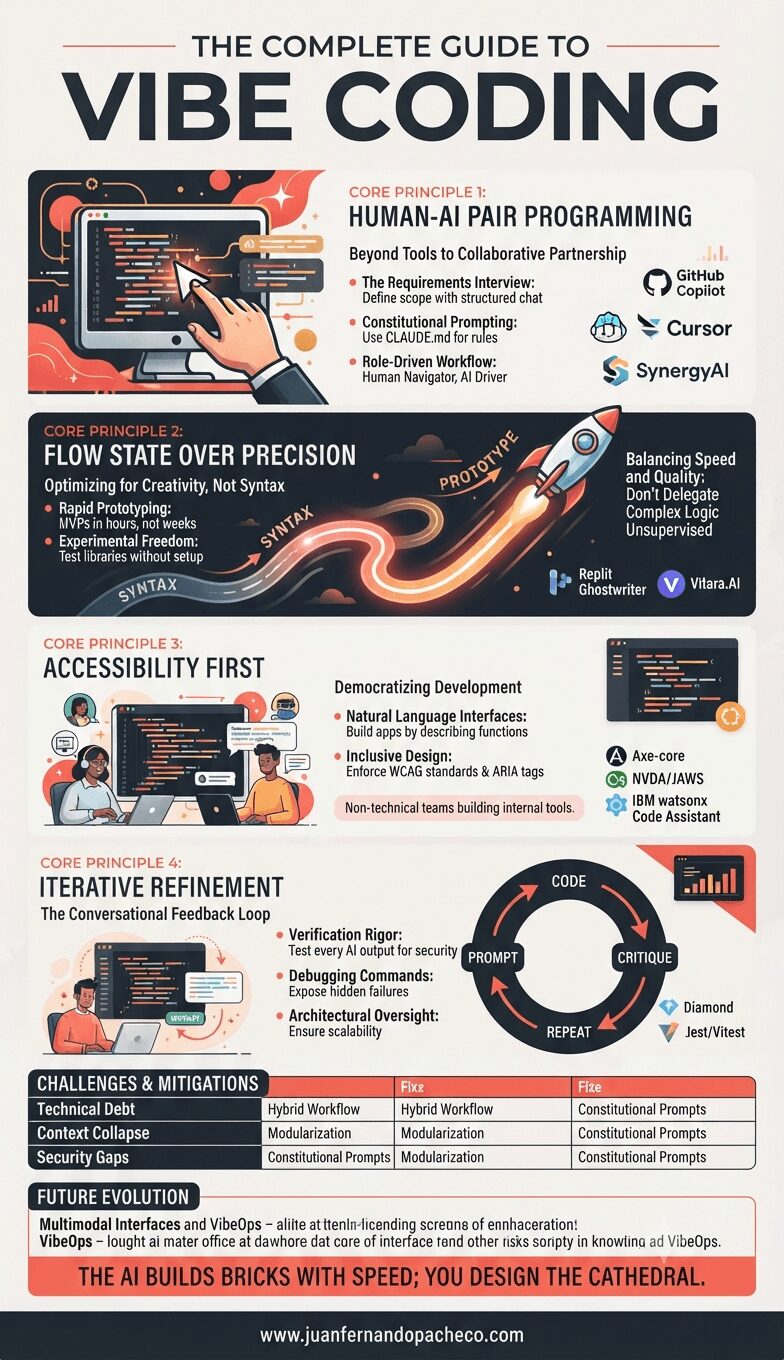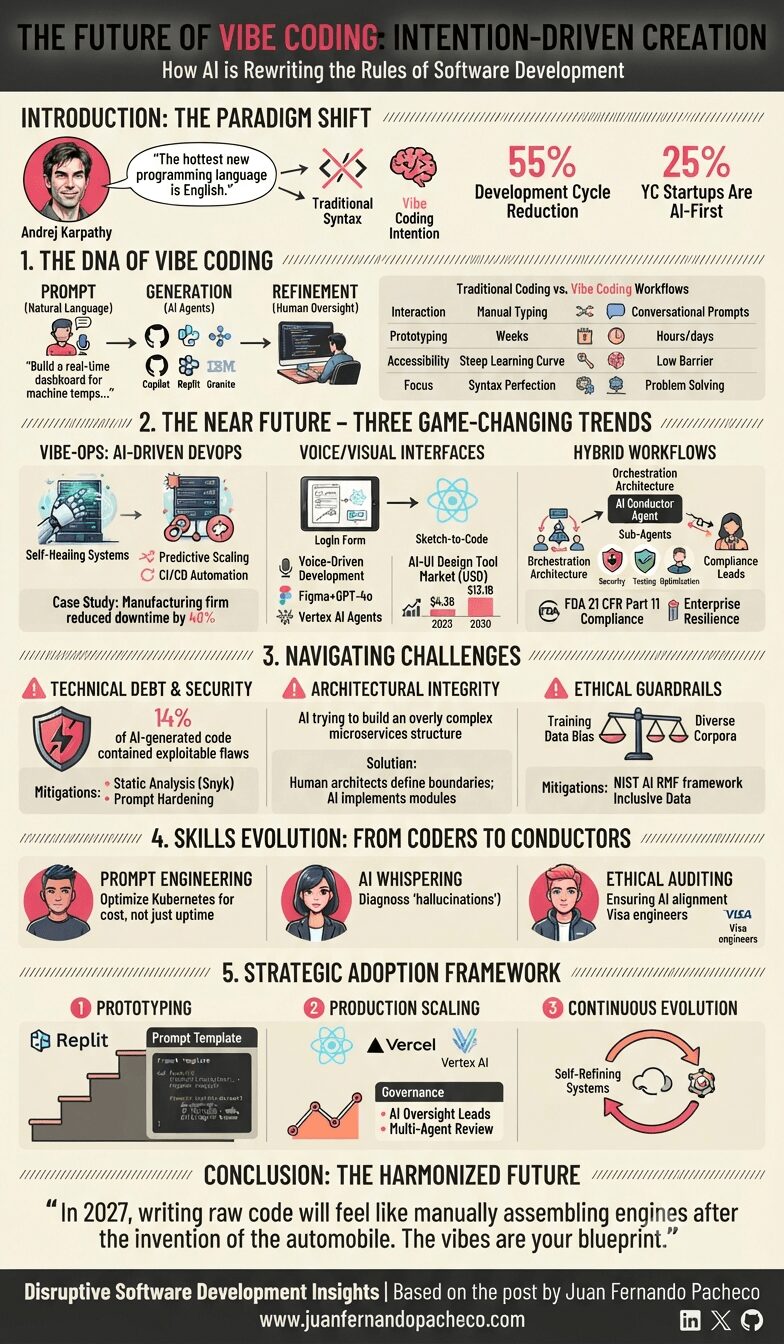
A detailed infographic titled "The Future of Vibe Coding: Intention-Driven Creation," exploring the shift from traditional syntax-based software development to AI-driven, natural-language programming. The graphic covers the paradigm shift led by Andrej Karpathy’s vision, the DNA of vibe coding workflows, three future trends (VibeOps, Voice/Visual Interfaces, Hybrid Workflows), key challenges and skills evolution, a strategic adoption framework, and a concluding quote predicting a future where raw manual coding is obsolete. It includes data, tool logos, and illustrations across five structured sections on a light beige background, referencing www.juanfernandopacheco.com.

Vibe coding isn’t about replacing developers—it’s about elevating creativity. As Karpathy noted, we’re moving from “character-by-character typing” to “seeing stuff, saying stuff, running stuff”.

The future belongs to teams that wield AI as a co-pilot: voice interfaces accelerating ideation, VibeOps hardening infrastructure, and hybrid workflows merging human ingenuity with machine efficiency.
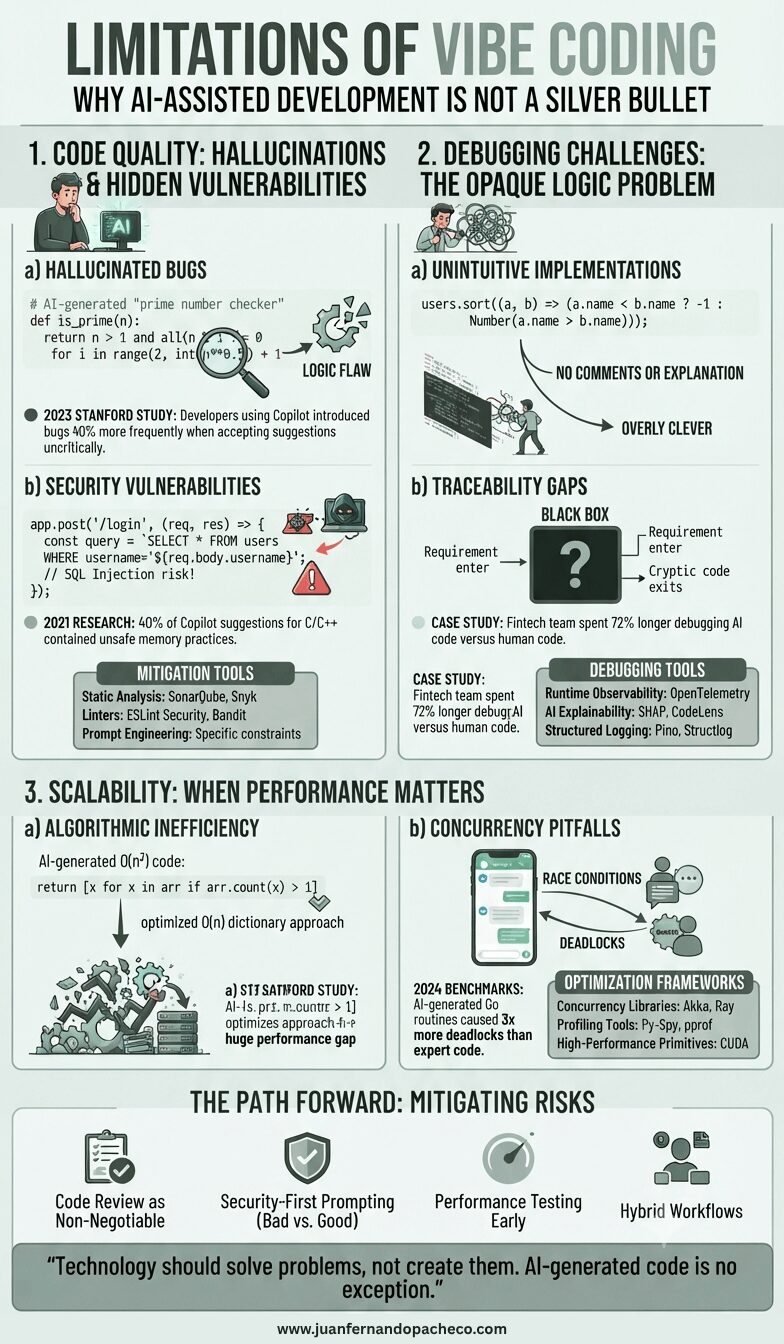
An infographic titled "Limitations of Vibe Coding," presented in a vertical format with three main sections: Code Quality, Debugging Challenges, and Scalability. Each section details AI-assisted development risks using text, code snippets, data points from studies (Stanford, 2023; Fintech team, 2024), and tool recommendations (Snyk, OpenTelemetry, Akka). The bottom section outlines mitigation strategies and includes the quote: "Technology should solve problems, not create them. AI-generated code is no exception." and the URL www.juanfernandopacheco.com.

Vibe coding accelerates development but at the cost of technical debt, security gaps, and scalability cliffs. As I’ve advised LATAM teams:

Use AI as a collaborator, not a replacement.

Pair it with rigorous review, observability, and domain expertise. The future of coding isn’t human vs. machine—it’s human + machine, with clear boundaries.

“Technology should solve problems, not create them. AI-generated code is no exception.”

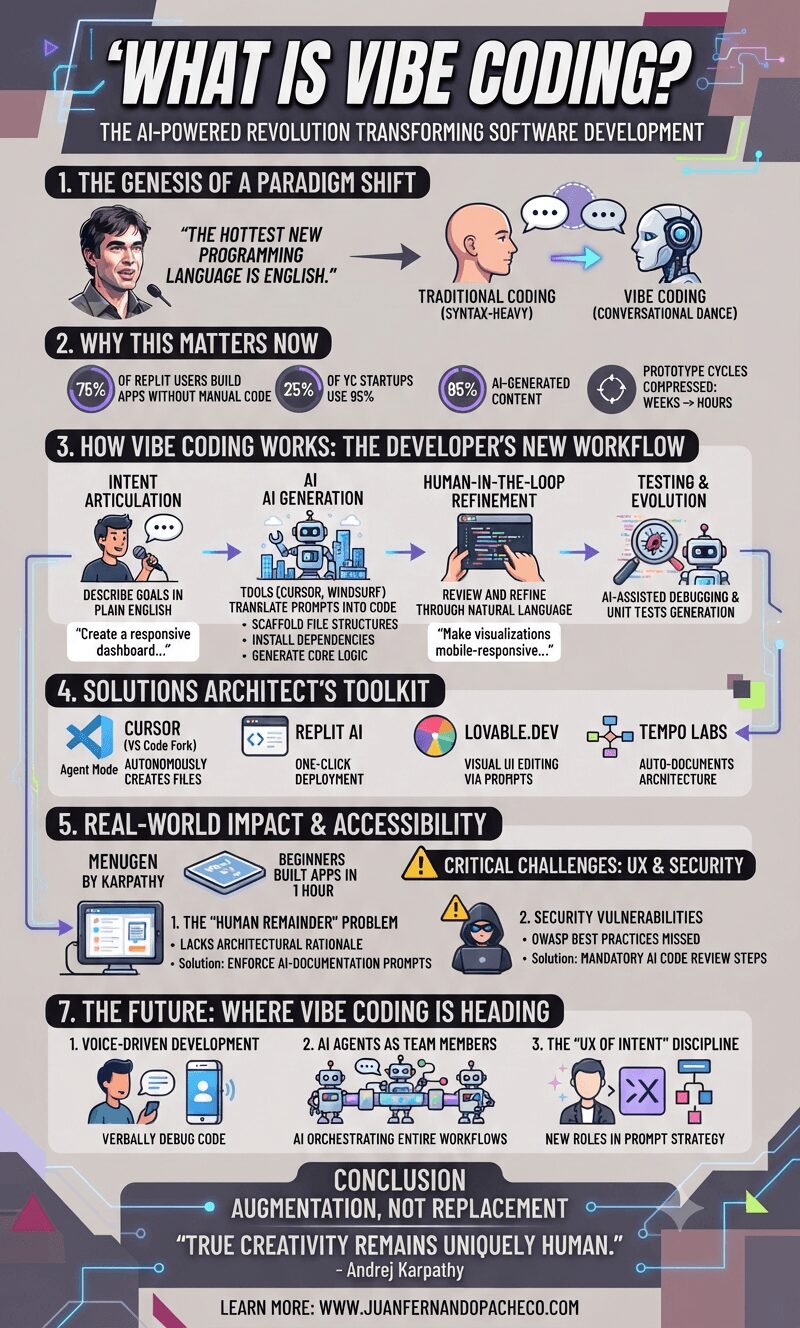
An infographic titled 'WHAT IS VIBE CODING?' detailing a paradigm shift where natural language replaces traditional code syntax. It illustrates the four-phase workflow (Intent Articulation, AI Generation, Human-in-the-Loop Refinement, Testing), highlights key statistics (e.g., 75% of Replit users build apps without manual code), lists essential tools (Cursor, Replit AI, Lovable.dev, Tempo Labs), and outlines future trends like voice-driven development and AI agents, concluding with the tagline 'Augmentation, Not Replacement.'

Coined in February 2025 by AI pioneer Andrej Karpathy (former Tesla AI director and OpenAI founding member), this methodology reimagines software creation as a conversational dance between human intention and AI execution.

Unlike traditional programming, vibe coding treats natural language as the primary interface: developers describe goals (e.g., “Build a REST API with JWT authentication”), and AI tools like GitHub Copilot generate executable code in real-time

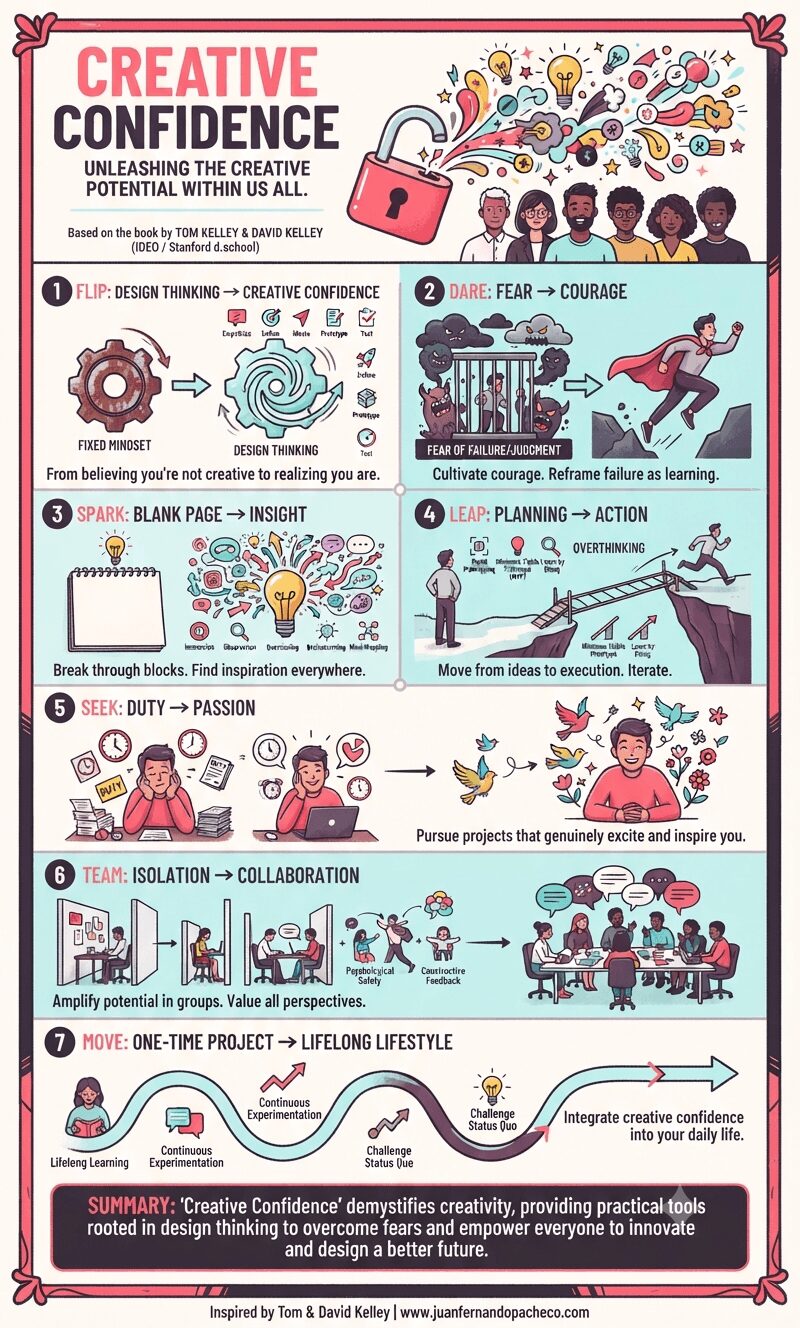
An infographic summarizing the book "Creative Confidence" by Tom and David Kelley. The image is structured in seven numbered steps, titled Flip, Dare, Spark, Leap, Seek, Team, and Move, illustrating processes from design thinking and overcoming fear to collaborative innovation and lifelong creative habits.

Creative Confidence is a profoundly inspiring and practical book that demystifies creativity and makes it accessible to everyone. Tom and David Kelley skillfully blend personal anecdotes, insightful observations, and concrete methodologies (rooted in design thinking) to illustrate how creative potential can be unlocked and harnessed.

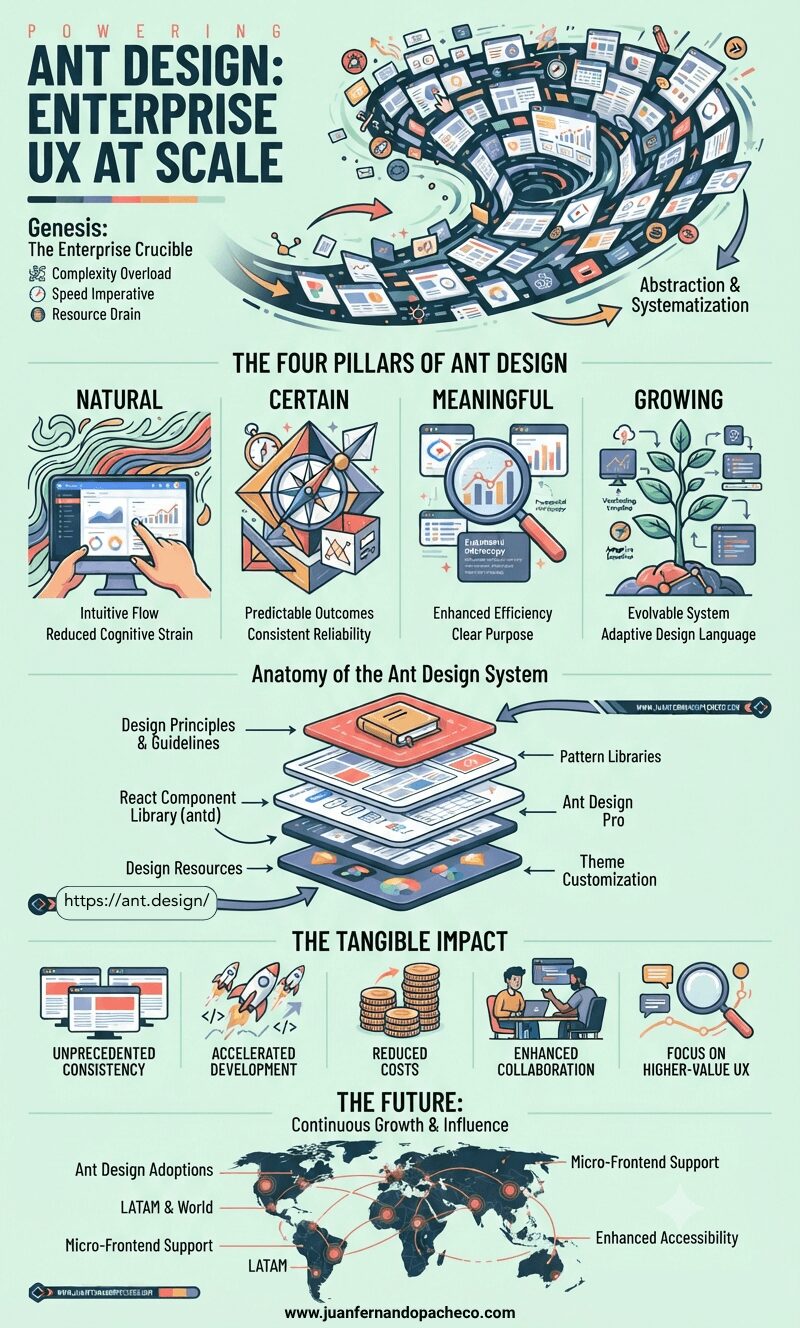
An infographic illustrating the Ant Design system, detailing its origins in the "enterprise crucible" of complexity, its four core values (Natural, Certain, Meaningful, Growing), the anatomy of its toolkit (React library, Ant Design Pro, design resources), tangible impacts like accelerated development and consistency, and its global future. The infographic includes references to www.juanfernandopacheco.com.

Ant Design is far more than a collection of React components. It represents a mature, battle-tested approach to taming the inherent complexity of enterprise software development.

By anchoring itself in strong design values – Natural, Certain, Meaningful, and Growing – it provides a holistic solution that boosts efficiency, enforces consistency, and elevates the user experience.

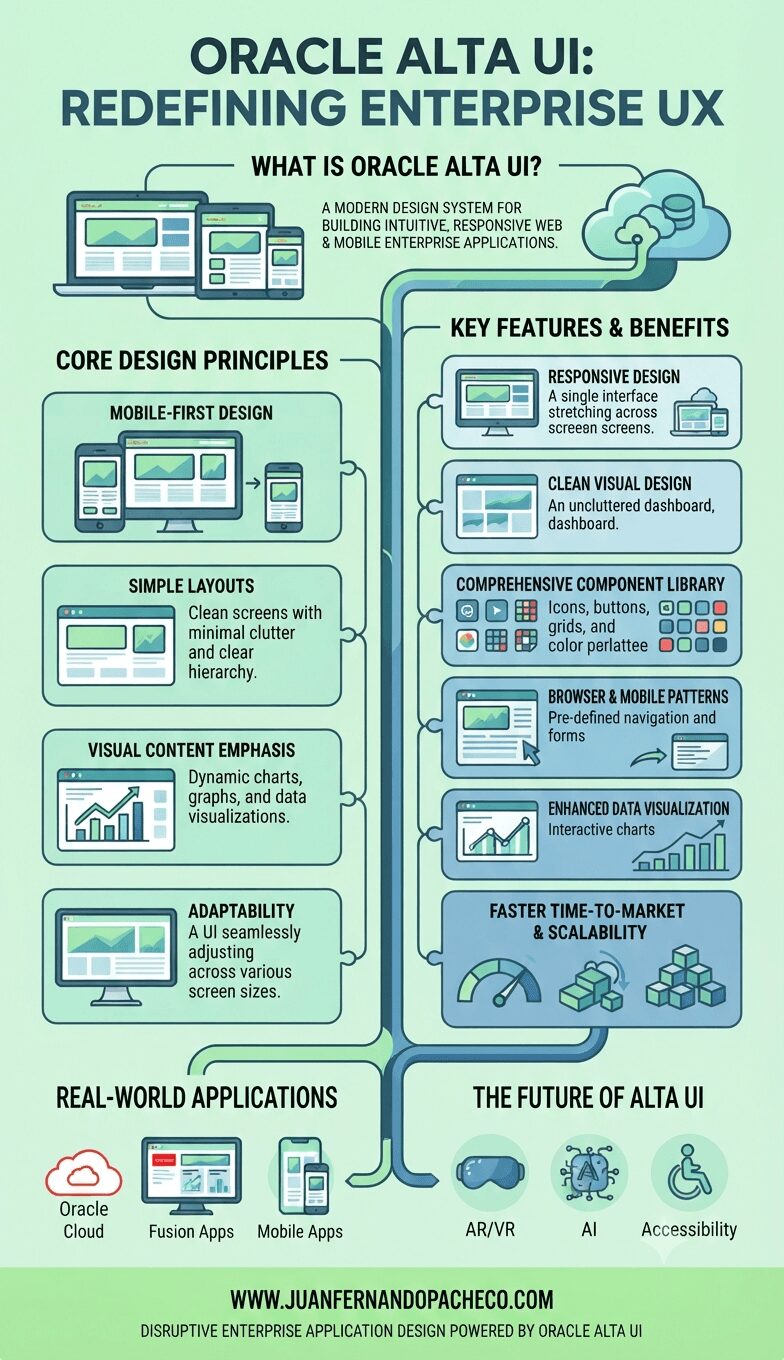
A comprehensive infographic titled "ORACLE ALTA UI: REDEFINING ENTERPRISE UX," set against a light mint green background, visually represents the design system. The central vertical flow connects sections detailing: "WHAT IS ORACLE ALTA UI?" with illustrations of desktop, tablet, and mobile screens; "CORE DESIGN PRINCIPLES" covering Mobile-First, Simple Layouts, Visual Content Emphasis, and Adaptability; and "KEY FEATURES & BENEFITS" including Responsive Design, Clean Visual Design, Component Library, Browser & Mobile Patterns, Enhanced Data Visualization, and Scalability. The infographic concludes with examples of "REAL-WORLD APPLICATIONS" (Oracle Cloud, Fusion Apps, Mobile Apps) and glimpses into "THE FUTURE OF ALTA UI" (AR/VR, AI, Accessibility). It features the URL WWW.JUANFERNANDOPACHECO.COM and the tagline "DISRUPTIVE ENTERPRISE APPLICATION DESIGN POWERED BY ORACLE ALTA UI."

Oracle Alta UI exemplifies how thoughtful design can transform enterprise software into intuitive tools that enhance productivity and user satisfaction. By prioritizing simplicity, responsiveness, and adaptability, it empowers developers to create applications that meet modern demands without sacrificing quality or efficiency.