Introduction: The evolution of developer workflows
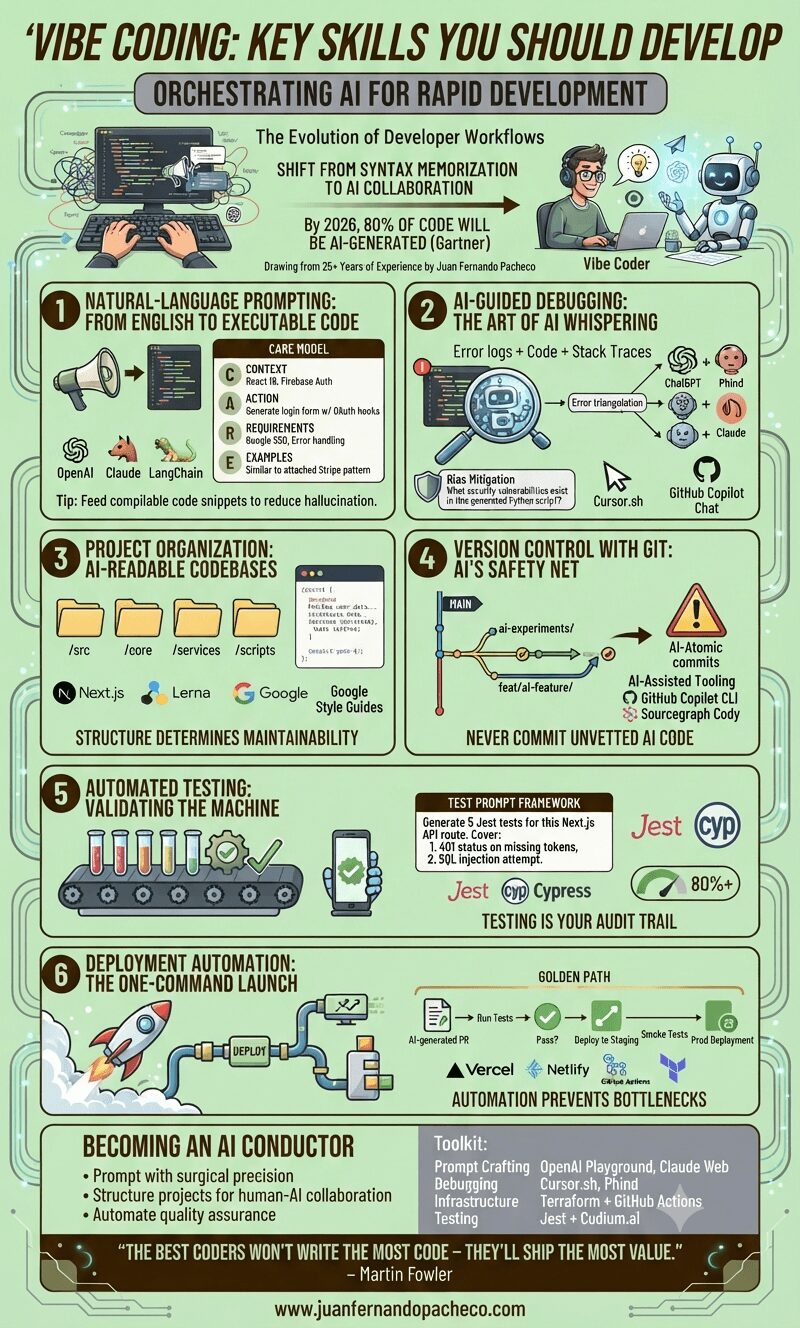
The rise of AI coding assistants like GitHub Copilot, ChatGPT, and Claude has birthed “Vibe Coding” – a paradigm where developers collaborate with AI to accelerate ideation, prototyping, and deployment.
Unlike traditional coding, Vibe Coding prioritizes prompt engineering, AI-augmented debugging, and infrastructure automation over manual syntax memorization.
In this post, I’ll dissect six non-negotiable skills for mastering Vibe Coding, drawing from 25+ years of building systems at scale.
Why It Matters: By 2026, 80% of code will be AI-generated (Gartner). Your value shifts from writing lines to orchestrating AI outputs.
1. Natural-Language Prompting: From English to Executable Code
Core Concept: Translate vague ideas (“Build a REST API for user profiles”) into precise AI prompts that generate production-ready code.
Key Tactics:
Structured Prompt Frameworks:
Use the CARE model:Context: “We’re using React 18 and Firebase Auth”
Action: “Generate a login form with OAuth hooks”
Requirements: “Must include Google SSO and error handling”
Examples: “Similar to the attached Stripe integration pattern”
Tools & References:
Claude’s Prompt Library
Frameworks: LangChain for chaining prompts across models.
Pro Tip: Feed AI compilable code snippets (e.g., “Extend this Next.js middleware to add rate-limiting”) – specificity reduces hallucination.
2. AI-Guided Debugging: The Art of AI Whispering
Core Concept: AI-generated code fails in subtle ways. Debugging now means interrogating AI outputs.
Critical Skills:
Error Triangulation:
Paste error logs + code + stack traces into ChatGPT/Gemini with:
“Explain why this Next.js API route crashes during Vercel deployment. Here’s the build log: [log snippet].”Cross-reference multiple AIs (e.g., Phind for technical depth, Claude for readability).
Bias Mitigation:
AI often ignores edge cases. Always ask:
“What security vulnerabilities exist in this generated Python script?”Tools:
Cursor.sh: AI-powered IDE with
/debugcommand.GitHub Copilot Chat: Context-aware debugging in VS Code.
Rubber Duck Debugging + AI: Verbalize problems to uncover gaps.
3. Project Organization: AI-Readable Codebases
Core Concept: AI struggles with spaghetti code. Structure determines maintainability.
Vibe Coding Conventions:
File/Folder Taxonomy:
/src
  /core      # Business logic (AI-friendly)
  /services  # APIs, third-party integrations
  /ui        *# Components with clear props*
/scripts # Automated workflows- Documentation-Driven Development:
Use JSDoc/TypeDoc to explain intent:
/**
 * @purpose Fetches user data with automatic JWT refresh
 * @throws {AuthError} On invalid session
 */
async function fetchUser() { ... }
Tools:
Next.js/Nuxt.js: Opinionated structure for full-stack apps.
Lerna/Turborepo: Monorepo management.
Google’s Style Guides: AI understands standardized patterns.
4. Version Control with Git: AI’s Safety Net
Core Concept: Git isn’t just for humans. AI-generated code requires aggressive branching/rollback.
Vibe-Optimized Git Flow:
Branch Strategy:
ai-experiments/: Isolate AI-generated POCs.feat/ai-[feature]: Test AI features beforemainmerge.
Atomic Commits:
git commit -m "feat: Add Stripe webhook handler [AI-generated]"
AI-Assisted Tooling:
GitHub Copilot CLI: Natural-language commands (
gh copilot explain [file]).Sourcegraph Cody: AI for cross-repo code searches.
Reference: Git Patterns for AI Collaboration
Warning: Never commit unvetted AI code to
main. Treat AI like a junior developer.
5. Automated Testing: Validating the Machine
Core Concept: AI code looks correct but fails under edge cases. Testing is your audit trail.
Vibe Testing Stack:
Toolchain:
Jest + React Testing Library: Component/unit tests.
Cypress/Playwright: E2E flows (critical for AI UIs).
AI Test Generators: GitHub Copilot for Tests, Codium.ai.
Test Prompt Framework:
"Generate 5 Jest tests for this Next.js API route.
Cover:
1. 401 status on missing tokens
2. SQL injection attempt via username"
Coverage Rules:
80%+ coverage for AI-generated modules.
SonarQube for static analysis.
6. Deployment Automation: The One-Command Launch
Core Concept: AI accelerates development; automation prevents deployment bottlenecks.
CI/CD for Vibe Coding:
Golden Path:
graph LR
  A[AI-generated PR] --> B[Run Tests]
  B --> C{Pass?}
  C -->|Yes| D[Deploy to Staging]
  D --> E[Smoke Tests]
  E  F[Prod Deployment]
Tools:
Vercel/Netlify: Zero-config frontend deploys.
GitHub Actions: AI-tuned workflows (e.g., AI Review Action).
FluxCD/ArgoCD: GitOps for Kubernetes.
Infrastructure as Code (IaC):
Use Terraform/Pulumi to codify environments. Prompt:
“Generate Terraform config for AWS Lambda with VPC access.”
Conclusion: Becoming an AI Conductor
Vibe Coding doesn’t replace developers – it elevates them to orchestrators. The future belongs to those who can:
Prompt with surgical precision,
Structure projects for human-AI collaboration,
Automate quality assurance.
Final Toolkit:
Prompt Crafting: OpenAI Playground, Claude Web.
Debugging: Cursor.sh, Phind.
Infrastructure: Terraform + GitHub Actions.
Testing: Jest + Codium.ai.
“The best coders won’t write the most code – they’ll ship the most value.” – Martin Fowler
Further Reading: