A before, during, and after system for building lasting relationships.
Some of the most important conversations of my career have lasted less than five minutes. A hallway between meetings in Mexico City. The coffee station at a technology summit in Bogotá. The quiet corner of a lobby in Quito, right before a steering committee. In each case, a handful of sentences decided whether an executive would remember me as just another vendor, or as someone worth calling when the hard problem showed up.
For more than twenty years, I have worked across product design, user experience, and business development, and today I lead strategic deals and technology revenue growth across Latin America. That path has put me in hundreds of first meetings with CEOs, CIOs, CFOs and procurement leaders in Mexico, Colombia, Ecuador and beyond. And if there is one skill I have had to learn, unlearn and relearn, it is how to introduce yourself at the executive level. Not the polite version we exchange at cocktail parties, but the commercial version: the introduction that opens a relationship strong enough to survive a long sales cycle, a rigorous RFx process and a difficult negotiation.
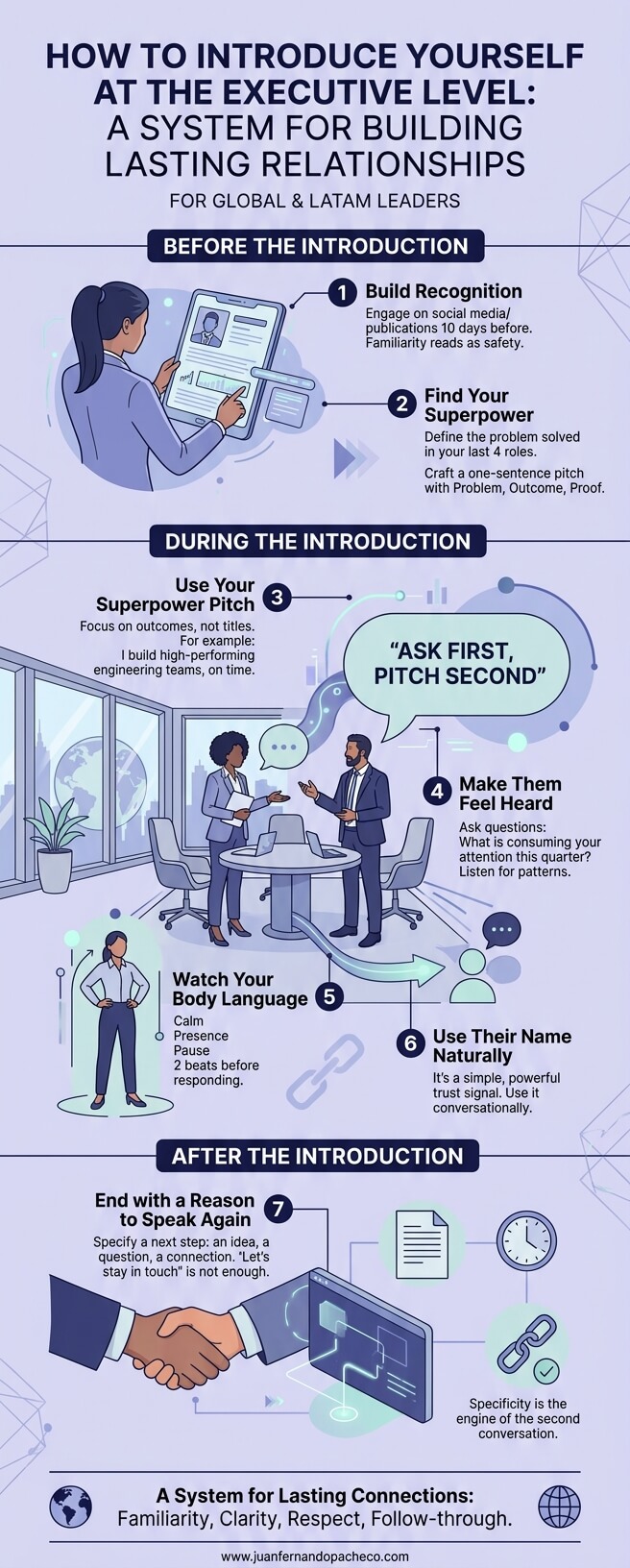
A good infographic I reviewed recently condenses that skill into seven moves, organized in three moments: before, during and after. In this post, I expand each move, connect it to what I have seen work in real enterprise deals, and leave you with a system you can use for the rest of your career. Platforms will change. Titles will change. Markets will change. The psychology will not. That is why this piece is written to be as useful five years from now as it is today.
Why executive introductions are a different game
When two executives meet, a quiet evaluation runs underneath the small talk. Each person is asking three questions: what do you do, have you actually done it before, and why should I believe you? Most introductions fail because they answer the wrong question first. We lead with our title, our company, our place in the org chart. But the executive across the table is scanning for outcomes, patterns, and risk, not labels.
There is a second difference: executives are protected, people. Assistants, routines, and habits filter the noise out of their day, and a cold introduction, no matter how brilliant, arrives as noise. A warm one arrives as a signal, and warm, referred approaches consistently convert several times better than cold ones. That is why the system below starts long before the handshake, and why it does not end when the conversation does.
Before the introduction
1. Build recognition, because warm beats cold every time
The first move says it plainly: warm introductions are far more effective than cold ones. And it offers a concrete habit. For about ten days before you expect to meet someone, comment intelligently on what they publish. Add a thoughtful point to their articles, their posts, their public interviews. When the introduction finally happens, you are no longer a stranger. You are the person who left that sharp comment about their distribution strategy, and they feel like they already know you.
This works because of a well-documented principle in psychology called the mere exposure effect: people tend to develop a preference for things simply because they are familiar with them. Familiarity reads as safety, and safety is what lowers the guard of a busy executive. In commercial terms, ten days of intelligent comments are a small investment that removes the largest tax on any first conversation: the cost of proving you are not a stranger.
In my own practice, before a major RFx or a first meeting with a new account, I map the people I will meet and spend one or two weeks interacting with their public thinking before I ask for anything. Reading what a CIO writes about cloud migration and responding with a serious point of view is free, respectful, and enormously effective. When we finally sit across the table, the first ten minutes are not spent breaking ice; they are spent building on recognition.
If the person does not publish, the same principle travels through other warm channels: a shared connection, a shared alumni group, a precise reference to something they said on a panel. The rule never changes: never arrive as a stranger if you can arrive as a familiar name.
2. Find your superpower, and say it in one sentence
The second move asks you to work out the problem you solved in each of your last four roles. Not your responsibilities: the problem. Then look for the pattern and build a one-sentence pitch with three ingredients: the problem, the outcome, and the proof. Memorize it and carry it with you.
This is one of the most powerful exercises I know, and I have used it with product designers, engineers and sales leaders alike. The best pitches are short, and the discipline of a single sentence forces you to find the sharpest possible version of your value. When I did the exercise myself, the pattern across my last four roles was clear, whether I was designing user experiences or leading enterprise deals: complex, ambiguous situations that had to become clear, sellable, and executable. My one-sentence pitch today sounds something like this: most technology initiatives in our region lose money not because the idea is bad, but because the business case never gets translated into language the buyer trusts; I build that translation, and I have used it to scale technology revenue across Latin American markets.
Notice the structure. The problem: initiatives lose money when value is not translated. The outcome: the translation gets built and revenue scales. The proof: my own track record across those markets. One sentence, no jargon, no title.
The audit of your last four roles matters because it forces honesty. If you cannot name a problem you solved in each of your recent positions, then either you were not paying attention, or the roles were too passive. Either way, the audit tells you something important about your career, not just your pitch. Write your sentence down, say it out loud until it sounds like something a human would say in an elevator, and keep it ready for your next event, meeting or conference.
During the introduction
3. Use your superpower pitch naturally, because people remember outcomes, not titles
The material I am commenting on gives a beautiful example. When someone asks what you do, do not answer “I am a CTO” or “I lead engineering teams.” Instead, say something like: sixty percent of tech CEOs fail in their first year because they cannot build the right team fast enough; I build those teams for them, on time. A pitch like this works the way a film logline works: one or two sentences that tell the whole story and make the listener want the rest.
A title is a label, but an outcome is a story. Labels get filed; stories get remembered. When you answer with a problem-outcome-proof sentence, you give the executive three gifts at once: a clear picture of the pain you understand, a picture of the future you create, and a reason to keep asking you questions.
In enterprise sales and RFx execution, this is even more important. The people you meet at the executive level have seen hundreds of vendors. Introduce yourself as the account owner for a vendor, and you inherit all the skepticism attached to that word. Introduce yourself as the person who turns messy procurement processes into predictable outcomes, and you become a peer with a point of view, not a supplicant with a brochure.
Two practical notes. First, deliver the pitch at conversation speed, with a smile, and let it breathe; if it sounds recited, it dies. Second, watch for the follow-up question. A good superpower pitch always produces one: how do you do that, does that apply to my industry? That question is your invitation to go deeper. If no question comes, your pitch was a statement about you, not a hook for them.
4. Make them feel heard, because the best introduction starts with a question
Here is where commercially minded professionals get it backwards. We finally get five minutes with a senior executive, and we spend four of them talking. The better order is the opposite: ask what they are working on before you say what you do, and listen for the problem before you position yourself as the solution.
This is exactly the discipline of a good discovery conversation in a complex deal. Decades of research on consultative selling show that in larger deals, the people who ask the right questions at the right time outperform the people who rush to present. The same logic applies to a five-minute introduction. The executive does not remember the person who talked the most; they remember the person who made them feel the most understood.
So the sequence matters. First your question: what is consuming your attention this quarter? Then silence, real listening, and one or two follow-ups that go one level deeper. Only then, and only if it genuinely fits, do you connect your superpower to their problem: that is interesting, because the pattern you describe is exactly the one I work on. Now your pitch lands on prepared ground, and the introduction starts to look like the beginning of a deal.
Making them feel heard is not a manipulation technique; it is a posture of respect that happens to be commercially effective. People open up to those who listen, and the information you receive in those first minutes often decides whether, and how, you will ever be useful to each other.
5. Watch your body language, because you make an impression before you speak
Shoulders back, feet planted, slow your pace, pause for two beats before responding. Four instructions, and each one is worth its weight in gold. Before a single word arrives, your posture communicates status, calm, and intent, and research on first impressions reminds us that observers form judgments quickly and hold onto them stubbornly.
A hurried entrance, a floating handshake, eyes scanning the room for someone more important: all of it says I am not fully here, and nothing kills trust faster. The two-beat pause is my favorite correction. When an executive asks you a question and you answer instantly, you sound rehearsed or anxious. When you pause for two beats, you signal that you considered the question, and your answer lands with more weight. In negotiations and deal reviews I have seen this small habit change how senior people perceive a counterpart: slower reads as more senior, in almost every culture I have worked in, from Mexico to Ecuador.
None of this is about performing dominance. It is about aligning your body with your intent: present, calm, interested. Presence is the quiet multiplier of everything else in this system.
6. Use their name naturally, because it is the simplest trust signal almost nobody uses
When you first hear their name, use it once to lock it in: it is a pleasure to meet you, Andrea. Then use it again, naturally, once during the conversation and perhaps once at the end. Not in the artificial way of a manual, but the way you would with someone you genuinely respect.
A person’s name is the sound they respond to most readily, and Dale Carnegie captured it perfectly: to any person, their own name is the sweetest and most important sound in any language. Used well, a name converts an interaction between two roles into an encounter between two people. Used poorly, repeated every sentence like a bad sales script, it sounds manipulative. The dose is the difference: once at the start, once or twice in the middle, once at the end.
In long sales cycles this small habit compounds. The executive you met at an event becomes a person you address by name in every follow-up, and that continuity of recognition is part of what turns a contact into a relationship. Remembering is itself an act of respect: you cannot use a name you never bothered to keep.
After the introduction
7. End with a reason to speak again, because the introduction is only the beginning
The last move is where most introductions die: the exit. Let’s stay in touch means nothing and goes nowhere. It is a polite way of closing a door while pretending to open one.
Instead, close with a specific reason to reconnect: an idea (I will send you that example of how a retailer in Colombia handled the same rollout), a question (you mentioned the audit in March; may I ask how it ended?), or a connection (my colleague in Ecuador works on exactly that; I would love to introduce you). Specificity is the engine of the second conversation.
In deal-making terms, this is the difference between an open loop and a closed one. A specific next step creates a small, honest commitment that both sides can honor. When I leave an executive introduction, I want three things in my notes: their name spelled correctly, one thing they care about, and one specific reason for us to speak again. If I have those three, the relationship has a future. If I do not, I just met a stranger.
And then, of course, honor the loop you opened. Send the example. Ask the question. Make the introduction. Even when a first meeting goes badly, relationships can recover; people get second chances to make the right impression when they follow up with something useful. The follow-through is the real introduction; the handshake was only the trailer.
Putting the seven moves into one simple habit loop
If all of this feels like a lot, compress it. Before: become familiar, and carry your sentence. During: ask first, pitch second, slow down, use their name. After: close with a specific next step. That is the whole system in one breath.
You do not need to execute all seven moves perfectly every time. You need to stop leaving introductions to chance. Executives meet hundreds of people; they remember the few who made the encounter easy, useful and human. Practice the system in low-stakes settings first: a meetup, a school event, a casual coffee. By the time the high-stakes meeting arrives, the sequence should feel like walking, not like juggling.
Why this will still work in five years
I promised this piece would age well, so let me be explicit about why I believe it will. The seven moves do not depend on any platform, industry or economic cycle. They depend on stable features of human beings: we trust the familiar, we remember stories better than labels, we open up to those who listen, we read calm bodies as capable ones, we respond to our own name, and we honor specific commitments more than vague intentions. None of that changed in the last twenty years of my career, and none of it will change in the next five.
Tools will change. The network where you comment for ten days may not exist in a decade, and the formats of your pitch will shift. But the underlying system, warm before, human during, specific after, will keep working as long as business is done between people.
So practice your sentence. Read what they publish. Ask before you tell. Pause before you answer. And never, ever end with let’s stay in touch.
References and further reading
Web references
- Harvard Business Review – how to make a great first impression
- Harvard Business Review – the art of the elevator pitch
- Harvard Business Review – your elevator pitch needs an elevator pitch
- Harvard Business Review – a second chance to make the right impression
- Wikipedia – mere-exposure effect
- Altrata – the value of warm introductions
- Dale Carnegie Training – how to remember people’s names
- Lucid – the 4 steps to SPIN selling, on asking questions before presenting
Books that reinforce this post
- How to win friends and influence people, by Dale Carnegie — the classic on names, listening, and genuine interest
- Never split the difference, by Chris Voss — tactical empathy, active listening, and the power of the pause
- Never eat alone, by Keith Ferrazzi — building relationships in advance, with generosity and consistent follow-up.
- SPIN selling, by Neil Rackham — why asking questions before presenting changes the outcome of bigger deals
- The challenger sale, by Matthew Dixon and Brent Adamson — leading executive conversations with insight instead of approval.
- Presence, by Amy Cuddy — bringing your boldest, calmest self to high-pressure moments.
- Give and take, by Adam Grant — why givers build the strongest long-term networks.