Your brain is not tired. It’s overloaded
The tiredness that sleep does not fix
There is a specific kind of exhaustion that most knowledge workers know well. You sleep seven or eight hours. You have your coffee. You sit down with a full agenda. And yet, by mid-afternoon your mind feels like a browser with too many tabs open: everything is slow, nothing loads properly, and the smallest additional request makes you want to close it all.
For a long time I interpreted that feeling as tiredness, and I treated it the way most professionals do: more coffee, more effort, more hours. I have spent more than twenty years in product design, product ownership, and business development across Latin America, and for a good part of that time I led high-stakes procurement processes — requests for proposals, quote requests, multi-year contracts with banks and insurers where a single missed clause could change the economics of a deal.
In those seasons I regularly ended the day unable to read even one page of a book, even though I had spent the entire day “thinking.”
It took me years to understand the sentence that now organizes how I manage my own mind: your brain is not tired. It is overloaded.
That distinction is not semantics. It is the difference between resting and resetting. Rest fixes tiredness. Only removing load fixes overload.
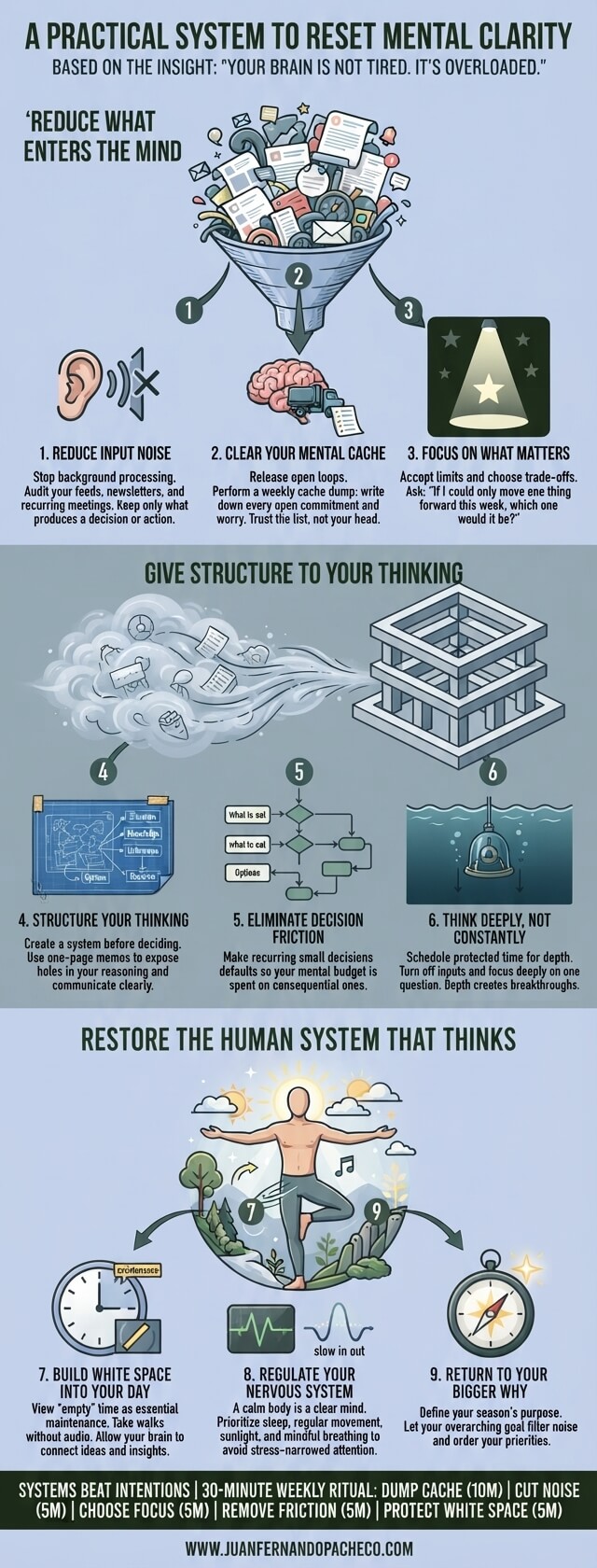
This post is a complete, practical system to do exactly that, written to remain useful whether you read it today or five years from now: no apps, no trends, no hacks that expire. Just nine practices, ordered in a simple sequence — first reduce what enters your mind, then give structure to what is already there, and finally restore the human system that thinks.
Tired and overloaded are different problems
Tiredness is what you feel after effort, and it has a clean solution
Rest. Sleep, a walk, a weekend. Overload is different. It is what you feel when the amount of information, open decisions, and unresolved loops in your head exceeds its processing capacity.
You can sleep a full night and wake up exhausted, because the load was still there when you woke up. The exhaustion was never about energy. It was about occupancy.
Cognitive science has studied this for decades
Our working memory is surprisingly small, and every unprocessed item competes for the same limited space. Unfinished tasks have a documented tendency to keep demanding attention — psychologists call it the Zeigarnik effect.
And every time you switch tasks, part of your attention stays stuck on the previous one, a phenomenon researcher Sophie Leroy named attention residue. Add the switching costs of constant multitasking, which can waste a large share of productive time, and you have a precise description of the modern professional mind: not weak, not lazy, not tired. Overloaded.
The good news is that overload is an engineering problem, and engineering problems have solutions. The nine resets below are those solutions.
One: reduce what enters the mind
1. Reduce input noise
Your mind cannot think clearly when it is constantly fighting for space
Every newsletter you never read, every feed you scroll “for two minutes,” every group chat you monitor “in case something important comes up” is paying rent in your head. The cost is not the content itself; it is the background processing it generates.
The reset is an input audit, and you can do it in one sitting
List your recurring sources of information — feeds, newsletters, chats, news, recurring meetings — and ask one question about each: has this produced a decision or an action in the last three months? If the answer is no, it is noise. Unsubscribe, mute, leave. The goal is not to live in a cave. It is to make every input intentional, so your attention is spent on purpose instead of being stolen by default.
I apply the same rule in deal work
A communication channel that nobody uses to decide anything becomes a source of anxiety, not information. Fewer, cleaner channels produce better signal. The same is true of your personal mind: clarity starts at the door, by controlling what gets in.
2. Clear your mental cache
Unprocessed thoughts consume mental bandwidth even when you are not looking at them
The loops of “I need to reply to that email,” “I have to prepare the agenda,” “I must call the bank” run in the background like applications you forgot to close. This is the Zeigarnik effect at work: the unfinished insists on being remembered.
The antidote is almost embarrassingly simple: write it out. Release it. Research on bedtime writing has shown that people who wrote a to-do list fell asleep faster than those who wrote about completed tasks, and the more specific the list, the stronger the effect. Your mind relaxes when it trusts that something outside the head is holding the loop.
A weekly “cache dump” is one of the highest-return habits I know
Once a week, take twenty minutes and write down everything open: commitments, worries, ideas, pending conversations, half-finished plans. Do not organize yet; just extract. Then, in a second pass, classify each item: something to do, something to decide later, something to delegate, or something to drop. What matters is the extraction. The mind is a terrible office for open loops and an excellent engine for processing them — but only once the loops are outside the head, on paper, where they can be looked at instead of lived in.
I learned this the hard way in procurement seasons where I carried dozens of parallel threads: legal clauses, security questionnaires, pricing models, stakeholder egos. The week I started writing all of them into one trusted list, my memory did not get worse; it got free. The list remembered, so I could think. This is also the core insight of David Allen’s Getting Things Done method: your head is for having ideas, not for holding them.
3. Focus on what matters
Clarity comes from deciding what deserves your attention — not everything
This is harder than it sounds, because “everything feels important” is the default state of a busy professional. The reset is to choose, in writing, the few things that actually matter this quarter, this month, this week — and to accept that everything else is, by definition, lower priority.
A useful test I borrowed from strategy work is the “if we could only do one” question
If you could only move one thing forward this week, which one would make the others easier or irrelevant? That is your priority. Not because the rest does not matter, but because attention is a finite budget and every yes is funded by a no.
People with durable clarity are not people with fewer responsibilities; they are people who have made peace with trade-offs, which is the heart of the essentialism discipline.
Two: give your thinking a structure
4. Structure your thinking
A clear system for your thoughts creates clarity in your decisions
Most mental fog is not a lack of intelligence; it is a lack of structure. A problem that swirls in your head as emotion and fragments becomes a different object when you force it into a simple shape: what is the situation, what do we know, what do we not know, what are the options, what would change our mind?
Writing is the cheapest thinking structure ever invented
When I prepare a negotiation or a product decision, I write a one-page memo: context, question, options, recommendation, risks. The memo not only communicates the decision to others; it exposes the holes in my own reasoning. You cannot hide a fuzzy argument from a page the way you can hide it from yourself in your head.
You do not need a fancy method. A notebook, a notes app, a consistent template
What you need is the habit of moving thoughts from swirl to structure before you expect yourself to decide well. Daniel Levitin built much of his work on this principle: when information is organized outside the brain, the brain recovers its capacity to think straight.
5. Eliminate decision friction
The more small decisions you remove, the more clarity you gain
Every trivial choice — what to eat, what to wear, which app to use, when to exercise — spends a little of the same budget you need for the decisions that actually shape your work and your life. The reset is to convert recurring small decisions into defaults: a simple weekly menu, a repeated wardrobe, a fixed morning routine, a standard agenda for recurring meetings.
This is not about becoming a robot
It is about protecting your decision quality where it matters. In proposal processes, I standardize everything that can be standardized — templates, checklists, review rituals — precisely so the team spends its judgment on the things that win deals: the client’s real problem, the risk profile, the price strategy. Automate the trivial so you can be fully present for the consequential.
6. Think deeply, not constantly
Depth creates breakthroughs; constant thinking creates burnout
Modern work pushes the opposite pattern: thinking constantly but never deeply, all day in shallow water. The reset is to schedule real thinking time — a protected block, one to two hours, with a single question, no inputs, no switching. One block a day is already elite practice; two or three a week will change the quality of your output.
Attention residue research explains why this works: after a switch, part of your attention does not come back with you. Deep thinking is therefore not a personality trait; it is an environment you build. Phone in another room, one document open, one question on the page.
You will be surprised how often the solution that avoided you for weeks arrives in the second hour of a quiet block. This is the practice Cal Newport has spent years documenting: the ability to work deeply is becoming rarer at exactly the moment it is becoming more valuable.
Three: restore the human system
7. Build white space into your day
Your brain needs intervals of silence to process, connect, and reset
White space is not empty time; it is maintenance time. Walks without podcasts, commutes without audio, queues without a phone. In those apparently idle moments, the brain runs one of its most valuable processes: it connects what you learned with what you already know, which is exactly where insight comes from.
I defend white space the same way I defend scope in a project: as a requirement, not a luxury.
A calendar with no margins is a defect, not a badge of honor. If your day is a continuous sequence of meetings and inputs, you are not managing your attention; you are renting it out by the hour. The science of deliberate rest makes the case plainly: rest is not the opposite of work; it is the partner that makes sustained work possible.
8. Regulate your nervous system
A calm body creates the conditions for a clear mind
This is the most ignored item on the list and the one with the strongest biology behind it. Under stress, your physiology narrows attention toward threats; you literally lose access to the patient, integrative thinking that complex decisions require. No framework will save you if your body is running an alarm.
The resets here are unglamorous and unbeatable: enough sleep, regular movement, sunlight, caffeine with limits, and a few slow exhalations before a difficult conversation. In my experience leading teams across time zones, the leaders who sustain clarity for years are not the ones with the best hacks; they are the ones who treat sleep and rest as part of their professional discipline, the same way an athlete does.
9. Return to your bigger why
Purpose is the filter that instantly brings mental clarity
When you are clear about why you are doing something, deciding becomes dramatically cheaper: opportunities that do not serve the purpose are easy to decline, and sacrifices that serve it become bearable. Much of the overload we feel is not volume; it is volume without direction — many things to do and no reason strong enough to order them.
You do not need a grand mission statement
You need an honest answer to a small question: what is this season of my life for? Building a craft, providing for a family, growing a team, recovering health? Write the answer in one sentence and keep it visible. When the week gets noisy — and it will — that sentence is the filter that turns noise back into signal.
Oliver Burkeman’s reflection on our finite weeks lands exactly here: accepting limits is what finally lets us choose what matters.
A simple weekly reset ritual
Systems beat intentions, so here is the whole thing compressed into a thirty-minute weekly ritual you can start this week:
- Dump the cache (10 minutes): write down every open loop.
- Cut noise (5 minutes): unsubscribe, mute, or leave one source of input.
- Choose focus (5 minutes): define the one thing that matters this week.
- Remove friction (5 minutes): convert one recurring small decision into a default.
- Protect white space (5 minutes): block one hour of silence in the coming week.
Thirty minutes a week to keep the system clean. That is the entire price of clarity.
Closing thoughts
If you recognize yourself in the exhausted-but-busy professional of the first paragraph, I want to leave you with the same reframe that helped me: you are probably not lacking energy, discipline, or talent.
You are carrying a load that was never designed to be carried in your head. Reduce the noise. Write the loops down. Choose what matters. Structure the thinking. Protect the silence. Calm the body. Remember the why.
Your brain is not tired. It is overloaded. And overload, unlike talent or luck, is something you can systematically remove.
References and further reading
Web references
- UW Bothell — Sophie Leroy on attention residue:
- ScienceDirect — “Why is it so hard to do my work? The challenge of attention residue when switching between work tasks”
- American Psychological Association — multitasking and switching costs
- PMC / Baylor University — “The effects of bedtime writing on difficulty falling asleep“
- Psychology Today — overview of the Zeigarnik effect