The negotiation habit that closes enterprise deals
The question that froze the room
Early in my career as a deal leader, I sat in the final round of a multi-year technology contract with a regional bank. The procurement director slid a single sheet of paper across the table and announced, in the polite but firm tone that only procurement people master, that our offer was eighteen percent above their budget ceiling—two years of work had come down to one number on one page.
My instinct was to defend the price, and my second instinct was worse
I asked, “Why is your budget so tight?” The change in the room was immediate. The director leaned back and spent the next ten minutes explaining, with growing heat, why the ceiling was reasonable, fixed, and non-negotiable. I had turned a counterpart who could have helped me into an opponent who needed to win. One word did that.
When the committee returned after the break, I tried a different question:
“I understand the ceiling. How do you see us moving forward with these budget constraints?”
The same director now leaned forward and started thinking out loud. He walked us through phasing the rollout, moving part of the license cost to another budget line, and co-funding the pilot with the digital channels team. In under an hour, he had designed a path to yes. He solved my problem for me, and he did it feeling fully in control.
That afternoon planted a rule I have used in every deal since, across banking, retail, and telecom, in Ecuador, Colombia, Mexico, Peru, Chile, Argentina, and Brazil: ask how, not why.
Replace every “why” with “how” or “what,” and watch the same person who defended a position yesterday design your solution today.
The rule in one sentence
The rule fits on a card:
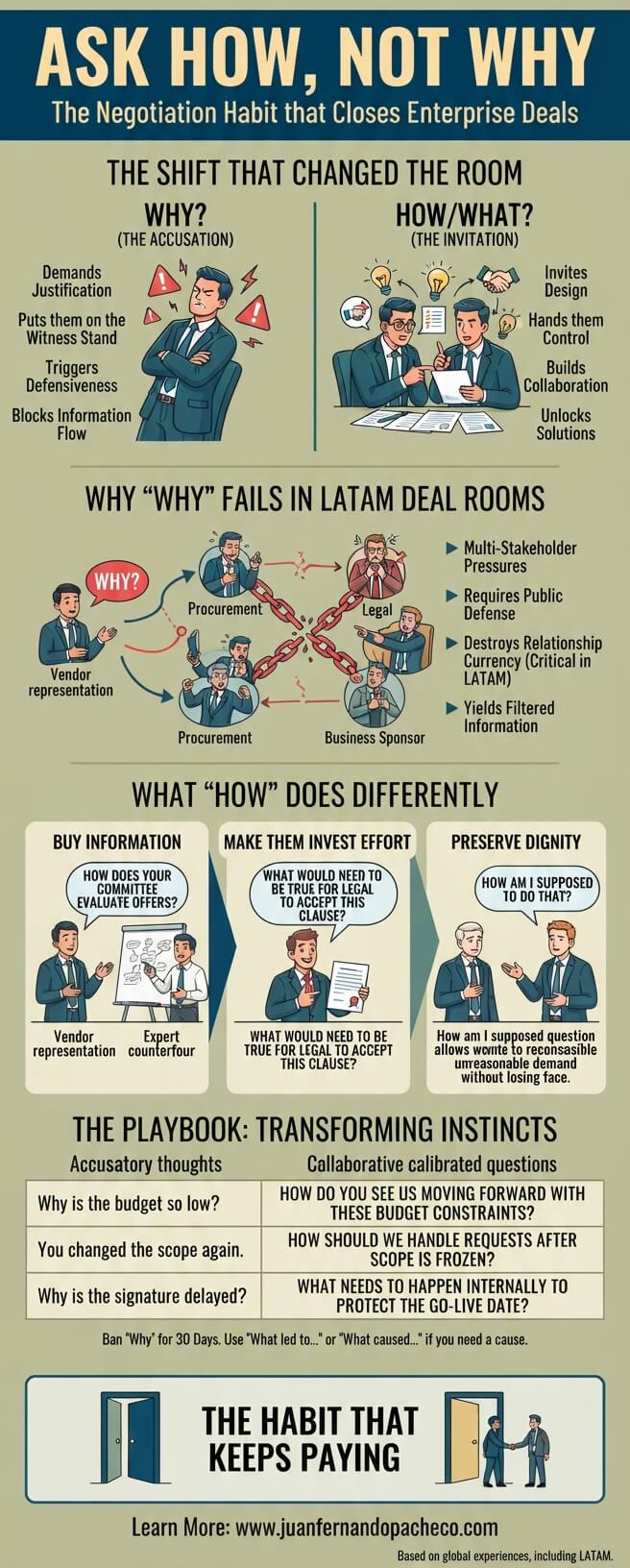
“why” makes people defensive, and “how” makes them solve your problems while thinking they are in control of the negotiation.
When you ask “why,” you ask for a justification
You put the counterpart on the witness stand and demand they explain their numbers, their delays, their requirements. Justification is experienced as a threat, and the natural response to threat is defense.
A defending counterpart stops sharing information, hardens positions, and spends energy protecting what they already said instead of exploring what could be.
When you ask “how” or “what,” you invite design instead of demanding defense
The counterpart’s brain switches from protecting the past to building the future, and the question hands them a sense of control: they choose how to answer and what to propose. People support what they help create. That is the quiet magic of the habit: your counterpart works on your problem, with pride, convinced they are leading.
And when the urge to accuse shows up, the same shift applies
- “Why is your budget so low?” is an accusation wrapped in a question.
- “How do you see us moving forward with these budget constraints?” is the same concern handed over as a shared problem.
The content does not change; the direction of the energy does.
Why “why” fails in enterprise deals
Enterprise deals are not one conversation
They are a chain of conversations inside your counterpart’s organization: procurement, legal, security, compliance, the business sponsor, sometimes the board. Each person carries pressures you cannot see: internal policies, regulatory mandates, past failures, personal reputation.
A “why” question forces them to expose or defend those pressures on the spot, in front of colleagues, against an external vendor.
Think of the most common “why” questions in technology deals.
- Why can’t you accept our SLA?
- Why does security demand on-premises deployment?
- Why is the signature delayed again?
Each sounds reasonable to the asker, and each lands as a challenge: prove to me that your position is legitimate.
Nobody enjoys proving legitimacy to a vendor, so you receive answers that are short, formal, and carefully filtered. You get the position, not the interest behind it, and decades of negotiation research agree that value is created at the level of interests, not positions.
There is also a second-order cost
Ask “why” often and you train your counterparts to be defensive with you. They learn that conversations with you are audits, so they bring fewer details, more scripts, more lawyers.
I have inherited accounts where the client’s only word was “no,” and the account history was full of our “why” questions. The client had been trained to defend, and every renewal had become a battle.
What “how” does differently
Questions that start with “how” or “what” are often called calibrated questions: open questions deliberately designed to keep the conversation flowing, extract information, and let the counterpart introduce new options without feeling pressured. In a deal, they do three things at once.
First, they buy information you cannot buy any other way
“How does your committee evaluate offers like ours?” reveals the real scoring criteria. “What would need to be true for legal to accept this clause?” reveals the real constraint.
The counterpart answers generously because the question feels like consulting, not interrogation. They are the expert explaining their world, and people love being the expert.
Second, they make the counterpart invest effort in your problem
When a procurement director designs the phasing plan that fits your offer inside his ceiling, that plan is his. He will defend it internally because it is his idea.
You did not convince him; he convinced himself, using knowledge of his organization that you could never have. That is the difference between pushing a counterpart and letting them walk.
Third, they preserve autonomy and dignity
In my experience across LATAM markets, this is decisive. Business culture in Mexico, Colombia, Ecuador, Peru, Chile, Argentina, and Brazil is relationship-driven, and a direct “why” can read as a public challenge that demands a public defense.
A “how” question is an invitation to co-author. It lets the counterpart move without losing face, and in cultures where face and relationship are the currency of long-term business, that is not a detail. It is the deal.
One calibrated question deserves special mention
“How am I supposed to do that?”
Asked calmly, it is a respectful way to push back on an unreasonable demand without fighting it. I have used it against mathematically impossible penalty tables, and more than once the counterpart revised the number themselves after a pause, because the question made the asymmetry visible without a single accusation
The anatomy of a calibrated question
Not every question that starts with “how” is calibrated. After hundreds of RFx processes, I filter every question through four checks before asking it in a room.
One, it starts with “how” or “what”
These words open a field that cannot be answered with yes or no, so they force thinking, and thinking is exactly what you want from a counterpart stuck in a position.
Two, it points to their world, not mine
“How do you see us moving forward?” is about their vision. A question about my price framed as their fault is a complaint, not a question.
Three, it is short, and it is followed by silence
The value is in the answer, and the answer needs air. Ask, then shut up. The counterpart will usually fill the silence with the information you actually needed: the real constraint, the real timeline, the real objection.
Four, it carries a neutral, curious tone
The same words with an edge become a weapon, and weapons trigger defense no matter how they start. If you are angry, postpone the question.
Before every difficult meeting, I do a small translation exercise. I write my accusatory instinct down, then rewrite it:
- “Why is the budget so low?” becomes “How do you see us moving forward with these budget constraints?”
- “Why did security reject the architecture?” becomes “What would a compliant architecture look like to your security team?”
- “Why is the signature delayed?” becomes “What needs to happen internally for us to protect the go-live date?”
- “Why do you demand local data residency?” becomes “How does your compliance team see us handling data sovereignty inside this design?”
- “Why are you comparing us with a cheaper competitor?” becomes “What matters most to the committee when they compare offers?”
The concern is identical in each line. The accusation disappears. The counterpart becomes the person who knows the answer, and you become the person who respects that knowledge. The whole shift fits in one word.
Field notes from LATAM deal rooms
Let me ground this in the deals I actually run: multi-year technology contracts executed through formal RFI, RFQ, and RFP processes, with government mandates, complex legal clauses, enterprise security requirements, and strict SLAs with real penalties. In that world, asking how, not why, is not a trick. It is an operating discipline.
Take SLA negotiation
- A bank’s risk team demands near-perfect availability with penalties that would erase our margin.
- Asking why invites a lecture on regulatory obligation and ends with the number unchanged.
Asking how they measure downtime today, and what happens to the business when the channel is down for one hour, almost always reveals that the fear concentrates in a few critical windows and that the penalty table was copied from a template. The number stops being a symbol and becomes an engineering conversation.
Take data sovereignty
A public entity demands that everything stays in the country.
- Asking why sounds like you question the mandate.
- Asking how the mandate applies to each component opens a map:
- which data is regulated,
- which is not,
- which cloud regions qualify.
The mandate does not change, but the surface of the negotiation does, and suddenly there is room to build.
Take the silent deal, where the client stops responding after the proposal
- “Why haven’t we heard back?” is an accusation that guarantees more silence.
- “What has changed on your side since our last session?” assumes life happened inside their organization, which is almost always true, and gives the counterpart an easy, dignified way back into the conversation.
The habit also works inside your own company
When engineering says a request is impossible, “why can’t you do it?” produces a wall, and “how could we deliver a version of this inside the constraints?” produces a design session. One habit, every table.
Turning accusations into collaboration
The tip on the card is worth repeating
Turn accusations into collaboration with “how” questions. I treat every accusation I feel as raw material. The urge to accuse is a signal that something matters to me; the discipline is to translate that signal into a question the counterpart can work on.
- “You changed the scope again” becomes “how should we handle requests that arrive after scope is frozen?”
- “Your team is blocking our access” becomes “what process would make access easy for your people and safe for your policies?”
- “You are asking for a discount we cannot give” becomes “how would you like us to rebalance the package so the numbers work for both sides?”
The first version of each pair wins nothing and costs the relationship. The second puts the problem on the table as a shared design task, and it usually surfaces the fact you did not have: the scope change came from a new regulator, the access block from a security audit, the discount demand from a budget cut the director must absorb.
Accusations hide those facts. Calibrated questions mine them.
A playbook you can keep for the rest of your career
Platforms change, and markets cycle, but human defensiveness and the need for autonomy are permanent, which is why this habit is evergreen. Keep a pocket list of calibrated questions and reuse them without shame:
- How do you see us moving forward with these budget constraints?
- What matters most to the committee in this decision?
- How will you measure success one year from now?
- What would need to be true for this to move to the next step?
- How am I supposed to do that?
- What happens if we keep things as they are?
Then ban “why” from your negotiation vocabulary for thirty days. If you genuinely need a cause, use “what led to” or “what caused” instead:
What led the committee to prefer the shorter timeline? Same information, no courtroom tone. Write your questions before the meeting, because in the heat of the room the defensive brain writes the script, and the defensive brain loves “why.”
And after each key meeting, debrief on questions, not only on numbers: which questions opened doors, which closed them? Within a quarter, your whole team speaks the language of collaboration, and your win rate follows.
Closing thought
The best negotiators I know do not sound like negotiators. They sound like curious colleagues trying to understand a shared problem. They never ask why the mountain is there; they ask how we should walk around it, and the counterpart, feeling in control, picks up the map and starts drawing the route.
Five years from now, the clauses and the platforms will look different, but the human across the table will still lean in when invited to design. Ask how, not why, and let them solve your problem for you, with pride. That is why this habit keeps paying.
Web references and further reading
Web references:
- Harvard Law School Program on Negotiation, on asking better questions in negotiation
- Harvard Law School Program on Negotiation, on principled negotiation and focusing on interests
- Black Swan Group, on using calibrated questions to win more deals
- Scotwork, on calibrated questions in negotiation
- Crucial Learning, on why people get defensive about a normal question
- Nate Anglin, on turning “why” into “what” and “how”
Books that reinforce this post:
- Never Split the Difference by Chris Voss and Tahl Raz — the source of calibrated questions and “how am I supposed to do that?”
- Getting to Yes by Roger Fisher, William Ury, and Bruce Patton — positions versus interests and principled negotiation
- Difficult Conversations by Douglas Stone, Bruce Patton, and Sheila Heen — moving from blame and accusation to shared contribution
- How to Win Friends and Influence People by Dale Carnegie — the permanent truth that people support what they help create