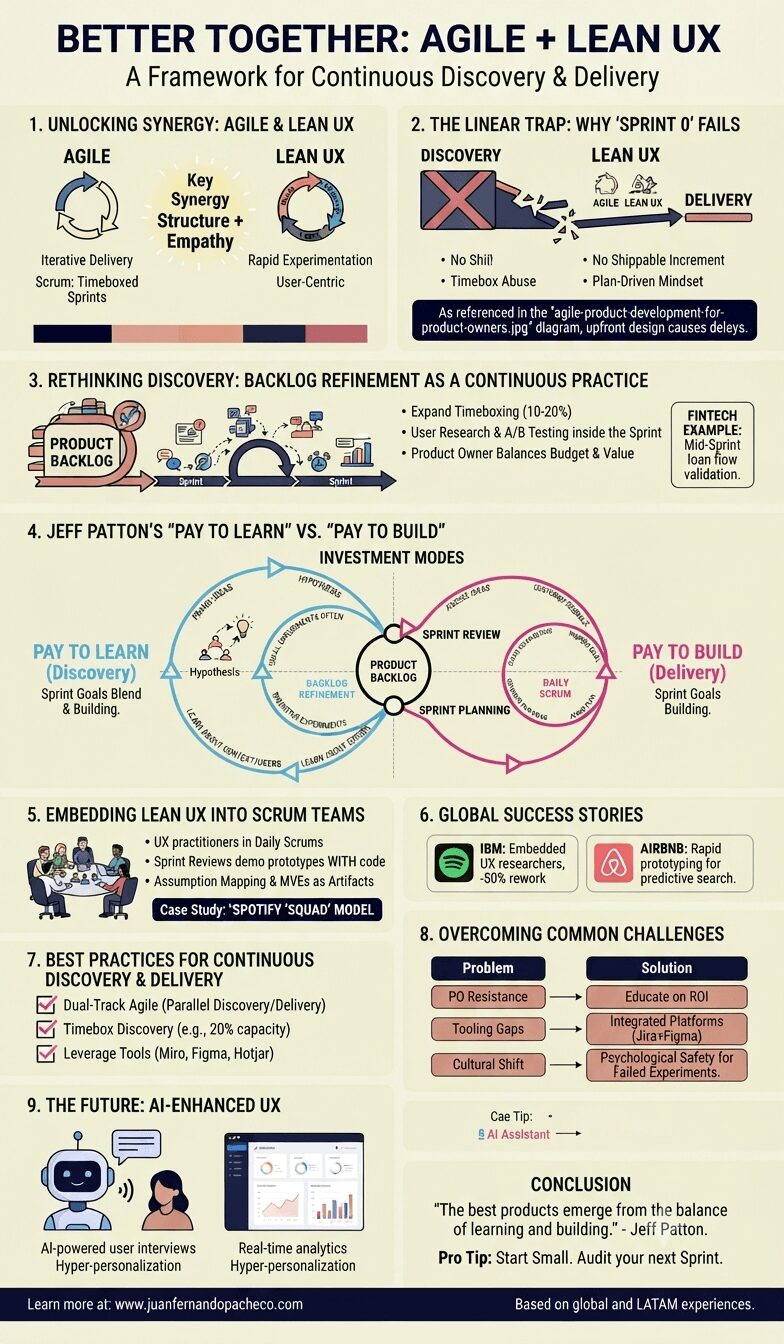
A detailed vertical infographic titled "Better Together: Agile + Lean UX: A Framework for Continuous Discovery & Delivery." The image is organized into nine numbered sections with illustrations, icons, and text, utilizing a color palette of cream, navy, pink, peach, and dark blue. It details how to integrate Lean UX principles like continuous discovery and "Pay to Learn" into Agile Scrum rituals, and includes case studies from Spotify, IBM, and Airbnb, as well as future trends like AI. The central diagram visually merges "Pay to Learn" and "Pay to Build" cycles.

Agile + Lean UX are not competing frameworks—they’re complementary forces. By embedding continuous discovery into Sprints, teams can deliver value faster while staying user-centric. As Jeff Patton says, “The best products emerge from the balance of learning and building.”
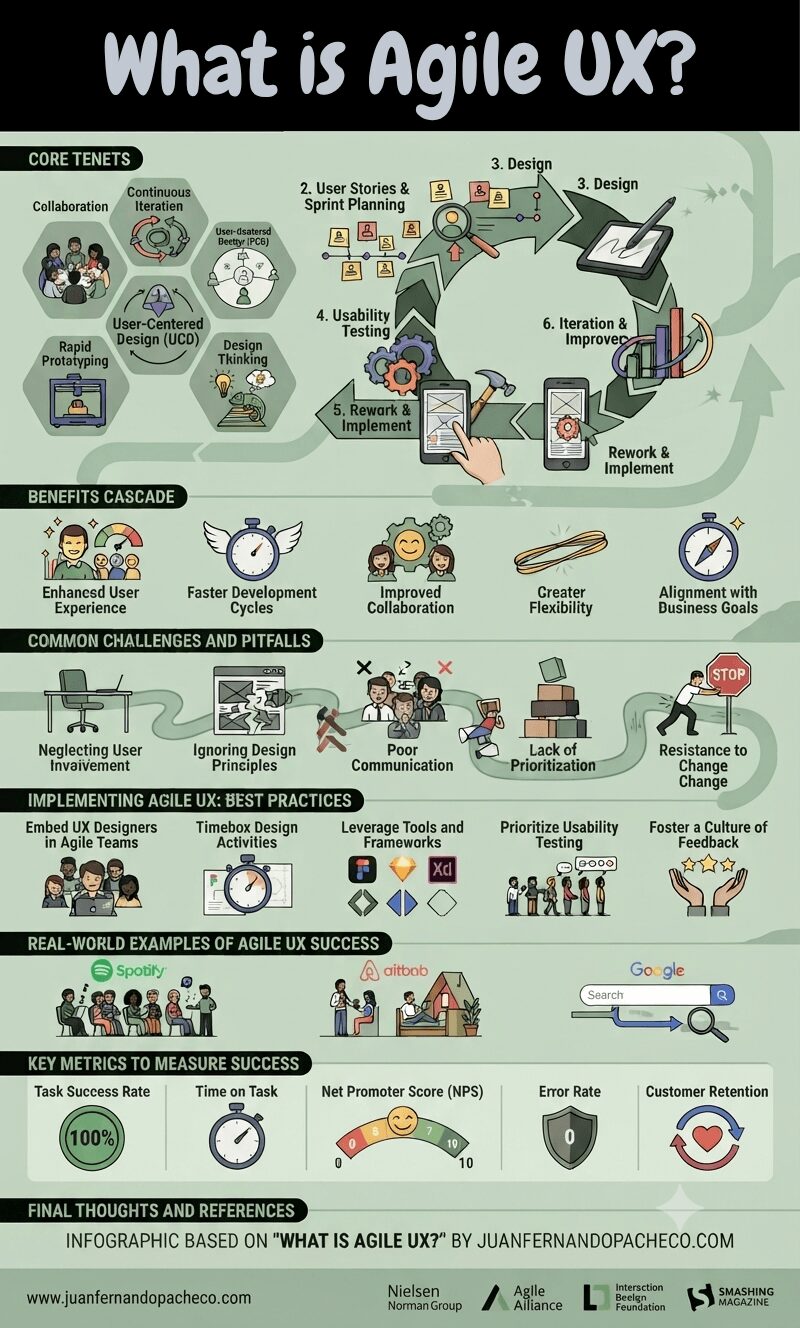
A detailed infographic titled "WHAT IS AGILE UX?" presented as a structured guide on a light green background. It covers six main sections: "CORE TENETS" (Collaboration, Continuous Iteration, User-Centered Design, Rapid Prototyping, Design Thinking, Design), the "AGILE UX PROCESS" (a 6-step circular flow from Planning to Iteration), "BENEFITS CASCADE" (User Experience, Development Cycles, Collaboration, Flexibility, Business Goals), "COMMON CHALLENGES AND PITFALLS" (Neglecting User Involvement, Ignoring Principles, Poor Communication, Lack of Prioritization, Resistance to Change), "IMPLEMENTING AGILE UX: BEST PRACTICES" (Embed Designers, Timebox Activities, Leverage Tools, Prioritize Testing, Foster Feedback), "REAL-WORLD EXAMPLES" (Spotify, Airbnb, Google), "KEY METRICS TO MEASURE SUCCESS" (Success Rate, Time on Task, NPS, Error Rate, Retention), and "FINAL THOUGHTS AND REFERENCES."

Agile UX is a user experience design methodology that integrates seamlessly with Agile software development principles.
It emphasizes collaboration, flexibility, and continuous iteration to create user-centric and high-quality products.