Why your best ideas die quietly and how to fix them
In my twenty years of navigating the intersection of product design, user experience, and high-stakes commercial strategy, I have seen a recurring tragedy in the corporate world. Companies pour millions into innovation labs, hire top-tier talent, and run endless workshops, only to see their best ideas die quietly. They don’t fail with a bang; they fail with a whimper. They get stuck in backlogs, lost in “pilot purgatory,” or starved of budget.
Whether you are scaling technology revenue across LATAM markets or managing complex enterprise deals in North America, the patterns of failure are surprisingly consistent. Innovation is not magic; it is a discipline. And like any discipline, it has specific failure modes.
Based on my experience leading strategic product initiatives and managing complex RFx (Request for Proposal/Quote) processes, I have synthesized the most common patterns that predict an innovation effort will fail. These are the 7 red flags of innovation. If you recognize these in your organization, it is time to pivot before you waste another dollar.
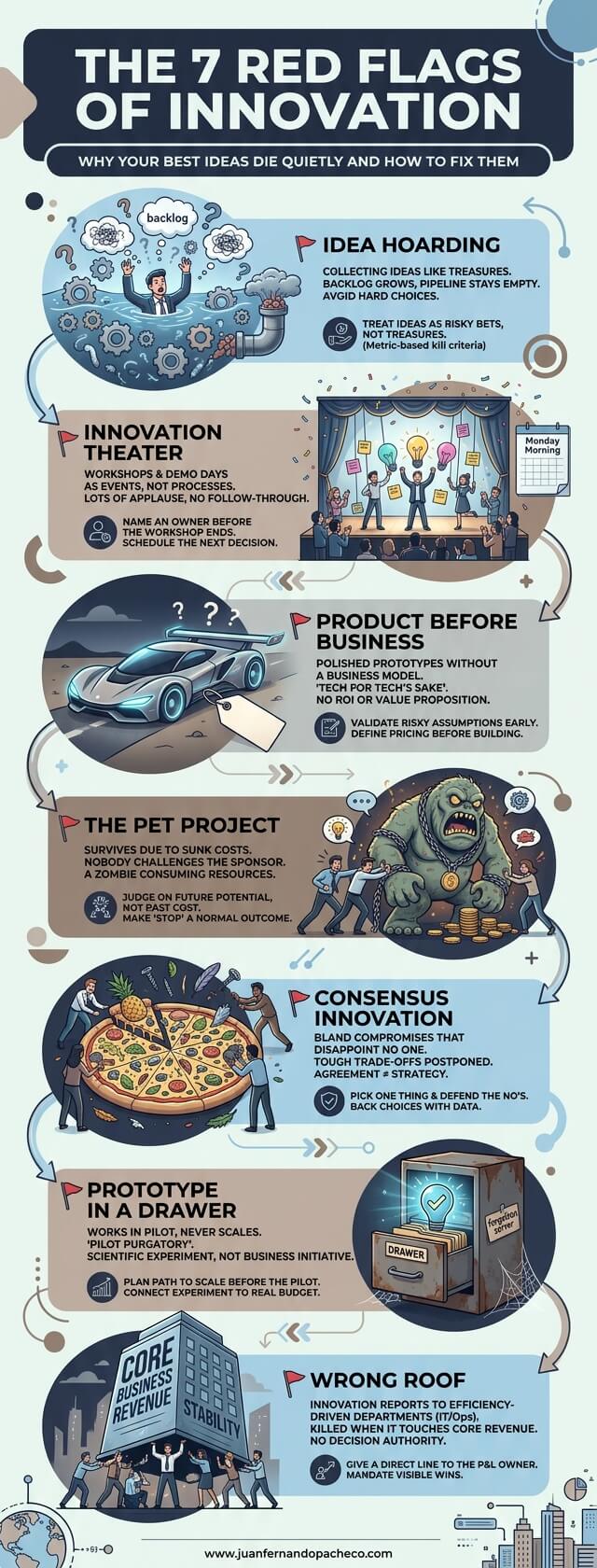
1. Idea hoarding
The pattern:
We often mistake a full backlog for a healthy pipeline. In the product world, and especially in sales and business development, there is a tendency to collect ideas like treasures. Everyone is encouraged to “think outside the box,” resulting in a massive list of potential features, products, or services. But here is the catch: nobody kills any of them. The backlog grows, but the actual pipeline of executed projects remains empty. You hear phrases like “we just need more creativity,” which is usually code for “we are afraid to make hard choices.”
Why it happens:
In my work with enterprise clients, I often see this during the discovery phase of a large deal. The client wants everything. They want the AI integration, blockchain security, predictive analytics, and the legacy system support. If you say “yes” to everything to keep the peace, you end up with a bloated proposal that is impossible to deliver profitably. Hoarding ideas is a risk-aversion strategy. If we don’t kill an idea, we don’t have to admit it was bad.
How to fix it:
You must decide after every step, not just at the end. Treat ideas as bets, not treasures. A bet implies risk and a potential loss. When you treat an idea as a treasure, you become emotionally attached to it.
Actionable step:
Implement a “kill criteria” for every project at the start. If a prototype does not achieve X metric by Y date, it is killed. Reward the next decision, not the next idea. The goal is velocity of learning, not volume of ideas.
2. Innovation theater
The pattern:
This is perhaps the most insidious red flag because it looks like work. It involves workshops, colorful post-it notes on glass walls, and exciting “demo days.” There is lots of applause and high energy on stage. But by Monday morning, it’s silent. Nothing changes. The workshop was an event, not a process.
Why it happens:
As a former senior product designer, I love a good design sprint. Nothing quite matches the energy of a room full of smart people solving a problem. But I have learned that energy is not progress. In the LATAM market, where relationship-building is crucial, it is easy to confuse a good meeting with a good outcome. We hold the workshop to show stakeholders that we are “innovating,” but we lack the operational rigor to follow through.
How to fix it:
Name an owner before the workshop ends. If you leave the room without a single person whose name is on the line for the next step, the workshop was a waste of money.
Actionable step:
Schedule the next decision, not the next event. Do not schedule a “follow-up meeting” to discuss the workshop. Schedule a “go/no-go decision” for the prototype. Measure progress (did we ship? did we learn?), not participation (how many people attended?).
3. Product before business
The pattern:
You have a polished prototype. It looks beautiful. The user experience is seamless. But there is no business model. You hear “customers will love it” with zero evidence of willingness to pay. Features grow, but the revenue logic stays blank.
Why it happens:
This is the classic “tech for tech’s sake” trap. In the technology sector, engineers and designers often fall in love with the solution. We build a magnificent house but forget to check if anyone wants to live in that neighborhood. In high-stakes RFx execution, this is fatal. If I present a technical solution that is brilliant but does not clearly map to the client’s ROI or operational savings, the deal will die. The business case must shape the product, not the other way around.
How to fix it:
Validate the riskiest assumption first. Usually, the riskiest assumption is not “can we build it?” but “will someone pay for it?”
Actionable step:
Ask who pays, and why, early. Before writing a line of code or designing a screen, write the press release and the pricing page. If you cannot articulate the value proposition in monetary terms, you do not have a product; you have a science project. Let the business case shape the product features. If a feature does not drive revenue or retention, cut it.
4. The pet project
The pattern:
This project survives simply because too much money was already spent. Stopping feels like admitting failure. Nobody dares to question the sponsor, usually a senior executive who championed the idea two years ago.
Why it happens:
This is the sunk cost fallacy in action. In my career managing large IT services deals, I have seen projects drag on for years because the initial investment was so high that cancelling it would look bad on a quarterly report. We throw good money after bad. The “pet project” is dangerous because it consumes resources that could be used for viable innovations. It is a zombie project—dead, but still walking.
How to fix it:
Make “stop” a normal, respected outcome. In a healthy innovation culture, killing a project is celebrated as a success because it saves future resources.
Actionable step:
Judge the project on its future potential, not its past cost. Treat sunk cost as gone, because it is. When reviewing the portfolio, ask: “If we were starting today, with no prior investment, would we start this project?” If the answer is no, kill it immediately.
5. Consensus innovation
The pattern:
The result is a bit of everything, so nobody is upset. Tough trade-offs are postponed forever. Agreement is mistaken for strategy. The image of the pizza with too many toppings is perfect here.
Why it happens:
In large organizations, especially in matrixed structures common in global firms, getting buy-in is hard. To avoid conflict, leaders water down the innovation until it is a bland compromise. We try to serve every stakeholder. But a product that tries to be everything to everyone ends up being nothing to no one. In UX design, we call this “feature creep.” In business strategy, we call it “lack of focus.”
How to fix it:
Pick one thing, and defend the no’s. Innovation requires sacrifice. You cannot be the cheapest, the fastest, and the highest quality all at once.
Actionable step:
Back the choice with data, not mood. When a stakeholder asks for a feature, ask for the data that supports it. If they don’t have it, say no. Accept that a real choice will disappoint someone. If everyone is happy with the roadmap, you probably aren’t being bold enough.
6. Prototype in a drawer
The pattern:
It works, but it never scaled. The pilot ran, then nothing. The demo lives in a drawer (or a forgotten server), while the business runs elsewhere.
Why it happens:
This is “pilot purgatory.” It is incredibly common in the enterprise software space. We build a proof of concept (PoC) for a client. It works beautifully in a controlled environment. But when it comes time to integrate it into the core legacy systems, the cost is too high, or the IT department blocks it. The innovation was treated as a science experiment, not a business initiative.
How to fix it:
Plan the path to scale before the pilot. Do not start a pilot unless you know how it will be funded and supported at scale.
Actionable step:
Connect the experiment to a real budget line. If the pilot is funded by an “innovation slush fund” but the scale-up requires “IT operations budget,” it will fail. Decide go or stop; do not let it sit. If the pilot is successful, the transition to production must be pre-planned.
7. Wrong roof
The pattern:
Innovation reports to whoever has spare budget. There is no authority to actually decide. It is killed the moment it touches core revenue.
Why it happens:
Organizational structure dictates behavior. If innovation sits under a department that is measured on efficiency (like IT or Operations), it will be crushed by the need for stability. Otherwise, if it sits under Marketing, it might become a campaign rather than a product. Or if it reports to someone with “spare budget,” it is the first thing cut when the economy tightens.
How to fix it:
Place innovation where decisions can be made. It needs a mandate, not just a mission.
Actionable step:
Give it a direct line to the P&L (Profit and Loss) owner. If the innovation is meant to disrupt the core business, it cannot report to the core business leader who is incentivized to protect the current revenue. Give it a mandate that includes visible wins the business cannot ignore.
Conclusion
Innovation is not about having more ideas; it is about executing the right ideas effectively. As we look at the markets in Mexico, Colombia, Ecuador, and beyond, the companies that will win are not the ones with the most Post-it notes. They are the ones with the discipline to kill bad ideas quickly, the courage to make hard trade-offs, and the strategic alignment to connect prototypes to real revenue.
Avoid these 7 red flags. Build a culture where “stopping” is a valid strategy, where business models are validated before code is written, and where innovation sits at the table where real decisions are made. That is how you scale technology revenue and build lasting value.
Web references and recommended reading
To deepen your understanding of these concepts and build a robust framework for innovation strategy, I recommend the following resources. These books and articles have significantly influenced my approach to product leadership and deal strategy.
Books:
- The Lean Startup by Eric Ries
Why read it: This is the foundational text for “validating the riskiest assumption” and treating ideas as bets. It moves you away from the “product before business” trap. - The Innovator’s Dilemma by Clayton M. Christensen
Why read it: Essential for understanding why successful companies fail to innovate (often due to “idea hoarding” or protecting core revenue). It explains the structural issues of the “wrong roof.” - Inspired: How to Create Tech Products Customers Love by Marty Cagan
Why read it: A masterclass in product management. It addresses the “prototype in a drawer” issue by focusing on discovery and delivery. - Crossing the Chasm by Geoffrey A. Moore
Why read it: Crucial for scaling. It explains why products get stuck in the “pilot” phase and how to move from early adopters to the mainstream market. - Team of Teams: New Rules of Engagement for a Complex World by General Stanley McChrystal
Why read it: Great for fixing “consensus innovation” and organizational silos. It teaches how to build shared consciousness and empowered execution.
Web Articles & Concepts:
- Harvard Business Review: “Why Innovation Initiatives Fail”
This article dives deep into the structural reasons innovation fails, mirroring the “wrong roof” and “innovation theater” concepts. - The Concept of “Sunk Cost Fallacy” in Behavioral Economics
Understanding the psychology behind “the pet project.” - Marty Cagan’s “Product Discovery”
Resources on how to validate business models before building products.