Lessons I learned from 20 years in LATAM tech markets
When I first entered the technology sector more than twenty years ago, the landscape of Latin America was vastly different from the innovation powerhouse it is today. I began my career deep in the trenches of product and UX design, obsessing over user flows, interface aesthetics, and customer pain points.
Today, as a strategic product and deal leader focusing on high-stakes commercial execution, my canvas has expanded from digital screens to entire enterprise ecosystems across Mexico, Colombia, Ecuador, and beyond.
Over the past two decades, I have witnessed the remarkable maturation of LATAM tech markets
We have transitioned from being primarily viewed as cost-saving outsourcing hubs to becoming critical centers for digital transformation, complex IT services, and strategic technological innovation.
Navigating this evolution has required constant adaptation, a shift in mindset, and a deep understanding of how commercial strategy intersects with technical execution.
Many young professionals today ask me how to accelerate their careers in a saturated and highly competitive tech industry. The conventional advice often revolves around mastering the latest programming language, acquiring a specific certification, or learning the newest design framework.
While technical proficiency is the baseline, it is not the catalyst for exponential career growth
True acceleration happens when you learn to connect the dots between product creation, user-centric design, and commercial revenue generation. It happens when you understand how to navigate complex enterprise deals, align cross-functional teams, and scale technology solutions across culturally diverse markets.
In this post, I want to share the core lessons I have gathered over twenty years of operating at the intersection of design, product strategy, and business development.
These principles are not tied to a specific software stack or a fleeting industry trend. They are evergreen strategies that will remain relevant whether you are reading this today or five years from now, as the fundamental mechanics of value creation, strategic negotiation, and market expansion endure.
Understanding the true nature of LATAM tech markets
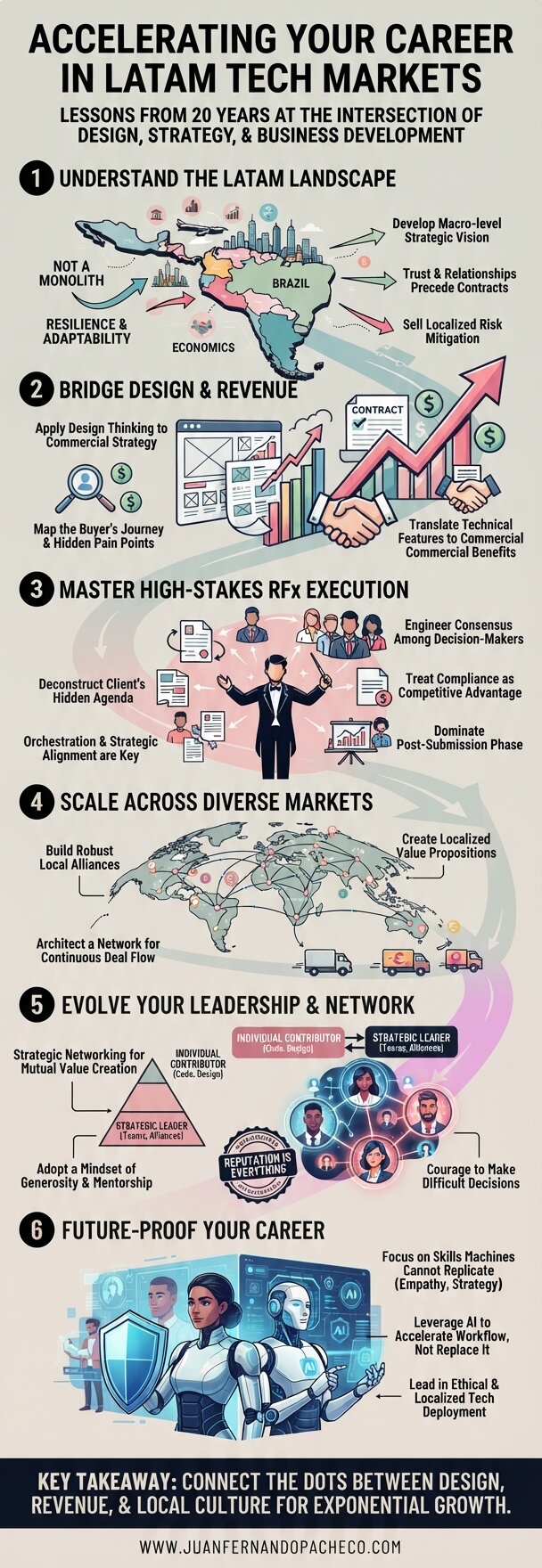
To build a successful career in technology within Latin America, you must first understand the unique macro-environment in which you operate. The LATAM tech markets are not a monolith.
The business culture in Mexico, heavily influenced by its proximity to the United States and its robust manufacturing and nearshoring ecosystem, operates very differently from the market in Colombia, which has rapidly positioned itself as a premier hub for software development and BPO services.
Ecuador, Brazil, and Argentina each possess their own distinct regulatory frameworks, economic rhythms, and relationship-building norms.
Early in my career, I realized that applying a one-size-fits-all approach to technology deployment was a recipe for failure. An enterprise solution that streamlines operations perfectly in Bogotá might face unexpected friction in Guadalajara simply due to differences in local vendor management expectations, labor union dynamics, or internal corporate governance.
Accelerating your career means developing a macro-level strategic vision
You must learn to read the economic indicators, understand the local regulatory environments, and appreciate the cultural nuances that dictate how business is actually done. In LATAM, trust and personal relationships often precede contractual agreements.
A signature on a multi-million-dollar IT services contract is rarely just a legal formality; it is the culmination of months of relationship building, mutual understanding, and demonstrated reliability. Professionals who recognize that they are not just selling software or design services, but are actually selling trust and localized risk mitigation, are the ones who rise to leadership positions.
LATAM region is characterized by its resilience and resourcefulness
We often operate in environments of high volatility, currency fluctuations, and shifting political landscapes. The tech leaders who thrive here are those who build adaptable, flexible architectures—both in their software and in their business models.
If you can position yourself as a professional who brings stability and strategic foresight to chaotic environments, your value to any global organization becomes immeasurable.
Understanding these macro-economic realities allows you to anticipate market shifts before they happen, positioning your products and services exactly where the capital is flowing next.
Bridging the gap between product design and commercial strategy
One of the most pivotal transitions in my career was moving from a senior product and UX designer role into business development and strategic deal leadership.
At first glance, these disciplines might seem worlds apart. Design is often associated with empathy, aesthetics, and user psychology, while business development is associated with revenue targets, contracts, and aggressive negotiations.
However, I quickly discovered that the core tenets of user-centered design are incredibly powerful when applied to commercial strategy.
- In UX design, we are taught to deeply understand the user’s journey, identify their hidden pain points, and design frictionless experiences that lead to a desired outcome.
- In high-stakes enterprise deals, the “user” is the buyer—the procurement officer, the chief information officer, or the board of directors. Their pain points are not about button placements or color contrasts; their pain points are about risk mitigation, return on investment, integration capabilities, and vendor reliability.
When I approach a complex RFx (request for proposal or quote) process, I do not view it merely as an administrative hurdle. I view it through the lens of a UX designer:
- I map the buyer’s journey.
- I analyze the underlying anxieties of the stakeholders evaluating our proposal.
By applying design thinking to commercial strategy, you can craft value propositions that resonate on a deeply human level, addressing the unspoken fears of the decision-makers.
The pre-sales discovery call is essentially a user research interview. If you ask the right probing questions, you uncover the emotional and strategic drivers that will ultimately dictate the purchasing decision.
Many technical professionals stall in their careers because they remain siloed in their specific domain
A brilliant engineer might build a flawless backend architecture, but if they cannot articulate the commercial value of that architecture to a non-technical stakeholder, their impact is limited.
To accelerate your career, you must become bilingual. You must be able to speak the language of technical execution and the language of business value. Learn how to translate technical features into commercial benefits.
Understand how a specific UX improvement directly impacts the client’s bottom line by reducing customer churn or increasing operational efficiency. When you bridge the gap between product creation and revenue generation, you transition from being an order-taker to a strategic partner.
The ultimate user experience for an enterprise buyer is the realization of measurable business value; if you can deliver that, you become indispensable.
Mastering the art of high-stakes RFx execution
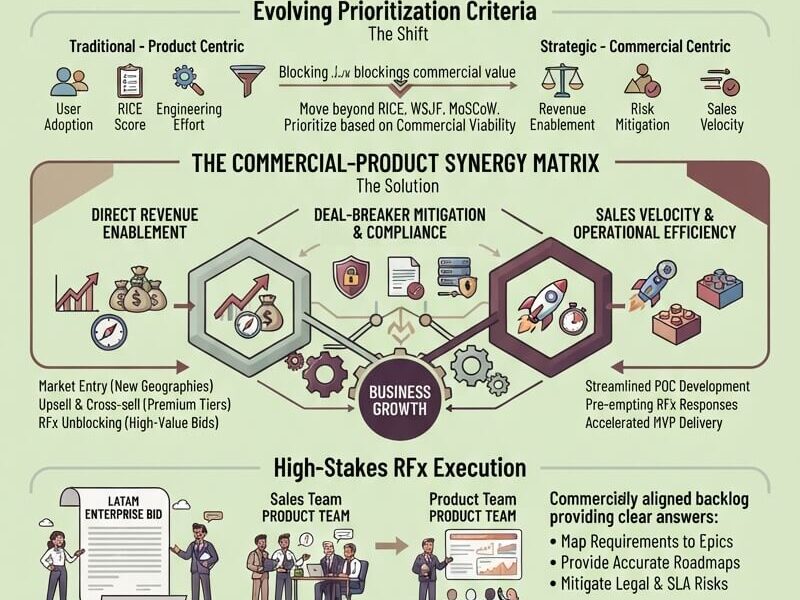
If there is one specific domain expertise that has consistently driven major revenue growth in my career, it is the mastery of high-stakes RFx execution. For those unfamiliar with the terminology, RFx encompasses the various request processes used in enterprise procurement:
- Request for information (RFI),
- Request for proposal (RFP), and
- Request for quote (RFQ).
In the world of large-scale IT services and enterprise technology, these processes are notoriously complex.
A single RFP for a digital transformation initiative can span hundreds of pages, requiring input from legal, security, engineering, design, and finance teams.
Many professionals view RFx responses as a tedious chore, delegating them to junior staff or treating them as a copy-paste exercise from previous bids. This is a massive strategic error.
Winning a high-stakes RFx is about orchestration and strategic alignment
It is the ultimate test of a company’s internal cohesion and its ability to understand the client’s true needs. When I lead an RFx execution, my role is that of a conductor. I must assemble a cross-functional team of experts and align them toward a singular, compelling narrative.
Here are the evergreen lessons I have learned about mastering RFx execution:
- First, deconstruct the client’s hidden agenda. The written requirements in an RFP are often just the baseline. The real decision is made based on unwritten factors: the client’s internal politics, their past traumas with previous vendors, and their long-term strategic goals. Your proposal must subtly address these hidden anxieties.
- Second, engineer consensus. A complex enterprise deal is rarely sold to a single person; it is sold to a committee. Your proposal must provide the technical champion with the data they need to defend your solution, while simultaneously providing the financial stakeholder with the ROI metrics they require. You must design your proposal to arm your internal champions within the client’s organization.
- Third, treat compliance as a competitive advantage. Meticulous attention to detail in security protocols, legal terms, and compliance standards signals operational maturity. In LATAM, where regulatory landscapes can be highly complex, demonstrating absolute mastery of local compliance requirements can be the deciding factor in a tight race against global competitors.
- Fourth, dominate the post-submission phase. The written proposal only gets you to the table; the oral presentations and subsequent negotiations are where the deal is actually won. Treat the orals not as a summary of your document, but as a strategic interactive workshop. Use this time to demonstrate your team’s cultural alignment, problem-solving agility, and long-term commitment to the client’s success.
Professionals who can successfully navigate, manage, and win complex RFx processes become indispensable rainmakers, and their expertise is highly sought after by global IT firms looking to expand their footprint in emerging markets.
Scaling technology revenue across diverse markets
As my career progressed into business development management, my focus shifted toward scaling technology revenue across the LATAM region. Scaling is not just about selling more; it is about building repeatable, sustainable engines of growth that can adapt to different territories.
One of the most critical lessons in scaling revenue is the concept of localized value propositions
Global technology firms often make the mistake of trying to sell their standardized global product suite to the LATAM market without contextualizing it. They assume that a solution that works in Silicon Valley or London will automatically work in San José or Medellín.
To scale effectively, you must act as a bridge between global capabilities and local realities
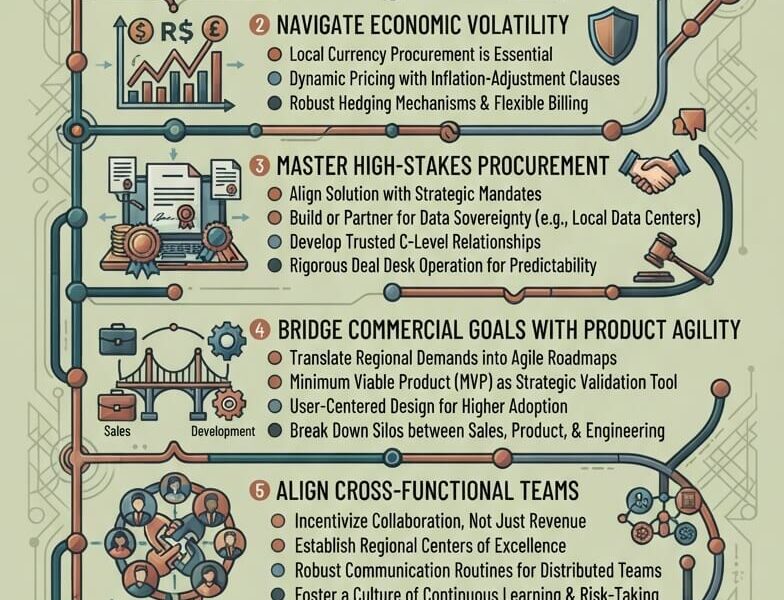
This means taking a global technology platform and wrapping it in a layer of localized expertise. For example, a cloud migration strategy might be technically identical across regions, but the commercial packaging, the financing model, and the change management support must be tailored to the specific economic realities of the target country. In markets facing high inflation or currency volatility, offering flexible, consumption-based pricing models can be the key to unlocking massive enterprise deals.
Scaling requires building robust local alliances
You cannot scale a massive enterprise tech footprint alone. You must identify and nurture relationships with local system integrators, regional consulting firms, and niche technology providers. By creating an ecosystem of partners, you amplify your reach and embed your solutions deeper into the local market. As a strategic leader, your job is not just to close a single deal, but to architect a network that generates continuous deal flow.
This ecosystem approach also mitigates risk
When you are deeply embedded in the local tech community through partnerships and alliances, you gain early insights into market shifts, regulatory changes, and emerging competitor strategies. This intelligence allows you to pivot your commercial strategy proactively, rather than reacting defensively to market disruptions. Furthermore, the current global push toward nearshoring has placed LATAM at the center of international supply chain and technology service strategies.
Leaders who understand how to position local tech talent and infrastructure as a strategic advantage for global enterprises will find themselves at the forefront of the next major wave of regional investment.
The evolution of leadership and strategic networking
As you move from individual contributor roles into strategic leadership, the nature of your work fundamentally changes. In the early stages of your career, your value is determined by what you can produce with your own hands—the code you write, the interfaces you design, the spreadsheets you analyze. As you progress into deal leadership and business development, your value is determined by the quality of the teams you build, the alliances you forge, and the strategic decisions you make.
This transition requires a profound shift in how you approach professional networking. Early in your career, networking is often transactional. You attend industry events, collect business cards, and look for immediate job opportunities or freelance gigs.
However, strategic networking—the kind that accelerates your career over a twenty-year horizon—is about cultivating deep, reciprocal relationships based on mutual value creation.
In the LATAM tech community, reputation is everything
The region is large, but the upper echelons of the enterprise technology sector are surprisingly interconnected. The chief technology officer you pitch to today might become the chief executive officer of a different enterprise tomorrow.
The junior developer you mentor today might become the founder of a highly successful startup that you eventually acquire or partner with.
To build this kind of enduring professional capital, you must adopt a mindset of generosity and mentorship. Share your knowledge freely. Introduce people in your network who could benefit from knowing each other.
Write about your experiences, speak at industry conferences, and contribute to the elevation of the entire regional tech ecosystem. When you focus on raising the tide for everyone else, you inevitably rise with it.
Strategic leadership requires the courage to make difficult decisions
It means knowing when to walk away from a lucrative deal because the strategic alignment is wrong, or when to invest heavily in a seemingly risky market because you see a long-term macro trend that others are missing.
Developing this intuition takes time, exposure to failure, and a relentless commitment to analyzing both your successes and your defeats.
True leadership is not about avoiding risk; it is about accurately calculating risk and having the conviction to act on your strategic foresight even when the consensus disagrees.
Future-proofing your career in a shifting global economy
We are currently standing on the precipice of another massive technological shift, driven by artificial intelligence, advanced automation, and decentralized systems. Many professionals are understandably anxious about how these technologies will impact their careers.
- Will AI replace UX designers?
- Will automated negotiation bots eliminate the need for business development managers?
While the tools we use will inevitably change, the core human elements of strategic technology leadership will remain highly relevant.
AI can generate code, synthesize vast amounts of data, and even draft initial responses to an RFP. However, AI cannot easily replicate the nuanced empathy required to navigate a tense negotiation between a global vendor and a local procurement team.
It cannot build genuine trust over a cup of coffee in Bogotá, nor can it intuitively understand the complex internal politics of a legacy enterprise undergoing digital transformation.
To future-proof your career, you must lean heavily into the skills that machines cannot replicate
Focus on complex problem framing, ethical decision-making, cross-cultural communication, and strategic orchestration.
Become the professional who knows how to leverage AI to accelerate your workflow, rather than the professional who is replaced by it. Use automation to handle the repetitive aspects of RFx compliance checking or market data gathering, freeing up your cognitive bandwidth to focus on high-level relationship building and strategic narrative construction.
In the context of LATAM tech markets, there is a massive opportunity to become a leader in the ethical and localized deployment of these emerging technologies.
The region has unique challenges regarding data privacy, digital inclusion, and infrastructure limitations. Professionals who can design and implement technological solutions that respect these local realities while leveraging global AI capabilities will be the architects of the next twenty years of innovation in Latin America.
The future belongs to those who view technology not as a replacement for human ingenuity, but as an amplifier of strategic vision.
conclusion
Looking back on two decades in the technology sector, from the granular details of UX design to the high-stakes arena of enterprise deal leadership, the journey has been anything but linear. It has required continuous learning, profound adaptability, and a deep respect for the unique cultural and economic tapestry of Latin America.
Accelerating your career is not about finding a secret shortcut or chasing the latest hype cycle
It is about building a robust foundation of cross-disciplinary knowledge. It is about understanding that beautiful product design must be supported by sound commercial strategy. It is about recognizing that a complex RFP is not a bureaucratic hurdle, but a strategic battleground where deep client empathy wins the day.
Whether you are just starting your journey in tech or you are a seasoned professional looking to break into executive leadership, remember that your greatest asset is your ability to connect disparate dots.
Bridge the gap between design and revenue, between global technology and local realities, and between transactional networking and enduring strategic alliances.
The LATAM tech market is brimming with potential, and those who approach it with strategic rigor, cultural empathy, and commercial acumen will undoubtedly lead its next great chapter.