When people look at my resume today, they see a strategic product and deal leader. They see a business development manager focused on scaling technology revenue across LATAM markets, navigating high-stakes RFx execution, and securing multi-million-dollar contracts in the banking and finance sectors.
They see someone who spends their days aligning cross-functional teams, negotiating stringent SLAs, and presenting value propositions to C-level executives and board members. But long before I was managing complex legal clauses and enterprise security requirements.
I was a web designer
I started my career over twenty years ago, designing and building interfaces, studying user behaviors, and trying to figure out why a user would abandon a shopping cart or struggle to navigate a banking portal. I spent years as a senior UX designer and solutions architect, obsessing over every pixel, every interaction, and every friction point that stood between a human being and their goal.
Over the years, as I transitioned from designing digital products to designing business strategies and leading diverse teams across LATAM, I realized something profound. The methodologies that make a digital product successful are the same methodologies that make a team successful. The transition from user experience to employee experience is not a leap; it is a direct evolution.
Empathy in leadership is often dismissed as a “soft skill,” something nice to have but secondary to hard metrics like revenue, uptime, and market share. My background in UX taught me the exact opposite. Empathy is a rigorous, analytical, and highly strategic framework. It is the mechanism by which we understand the underlying needs, motivations, and blockers of the people we work with.
Whether you are designing a mobile app for millions of retail banking users or leading a product team through a grueling request for proposal process, the core challenge remains the same: you must deeply understand the human on the other side of the interaction.
In this post, I want to share how the core principles of user experience design have shaped my approach to team management, commercial strategy, and business-led growth.
These are evergreen principles. The technology we use will change, the markets will shift, and new frameworks will emerge, but human nature remains constant. If you can master the art of applying UX thinking to your leadership style, you will build resilient teams, accelerate time-to-market, and drive sustainable growth in any economic climate.
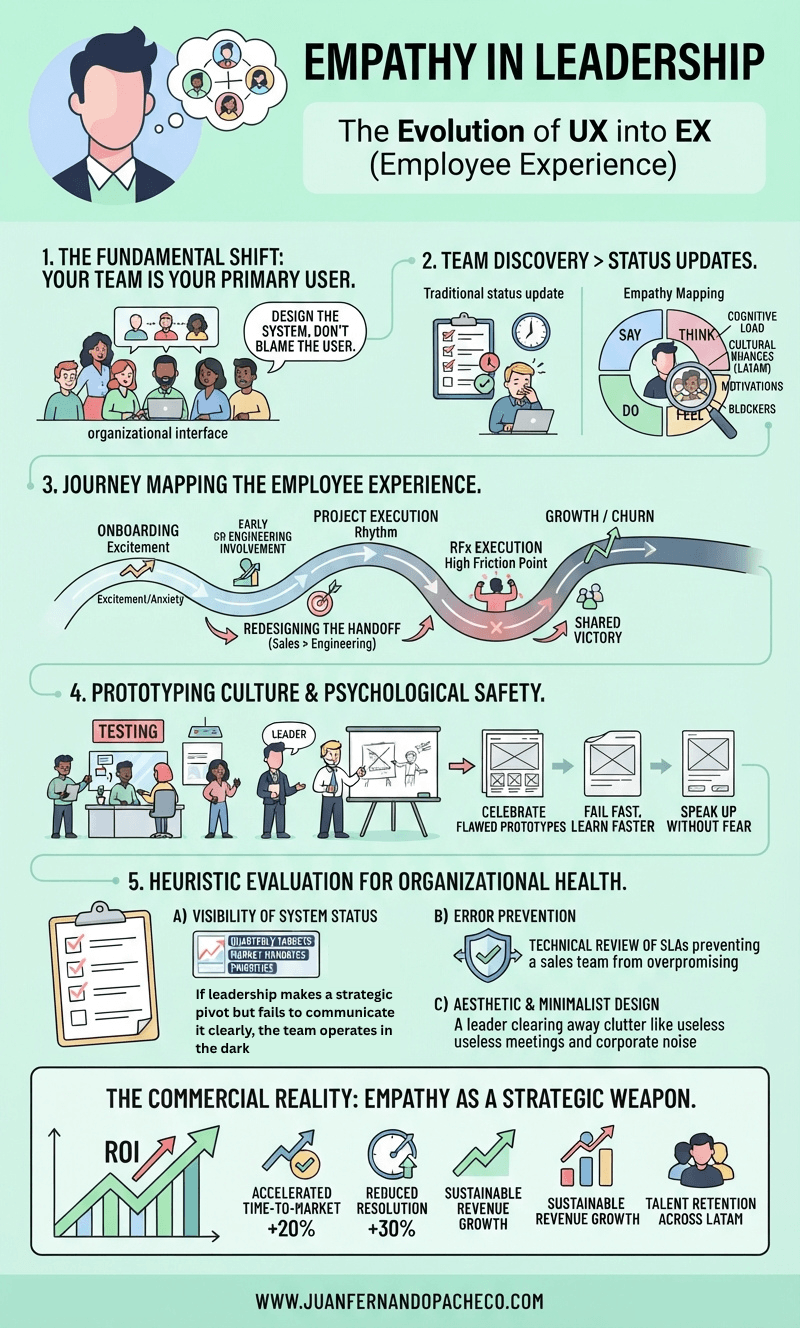
The fundamental shift: your team is your primary user
In the world of UX design, the cardinal rule is that you are not the user
What makes sense to a designer or an engineer might be completely baffling to the person actually using the product. We conduct research, we build personas, and we test relentlessly to ensure we are solving the right problems for the right people.
When you step into a leadership role, a similar paradigm shift must occur. Your team is your primary user. The processes you implement, the communication structures you build, the agile product roadmaps you define, and the goals you set are all “products” that your team must “use” every single day. If your team is struggling with burnout, misalignment, or inefficiency, a UX-minded leader does not immediately blame the users. Instead, they look at the design of the organizational system.
Early in my career, when I was managing product backlogs and leading sprint planning, I noticed that some of the most brilliant engineers were consistently missing deadlines. A traditional management approach would involve applying pressure, enforcing stricter KPIs, or questioning their work ethic. A UX approach asks a different question: where is the friction in their user journey?
By treating my team members as users, I started conducting “usability tests” on our internal processes. I discovered that the friction wasn’t a lack of skill or dedication; it was a poorly designed handoff process between the sales team and the engineering team.
The engineers were receiving vague requirements wrapped in complex legal clauses from enterprise clients, forcing them to spend hours deciphering what was actually needed for the minimum viable product.
By redesigning that internal touchpoint—creating a streamlined translation layer between commercial requests and technical user stories—we reduced customer request resolution times by 30 percent. The team didn’t need to work harder; the internal product they were using just needed a better design.
User research meets team discovery
In UX, we rely heavily on user interviews and empathy mapping to uncover what users are saying, thinking, doing, and feeling. We look for the gap between what a user says they want and what their behavior actually shows they need. This exact methodology is the bedrock of effective one-on-one meetings and team discovery.
Many leaders treat one-on-ones as simple status updates
They ask for a list of completed tasks and upcoming blockers. But a status update is not user research. To truly practice empathy in leadership, you must dig into the cognitive and emotional load your team is carrying.
When managing cross-functional teams across more than ten countries in Latin America, this level of discovery becomes even more critical. The cultural nuances of doing business in Mexico are vastly different from those in Colombia, Argentina, or Brazil. An empathetic leader must practice cultural empathy just as rigorously as interpersonal empathy. What motivates a senior developer in Quito might differ from what drives a sales lead in São Paulo.
I use a variation of the UX empathy map when onboarding new team members or when a squad is going through a particularly high-stress period, such as a massive RFx execution.
I ask questions designed to uncover the unsaid
What is the team thinking about the current market mandates regarding data sovereignty? How are they feeling about the stringent SLA negotiations we are undertaking with a new government client? What operational risks are keeping them up at night that they haven’t explicitly voiced in the daily stand-up?
By mapping these emotional and cognitive states, you move beyond managing tasks and start managing human capacity. You begin to see that the engineer who is pushing back on a timeline isn’t being difficult; they are acutely aware of an enterprise security requirement that the sales team has overlooked.
By validating their concerns and incorporating their technical reality into the commercial strategy, you build immense trust. You transform from a manager who assigns work into a leader who removes friction.
Journey mapping the employee experience
A user journey map visualizes the entire lifecycle of a customer’s interaction with a product, from the moment they realize they have a problem, through the onboarding process, to their daily usage and eventual renewal or churn. It highlights moments of delight and moments of severe frustration.
Every employee goes on a journey within your organization
They start with the excitement and anxiety of onboarding. They move into the rhythm of project execution. They face the intense pressure of a major product launch or a complex deal closure. Eventually, they either grow into new roles or they churn, taking their valuable institutional knowledge with them.
If you want to build high-performing teams focused on user story mapping and MVP efficiency, you must map their journey and design for their success at every touchpoint. Consider the handoff between the business development team and the delivery team. In many organizations, this is a moment of high friction.
The sales team celebrates winning a multi-million-dollar contract, while the engineering team groans under the weight of the complex legal clauses and aggressive uptime penalties that were negotiated without their input.
By journey mapping this specific touchpoint, I realized that the delivery team felt alienated from the commercial victory. They viewed the contract not as a shared success, but as a burden dropped on their desks. To fix this, we:
- Redesigned the journey.
- Brought engineering leads into the proposal creation phase earlier.
- Highlighted value propositions and winning themes together.
- Ensured that the people who would ultimately build and maintain the solution had a voice in the stringent SLA negotiations.
The result was a profound shift in team morale and commercial-product synergy. When the delivery team understands the “why” behind the deal, and when they feel their technical constraints were respected during the RFx process, they take ownership of the outcome.
This collaborative approach is exactly how we have been able to translate complex client objectives into agile product roadmaps, accelerating time-to-market by 20 percent and significantly boosting user adoption for the solutions we build.
The internal journey was optimized, which directly improved the external user experience.
Prototyping culture and psychological safety
One of the most powerful concepts in UX design is prototyping
We do not spend millions of dollars and two years coding a fully featured application only to launch it and hope the users like it. We:
- Build low-fidelity wireframes.
- Create clickable prototypes.
- Put them in front of users early and often, specifically looking for where they fail.
- Celebrate finding flaws in the prototype because it saves us from catastrophic failure in the final product.
This mindset is the key to fostering psychological safety within a team
Psychological safety is the belief that you won’t be punished or humiliated for speaking up with ideas, questions, concerns, or mistakes. It is the bedrock of innovation.
As a leader, you must create an environment where your team can “wireframe” their ideas before committing to them. When a team is tasked with solving a complex problem—perhaps figuring out how to ensure data sovereignty for a new banking client while maintaining system performance—they should not feel pressured to present a perfect, final solution on day one. They should be encouraged to present a rough prototype of their strategy.
When leaders react to early-stage ideas with immediate criticism or rigid demands for perfection, they kill the prototyping culture. The team learns to only bring forward safe, incremental ideas, or worse, they hide their mistakes until it is too late to fix them.
Empathy in leadership means understanding the vulnerability required to share an unfinished idea
It means responding to a flawed prototype with curiosity rather than judgment.
- What is the core assumption we are testing with this approach?
- Where do we think this might break down?
- How can we test this on a smaller scale before we roll it out to the entire LATAM region?
By treating team ideas like UX prototypes, you encourage rapid iteration and continuous learning
You build a team that is not afraid to fail fast and learn faster. This is how you drive business-led growth. You reduce the operational and legal risks of large-scale deployments because the team has already stress-tested their assumptions in a safe environment.
You mitigate risks for 100 percent on-time delivery because the team feels safe raising red flags early in the process, rather than hiding them until the deadline is looming.
Heuristic evaluation for organizational health
In UX, heuristic evaluation involves auditing an interface against a set of established usability principles, such as Jakob Nielsen’s ten usability heuristics. We look for things like “visibility of system status” (does the user know what is happening?) and “error prevention” (is the system designed to stop the user from making a critical mistake?).
Leaders can apply heuristic evaluation to their organizational structures to maintain team health and operational efficiency. Let’s look at a few core UX heuristics and how they translate to team management.
Visibility of system status
In a digital product, if a user clicks a button and nothing happens, they get frustrated and click it ten more times, crashing the system. In a team, if leadership makes a strategic pivot but fails to communicate it clearly, the team operates in the dark. They waste energy building features or pursuing deals that no longer align with the company’s mission.
Empathetic leadership requires over-communicating the “system status” of the organization.
- Where are we in our quarterly targets?
- What are the new government mandates affecting our sector?
- Why are we prioritizing this backlog item over that one?
- When the team has visibility into the broader business strategy, they can make autonomous, aligned decisions.
Error prevention
- In software, we use confirmation dialogs to prevent a user from accidentally deleting their entire database.
- In team management, error prevention means designing processes that protect your people from burnout and ethical compromises.
- In the high-stakes world of IT procurement and complex deal execution, the pressure to win can be immense.
Sales teams might be tempted to overpromise on response times to secure a contract. An empathetic leader designs “confirmation dialogs” into the business process, implementing mandatory technical reviews before any stringent SLA is signed. We ensure that the engineering and operations teams have veto power over operational risks.
This isn’t bureaucracy; it is a systemic safeguard that protects the team from the impossible burden of delivering on a broken promise.
Aesthetic and minimalist design
A good interface only shows the user what they need to know at that exact moment. It hides unnecessary complexity. Leaders often overwhelm their teams with data, metrics, and administrative overhead.
Empathy means respecting your team’s cognitive load. It means stripping away useless meetings, simplifying reporting structures, and shielding your product and engineering teams from corporate noise so they can focus on deep work.
When you reduce the cognitive friction of the workplace, you free up your team’s mental energy to solve the actual problems of your clients.
Navigating friction in high-stakes environments
The true test of empathy in leadership is not how you manage a team when everything is going well. The true test is how you navigate friction when business goals clash with human needs, especially in high-stakes environments.
In my role managing business opportunities across LATAM, I frequently deal with massive, complex RFx processes. We are often responding to requests from top regional brands in the banking and telecommunications sectors. These deals involve navigating intense government mandates, complex legal clauses, and stringent enterprise security requirements.
The pressure from the client side is immense, and the pressure from internal stakeholders to win the deal and hit quarterly revenue targets is equally heavy.
In these moments, the friction between the commercial team and the delivery team can become toxic. The commercial team sees a multi-million-dollar contract and a strategic foothold in a new market. The delivery team sees a nightmare of penalties, uptime guarantees, and technical debt.
A leader lacking empathy might simply force the delivery team to comply, using authority to push the deal through. This results in a won contract but a broken team. Morale plummets, key talent leaves, and the eventual delivery is plagued by operational failures and missed SLAs.
An empathetic leader steps into the friction and acts as a mediator, using UX principles to resolve the conflict. I bring the leads from product, sales, legal, engineering, and operations into the same room. I map out the underlying fears and incentives of each group. I validate the sales team’s drive for growth, and I validate the engineering team’s fear of technical insolvency.
Then, we collaboratively redesign the approach. We look for the middle ground. Can we negotiate a phased rollout to reduce the initial operational risk? Can we adjust the penalty clauses to account for third-party infrastructure failures in specific LATAM regions? Can we build a streamlined POC to prove our technical capability to the client before committing to the full, rigid SLA?
By treating the internal conflict as a design problem, we remove the emotion and focus on the structural blockers. We align the stakeholders not through coercion, but through shared understanding.
This is how you exceed KPIs and scale revenue over the long term. You win the deal, but more importantly, you preserve the team that will actually have to deliver the value. You ensure that the promises made in the boardroom can be realistically kept in the server room.
The commercial reality of empathy
There is a persistent myth in the corporate world that empathy is somehow at odds with profitability. The belief is that if you are too focused on the feelings and well-being of your team, you will lose your competitive edge and fail to drive business-led growth. My twenty years in the technology sector, particularly in the aggressive and fast-paced markets of Latin America, have proven this myth entirely false.
Empathy is a commercial weapon. It is a direct driver of technology revenue.
If you practice empathy in leadership, you build deep, authentic relationships. This applies internally to your team, and externally to your clients. I have forged strong connections with C-level executives and board members not by aggressively pitching them software, but by deeply understanding their business pressures.
When I sit down with a senior stakeholder at a major bank in Colombia or Mexico, I use the same active listening and empathy mapping skills I learned as a UX designer. I am trying to understand their underlying anxieties about market shifts, regulatory compliance, and customer retention.
Because I understand their true needs, I can position our company to capitalize on opportunities by delivering high-quality services that actually solve their problems, rather than just selling them a generic product. This is how you cultivate relationships with top business decision-makers and maintain strong partner ties. People do business with leaders who understand them.
Internally, the ROI of empathy is equally measurable. As I mentioned earlier, by empathizing with the friction our developers faced during POC development, we streamlined the process and reduced customer request resolution time by 30 percent.
By treating our team as our primary users and optimizing their journey, we accelerated time-to-market by 20 percent. In the technology sector, speed and efficiency are the ultimate differentiators. A team that feels understood, protected, and psychologically safe is a team that moves faster, innovates bolder, and delivers higher quality work.
Furthermore, in a region as diverse and dynamic as LATAM, talent retention is a critical business metric. Replacing a senior solutions architect or a seasoned business analyst is incredibly costly and disruptive. Empathetic leadership creates a culture where people want to stay.
It builds loyalty that survives market downturns and aggressive poaching by competitors. When your team knows that you are actively designing their work experience to be as frictionless and fulfilling as possible, they will go to bat for you when the pressure is on.
Final thoughts on human-centric growth
Looking back at my journey from a junior web designer in Ecuador to a strategic deal leader managing complex IT procurement across Latin America, the tools I use have changed dramatically. I no longer spend my days in Figma or writing CSS. I spend my days analyzing market research, structuring multi-year contracts, and aligning cross-functional teams across ten different countries.
Yet, the core philosophy remains the same.
Technology is ultimately a human endeavor. We build technology to solve human problems, and we build it using human teams. If you ignore the human element—if you treat your team like machines that simply execute code or close deals—you will eventually hit a ceiling. You will face high turnover, missed deadlines, and a toxic culture that repels both top talent and premium clients.
Empathy in leadership is the commitment to continuous discovery. It is the willingness to look at your own management style and ask, “Is this working for the people who have to use it every day?” It is the courage to prototype new ways of working, to map the emotional journeys of your team, and to design organizational systems that prioritize psychological safety and cognitive clarity.
Whether you are a startup founder trying to build your first MVP, or a senior executive managing high-stakes RFx execution for a global IT services firm, remember that your greatest asset is not your technology stack, your patent portfolio, or your market share.
Your greatest asset is the collective intelligence, creativity, and resilience of your team.
Design their experience with the same rigor, passion, and empathy that you would design a product for millions of users. When you do, you won’t just build better software or close bigger deals. You will build a resilient, adaptable, and deeply committed organization capable of thriving in any market, today and for the next five years and beyond.
The technology will evolve, but the profound impact of human-centric leadership will remain the ultimate competitive advantage.