Aligning tech with revenue goals
Introduction: the bridge between code and commerce
Over the past two decades, my career has traversed the entire spectrum of technology product development. I started my journey focused on the end-user, working as a senior UX designer and web designer, obsessing over pixel-perfect interfaces, user journeys, and interaction design. In those early years, success was measured by usability and adoption. However, as I transitioned into roles like solutions architect, product owner, and eventually business development manager, my perspective underwent a fundamental shift. I realized that a beautiful, highly usable product that fails to address complex commercial realities is ultimately a liability, not an asset.
Today, as a strategic product and deal leader focusing on scaling technology revenue across LATAM markets, I operate at the intersection of engineering capabilities and high-stakes commercial strategy. I have led end-to-end RFI, RFQ, and RFP processes for top regional brands in the banking, finance, retail, and telecommunications sectors. I have sat across the table from C-level executives and board members in Mexico, Colombia, Peru, Chile, Argentina, Brazil, and Ecuador, negotiating multi-million-dollar contracts. Through these experiences, one undeniable truth has emerged: the most critical lever for business growth is not the sales pitch, nor the marketing campaign, but the product backlog.
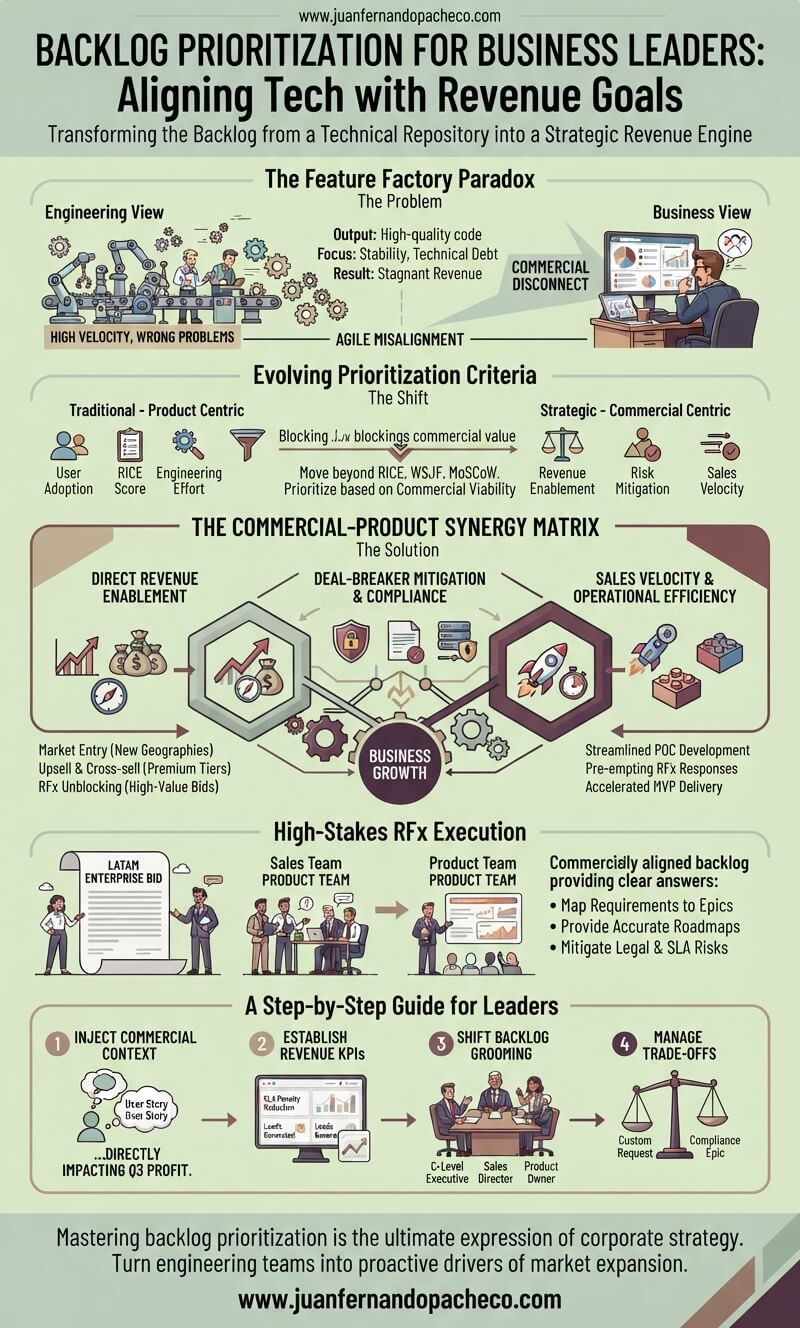
For many organizations, the backlog is treated as a technical repository—a dumping ground for feature requests, bug fixes, and engineering tasks managed exclusively by product managers and scrum masters. This is a profound strategic error. Backlog prioritization for business leaders is not an administrative task; it is the ultimate expression of corporate strategy. It is the mechanism through which abstract revenue goals are translated into tangible, shippable increments of value. When business leaders abdicate the backlog to engineering teams, they inadvertently decouple their technology output from their commercial objectives. The result is the “feature factory” paradox: engineering teams are working at maximum capacity, delivering high-quality code on time, yet the company’s revenue stagnates because the wrong problems are being solved.
This post is designed for executives, commercial directors, and business development leaders who want to reclaim the backlog as a strategic asset. Whether you are navigating stringent government mandates in the financial sector, managing complex legal clauses in enterprise agreements, or trying to accelerate time-to-market in highly competitive LATAM regions, the principles outlined here will remain continuously useful. Technology stacks will evolve, and market dynamics will shift, but the discipline of aligning technical execution with commercial viability is an evergreen imperative for sustainable growth.
The illusion of the feature factory
To understand why commercial alignment is so difficult to achieve, we must first examine the inherent tension between sales, product, and engineering. Sales teams are incentivized to close deals. To do this, they often promise the moon to prospective clients, especially during high-stakes RFx (Request for Proposal/Quote/Information) executions. They agree to stringent SLA negotiations, complex enterprise security requirements, and highly customized feature sets to secure the contract. Once the deal is signed, the sales team moves on to the next prospect, leaving the product and engineering teams to figure out how to deliver on those promises.
On the other side of the divide, engineering teams are incentivized by stability, efficiency, and technical excellence. They want to reduce technical debt, refactor legacy code, and build elegant, scalable architectures. When left to their own devices, engineering teams will naturally prioritize tasks that make the system more robust, even if those tasks do not directly generate new revenue or unlock new market segments.
The product manager is caught in the middle, often relying on standard Agile frameworks to mediate the conflict. The result is a compromise that satisfies no one. The sales team is frustrated because the “cool features” they promised are delayed by technical debt initiatives. The engineering team is frustrated because they are forced to build hacky, customized workarounds to satisfy arbitrary client demands, compromising the integrity of the core platform.
In my experience driving cross-functional teams across more than ten countries, I have seen this dynamic repeatedly stall growth. In the LATAM region, this disconnect is particularly dangerous. Our markets are characterized by deep regional complexities. A banking client in Colombia operates under vastly different regulatory frameworks than a retail giant in Mexico or a telecommunications provider in Brazil. If your backlog does not explicitly account for data sovereignty, local policies, and regional compliance mandates, you are not just risking a delayed release; you are risking severe legal penalties and the loss of multi-million-dollar accounts.
Therefore, backlog prioritization for business leaders requires stepping out of the boardroom and into the trenches of product strategy. It requires recognizing that every user story, every epic, and every technical spike represents a deployment of corporate capital. As a business leader, you must ensure that this capital is being invested in initiatives that directly mitigate operational risks, ensure regulatory compliance, or drive measurable revenue growth.
Why traditional prioritization fails the commercial test
If you ask a typical product manager how they prioritize the backlog, they will likely cite familiar frameworks such as:
- RICE (Reach, Impact, Confidence, Effort),
- WSJF (Weighted Shortest Job First), or the
- MoSCoW method (Must have, Should have, Could have, Won’t have).
These frameworks are excellent for optimizing engineering throughput and ensuring that user-centric features are delivered efficiently. However, they are fundamentally blind to commercial reality.
Let us examine the “Impact” metric in the RICE framework. Impact is usually defined by the product manager’s estimation of how much a feature will improve the user experience or increase user adoption. While boosting user adoption by 15% is a noble and necessary goal, it does not automatically translate to revenue recognition, especially in B2B enterprise environments. A feature might have a massive impact on daily active users but zero impact on the client’s willingness to renew their enterprise license or purchase an upsell module.
Furthermore, traditional frameworks completely ignore the concept of “deal-breakers.” In high-stakes IT procurement, particularly in the banking and finance sectors, there are features that do not necessarily delight the user, but are absolutely mandatory for the contract to be signed. For example, implementing a specific data encryption standard to comply with a new government mandate in Ecuador might require immense engineering effort and offer zero visible improvement to the end-user experience. Under a standard RICE scoring model, this compliance task might be pushed to the bottom of the backlog due to its high effort and low user “impact.” Yet, failing to deliver this feature means losing a multi-year, multi-million-dollar contract.
This is where the concept of commercial-product synergy becomes critical. Translating client objectives and complex requests into Agile product roadmaps requires a different lens. You cannot prioritize solely based on user delight or engineering convenience. You must prioritize based on commercial viability and risk mitigation. In my career, I have found that when business leaders actively participate in shaping the prioritization criteria, we can accelerate time-to-market by up to 20%, simply by ruthlessly eliminating features that look good on a roadmap but do not move the commercial needle.
We must evolve our prioritization models to include variables that matter to the CFO, the legal department, and the sales directors. We must ask questions like: Does this epic unblock a pending RFP response? Does this technical refactor reduce our SLA penalty risk? Does this MVP (Minimum Viable Product) allow us to run a streamlined POC (Proof of Concept) that reduces customer request resolution time? By injecting these commercial variables into the backlog, we transform it from a technical to-do list into a strategic revenue engine.
The commercial-product synergy matrix
To bridge the gap between user needs, business goals, and regional complexities, I advocate for a framework I call the commercial-product synergy matrix. This matrix is designed specifically for business leaders and product owners operating in complex, highly regulated, and diverse markets like LATAM. It forces the organization to evaluate every major backlog item across three distinct commercial dimensions before a single line of code is written.
Dimension 1: direct revenue enablement
The first dimension evaluates the direct line of sight between the backlog item and top-line growth. This is not about vague promises of “better user experience.” This is about hard commercial triggers.
- Market entry: does this feature allow us to deploy our solution in a new geography with specific local policies? For instance, adapting our core banking software to support specific tax reporting formats required by the Mexican authorities.
- Upsell and cross-sell: does this epic unlock a premium tier of our service offering that sales can immediately take to existing clients?
- RFx unblocking: is this feature a mandatory requirement listed in an active, high-value RFP that we are currently bidding on?
If a backlog item does not clearly map to one of these revenue enablement triggers, its priority must be heavily scrutinized, regardless of how passionately the engineering team wants to build it or how loudly a single vocal user is demanding it.
Dimension 2: deal-breaker mitigation and compliance
The second dimension focuses on risk, specifically the risks that kill deals or result in massive financial penalties. In the enterprise technology space, particularly when dealing with top regional brands in finance and telecommunications, compliance is not optional.
- Data sovereignty: many LATAM countries have strict laws regarding where financial data can be stored and processed. If our cloud architecture does not support local data residency in Brazil or Argentina, we cannot legally operate there. This is a high-effort, zero-user-delight task that must sit at the absolute top of the backlog.
- Enterprise security requirements: navigating complex legal clauses often means adhering to stringent third-party security audits. Failing to prioritize these security patches means failing the procurement vendor assessment, effectively ending the sales cycle before it begins.
- Stringent SLA negotiation: if our current system architecture is prone to downtime, and we are negotiating contracts with severe financial penalties for missed uptime guarantees, then technical debt related to system stability is actually a commercial priority. It directly protects the profit margin of the deal.
Dimension 3: sales velocity and operational efficiency
The third dimension looks at how the backlog can accelerate the sales cycle itself. One of the most significant bottlenecks in B2B tech sales is the proof of concept (POC) phase. Prospective clients want to see the technology working in their specific environment before they sign a multi-year contract.
- Streamlined POC development: by prioritizing the creation of modular, easily configurable MVP environments, we can drastically reduce the time it takes to spin up a POC. In my experience, focusing on MVP efficiency and building high-performing teams around user story mapping has reduced customer request resolution by 30%.
- Pre-empting RFx responses: when we know that a specific government mandate is coming down the pipeline, we prioritize the R&D for that mandate before the RFP is even issued. When the RFP finally drops, our sales team can confidently check the “compliant” box, while our competitors are scrambling to figure out if their tech stack can even support the requirement.
By filtering the backlog through this three-dimensional matrix, business leaders ensure that commercial-product synergy is not just a buzzword, but a daily operational reality.
The role of the backlog in high-stakes RFx execution
As a business development manager who has secured multi-year contracts by cultivating relationships with top business decision-makers, I view the RFx process as the ultimate stress test for a company’s product strategy. An RFP is essentially a highly detailed, legally binding questionnaire that probes the deepest capabilities and limitations of your technology.
When an organization treats its backlog purely as an engineering artifact, the RFx response process becomes a nightmare. The sales and pre-sales teams are forced to make promises about future capabilities that have not been scoped, estimated, or prioritized by the product team. They write “yes” to complex legal clauses and stringent SLA requirements, assuming that engineering will somehow figure it out post-sale. This leads to the dreaded “delivery gap,” where the sold solution and the actual delivered product are fundamentally misaligned, resulting in eroded margins, damaged client trust, and severe operational/legal risks.
Conversely, when business leaders are actively involved in backlog prioritization, the RFx execution becomes a streamlined, highly confident process. Because the backlog is already aligned with regional complexities and market gaps, the product team has already built the roadmaps necessary to support the sales team’s claims.
Consider a scenario where we are bidding on a massive digital transformation contract for a major retail bank in Peru. The RFP includes over a thousand line items, ranging from basic UI requirements to complex, real-time fraud detection algorithms that must comply with local financial regulations. If our backlog is commercially aligned, the product owner can immediately map the RFP requirements to existing epics, current sprint velocities, and planned MVP releases. We can provide accurate project estimates and realistic delivery timelines during the proposal creation phase. We can highlight our true value propositions and key differentiators because we know exactly what our technology can do, what it is currently building, and what the actual engineering effort will be.
This level of transparency mitigates operational and legal risks, paving the way for 100% on-time delivery. It also allows us to engage in stringent SLA negotiations with confidence. We know our system’s true uptime capabilities and response times because they are continuously measured and prioritized in the backlog, not just guessed at by a sales director trying to win a deal. Ultimately, mastering backlog prioritization for business leaders is what allows a company to navigate the treacherous waters of high-stakes IT procurement and emerge with profitable, sustainable contracts.
Aligning the C-suite, sales, and engineering
Achieving this level of alignment requires breaking down the silos that traditionally separate the C-suite, the sales floor, and the engineering labs. In my role representing customers and providing expert advice on best practices across diverse market segments, I have found that the primary barrier to alignment is a lack of shared context. Engineers do not understand the commercial pressure of a closing quarter, and sales leaders do not understand the architectural complexity of refactoring a legacy database.
To forge strong connections and align these disparate groups, business leaders must change how they communicate about the backlog. It is no longer sufficient to review a Gantt chart or a burn-down chart. The backlog must be presented as a portfolio of commercial investments.
When I facilitate face-to-face meetings with senior management and C-level executives, I do not talk about story points or sprint velocities. I talk about market gaps, risk mitigation, and revenue enablement. I show them how prioritizing a specific data sovereignty epic in Q2 directly enables the sales team to target a new segment of government clients in Q3. I explain how investing in a streamlined POC framework will reduce the sales cycle duration by several weeks, directly impacting the quarterly revenue targets.
This requires empowering product owners with deep commercial context. A product owner cannot effectively prioritize a backlog if they are shielded from the business realities. They need to sit in on sales calls; they need to read the executive summaries of major RFPs; and they need to understand the competitive landscape in Mexico, Colombia, and Chile. When a product owner understands why a feature is critical to a multi-million-dollar deal, they become a fierce advocate for commercial-product synergy. They will naturally push back against engineering requests for unnecessary refactoring and champion the features that drive business-led growth.
Furthermore, we must foster an environment of transparent trade-offs. In the complex world of enterprise technology, you cannot have everything. You cannot have a highly customized, bespoke feature set, a rock-solid stable core platform, and a rapid time-to-market all at the same time without exponentially increasing your budget. Business leaders must be willing to make the hard calls. If the strategic goal for the year is to scale revenue in the Brazilian telecommunications market, then the backlog must ruthlessly deprioritize niche feature requests from legacy clients in other regions. This level of disciplined stakeholder alignment is what separates market leaders from companies that merely tread water.
Executing the strategy: a step-by-step guide for leaders
Transforming your organization’s approach to the backlog is not an overnight endeavor. It requires a deliberate shift in processes, metrics, and culture. For business leaders looking to implement this strategy, I recommend the following step-by-step approach to ensure that technology execution remains permanently tethered to revenue goals.
Step 1: Inject commercial context into user story mapping
Traditional user story mapping focuses entirely on the end-user journey. While this is vital for UX design, it is insufficient for enterprise product development. We must expand the user story to include the “business user” and the “commercial trigger.”
Instead of a standard format like, “as a bank teller, I want to quickly access customer records so that I can process transactions faster,” we must add the commercial layer: “to reduce average handling time by 15%, thereby allowing the bank to process higher transaction volumes without increasing headcount, directly impacting their Q3 profitability metrics.”
By forcing product teams to articulate the commercial “why” behind every feature, we ensure that the development effort is always in service of a tangible business outcome. This practice is especially critical when mapping out MVPs for new market entries, ensuring that we only build what is strictly necessary to validate the commercial hypothesis.
Step 2: Establish revenue-linked KPIs for every epic
In Agile environments, we often measure success through velocity and sprint completion rates. These are lagging indicators of engineering health, not business health. For every major epic in the backlog, business leaders must define a leading commercial KPI.
If the epic is focused on improving system latency to meet stringent SLA negotiations, the KPI might be the reduction in SLA penalty payouts. If the epic is a new module designed for the retail sector in Argentina, the KPI is the number of qualified sales leads generated or the number of POCs deployed using that module. By attaching revenue-linked KPIs to the backlog, we create a direct feedback loop between engineering output and commercial success. This allows us to routinely report and measure progress against quarterly targets with regional and industry leaders, ensuring total transparency.
Step 3: Shift backlog grooming from a tech sync to a business review
The backlog grooming (or refinement) session is typically attended by the product owner, the scrum master, and the engineering lead. To achieve true commercial-product synergy, this meeting must occasionally include commercial stakeholders—such as a sales director, a legal compliance officer, or a business development manager.
During these sessions, the discussion should not just be about whether a feature is technically feasible, but whether it is still commercially relevant. Market conditions in LATAM change rapidly. A government mandate that was a priority six months ago might have been delayed; a competitor might have just released a feature that renders our current roadmap obsolete. By bringing commercial leaders into the grooming process, we ensure that the backlog remains a living, breathing reflection of the current market reality, allowing us to pinpoint gaps and drive solution development dynamically.
Step 4: Manage stakeholder alignment through transparent trade-offs
As a business development manager, I coordinate relationship-building efforts with relevant partners, engagement managers, subject matter experts, and client stakeholders. A key part of this relationship management is setting realistic expectations.
When internal stakeholders (like sales) or external stakeholders (like clients) demand new features, business leaders must use the commercially aligned backlog to illustrate trade-offs. If a client demands a highly customized reporting module, the business leader can show them the backlog and say, “We can build this for you, but it will require deprioritizing the data sovereignty compliance epic, which means we will not be able to deploy your solution in the Mexican market until Q4.”
This level of transparency builds immense trust. It moves the conversation from an emotional argument about “who wants what” to a rational, strategic discussion about resource allocation and market strategy. It positions your company not just as a vendor, but as a strategic partner invested in the client’s long-term success.
Conclusion: the evergreen advantage of commercial alignment
The landscape of technology is in a state of perpetual acceleration. The tools we use to build software, the cloud architectures we deploy, and the AI models we integrate will look vastly different five years from now than they do today. However, the fundamental mechanics of business will not change. Companies will always need to generate revenue, mitigate risk, and deliver value to their customers faster and more efficiently than their competitors.
Backlog prioritization for business leaders is the discipline that ensures your technology organization is always serving these fundamental business truths. By moving beyond the illusion of the feature factory and embracing the commercial-product synergy matrix, you transform your engineering teams from cost centers into proactive drivers of market expansion.
Whether you are navigating the complex legal clauses of a banking RFP in Ecuador, managing stringent SLA negotiations for a telecommunications giant in Chile, or streamlining POC development to win retail market share in Brazil, the backlog is your most powerful strategic weapon. It is the physical manifestation of your corporate strategy.
As leaders, our mandate is not just to manage business opportunities from assigned accounts, but to position our companies to capitalize on them by delivering high-quality, commercially relevant services. By aligning tech with revenue goals through rigorous, commercially-aware backlog prioritization, we do more than just close deals. We build resilient, scalable technology organizations capable of driving significant business growth and exceeding client expectations across the Latin American region and beyond, today and for years to come.