Saying less to win more in every negotiation you will ever have
The deal where nothing was said
Some years ago, in a boardroom far from my home office, I sat through the final round of a competitive technology RFP for a regional bank. The room was full: procurement, legal, IT, and a couple of executives I had worked months to earn a meeting with.
We had already survived the technical evaluation, the security review, and the reference calls. What remained was the hardest part, the commercial conversation where years of relationship and hundreds of pages of proposal compress into a handful of numbers.
At one point, the head of procurement leaned forward and asked the question every deal leader knows is coming and still dreads:
“So, is that your best number, or should we keep talking with your competitor?”
I gave the answer I had prepared.
Our proposal stands as submitted, because the price reflects the risk we are willing to take on your behalf, and we will not price the deal to win it and then fail to deliver it.
Then I stopped talking
I counted to ten in my head, slowly, the way you count when your pulse is in your ears. It felt like an eternity. Every instinct screamed at me to soften the message, to offer a small discount as a gesture, to fill the air with anything.
I didn’t. Around the seventh second, the procurement director shifted, looked at his own notes, and said something I did not expect:
“If the risk allocation is the issue, we can revisit the penalty caps.”
The conversation moved from pressing our price to reshaping the risk. We signed a multi-year contract that week, at margins my team had already mentally written off.
I didn’t win that deal because I was the smartest person in the room. I won it because, for ten seconds, I was the quietest.
What strategic silence is, and what it is not
The idea travels these days as one of those CEO negotiation secrets: state your position clearly, then go completely silent, because the first person to speak after stating terms usually loses negotiating power.
The advice fits on a card, but the discipline takes a career.
So let me define it precisely, because silence used badly is not strategy; it is rudeness.
Strategic silence is a deliberate, respectful pause that follows a clearly stated position, giving the other party room to respond first. It is not stonewalling. It is not a punishment, not a stare-down, not a trick to manufacture anxiety.
It is simply the space where the other party’s real priorities surface. Most people panic in silence and fill it, and what they fill it with is information: a better offer, a hidden constraint, a priority they had not disclosed.
Used well, silence is generosity
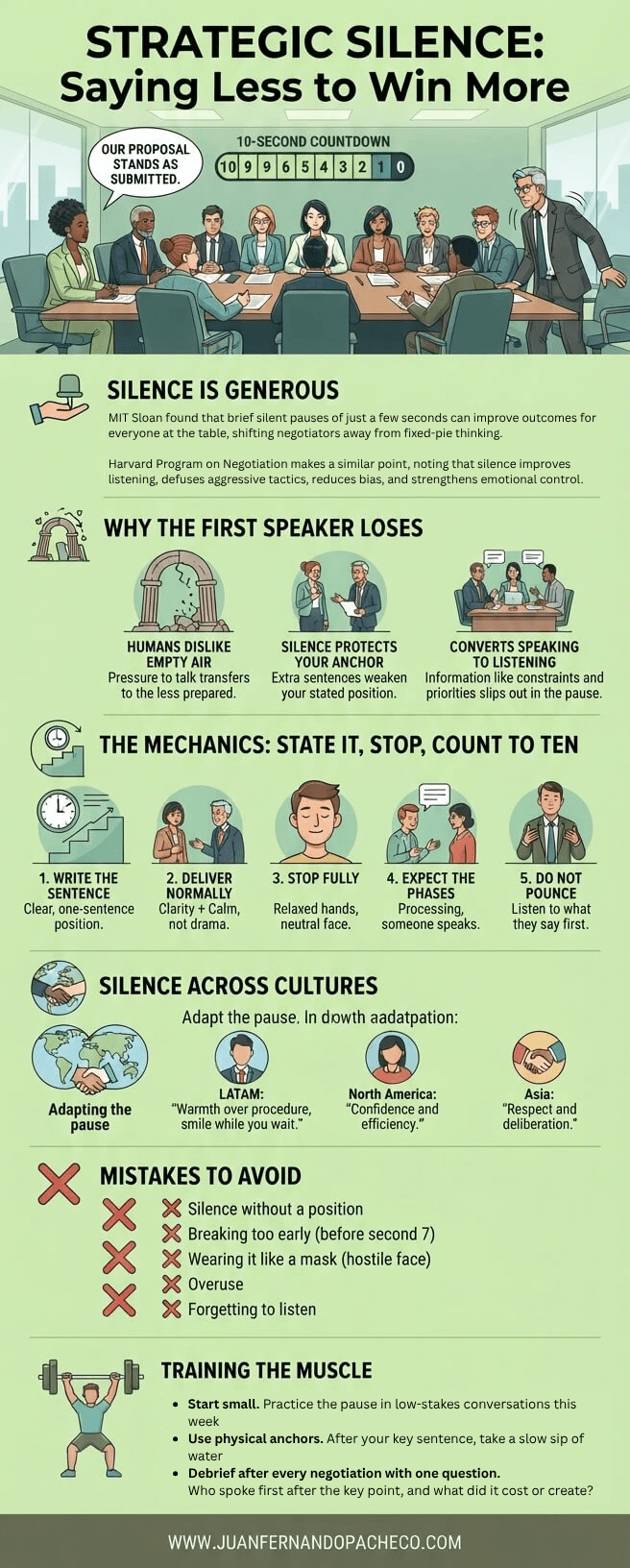
You are giving your counterpart the floor, and giving yourself the one thing talkers never have: the chance to listen. Research from MIT Sloan found that brief silent pauses of just a few seconds can improve outcomes for everyone at the table, shifting negotiators away from fixed-pie thinking.
The Harvard Program on Negotiation makes a similar point, noting that silence improves listening, defuses aggressive tactics, reduces bias, and strengthens emotional control.
So this is not a weapon. It is a posture. And like any posture, it can be learned.
Why the first speaker loses
To use silence on purpose, you need to understand why it works; otherwise, you will abandon it exactly when it starts to work.
First, humans are uncomfortable with empty air
Conversation is a contract in which each party takes turns, and a silence after a statement reads as a breach. The discomfort is real, and the easiest way to relieve it is to talk.
When you hold the pause, the pressure transfers to whoever is less prepared. If your position is clear and theirs is still flexible, they will usually move first, and the first move after a stated position is almost always a concession or a reveal.
Second, silence protects your anchor
Every extra sentence after your key point is a qualification, and every qualification is a crack in your anchor. “Our valuation is fifty million — although of course there is room to talk, we are flexible, we understand the market is…” Watch what happens to the number as the sentence continues.
The person who keeps talking after stating terms is negotiating against themselves, bidding down their own anchor before the other side has even asked.
Third, silence converts speaking time into listening time, and listening is where deals are actually won
Former FBI hostage negotiator Chris Voss built much of his method on this idea: silence, paired with a mirror of the other party’s words, encourages them to fill the void and reveal more of what they actually think.
In enterprise deals, the information you need most — budget ceilings, internal deadlines, political constraints — is rarely handed over in a formal answer. It slips out when people try to be helpful in an awkward pause.
None of this expires
Markets change, currencies move, technologies come and go, but the discomfort of an unanswered statement is a permanent feature of human wiring. That is why this habit is worth building once and keeping forever.
The mechanics: state it, stop, count to ten
The card version says:
State your position clearly, then go completely silent, count to ten, let them speak first.
Here is the field version, the way I coach teams to do it in real deals.
One, write the sentence before the meeting
Your key point must be one sentence, plain language, no adverbs, no apologies.
- “Our proposal stands at the submitted price.”
- “We can accept the liability cap as drafted, except clause twelve.”
- “Our valuation is $50 million.”
If you cannot write it in one sentence, you do not have a position yet; you have a mood.
Two, deliver it at normal speed with normal warmth
Do not drop your voice like a verdict. Say it the way you would say the meeting starts at ten. Clarity plus calm is what gives silence its power; clarity plus drama turns the pause into theater.
Three, stop. Fully
Close your mouth, relax your hands, keep your face neutral to friendly. Count to ten slowly in your head. If you are in a culture where ten seconds reads as hostile, count to seven and let your eyes say
“I am listening, not fighting.”
The count is not magic; it is a fence that keeps your anxiety from walking into the conversation.
Four, expect the three phases.
- Seconds one to three: they process.
- Seconds four to seven: they decide whether you are serious.
- Seconds eight to ten: someone starts talking.
What they say first is your reward. Sometimes it is a concession, sometimes a question that reveals their real constraint, sometimes an internal disagreement between their own people. All of it is more valuable than anything you could have said instead.
Five, when they finally speak, do not pounce
Answer slowly, or better, mirror the last few words of what they said and let them continue. The silence did its job opening the door; listening walks through it.
And one warning from experience
Never use the pause after a bluff. Silence amplifies whatever you said last. If what you said last is true and defensible, silence makes it stronger. If it is false, silence gives the other party ten quiet seconds to look at it closely.
Where silence works across the deal lifecycle
People associate silence with the final price meeting, but in complex technology deals it earns its keep much earlier.
In RFx processes, the clarification meeting after submission is where most vendors destroy their own position. They arrive nervous and talk for an hour, discounting, explaining, promising.
State your differentiators once, then ask your questions and let the buyer talk. The buyer’s own words will tell you which requirements are real and which are decoration.
In SLA and penalty negotiation, when the client demands uptime and response times beyond what your operation can sustain, the temptation is to agree in the room and fight later. Instead, state what you can commit to, and stop.
Let the client explain why they need more. Half the time the demand is a copy from another contract, and the pause gives their own team room to say so.
In legal review, when a clause comes back aggressively redlined, resist the urge to answer immediately by email. Let the redline sit for a day. A measured pause before responding reads as seriousness, not slowness, and it routinely produces a softer second draft from the other side before you have written a word.
And in procurement pressure — “your competitor is twenty percent cheaper” — the pause is your best ally. Do not defend the number. State that your price reflects the outcome you commit to, then go silent.
What comes back next will tell you whether the competitor is real, whether the number is real, and what the buyer actually wants you to do about it.
Silence across cultures: notes from LATAM and beyond
I have run deals across Mexico, Colombia, Peru, Chile, Argentina, Brazil, and Ecuador, and the truth is that the ten-second rule travels, but it must be translated.
In much of Latin America, business is relational before it is transactional
People expect warmth, conversation, a bit of football, family, and food before the hard numbers. A cold, procedural pause in that context can read as distance or displeasure. So in LATAM rooms I keep the silence but wrap it in relationship:
- I smile while I hold the pause,
- I let it land after a personal remark as often as after a commercial one, and
- I never let the pause replace the small talk that funds trust in our region.
The silence works there precisely because the relationship is warm; the contrast is what creates the gravity.
In other cultures, the adjustment is different
- In many North American and northern European rooms, silence reads as confidence and efficiency, and ten seconds costs nothing.
- In parts of Asia, silence is already a normal part of deliberation, and your pause will be read as respect rather than pressure, so you can hold it longer without cost.
The principle is constant — say your piece, then give the room space — but the length, the face, and the wrapping change with the culture.
Learn the local grammar of quiet the same way you learn the local greeting, and the tool will serve you in every market you will ever work.
Silence in rooms without walls
Deals are negotiated as much on video calls, email threads, and chat windows as in boardrooms, and silence has a version for each.
On video calls
The temptation is worse than in person, because dead air feels amplified by the technology. People jump in over latency, talking over each other to avoid the gap.
The discipline is the same:
After your key sentence, take your hand off the mouse, lean back, and let the gap live.
On calls, I also mute the urge to summarize; when I finish my point, I simply say “I will stop there,” and then I actually stop. That phrase, used honestly, turns silence from awkward into intentional.
In email
Strategic silence is the delay between receiving an aggressive ask and answering it. Most negotiators reply within minutes and discover later they negotiated against themselves at typing speed.
My rule:
No commercial reply leaves my outbox in under one business day unless the deal is genuinely on fire.
The pause almost always produces a second email from the other side — a clarification, a softening, a new data point — that you would have answered blindly if you had been fast.
In chat
The same logic applies at a smaller scale: read receipts are not reply obligations. Answering instantly trains everyone to expect instant answers, and instant answers are rarely your best answers.
The mistakes that turn silence into noise
Because silence is powerful, it is also easy to misuse. Five errors cover most of the damage I have seen.
First is silence without a position.
The pause amplifies your last sentence; if that sentence was vague, you have simply made vagueness more dramatic. State the position first, in one clean sentence, or the silence is empty.
Second is breaking at second six
The value of the pause lives between seconds seven and ten, exactly where your anxiety peaks. If you routinely break early, you teach counterparts that your positions are previews, not commitments.
Third is wearing the silence like a mask
A hard face, crossed arms, a stare: that is not strategy; that is hostility, and it taxes the relationship you will need during delivery. The pause must be warm.
Fourth is overuse
If every sentence ends in a dramatic pause, none of them mean anything. Reserve the tool for the moments that matter: price, risk, scope, commitment.
Fifth is forgetting that silence is for listening
If you spend the ten seconds rehearsing your next argument, you have learned nothing. The pause is a window, not a mirror.
Training the muscle
Nobody is born comfortable with ten seconds of quiet in a million-dollar conversation; it is trained, like any other professional muscle.
Start small. Practice the pause in low-stakes conversations this week
State an opinion in a team meeting, then stop. Notice the urge to add, “but that is just my view,” and let it pass. Then bring it to internal negotiations — budget discussions, scope debates with engineering — where the cost of error is low.
In live deals, use physical anchors
After your key sentence, take a slow sip of water, or rest your hands flat on the table. The body ritual occupies the part of you that wants to talk.
Debrief after every negotiation with one question
Who spoke first after the key point, and what did it cost or create? Keep a private note. Within a quarter, you will see the pattern the research describes, and the habit will stop feeling like a trick and start feeling like posture
When to break the silence
Every rule needs its exception, and this one has three
- Break the silence immediately when the other side is genuinely confused and needs information only you have; clarity is kindness, and deals die in fog more often than in conflict.
- Break it when the pause is damaging trust — when you read hurt rather than thought on the other face — because the relationship outranks the round. And
- Break it when your counterpart has already moved: if they answer your position with a real concession, reward it with a real response, not another theatrical pause.
Silence is a door you hold open for the other party, not a wall you build between you. The moment it stops serving the conversation, stop using it.
Final thoughts
Tools change. I have negotiated on paper, on fax, on video, and on chat, across currencies that no longer exist and technologies that did not exist when I started. What has never changed is the human being across the table, uncomfortable with quiet, eager to be heard, relieved when someone finally listens.
Learn to say your piece in one sentence
Learn to count to ten while your heart argues with you. Learn to let the other side speak first, and to treat what they say as the most valuable document of the deal. Do that for the rest of your career, and you will close deals that faster talkers lose — quietly.
References and further reading
Web references
- Harvard Program on Negotiation — silence in negotiation: why saying nothing can be powerful. Explains how pauses improve listening, defuse anchors and aggressive tactics, reduce bias, and strengthen emotional control.
- MIT Sloan — in negotiation, use silence to improve outcomes for all. Research shows that brief silent pauses shift negotiators away from fixed-pie thinking and can improve deals for everyone.
- Molly Fletcher — negotiation strategies: embracing the power of pause. A practical read on mastering quiet so others have the chance to reveal what they need.
- Red Bear negotiation — the power of silence in negotiations. Applied perspective on pausing for clarity and control in procurement and sales deals.
Books that reinforce this post
- Never split the difference by Chris Voss and Tahl Raz. The foundational text on silence, mirroring, and letting the counterpart fill the void.
- Getting to Yes by Roger Fisher, William Ury, and Bruce Patton. The classic on separating people from the problem and focusing on interests — the discipline that keeps your silence respectful instead of hostile.
- Negotiation Genius by Deepak Malhotra and Max Bazerman. A methodical guide to preparing positions so clear that a pause can do the work for you.
- Quiet: the power of introverts in a world that can’t stop talking by Susan Cain. The deeper case for why quiet carries power in cultures that never stop talking.