The discipline of problem definition under pressure
In more than twenty years of work across Latin American banking, finance and technology — first as a designer and solutions architect, later as a product owner, business analyst and business development manager —
I have sat in hundreds of status meetings, deal reviews, steering committees and RFx war rooms, from Quito to Mexico City, from Bogotá to São Paulo. And I can tell you that the most expensive phrase I have ever heard in those rooms is not “we failed.” It is “no problem.”
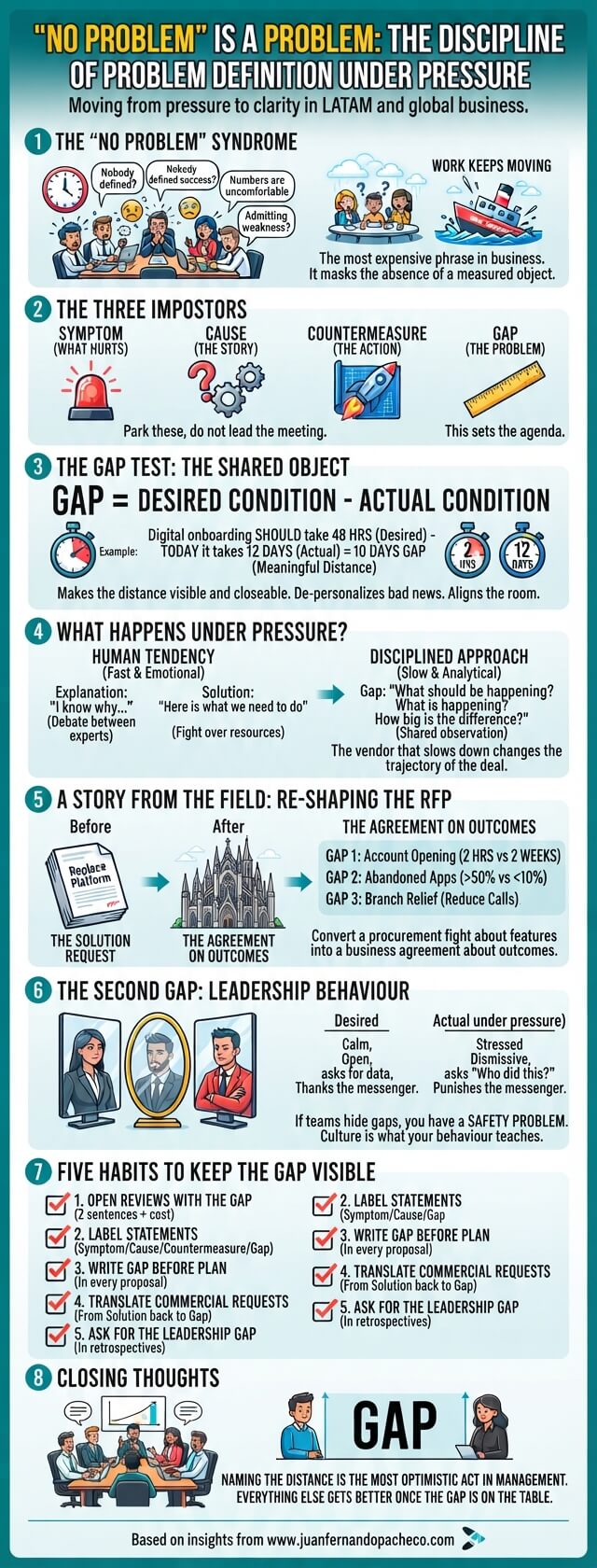
“No problem” usually means one of three things
Nobody defined what success should look like, so there is nothing to compare against. Somebody defined it, but the numbers are uncomfortable, so the gap stays private. Or the room is under so much pressure that naming a gap feels like admitting weakness.
In all three cases, the work keeps moving — the deal keeps advancing, the sprint keeps burning, the contract keeps running — without anyone being able to say which problem it is solving. That is why “no problem” is a problem: it is the absence of the very object our work is supposed to close.
This post is about problem definition under pressure, and about a habit that has served me across two decades and ten countries: define the problem as a gap before you discuss anything else.
It is written for product leaders, deal teams, analysts, designers, and managers who inherit pressure but not clarity. Nothing here depends on a specific tool, framework, or market cycle.
The habit works in an RFP for a regional bank, in a quarterly business review, in a backlog refinement, and in a board meeting. If you adopt it today, it will still work in five years.
A problem is not a symptom, a cause, or a countermeasure
Before the gap test, we need a filter, because most of what teams call “the problem” is one of three impostors.
- A symptom is what hurts. “Customers are complaining at the branches,” “the dashboard is red,” “the client is escalating.” Symptoms are real and they deserve attention, but they are only signals that something is off between what should be and what is.
- A cause is a story about why the symptom exists. “The core system is slow,” “the vendor is underperforming,” “users are not trained.” Causes may be true or false, but either way they are hypotheses, not problems.
- A countermeasure is an action we propose. “We need a new mobile app,” “let’s migrate to the cloud,” “let’s renegotiate the contract.” Countermeasures are bets we make with money and time.
None of the three is a problem
They are material around the problem, and confusing them with the problem is fatal in commercial work. I have seen multi-million-dollar RFPs written entirely in countermeasures: hundreds of pages describing a solution that never stated the gap it was supposed to close.
Answer that RFP as written, and you inherit the client’s blindness. You price a solution to an undefined problem, and later the SLAs, the penalties, and the legal clauses punish you for a gap you never measured.
The same confusion poisons product roadmaps
A stakeholder says,
The problem is that we don’t have feature X.
That is a countermeasure dressed as a problem. When roadmaps fill up with countermeasures, adoption stalls, because nobody verified the distance between what the user should experience and what the user actually experiences
So the first move is a linguistic discipline: label every statement in the room — symptom, cause, countermeasure, or gap. Whatever is not a gap gets parked. It will be useful later, but it cannot lead the meeting.
The gap test
A problem, properly stated, is a meaningful gap that we decide to understand and close. The formula is almost embarrassingly simple:
gap = desired condition − actual condition.
Three words do the heavy lifting: condition, meaningful, decide.
- “Condition” means both sides must be describable and, ideally, measurable. “Digital onboarding should take 48 hours; today it takes 12 days.” “Availability should be 99.9 percent; this quarter it was 99.2.” “Renewals should close in one cycle; half of them take three.” When you cannot state the desired and the actual, you do not have a problem yet — you have a mood, a fear, or a wish. Moods are worth listening to, but they cannot be closed; gaps can.
- “Meaningful” means we will not close every gap. Any organization carries hundreds of gaps at any moment, and strategy is the art of choosing which gaps deserve energy, money, and political capital. The gap test does not say “fix everything.” It says “name the gaps, size them, and then choose.” A gap with no owner and no intention to close it is not a problem either; it is a fact of life, like gravity. It becomes a problem at the moment we decide to work on it.
- “Decide” is the word that gives the test its power in deals. In RFx work, the gap paragraph is the anchor of the whole commercial relationship: what should be happening in the client’s business, what is happening today, how big the difference is, and what that difference costs per month. When I join a stuck deal, my first move is usually to write that one paragraph. Not a slide deck — a paragraph. It is the paragraph that aligns product, sales, legal, engineering, and the client, because it converts opinions into a shared object. It is also the paragraph that kills bad deals early, which is a gift: a deal without a gap is a deal where the discount becomes the only value proposition.
The gap test also protects you from scope drift. Once the gap is written, every change request has a simple judge: does it widen or narrow the gap? If neither, it is not part of this problem, whatever its merits.
What tends to come first under pressure?
Here is the uncomfortable part
When pressure rises — a deadline, an angry client, a regulator, a quarterly target — the gap is rarely the first thing to appear in the room. What tends to come first is an explanation: “I know why this is happening.” Or a solution: “Here is what we need to do.”
Explanations and solutions are not wrong; they are necessary
What fails is the order. Under pressure, the human mind prefers a fast story and a fast action over a slow, honest measurement.
- Explanations give us something to blame and make the speaker look like an expert.
- Solutions give us the feeling of movement and make the speaker look like a hero.
- Both relieve anxiety in the short term.
The gap does the opposite: it raises tension, because it makes the distance visible. So teams skip it — and then spend months implementing solutions that attack symptoms, or fixing causes that were never verified, while the original gap quietly widens.
Notice what each posture does to a meeting
- “I know why this is happening” turns the conversation into a debate between experts.
- “Here is what we need to do” turns it into a fight over resources and heroism.
- “What should be happening? What is happening? ” How big is the difference?” turns it into a shared observation.
Only the third posture puts the whole room on the same side of the table, looking at the same object. That is why the gap is not just an analytical tool; it is a social technology. It depersonalizes bad news. It is harder to shoot a number that describes a condition than to shoot a person who brings an opinion.
In commercial work, this pattern is brutal and predictable
The client issues an RFP under political pressure; vendors respond with solutions under revenue pressure; nobody slows down to state the gap. The result is the cycle every veteran knows: contracts won on promises, delivered in pain, renegotiated in conflict. The vendor that slows the room down for one hour to write the gap paragraph changes the whole trajectory of the deal.
A story from the field: when the RFP was the countermeasure
A few years ago, a financial institution in the region launched an RFP to “replace its digital banking platform.” The document was hundreds of pages of technical requirements, integration diagrams, and security clauses. Every vendor, including us, started building the same cathedral in their proposal: architecture, cloud strategy, migration plans.
In the first face-to-face session with the board, I asked a deliberately naive question:
What should be happening today in your digital channel, and what is actually happening?
Silence. Then fragments.
- Account opening should take less than two days; it was taking close to two weeks.
- Applications should survive the first session; more than half were abandoned.
- The digital channel should relieve the branches; instead, customers who started online ended up calling or walking into a branch to finish.
Nobody in the room could state the gap as a number — and that was the real problem behind the RFP.
Once we named and measured the gap, the deal changed shape. We stopped selling “a platform” and started selling the closure of three specific gaps, each with a baseline, a target, and a timeline.
The first release got smaller. Time-to-market accelerated. The business case became defensible in front of the regulator and the board, because it was no longer a story about technology — it was a story about conditions and distances. That is the commercial version of the gap test: it converts a procurement fight about features into a business agreement about outcomes.
The pattern repeats across segments — telecom, retail, public sector. The client’s first document is rarely a problem statement; it is a solution request. The vendor who translates the request back into a gap wins twice: the proposal carries less risk, and the conversation finally matches what the client’s executives actually care about.
The second gap: leadership behaviour under pressure
There is another gap worth seeing, and it is more personal
Every leader has a desired behaviour — the one written in the values deck: transparency, data over opinion, blameless analysis. And every leader has an actual behaviour under pressure: the tone of voice when the number is red, the first question asked in a crisis, what happens to the messenger who brings bad news. The distance between the two is a problem in the gap-test sense, because it is observable and it is closeable.
It is also measurable, if you are honest. What should be happening is that people bring gaps to you early, while they are small. What is happening is that they bring explanations and solutions, and hide gaps until they become incidents. When that is the actual condition, the cause is usually the leader under pressure: the moment a gap was presented and received as an accusation, the room learned. From then on, “no problem” becomes the rational answer for everyone below you.
This is why the gap test is also a leadership mirror
If your teams never surface gaps, you do not have a communication problem; you have a safety problem. Closing that gap starts with visible behaviour: thank the messenger, ask for the baseline, separate the person from the condition, and answer “we have a gap” with attention instead of punishment. Culture is not the poster in the lobby. It is what your behaviour under pressure teaches people to hide or to show.
A simple practice to keep the gap visible
Habits beat heroics. Here is a routine any team can adopt this week, in any industry, with any toolset.
One, open every review with two sentences:
What should be happening, and what is happening. Then a number for the difference and its cost per period. If the two sentences are missing, the meeting is theatre, not a review.
Two, label the statements
Draw four columns — symptom, cause, countermeasure, gap — and park each contribution in its column. The mislabeled ones are not deleted; they are ingredients for later. But only the gap column sets the agenda.
Three, write the gap before the plan
Any proposal, roadmap, or business case starts with one paragraph: desired condition, actual condition, size of the difference, why it matters. If you cannot write it, you are not ready to spend money.
Four, in commercial work, translate the request.
When the market asks for a solution, answer first with an agreement about the gap, then with the solution. Scope, SLAs, and penalties become consequences of the gap, not surprises in the legal review.
Five, ask for the leadership gap explicitly
In your next retrospective, put one question on the wall: when pressure rose this quarter, what did our behaviour teach us to hide? The answer is the most valuable gap you will close this year.
None of this requires software, certifications or budget. It requires repetition. The teams that state the gap before the explanation and the solution — calmly, every week, and especially under pressure — are the teams that ship, renew and grow.
Closing thoughts
“No problem” is comfortable, and it is rarely true. Somewhere there is always a distance between what should be and what is.
Naming that distance is not pessimism; it is the most optimistic act in management, because a named gap can be closed. So the next time pressure rises, and the first explanation or the first solution lands on the table, slow the room down for one minute and ask the three questions:
- What should be happening?
- What is happening?
- how big is the difference?
Everything else — the deal, the product, the team — gets better once the gap is on the table.
References and further reading
Web references:
- Harvard Business Review, Dwayne Spradlin, “Are you solving the right problem?” — the modern case for problem definition as a leadership discipline, published in September 2012
hbr.org - Mind Tools, “gap analysis” — a practical primer on comparing your current situation with the future state you want to achieve
www.mindtools.com - Toyota global, “toyota production system” — where a problem is understood as the gap between actual and ideal, and the first step of problem solving is clarifying the problem:
global.toyota - Gerald Weinberg’s official page for “are your lights on?”
geraldmweinberg.com
Books that reinforce this post:
- Donald Gause and Gerald Weinberg, “are your lights on? how to figure out what the problem really is” — the classic on problem definition, and the spiritual source of much of this post
- Charles Conn and Robert McLean, “bulletproof problem solving: the one skill that changes everything” — a structured, seven-step approach that always begins with defining the problem
- Mike Rother, “Toyota Kata: managing people for improvement, adaptiveness and superior results” — the practice routines that turn gap-driven improvement into a daily habit. And the practice site at TOYOTA KATA: A way to practice and develop scientific thinking
- Ken Watanabe, “problem solving 101: a simple book for smart people” — a timeless, simple method for separating problems from symptoms and solutions