The system behind sustainable performance
The hidden constraint behind every result
I have worked in technology for more than twenty years. Early in my career, I designed digital products under relentless release cycles. Later, I moved to the commercial side, and now I lead complex deals and RFx processes across Latin America. Different seats, same discovery:
Energy is the real currency of performance.
I learned this lesson during a public-sector bid in my first commercial year. We won the deal and lost our healthiest engineer in the same month. The win looked great on paper. Its cost never showed on any spreadsheet.
My designer years taught me the same truth from another angle
We obsess over user energy: friction, load, clarity, flow. Removing steps keeps people from draining. Yet we design our own workdays like hostile interfaces. They overflow with interruptions, skip recovery, and never end. The craft I applied to screens I now apply to capacity.
Motivation podcasts will not save a depleted operator. Neither will another planning app. The missing layer is structural, and structure is what this post gives you.
Every culture I have seen glorifies busyness
Teams wear exhaustion as a badge. Leaders answer email at midnight and call it commitment. I did the same thing for years, and I paid for it. Burnout does not announce itself. It accumulates quietly until a deadline, a negotiation, or a relationship breaks.
The problem is not discipline. It is design. We plan projects, territories, and quarters with rigor, yet we leave personal energy to chance.
That gap is where sustainable performance goes to die.
Why time management keeps failing
Time-based systems carry three flaws
- First, they treat all hours as equal, and they are not. An hour after a hard negotiation holds half the value of a fresh morning hour.
- Second, they ignore load: a calendar can look light while carrying heavy emotional work.
- Third, they lack a recovery loop, so the engine never gets repaired.
Energy architecture fixes all three flaws. It measures fuel, respects load, and builds recovery into the design. That shift from clock to fuel changes everything downstream.
What energy architecture actually means
Time management asks how to fit more into a day. Energy architecture asks a better question:
How do I generate, allocate, and renew the fuel that enables any output?
It borrows a designer’s mindset. You treat your capacity as a system with inputs, loads, limits, and recovery loops. Then you design that system on purpose, because nobody else will design it for you.
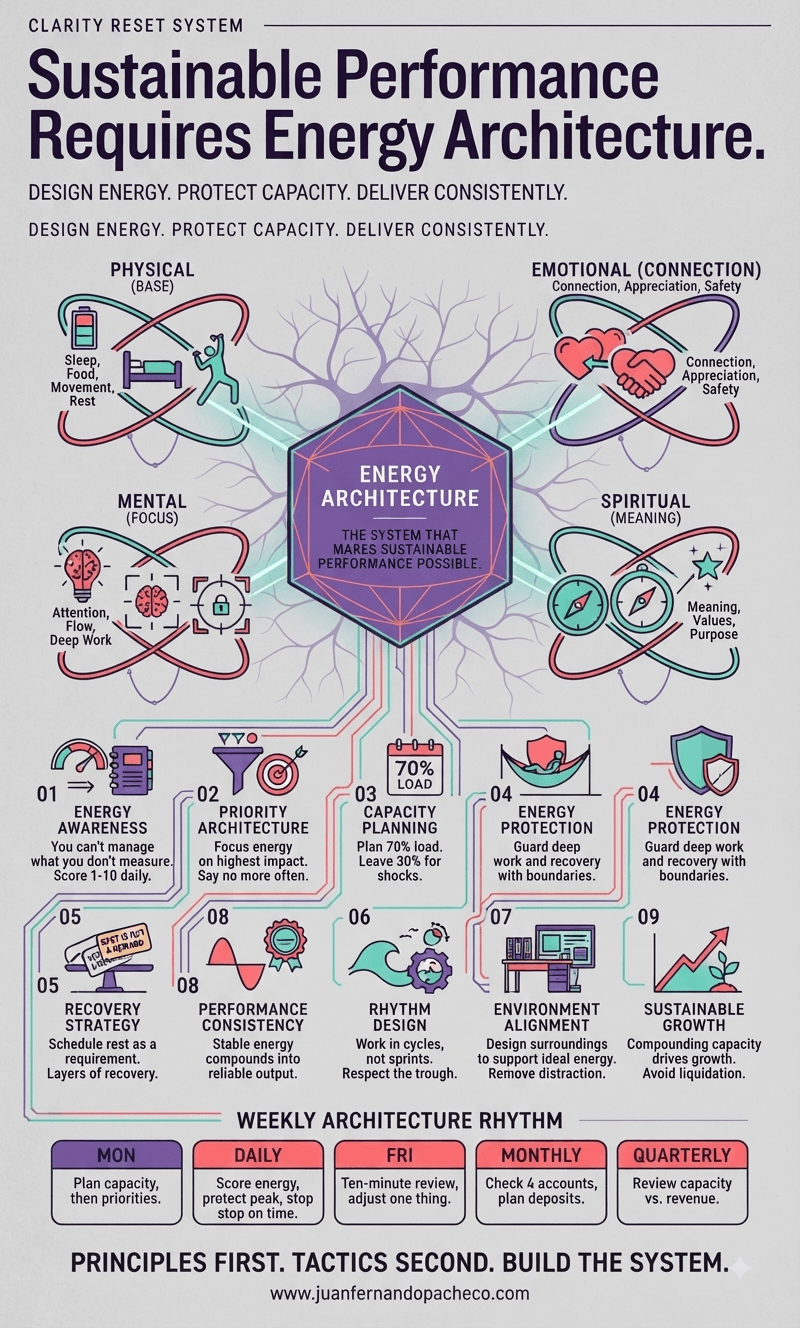
The clarity reset system frames this work through nine pillars. They move in a logical order. You first measure energy, then aim it, then protect it, and finally compound it. Each pillar is a practice, not a theory. Let me walk you through all nine.
Motivation fades by design; architecture holds when feelings leave. That is the entire point.
The four energy accounts
Energy is not one pool. I track four accounts, and each needs deposits
- Physical energy comes from sleep, food, movement, and rest. It sets the ceiling for everything else.
- Emotional energy comes from connection, appreciation, and psychological safety.
- Mental energy comes from focus, and it drains fastest of all.
- Spiritual energy comes from meaning: the reason a deal, a product, or a Monday matters.
Withdrawals happen automatically
Deposits take intention, and most burnout cases I have seen were not workload failures. They were deposit failures across three or four accounts at once. Name the account you neglect most.
Pillar 01: energy awareness
You cannot manage what you do not measure
Most people can recite their calendar yet cannot describe their energy, and they know meeting hours, not peak hours. Deadlines feel familiar, while drain points stay invisible. Awareness flips that.
For one week, keep a simple log
Three times a day, score your energy from 1 to 10 and note the activity that preceded it. You need no fancy tools, mobile apps, or any other unnecessary solutions. A notes app or just a notebook works fine; the thing is patterns show up fast:
The afternoon slump after heavy meetings, the quiet morning hour where strategy writes itself.
Awareness gives you the baseline, and every later pillar builds on it. Name your energy currency too. Some people drain in meetings, others in conflict, others in ambiguity. Knowing your personal drain list makes protection precise.
Try this:
- Score energy at breakfast, lunch, and dinner for seven days.
- Write down your two peak windows and your two drain points.
Pillar 02: priority architecture
Energy follows attention, so aim it where impact is highest
In deal work, I usually rank opportunities by strategic value and probability, not by noise; that is, a loud client rarely equals an important client. The same logic applies to your task list. A few moves create most of the value; find them and feed them first.
Say no more often
Every yes to a low-impact item is a quiet no to something that matters. Priority architecture turns that trade-off into a conscious choice instead of an accident.
In RFx work, this pillar decides profit
Every pursuit deserves an energy budget set by value and win probability. Spend like an investor, not like a fan.
Try this:
- List current commitments and mark the twenty percent that create most value.
- Cancel or delegate one low-impact item this week.
Pillar 03: capacity planning
Optimistic calendars produce broken promises
I plan my week at roughly 70% load; the empty thirty percent absorbs surprises: a client escalation, a legal review, a proposal that needs one more pass. Slack is not a waste. It is the shock absorber that keeps quality stable.
Before you accept new work, ask one question:
Which current commitment moves if this goes in?
If nothing moves, you are not planning capacity; you are borrowing from recovery. That loan always comes due.
Underloading is a risk as well
A calendar at forty percent invites other people’s priorities to colonize the void. Seventy percent keeps you hungry and honest. Clients notice broken promises long before they notice brave ones.
Try this:
- Plan next week at seventy percent load.
- Name the commitment that moves when a surprise lands.
Pillar 04: energy protection
Boundaries do the heavy lifting here
I block deep-work hours and treat them like client meetings. Notifications wait. Phones stay face down. Recovery gets the same guard
An evening stop time and a weekend that actually rests.
Protection also means managing access to you
Clear response-time expectations beat instant replies; a partner who answers everything in five minutes trains everyone to interrupt him. The one who answers well within a day teaches respect for focus. Choose which lesson you teach.
Protection includes emotional gates
I decide which conflicts deserve my fuel and which simply expire. Not every battle is a battle.
Try this:
- Block two deep-work sessions before noon this week.
- Publish your response-time expectation to your team.
Pillar 05: recovery strategy
Rest is not a reward. It is a requirement
Muscles grow between workouts, and professionals sharpen between efforts. Sleep sits at the base of everything: judgment, mood, memory, negotiation skill. Short breaks during the day reset attention. Real days off reset identity.
Schedule recovery before work, not after it
My calendar shows recovery blocks in the same ink as revenue calls. That habit alone changed my output more than any productivity app ever did.
Recovery has layers
Micro-pauses restore attention within a day, and evenings restore mood. Full days off restore perspective. Vacations restore identity. Skip a layer and the debt surfaces somewhere else.
Try this:
- Set a fixed stop time and honor it five days a week.
- Protect one full day off every single week.
Pillar 06: rhythm design
Humans run in cycles, not sprints
Focus rises and falls roughly every ninety minutes; keep that in mind, and work with that tide. I pair demanding work with peak windows and shallow work with troughs. A week also has a tide
front-load hard thinking, then back-load reviews and admin
Sprints have a place in delivery methods, not in personal operating models; remember nobody can redline a career. Gear shifts keep speed sustainable.
Respect the trough
The post-lunch dip is biology, not weakness. A walk or a light task honors it better than a fourth coffee.
Try this:
- Place hard thinking in your best two hours.
- Move admin to your trough hours.
Pillar 07: environment alignment
Your surroundings either tax you or charge you
Light, noise, temperature, and tools all count; I keep one desk for deep work and one table for calls and email. The same logic applies to digital space: fewer tabs, calmer channels, and a phone that interrupts only for real fires.
Design the room before you discipline the mind
A chair that hurts your back steals energy all day. That open seat near constant chatter steals attention you never get back. Fix the environment first; willpower is expensive.
Environment includes people; some colleagues charge you- don’t take it personally- but others drain you on contact. Schedule the chargers around hard work, and batch the drainers into narrow slots.
Try this:
- Remove one visual and one audio distraction from your desk.
- Cut phone notifications to the three apps that matter.
Pillar 08: performance consistency
Stable energy creates reliable output over the long term
Clients and colleagues trust the person who shows up well every week, not the star who flashes and fades. Consistency compounds into reputation, and reputation wins deals long before the proposal lands.
Track your variance, not just your average
If your output swings wildly, capacity is leaking somewhere. Smooth the curve, and the results take care of themselves.
Consistency also builds self-trust
When your output steadies, your nerves settle. Calm nerves make better commercial judgments. Buyers sign with people they can predict.
Try this:
- Rate your output stability each Friday from one to ten.
- Ask one colleague how steady you appear under pressure.
Pillar 09: sustainable growth
Compounding results come from compounding capacity. Growth that burns the asset is not growth; it is liquidation. I add one skill or relationship investment per quarter, never five. Small deposits, repeated for years, build an enormous reserve.
Review the system itself twice a year
Drop practices that stopped paying, and add one practice that fits your season of life. An energy architecture that evolves with you will still serve you in five years.
Growth seasonality matters too
A quarter of heavy travel calls for maintenance, not new ambitions. Match the investment to the season.
Try this:
- Choose one capacity investment for this quarter.
- Retire one practice that no longer pays.
Putting the nine pillars into a weekly rhythm
Theory matters less than routine
Here is a simple loop I still use, and remember, a system only survives when it lives in the calendar; just copy & paste the loop below into your notes and adapt the words to your reality.
- Monday: plan capacity before priorities. Mark deep-work blocks and recovery blocks first. Then place meetings into what remains.
- Daily: score energy three times, protect the peak window, and stop on time.
- Friday: review the week in ten minutes. Where did energy leak? Which pillar needed attention? Adjust one thing for next week.
- Monthly: look at the four accounts. Which account ran a deficit? Plan one deposit per account for the month ahead.
- Quarterly: run a capacity review like a business review. Revenue per energy unit is the metric. If income rises while energy falls, the model is failing.
Start small
Pick one pillar this month, master it, and add the next. Nine pillars in nine months gives you a different operating life.
Energy architecture in deal rooms and teams
Personal systems fail when team culture fights them
Leaders set the energy tone; I watch three signals in any deal team: meeting load, after-hours traffic, and recovery respect.
- Meeting load tells me whether thinking time exists
- After-hours traffic tells me whether rest is real
- Recovery respect tells me whether people return stronger or merely return.
When I run an RFx, I schedule the crunch before the crunch
We agree on redline windows, and we agree on quiet windows; the proposal improves because the team improves, and the clients feel and notice the difference too. Keep in mind a rested team negotiates better, listens better, and holds value longer.
If you lead people, remember this:
Your team will mirror your rhythm. Your calm becomes their calm. That panic becomes their overtime. Architect your energy, and you architect theirs.
Three rules keep best performance teams healthy
- Meetings default to twenty-five or fifty minutes, never longer by habit.
- Every recurring call gets a quarterly death review. No message expects a reply after hours unless a client is truly on fire.
- Energy tone travels from the leader’s calendar to everyone’s.
Why this stays true in five years
Tools will change. Channels will change. The biology will not
Human energy still runs on sleep, rhythm, meaning, and recovery long after any app dies. That is what makes energy architecture evergreen. You can swap every tactic in this post and keep every principle.
Markets in Latin America will continue to grow. Technology will keep changing shape. The operator who manages fuel will outlast the operator who manages minutes in any era.
Principles first, tactics second. Build the system, then let it compound.
Final word
Sustainable performance is not a personality trait
It is an engineered outcome. You already architect systems for clients, products, and deals. Give your own energy the same respect. Design it, protect it, and let it compound. The work will still be hard. You will finally be strong enough for it.
Five years from now, the tools around you will look different. The nine pillars will not. Read this page again, then check your accounts.
References and further reading
- Schwartz, Tony, and Catherine McCarthy. Manage your energy, not your time. Harvard Business Review. https://hbr.org/2007/10/manage-your-energy-not-your-timehbr.org
- American Psychological Association. Stress and recovery resources. https://www.apa.org/topics/stress
- Greater Good Science Center, UC Berkeley. Research on rest, meaning, and well-being. https://greatergood.berkeley.edu
- Loehr, Jim, and Tony Schwartz. The power of full engagement.
- Newport, Cal. Deep work.
- McKeown, Greg. Essentialism.
- Pang, Alex Soojung-Kim. Rest: why you get more done when you work less.
- Walker, Matthew. Why we sleep.
- Stulberg, Brad, and Steve Magness. Peak performance
- Clear, James. Atomic habits.