Why the best deal makers stop chasing yes
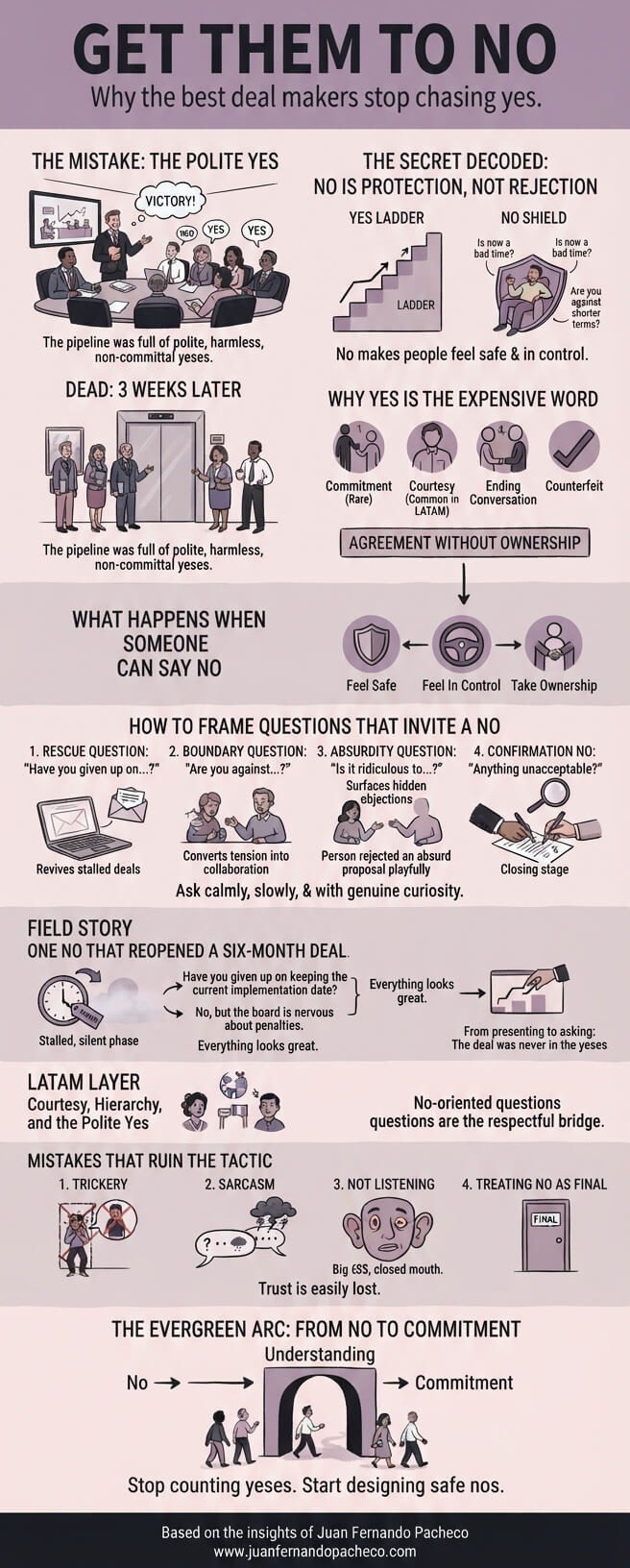
A few years ago I walked out of a meeting room on the top floor of a bank and made a mistake that felt like a victory. The committee had said yes to everything that afternoon. Yes to the vision, yes to the roadmap, yes in principle to the commercial frame. My colleagues were celebrating in the elevator. Three weeks later the deal was dead, and nobody would tell us why.
I have spent more than twenty years in product, design, and business development across Latin America, and I can tell you that this story repeats in almost every stalled deal I have audited since. The pipeline was not full of opportunities; it was full of polite, harmless, non-committal yeses.
The turning point in how I run negotiations came when I learned to do the opposite of what classic sales training teaches: instead of chasing yes, I started designing questions that get the other side to say no.
That is one of the principles in the series of negotiation secrets I have been studying, “get them to no”, and it is the one that most contradicts conventional commercial wisdom. The card that summarizes it says this:
Ask questions designed to get a “no” answer first, because “no” makes people feel safe and in control, and starting with “no” actually opens up the real negotiation and honest dialogue.
The tip is to frame questions that trigger protective “no” responses, and the example it gives is brutal in its elegance:
“Have you given up on making this partnership work this quarter?”
In this post, I want to unpack that idea the way I unpack it with my deal teams: why it works, how to apply it across the lifecycle of a complex enterprise deal, the mistakes that ruin it, and why it will work just as well in five years as it does today.
Technology changes, markets change, procurement tools change. Human nature does not.
The secret, decoded
What the principle says and what it does not say
It does not say be contrary, provocative, or negative. It does not say push people into rejection. It says design questions whose natural answer is no, because no is the answer that makes your counterpart feel protected.
Think about the last time someone tried to walk you up a yes ladder, that old sequence of small yeses engineered to make the final yes feel inevitable.
You felt it, right?
The pressure, the manipulation, the guard going up. Every yes after that one became more expensive to give. Now think about the last time you were free to say no.
- “Is now a bad time to talk?”
- “Are you against exploring a shorter contract term?”
The no costs nothing. The no feels like a shield. And once the shield is up, people relax and start talking honestly.
“No” is not rejection. “No” is protection. That single reframe is the entire secret.
Why yes is the most expensive word in your pipeline
In classic sales training, yes is treated as progress
Every yes is counted as a step toward the signature. In complex enterprise deals, especially in banking and regulated industries where I have spent most of my career, that accounting is fiction.
A yes can mean four very different things.
- It can be a commitment, which is rare.
- It can be a courtesy, which is extremely common in our cultures.
- It can be a way to end the conversation, the “yes, send me the information” that really means please leave. Or it can be a counterfeit,
- A yes given because the other side wants to keep options open without confronting you.
Only the first type moves the deal. The other three fill your forecast with mirages.
The deeper problem with yes is that it commits to nothing.
A yes is often agreement without ownership. No, on the other hand, is a position. When a procurement lead tells you “no, we cannot accept that liability clause”, you finally have something real: a concern, a constraint, a boundary you can work with. No reveals information. No defines the edges of the map, and once you know the edges, you can negotiate the territory.
There is also a cost nobody measures
The cost of the yes that becomes a silent no later. The deal that dies without an email. The RFP where your proposal was “excellent” but never shortlisted. Every deal leader eventually learns that a clear no early in the cycle is worth more than a chain of yeses that evaporate in committee, because a no lets you fix the deal or fix your forecast. Both are progress.
What happens when someone can say no
The reason this works is not a trick; it is human nature, and that is exactly why it is evergreen. People need to feel in control of their decisions. Decades of research on motivation and on psychological reactance point to the same conclusion: the moment people feel pushed, they resist, even if they were originally inclined to agree. Push for yes, and you trigger that resistance. Offer an exit, and you deactivate it.
When your counterpart can say no, three things happen
- First, they feel safe, because no is the word that protects them from risk, from pressure, from looking weak in front of their own organization.
- Second, they feel in control, and a counterpart who feels in control lowers their voice, shares more, and listens better.
- Third, they take ownership of the conversation, because they chose to continue; nobody forced them.
That is why the example on the card is so powerful:
“Have you given up on making this partnership work this quarter?”
It does not ask for a favor. It does not complain. It offers the other side a chance to defend their own territory. And most executives, when offered the chance to say “no, we have not given up”, will correct you, and in correcting you they recommit to the relationship.
The no reopens the door that the polite yes had closed.
How to frame questions that invite a no
Let me get practical. In a complex deal, there are recognizable families of no-oriented questions, and once you learn the pattern you can build your own in any language and for any channel.
The first family is the rescue question, for stalled deals and silent counterparts
“Have you given up on…?” It is the best email I know to revive a dead opportunity.
- “Have you given up on signing the outsourcing contract this year?”
- “Have you given up on the channel modernization project?”
The answer “no, we have not given up, what happens is that…” hands you the real reason for the stall on a silver platter.
The second family is the boundary question, for moments of tension:
“Are you against…?”
- “Are you against a clause that caps penalties at a reasonable percentage?”
- “Are you against reviewing the SLA table together, line by line?”
It is very hard to answer “yes, I am against reviewing it”, and the no converts hostility into collaboration.
The third family is the absurdity question, useful to surface hidden objections:
- “Is it a ridiculous idea to…?
- “Would it be a mistake to…?
- “Is it completely out of the question that…?”
These formulations give the other side the pleasure of rejecting the framing while accepting the substance, and when they genuinely think it is ridiculous, they tell you why, which again is the information you needed.
The fourth family is the confirmation no, for closing stages.
Instead of “do you agree with the proposal?” ask “is there anything in this contract that still feels unacceptable to you?” The no, “nothing unacceptable”, is a far more honest signal than a premature yes, and if there is something, it finally surfaces while there is still time to fix it.
One note on tone
These questions only work when they are asked calmly, slowly, and with genuine curiosity. The moment they sound like a trap, they become one. The goal is not to steal a no; the goal is to give your counterpart a safe place to stand while they tell you the truth.
A field story: one no that reopened a six-month deal
Let me share one example from my own notebook, compressed for brevity
We were in a regional RFP for a financial client, a multi-year contract with heavy regulatory constraints: data sovereignty, local support policies, and penalty clauses our legal team could not swallow as written. For weeks, every interaction was smooth and empty. “Everything looks great”, they said. “We are in final internal review.”
I finally wrote to the executive sponsor a single line:
“Have you given up on keeping the current implementation date for this project?”
He replied in less than an hour:
“No, but the board is nervous about the penalty regime and the data residency clause.”
There it was. The real deal, hidden for two months behind excellent manners.
From that moment, every conversation changed
I stopped presenting and started asking.
- “Are you against structuring penalties around uptime credits instead of cash penalties?” No.
- “Is it out of the question to host sensitive data in-country while keeping regional management layers?” No.
Each no shrank the fog. Each no converted an invisible objection into a workstream with legal, engineering, and operations. We rebuilt the proposal around those nos, and we signed.
The lesson I write on the board for every new joiner in my teams: the deal was never in the yeses. The deal was in the nos we finally managed to surface.
The LATAM layer: courtesy, hierarchy and the polite yes
If you negotiate in Mexico, Colombia, Peru, Chile, Argentina, Brazil, or Ecuador, as I have for most of my career, this principle is even more valuable; I would say almost mandatory. Our business cultures are high-context and relationship-driven. We avoid open confrontation, we protect harmony, and we rarely say a raw no to someone’s face, especially when they outrank us or when we expect to see them again at the next industry event.
That is a beautiful cultural trait, and it is also a forecast killer
The Latin American no arrives dressed as something else: “let me review it internally”, “we will circle back after the committee”, “it is complicated”. If you wait for an explicit rejection, you will wait forever, and your pipeline will rot in silence.
No-oriented questions are the respectful bridge across that gap
They let your counterpart protect the relationship and tell you the truth at the same time. You are not forcing confrontation; you are offering a socially safe format for disagreement. In hierarchical organizations, where a mid-level manager will never contradict the sponsor in front of a vendor, a written no-oriented question is sometimes the only channel through which the truth can travel.
Mistakes that ruin the tactic
Because the tactic is powerful, it is also easy to ruin, and it fails in predictable ways
- The first mistake is using it as a trick to corner people into a double negative that means yes. People notice, and trust, once lost, does not come back.
- The second is tone: a no-oriented question delivered with sarcasm or desperation sounds like a complaint, and “have you given up on making this partnership work?” becomes poison if it reads as passive aggression.
- The third mistake is asking and then not listening. The value of the no is in the explanation that follows, in the “no, because…” that contains your next workstream.
- The fourth is treating every no as final. Some nos are protective, not definitive; they mean not like this, not now, not with this risk attached.
Your job after a no is to ask what would have to change for the no to become workable. And the fifth mistake is abandoning the arc: no is the opening of honest dialogue, not the close of the negotiation.
From no to commitment: the evergreen arc
The mature way to use this principle is as a sequence
No first, for safety and truth. Then understanding, summarized so well that your counterpart says “that’s right” instead of “yes, exactly”, because “that’s right” means they feel understood, while “yes, exactly” is often just another polite reflex. And only then, commitment: calibrated questions about how the agreement will be executed, who signs, and what happens next week.
Notice that nothing in this sequence depends on a specific technology, industry, or channel. It worked in face-to-face meetings twenty years ago; it works in video calls today, and it will work in whatever medium replaces them, because the material it works on is not the medium.
It is the human need for safety, control, and respect. That is the test I apply to any commercial technique before adopting it: will this still be true in five years? For get them to no, the answer is clear, and I say that with some irony, because I earned it by learning to ask better questions.
Closing thoughts
Stop counting yeses as progress. Start designing safe nos.
The next time a deal goes quiet, resist the urge to send another deck, another discount, another “just following up”. Send a question that gives them the dignity of a no: “Have you given up on…?” You will be surprised how often the answer reopens the deal, and how much faster the truth travels once people feel safe enough to protect themselves from you.
In the end, that is the whole job of a deal leader: not to win arguments, but to make it easy for the other side to tell you the truth, and then to build, on top of that truth, an agreement that survives contact with reality.
References and further reading
Books:
- Never split the difference: negotiating as if your life depended on it, by Chris Voss and Tahl Raz. The foundational modern text on no-oriented questions, protective nos and why “no” starts the real negotiation.
- Start with no, by Jim Camp. The earlier classic on decision-based negotiation and on treating “no” as a starting point rather than a defeat.
- Getting to yes: negotiating agreement without giving in, by Roger Fisher and William Ury. The complementary classic on principled, interest-based negotiation; read together, these three books form a complete system.
Web references:
- The Black Swan Group, Chris Voss’s negotiation training firm, with articles and study guides on no-oriented questioning
- The Program on Negotiation at Harvard Law School, a university consortium dedicated to the theory and practice of negotiation, with free daily articles on negotiation strategy
- Harvard PON’s practical guidelines connected to the Getting to yes method, useful as the interest-based counterpart to today’s tactic
Read them in this order
Voss for the psychology of “no”, Camp for the discipline of decision-based negotiation, and Fisher and Ury for the framework that turns the truth you uncover into durable agreements. The tactics will differ; the human being on the other side of the table will not.