Clear thinking: the foundation skill behind every good strategy
Every few years I come across a simple idea that puts a name on something I have felt for a long time. Clear thinking is one of those ideas. In one sentence.
Clear thinking is about bringing structure to your thoughts and guiding them toward a big goal, and it is a foundation skill for a strategist.
Going further
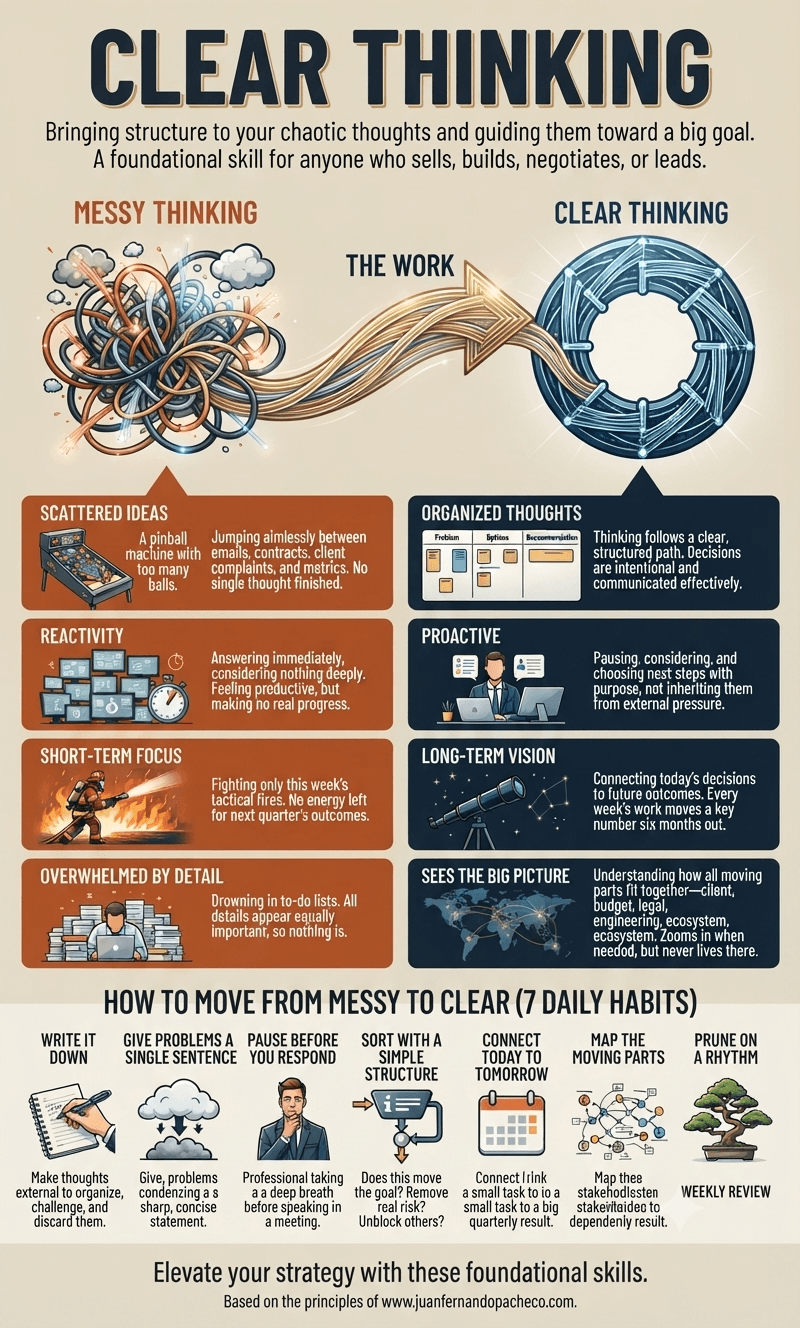
It is a foundation skill for anyone who sells, builds, negotiates, or leads, because almost every professional activity is really a thinking activity wearing a different costume. The image that inspired this post shows it perfectly: a tangle of lines on one side, a clean circle on the other, and a simple arrow between them. That arrow is the work.
I have spent more than twenty years in technology, starting as a web designer, moving through UX and product roles, then into solutions architecture and business development across Latin America.
I have sat on both sides of the table
designing banking products used by millions of people, and leading end-to-end RFI, RFQ, and RFP processes for multi-million-dollar contracts.
The pattern I keep seeing is that deals, products, and careers rarely fail from a lack of effort. They fail from a lack of structure in the thinking behind them. Teams do not lose because they work too little. They lose because their thoughts are scattered, their reactions are fast but aimless, and their attention is trapped in detail while the big picture moves on without them.
That is the distance between messy thinking and clear thinking, and it is a distance any professional can close. Let me walk through what each side looks like in real work, and how to make the shift in a way that stays useful no matter your role, your industry, or the year on the calendar.
The messy thinking trap
Messy thinking creeps in when we try to juggle too many thoughts at once. It does not announce itself. It accumulates. And it usually shows up in four habits.
Scattered ideas.
Your mind jumps from one thing to another: an email, a clause in a contract, a complaint from a client, a metric in a dashboard, without ever finishing a single line of thought. Meetings end with ten new topics and zero decisions.
Reactivity.
You answer everything immediately and consider nothing deeply. Reactivity keeps you in a cycle of busyness without real progress, and it feels like productivity because the calendar is full. I have watched entire deal teams live like this during a tender: every clarification question from the client triggers a panic rewrite, every competitor rumor triggers a price debate, and nobody ever sits down to ask what actually wins this deal.
Short-term focus.
The work becomes mostly tactical, a permanent fire-fighting exercise. This week’s problem gets all the energy, and next quarter’s outcome gets none.
Being overwhelmed by detail.
You drown in to-do lists and small tasks, and because everything looks equally important, nothing is. In complex procurement processes, this is lethal. A single RFP can carry hundreds of functional requirements, legal clauses, security questionnaires and SLA penalties.
If you approach it as a pile of details, you will produce a proposal that reads like an inventory of features, and a team that is exhausted by submission day.
Notice what messy thinking really is
It is not stupidity, and it is not laziness. It is cognitive overload without structure. Smart, committed people fall into it, especially in high-pressure environments. That is exactly why the opposite of messy thinking is not calmness. It is structure.
What clear thinking looks like
Clear thinking is different. Your ideas are structured, and your decisions are intentional, and you can recognize it by four marks that mirror the messy habits.
Organized thoughts
Your thinking follows a clear structure. You can state the problem in one sentence, the options in three, and the recommendation in one more. People leave your meetings knowing what was decided and why.
Proactive
You pause, consider, and choose your next step instead of inheriting it from the loudest event of the day. Proactivity is not about doing more things first. It is about choosing on purpose.
Long-term vision
The decisions you make today are connected to the outcomes you want tomorrow. You can explain how this week’s work moves a number that matters in six months.
Sees the big picture
You know how the moving parts fit together. The client, the budget, the legal constraints, the engineering capacity, the partner ecosystem. You can zoom into a detail when needed, but you never live there.
- In commercial language, clear thinking is what separates a proposal that lists capabilities from a proposal that tells a winning story.
- In product language, it separates a roadmap that is a wish list from a roadmap that is a strategy. And\
- In personal language, it separates a career that happens to you from a career you design.
How to move from messy to clear
The good news is that clear thinking is a practice, not a personality trait. These are the habits that have worked for the teams I have led, and they are deliberately boring, because evergreen skills are usually built on boring, repeatable fundamentals.
1. Write things down.
A thought you hold only in your head competes with every other thought for the same limited space. Writing externalizes it, and once it is on paper, you can organize it, challenge it, and discard it. Before any important negotiation or proposal kickoff, I write three things on a page: what the client is really trying to achieve, what we are really trying to achieve, and what would make both sides feel the deal was a success. Almost every messy situation I have inherited became workable once somebody wrote those three sentences down.
2. Give every problem a single sentence.
If you cannot state the problem in one sentence, you do not have a problem yet, you have a cloud of anxieties. “Our proposal is weak” is a cloud. “The client cares about data sovereignty, and our answer spends four pages on user interface” is a problem. Structure begins when the problem has edges.
3. Pause before you respond.
This is the proactive muscle. An email does not need an answer in four minutes. A client question during a tender deserves a considered position, not a reflex. The pause is not slowness. It is the space where judgment lives. In SLA negotiations, for example, the first number on the table is rarely the right one, and the team that pauses to model uptime, response times, and penalties against real operations wins against the team that reacts.
4. Sort with a simple structure.
Not everything matters equally, and clear thinkers use a small number of honest filters: does this move the goal, does it remove a real risk, does it unblock someone else? If a task passes none of the three, it goes to the bottom of the list or out of the list. Backlog prioritization in product teams works on the same logic, and it is why disciplined teams ship MVPs that learn, while scattered teams ship everything except what matters.
5. Connect today to tomorrow.
Once a week, ask of your main activities: which outcome does this serve? If you cannot name the outcome, you are renting busyness, not building anything. Long-term vision is not a grand annual plan. It is the weekly habit of linking present effort to future result.
6. Map the moving parts.
Big-picture seeing is a concrete activity: list the stakeholders, the constraints, the dependencies, and the incentives, and draw how they touch each other. In a regional deal, that means the client’s business owner, the legal team, the regulators, the partners, and the delivery teams across countries. When you see the map, you stop negotiating clauses in isolation and start trading what is cheap for you against what is valuable for them.
7. Prune on a rhythm.
Clear thinking decays if you do not maintain it. A short weekly review (what did we decide, what changed, what do we stop) keeps the structure alive. Messiness always returns, like dust. You do not defeat it once; you clean on a schedule.
Clear thinking in deals, products, and teams
Let me ground this in the work I know best.
In high-stakes RFx execution, the messy team treats the request for proposal as a questionnaire and answers all two hundred questions with equal energy. The clear team reads the document twice: once to understand the requirements, and once to understand the person who wrote them.
- What keeps the client awake?
- A regulatory mandate?
- A past outage?
- A penalty they suffered with a previous vendor?
Then they build the response around a few winning themes (compliance, risk mitigation, speed to value) and let every detail serve those themes. That is organized thought applied to a commercial artifact, and it is a large part of how multi-year contracts are won.
In product work, the same discipline shows up in the roadmap.
I have translated client objectives into agile roadmaps that cut time-to-market and lifted adoption, and the mechanism was never a clever tool. It was the refusal to let the roadmap become a parking lot for every request. Clear thinking asked: which user need, connected to which business goal, produces which outcome this quarter? Everything else waited.
In leadership, clear thinking is what lets a cross-functional team of product, sales, legal, engineering, and operations people across ten or more countries move as one.
Alignment is not a meeting. Alignment is shared structure: the same problem sentence, the same filters, the same map. When the thinking is clear, the coordination cost drops, and that is how teams exceed KPIs without burning out.
Why this stays useful for years
Tools change, platforms change, even job titles change.
I started as a web designer when most of the web was static pages, and today I discuss data sovereignty and cloud strategy with senior executives and board members. What never changed is that the professional who can take a messy situation, structure it, choose intentionally, and connect it to a long-term goal becomes more valuable every year.
Clear thinking compounds.
Every structured decision makes the next one easier, and every reactive month makes the next reaction more likely. That is why this is not a technique for one season of your career. It is the foundation you lay everything else on.
A simple place to start
If you want one exercise to begin with, take this:
At the end of each working day, write the single most important thought you had, in one sentence, and the next step it implies.
One sentence, one step. In a month you will have thirty structured thoughts instead of three hundred scattered ones, and you will feel the difference in meetings, in proposals, in negotiations, and in the quiet confidence of knowing how the moving parts fit together.
Messy thinking is a tangle. Clear thinking is a circle drawn on purpose. The distance between them is not talent. It is practice.