How to manage stakeholder alignment in multinational RFx
Large enterprise technology deals dictate market leadership
Securing these contracts demands absolute precision. Procurement processes evaluate more than just technical capabilities. They test organizational cohesion. Multinational bids introduce immense friction. Diverse time zones create communication silos. Cultural nuances complicate negotiations. Regulatory environments shift across borders. True stakeholder alignment separates market leaders from struggling vendors.
I spent over two decades navigating these high-stakes environments. My journey spans UX design and strategic business development. Countless proposals fail due to internal fragmentation. A brilliant technical solution loses to a cohesive competitor. Buyers spot internal misalignment immediately. Disjointed answers reveal severe operational risks. Today, I lead complex deal executions across Latin America. We secure multi-million-dollar contracts in banking and finance. Our teams achieve this by forging unbreakable internal alliances.
This post details my exact framework for unifying global teams. You will learn to transform regional complexities into scalable revenue. We will explore practical strategies for your next procurement cycle. These principles remain relevant regardless of shifting technology trends. Human collaboration ultimately dictates commercial success. Enterprise procurement cycles test organizational endurance. Vendors must sustain intense focus for months. Fatigue causes critical errors. Discipline prevents these costly mistakes. We will build your endurance today.
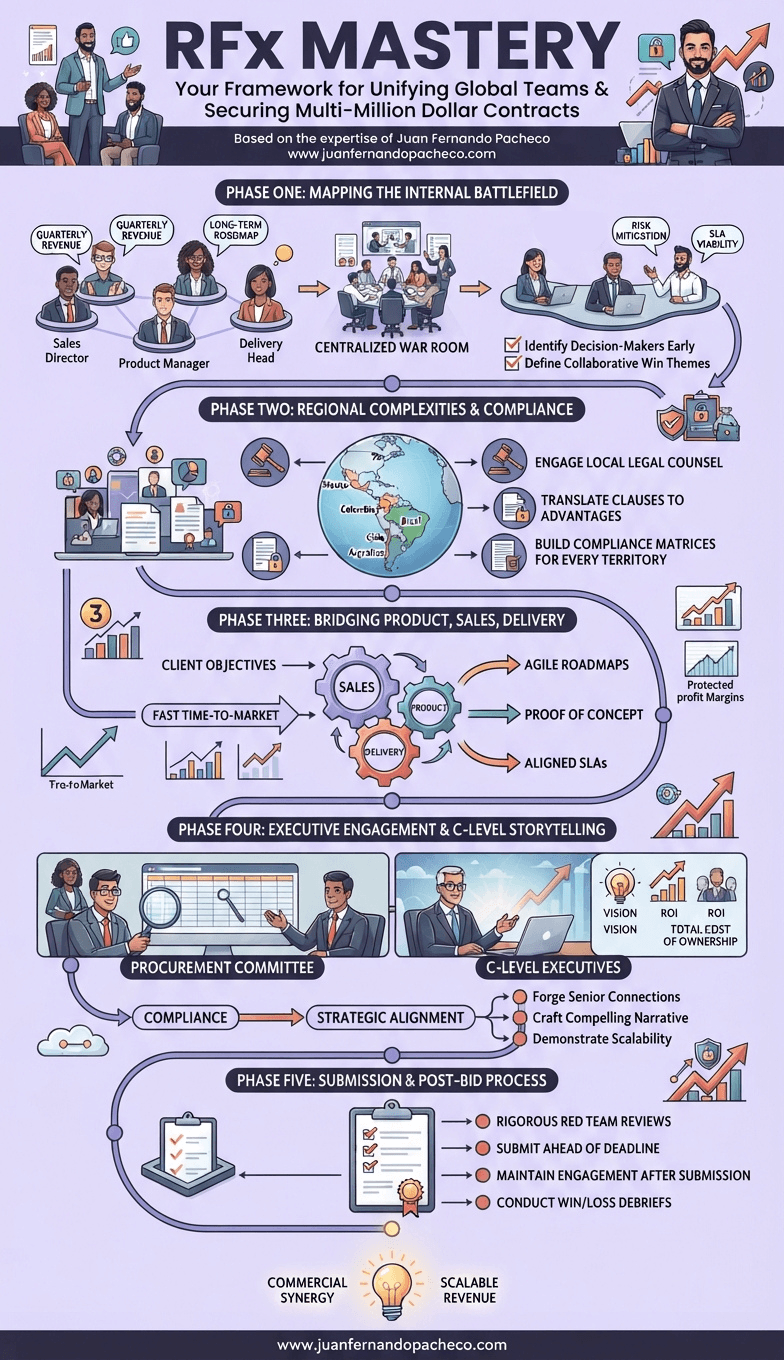
Phase one: mapping the internal battlefield
Global organizations naturally operate in isolated silos
Sales teams aggressively chase quarterly quotas. Product managers strictly prioritize long-term roadmaps. Legal departments obsessively mitigate corporate risk. These distinct goals often clash during intense bidding cycles. You must map every internal stakeholder before reading requirements.
Identify your core decision-makers very early
A typical enterprise bid involves regional sales directors. It also pulls in global delivery heads. Local subject matter experts join the fray. Map their individual motivations carefully. The regional director wants immediate revenue recognition. Delivery leaders fear unrealistic service level agreements. Acknowledge these conflicting priorities openly.
Establish a centralized war room immediately
Physical or virtual spaces work equally well. Dedicate this environment solely to the active bid. Invite representatives from engineering, marketing, and operations. Assign clear roles to every single participant. One person must own the commercial narrative. Another must govern strict technical compliance.
Define your win themes collaboratively
Brainstorming sessions generate the best value propositions. Ask your team why the client should choose us. Distill the answers into three core pillars. Ensure every department agrees on these pillars. This consensus prevents contradictory statements later.
Phase two: navigating regional complexities and compliance
- Multinational bids introduce severe regulatory hurdles
- Governments demand strict data sovereignty
- Local policies dictate specific hosting environments
Ignorance of these mandates guarantees immediate disqualification.
Engage local legal counsel immediately
Global templates rarely satisfy regional authorities. Latin American markets present unique challenges. Countries enforce distinct privacy laws. Your proposal must reflect deep local knowledge.
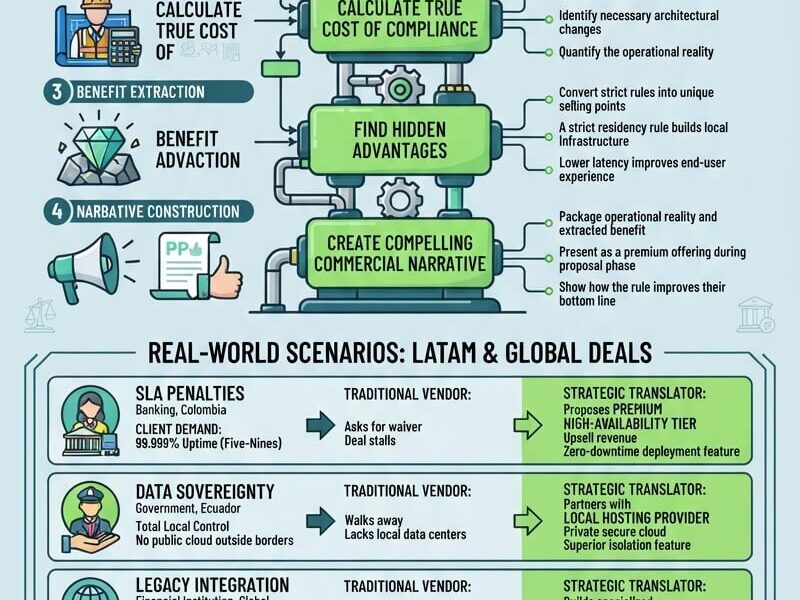
Translate complex legal clauses into commercial advantages
Clients worry about operational continuity. Show them how local infrastructure guarantees uptime. Detail your disaster recovery protocols explicitly. Address stringent penalties for service interruptions.
Build compliance matrices for every territory
Track each regulatory requirement systematically. Assign an owner to every single line item. Review these matrices daily. Rigorous tracking prevents costly oversights.
Phase three: bridging product, sales, and delivery
Commercial success requires total synergy
- Sales professionals often promise the moon
- Product teams build realistic minimum viable products
- Delivery squads execute the final implementation
Misalignment here destroys profit margins.
Translate client objectives into agile product roadmaps
Buyers want remarkably fast time-to-market. Show them an iterative delivery schedule. Break the massive project into manageable sprints. Highlight early wins to build momentum.
Streamline proof of concept development
Clients evaluate tangible results. Reduce customer request resolution times drastically. Build high-performing teams focused on user story mapping. Efficiency in the POC phase predicts overall success.
Align service level agreements with actual capabilities
Sales teams often overpromise to win deals. Delivery teams must push back firmly. Negotiate realistic response times. Define clear escalation paths. Protect your operational margins fiercely.
Phase four: executive engagement and C-level storytelling
Procurement committees evaluate spreadsheets
C-level executives evaluate vision. You must win both audiences simultaneously. Technical compliance gets you in the door. Strategic alignment wins the contract.
Forge strong connections with senior management
Facilitate face-to-face meetings whenever possible. Digital communication lacks emotional resonance. Board members buy from people they trust. Build robust relationships across the entire region.
Craft a compelling commercial narrative
Highlight your key differentiators prominently. Explain how your solution solves specific business problems. Connect technical features directly to revenue goals. Use their industry terminology fluently.
Anticipate rigorous executive scrutiny
Prepare detailed answers for tough financial questions. Demonstrate clear return on investment. Show total cost of ownership models. Prove long-term scalability.
Phase five: mastering the submission and post-bid process
The final submission requires absolute perfection
Formatting errors suggest careless execution. Missing documents imply organizational chaos. Treat the final compilation as a critical milestone.
Conduct rigorous red team reviews
Invite senior leaders outside the bid team. Ask them to tear the proposal apart. Fix every identified weakness immediately. Polish the final document relentlessly.
Submit your proposal ahead of the deadline
Technical glitches happen frequently. Early submission eliminates unnecessary stress. Confirm receipt with the procurement office.
Maintain engagement after submission. Buyers often request clarifications. Respond to these queries rapidly. Use this phase to reinforce your win themes. Keep your core team engaged until the final decision.
Conduct thorough win or loss debriefs
Capture valuable lessons learned. Update your internal knowledge base. Refine your backlog prioritization strategies. Continuous improvement guarantees future dominance.
Deep dive into LATAM market leadership
Latin America offers tremendous growth opportunities
Diverse cultures enrich the business landscape. Regional complexities demand specialized strategies. Scaling revenue across ten countries requires intense focus.
- Mexico presents massive manufacturing opportunities.
- Colombia boasts a rapidly evolving financial sector.
- Brazil demands immense scale and robust infrastructure.
- Ecuador serves as a strategic regional hub.
- Argentina offers highly skilled technical talent.
- Chile leads the region in digital transformation.
You must adapt your approach for each nation
Standardized global pitches fail miserably here. Local stakeholders expect deep cultural resonance. Learn the specific business etiquette of each country. Respect local holidays and working hours.
Build regional partnerships to accelerate market penetration. Partner ties provide crucial local intelligence. They help navigate obscure bureaucratic processes. Leverage these connections during complex negotiations.
Cross-functional teams must understand these regional nuances. Educate your global engineers on local realities. Ensure your product managers respect cultural differences. This empathy builds immense trust with buyers. Trust translates directly into signed contracts.
I drove cross-functional teams across this vast region
We exceeded KPIs through deliberate stakeholder alignment. Backlog prioritization reflected local market demands. Revenue scaled consistently over six years. Such results require unwavering discipline.
Risk mitigation and operational excellence
High-stakes IT procurement involves massive risks. A single mistake can derail the entire deal. Operational excellence minimizes these vulnerabilities.
Mitigate legal risks through proactive documentation:
- Record every assumption clearly
- Define out-of-scope items explicitly.
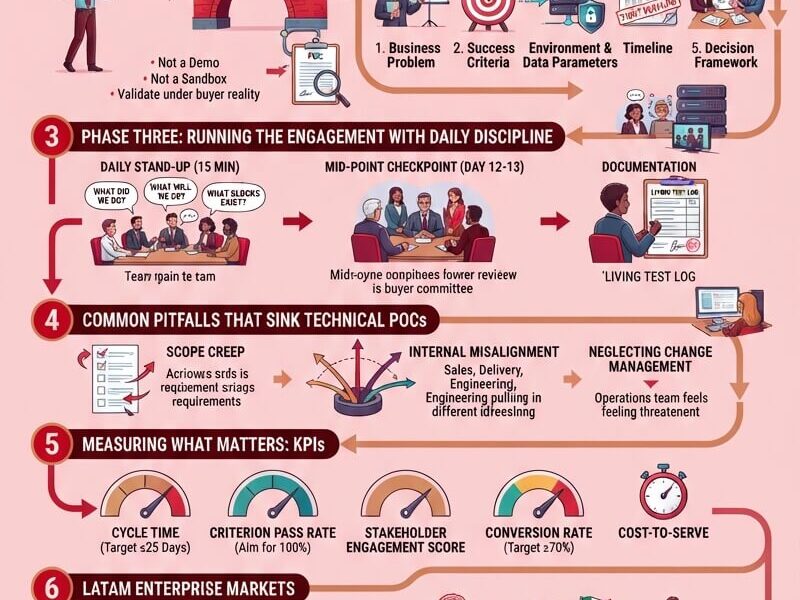
Ambiguity breeds costly disputes later. Protect your delivery teams from scope creep. Establish strict change management protocols.
Financial risks require equal attention
Currency fluctuations impact multi-year contracts heavily. Hedge against volatile exchange rates. Build financial buffers into your pricing models. Inflation affects long-term service delivery costs. Index your pricing to local economic indicators.
Delivery risks threaten your corporate reputation
Guarantee one hundred percent on-time delivery. Allocate sufficient resources for rigorous testing. Implement automated quality assurance pipelines. Monitor project health through daily stand-ups. Address blockers before they escalate.
Security risks dominate modern technology bids
Enterprise buyers demand ironclad cybersecurity measures. Detail your encryption standards thoroughly. Explain your vulnerability management processes. Provide recent third-party audit reports. Prove your adherence to global security frameworks.
Such transparency accelerates the procurement cycle. Buyers trust vendors who prioritize security. Your proposal must scream operational maturity. Maturity wins highly regulated financial deals.
The role of the strategic deal leader
Someone must orchestrate this massive symphony. The strategic deal leader owns the outcome. This role requires diverse skills. You need deep commercial acumen. Technical fluency remains essential. Emotional intelligence drives team cohesion.
I evolved from a senior UX designer
Designing user experiences taught me empathy. Empathy helps understand client pain points. Product ownership taught me agile execution. Business development honed my negotiation skills. This unique blend creates formidable deal leaders.
You must synthesize information rapidly
Digest complex legal documents quickly. Understand intricate technical architectures deeply. Translate these details into compelling business value.
Lead face-to-face meetings with absolute confidence
Command the room during tense negotiations. Defend your pricing models logically. Concede minor points to win major battles.
Keep your internal teams motivated
Bidding cycles cause immense fatigue. Celebrate small victories along the way. Order dinner for the war room team. Recognize outstanding individual contributions publicly.
A motivated team produces superior proposals. Superior proposals secure multi-million-dollar contracts. Leadership makes the difference. Embrace this responsibility fully.
Future-proofing your RFx strategy
Technology evolves at a blistering pace. Artificial intelligence transforms procurement processes. Automated tools evaluate initial compliance. Human judgment still decides final winners.
Your core strategy must remain adaptable. Focus on fundamental business principles. Value creation never goes out of style. Risk mitigation remains perpetually relevant. Stakeholder alignment dictates success everywhere.
Invest heavily in your personal brand. Build a reputation for integrity. Deliver on every single promise. Clients remember reliable partners fondly. They award subsequent contracts to trusted vendors.
Cultivate a vast professional network. Attend major industry conferences regularly. Share your expertise through published articles. Mentor junior business development professionals. Teaching others solidifies your own knowledge.
Stay curious about emerging market trends. Read financial reports from target industries. Understand the macroeconomic forces at play. Position your solutions against these forces. Anticipate client needs before they articulate them.
Proactive vendors dominate reactive competitors. Master the art of strategic storytelling. Data informs decisions. Stories compel action. Blend hard metrics with compelling narratives.
Paint a vivid picture of future success. Make the client the hero of the story. Position your company as the trusted guide. This framework guarantees long-term relevance.
Integrating UX and agile methodologies into commercial bids
User experience directly impacts commercial success. My background in UX design shapes my approach. Beautiful interfaces mean nothing without solid architecture. Robust architecture fails without intuitive user journeys.
Blend these disciplines seamlessly in your proposals. Show clients how you map user stories. Explain your rigorous usability testing protocols. Demonstrate deep empathy for their end customers.
Banking users demand frictionless digital experiences. Retail shoppers expect lightning-fast checkout processes. Telecommunications subscribers crave simple account management. Address these specific segment needs explicitly.
Agile methodologies accelerate time-to-market significantly. Buyers fear massive multi-year waterfall projects. Such projects often fail spectacularly. Propose iterative delivery models instead.
Promise functional minimum viable products quickly. Gather user feedback continuously. Adapt the product roadmap dynamically. This flexibility reduces client anxiety. It also protects your development teams.
Scope changes become manageable adjustments. They no longer trigger massive contract disputes. Highlight your scrum certifications prominently. Prove your team understands modern delivery.
Commercial synergy emerges from technical excellence. Translate these agile benefits into financial terms. Show how faster releases generate earlier revenue. Connect user adoption directly to ROI. This holistic approach wins complex enterprise deals.
Final thoughts on commercial synergy
Mastering complex deal execution takes time. Patience and persistence yield incredible results. Treat every lost bid as a learning opportunity. Celebrate every hard-fought victory humbly.
Refine your processes continuously. Empower your cross-functional teams daily. Align your internal stakeholders relentlessly. Navigate regional complexities with confidence. Deliver exceptional value to your clients.
Scale your revenue across diverse markets. The journey requires immense dedication. The rewards justify the effort completely. Go win your next major contract.
Your strategic vision awaits execution. The market rewards bold leadership. Remember your core purpose. You solve complex business problems. Technology merely enables the solution. Keep the human element central. Your success will follow naturally.