LATAM and the Monolith Illusion
Technology executives frequently treat LATAM as a single market
This assumption creates immediate friction during enterprise negotiations. The region actually comprises diverse economies with unique legal systems; i.e Mexico operates under different commercial codes than Colombia or Ecuador, and a standardized global pricing model ignores these fundamental realities.
Local customers quickly reject proposals that misunderstand their local operational constraints, and as a result, sales teams face stalled pipelines and frustrated regional partners.
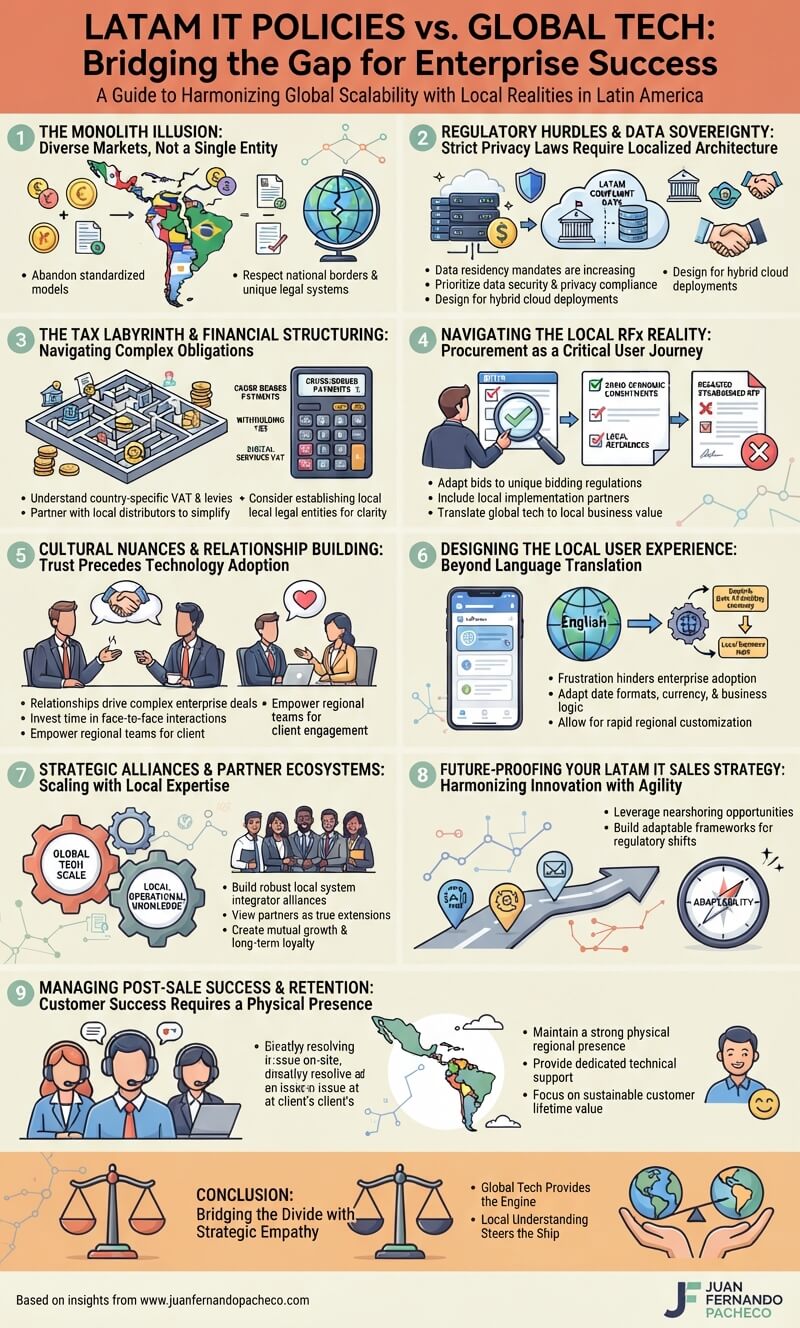
Scaling revenue requires abandoning the monolith illusion entirely; you must tailor your commercial strategy to respect national borders.
- Global tech offers incredible scalability.
- Local policies dictate the actual rules of engagement.
Successful leaders harmonize these two opposing forces, and they build flexible frameworks that accommodate local complexity without sacrificing global margins. This balance separates market leaders from perpetual strugglers.
Regulatory hurdles and data sovereignty
Data protection laws define modern digital commerce
Latin American governments recently enacted strict privacy frameworks; i.e., Brazil leads the charge with comprehensive data protection legislation, while Mexico and Colombia enforce similar digital privacy mandates.
Global cloud providers often rely on centralized data centers located in North America, and local regulators increasingly demand data residency within national borders.
Financial institutions and healthcare providers face extreme scrutiny regarding information storage; that’s why a global tech vendor must address these sovereignty concerns immediately. Ignoring local data mandates guarantees immediate disqualification from major enterprise deals.
Procurement committees evaluate data architecture before reviewing software features, and your sales engineers must understand regional compliance requirements intimately. Product teams should design modular infrastructure that supports local deployment options, and hybrid cloud models often satisfy both global scalability needs and local regulatory demands.
Offering flexible hosting environments demonstrates respect for national security priorities, and commercial leaders must factor compliance costs into their regional pricing strategies; legal reviews also consume significant time during complex RFP cycles.
Anticipating these hurdles accelerates the final contract signature. You protect your profit margins by designing compliant solutions from day one; adapting your architecture to local mandates builds immense trust with government buyers.
Trust ultimately drives long-term revenue retention across the entire region.
The tax labyrinth and financial structuring
International software sales trigger complex tax obligations across the continent, and value-added taxes apply differently to digital services in every country.
- Colombia imposes specific levies on foreign software subscriptions.
- Ecuador requires precise withholding tax documentation for cross-border payments.
A global finance team might view these rules as minor administrative burdens. However, regional buyers consider them critical factors in their total cost of ownership, and failing to calculate local taxes accurately destroys your competitive advantage.
Competitors with established local entities easily undercut your final pricing.
You must structure your billing processes to handle regional financial complexities; partnering with local distributors often simplifies tax compliance significantly. These regional allies manage the intricate invoicing requirements on your behalf.
Commercial strategists should evaluate the profitability of establishing local legal entities, and direct subsidiaries provide greater control over financial operations and brand presence. However, setting up a subsidiary requires substantial initial capital and time.
Weighing these options demands a thorough analysis of your long-term revenue goals
Product designers can also help by creating transparent billing dashboards, while buyers appreciate interfaces that clearly separate base costs from local tax obligations. Transparency reduces friction during the final procurement approval stages, and financial clarity accelerates deal velocity and improves overall customer satisfaction.
Mastering regional taxation transforms a major obstacle into a strategic advantage. Your organization captures more value by respecting local financial ecosystems.
Navigating the Local RFx reality
Enterprise technology deals rely heavily on formal procurement processes
Multinational vendors bring standardized RFP templates from their headquarters, and local buyers in Mexico or Bogotá often reject these rigid documents. Government agencies and large regional corporations operate under unique bidding regulations, while they demand extensive local references and specific corporate social responsibility commitments.
A global sales director might find these requirements inefficient or redundant, and dismissing local procurement norms guarantees immediate failure in the public sector. You must adapt your bid management strategy to respect regional expectations.
My background in user experience design influences my approach to complex bidding, and I view the procurement process as a critical user journey for the buyer; only frictionless experiences win competitive evaluations and secure massive enterprise contracts.
Your proposal teams must translate global technical capabilities into local business value
Evaluators score responses based on regional relevance rather than pure technological superiority, and including local implementation partners strengthens your bid significantly. Regional allies provide the necessary on-the-ground support that foreign vendors lack.
Procurement officers want assurance that technical support speaks their native language, and these officials also require guarantees regarding local job creation and economic impact. Addressing such socio-economic factors elevates your proposal above purely technical competitors.
Sales leaders must train their global teams on these cultural procurement nuances; showing flexibility during the question-and-answer phases demonstrates genuine commitment to the region, and rigid adherence to corporate templates alienates key decision-makers instantly.
Winning complex deals requires balancing global standards with profound local empathy. This balance defines successful commercial leadership in emerging markets.
Cultural nuances and relationship building
Business culture in Latin America relies heavily on personal relationships
Transactional sales models imported from Northern Europe or North America falter here. Buyers expect deep engagement and frequent face-to-face interactions before signing contracts, and trust precedes technology adoption in this vibrant commercial landscape.
Global account managers often underestimate the time required to build regional rapport, and rushing the discovery phase damages credibility with key local stakeholders. You must invest significant resources in networking and executive alignment, and attending regional industry conferences establishes your brand as a committed local player. Sponsoring local technology events generates valuable word-of-mouth referrals among peers.
Several years of experience confirm that relationships drive complex enterprise deals; product designers understand that user adoption depends on emotional connection and trust. B2B sales follow the same psychological principles as consumer products.
Clients purchase from vendors they know, like, and genuinely respect, and sales organizations must empower their regional teams to entertain and engage clients. Rigid corporate expense policies often stifle necessary relationship-building activities, and commercial leaders should allocate flexible budgets specifically for regional client engagement. Allowing local managers to host working lunches builds immense goodwill and loyalty.
These informal settings reveal critical insights into the buyer’s actual operational challenges
You uncover hidden objections long before they surface in formal negotiations, and global headquarters must recognize that relationship building constitutes actual revenue-generating work. Measuring success solely by immediate pipeline metrics ignores cultural realities.
Long-term strategic accounts require patience, empathy, and continuous personal investment. Cultivating these deep connections creates an impenetrable moat against aggressive global competitors. Local buyers defend trusted partners fiercely during economic downturns and budget cuts.
Designing the local User Experience
Product interfaces often reveal a vendor’s true commitment to a specific region
Many global software platforms force LATAM users into English-centric workflows. This lack of localization frustrates end-users and hinders widespread enterprise adoption. True user experience design extends far beyond simple language translation; it requires adapting date formats, currency symbols, and regional business logic.
A platform that ignores local administrative practices will fail during implementation, and software leaders must collaborate closely with regional sales teams to gather feedback. Frontline sellers hear daily complaints regarding clunky or culturally inappropriate interfaces, while bridging the gap between global tech and local policies demands product flexibility.
Engineering teams should build modular architectures that support rapid regional customization, allowing local partners to develop custom integrations that expand your platform’s utility immensely. These localized applications solve specific problems unique to the Colombian or Ecuadorian markets.
Commercial success depends directly on the end-user’s daily satisfaction with your software, since unhappy users eventually convince their executives to cancel expensive enterprise subscriptions; therefore, treating local user experience as a strategic priority protects your recurring revenue.
Global vendors must allocate dedicated engineering resources to support regional customization requests, since this investment demonstrates profound respect for the local workforce and operational realities. Buyers notice when a platform feels tailor-made for their specific national context. That attention to detail justifies premium pricing and secures long-term contract renewals.
Strategic Alliances and Partner Ecosystems
Scaling revenue across diverse borders requires robust local partnerships
Direct sales models struggle against entrenched regional competitors with deep political connections; establishing strategic alliances with local system integrators accelerates your market penetration significantly. These partners possess invaluable knowledge regarding municipal regulations and informal business networks, since they navigate bureaucratic hurdles that would paralyze a foreign sales team entirely.
Global tech companies often treat local partners as mere lead generation channels
This transactional mindset breeds resentment and high partner churn rates, and you must view regional allies as true extensions of your own commercial organization. Joint value propositions combine your global technological scale with their local operational expertise, since co-selling initiatives require aligned incentives and transparent communication channels between both organizations.
Product teams should provide partners with specialized training and dedicated technical support resources, and empowered allies sell your solutions more effectively than distant corporate account managers ever could. Furthermore, local partners assume significant financial and legal risks during complex implementations.
Regional allies manage local payroll, hardware logistics, and on-site customer support seamlessly, while commercial leaders must design partner programs that reward long-term loyalty and mutual growth. Sharing regional success stories attracts higher-tier consulting firms to your ecosystem, and a thriving partner network creates a sustainable competitive advantage that competitors cannot easily replicate.
Building this ecosystem takes time, patience, and consistent executive sponsorship from your headquarters, and ultimately, your regional revenue scales proportionally with the success of your local partners.
Future-Proofing Your LATAM IT Sales Strategy
The technology landscape evolves rapidly across the entire American continent, and artificial intelligence with automation will soon redefine enterprise procurement expectations globally.
Regional governments will inevitably introduce new regulations governing algorithmic transparency and digital ethics, and forward-thinking commercial leaders anticipate these shifts rather than reacting defensively after legislation passes. You must build adaptable sales frameworks capable of absorbing sudden regulatory changes seamlessly, and investing in local legal expertise provides an early warning system for upcoming policy shifts.
Continuous education ensures your sales teams understand emerging technologies and their local implications
Nearshoring trends also present massive opportunities for technology vendors in Mexico and Colombia. Global corporations increasingly relocate critical operations closer to North American markets, and these migrating companies require robust digital infrastructure and localized enterprise software solutions.
Positioning your offerings to support this nearshoring boom guarantees substantial long-term revenue growth, and agility remains the ultimate differentiator in unpredictable emerging markets.
Rigid global mandates will always clash with dynamic local realities eventually, and harmonizing international innovation with regional execution requires constant vigilance and strategic empathy; organizations that master this delicate balance will dominate the regional technology sector completely.
Structuring the Deal: Commercial Models that Work
Global finance departments prefer predictable, multi-year subscription agreements with fixed annual billing cycles, and local procurement officers in emerging markets often face severe currency fluctuation risks.
Locking a Colombian enterprise into a rigid five-year dollar-denominated contract invites disaster, since economic volatility forces buyers to default on long-term international financial commitments. You must design flexible commercial models that protect both your margins and their budgets.
Offering localized currency pricing mitigates exchange rate risks for regional buyers significantly
Third-party financial intermediaries can absorb currency volatility in exchange for a small premium; consider structuring payment milestones around actual project deliverables, which builds trust and reduces buyer anxiety.
Large enterprise deals often require extensive custom development and localized integration work, and separating software licensing fees from professional services clarifies the true value proposition completely. Buyers appreciate transparent pricing structures that align costs directly with realized business outcomes. Subscription models should include built-in review clauses triggered by extreme macroeconomic events.
This flexibility prevents contentious legal disputes during unpredictable regional economic downturns. Commercial leaders must collaborate closely with their legal teams to draft adaptable contracts. Standardized global templates lack the necessary nuance to survive complex international negotiations.
Protecting your revenue stream requires profound empathy for the financial realities facing your clients. Mutual risk-sharing arrangements ultimately forge stronger, more resilient long-term enterprise partnerships.
Managing Post-Sale Success and Customer Retention
Closing the deal represents only the beginning of the actual value creation process
Global technology companies frequently celebrate the signed contract and immediately abandon the client, and local enterprise buyers remember this neglect and actively sabotage future renewal opportunities.
Customer success teams must maintain a strong physical presence within the target region, since the remote support centers located in distant time zones fail to resolve urgent operational crises; you need regional technical experts who understand local infrastructure quirks and legacy systems.
Proactive account management prevents minor technical glitches from escalating into catastrophic contract cancellations, and regular executive business reviews demonstrate your ongoing commitment to their specific organizational goals. Translating global product roadmaps into regional business benefits keeps stakeholders engaged and informed.
Buyers want to know how upcoming features will solve their unique local operational challenges. Furthermore, establishing regional user communities fosters peer-to-peer learning and strengthens brand loyalty immensely, and national champions emerge naturally when you provide them with exclusive training and networking opportunities.
These advocates defend your platform internally during tight budget review cycles and procurement audits, and retention metrics matter far more than initial acquisition costs in mature enterprise software markets. Investing heavily in regional post-sale support guarantees predictable recurring revenue streams for decades. Corporate leaders must shift their focus from pure acquisition to sustainable regional customer lifetime value.
Overcoming the Infrastructure Deficit
Technology vendors often assume their clients possess robust, high-speed internet connectivity everywhere
This assumption breaks down completely when deploying cloud solutions in rural or developing areas. Latin American infrastructure varies drastically between major metropolitan hubs and remote provincial territories, and software architectures must accommodate intermittent connectivity and low-bandwidth environments gracefully.
Offline capabilities and local data caching become essential features rather than optional premium add-ons, and product designers should prioritize lightweight mobile interfaces that function perfectly on older hardware devices.
Field workers in agriculture or logistics rely heavily on these resilient, accessible digital tools. Ignoring the regional infrastructure deficit severely limits your total addressable market across the continent, and strategic commercial leaders recognize these technical limitations as unique opportunities for competitive differentiation.
Building edge computing solutions that process data locally reduces reliance on unstable international networks, with regional governments actively incentivizing technology investments that improve rural connectivity and digital inclusion. Aligning your product strategy with national infrastructure development goals unlocks lucrative public sector contracts.
You position your company as a vital partner in regional modernization rather than just another foreign vendor. Technical resilience demonstrates a profound understanding of the actual environment where your software operates. Clients reward vendors who solve real-world logistical challenges rather than forcing idealized global assumptions. Adaptability remains the core competency separating successful regional expansions from expensive corporate failures.
Conclusion: The Strategic Imperative
Bridging the gap between global innovation and local execution demands exceptional commercial leadership, and technology companies can no longer afford to treat emerging markets as mere secondary territories.
Latin America offers immense growth potential for organizations willing to respect its unique complexities, while success requires abandoning rigid corporate playbooks in favor of flexible, empathetic regional strategies; you must harmonize international scalability with profound respect for local regulations, cultures, and procurement norms.
Building strategic alliances, designing localized user experiences, and structuring adaptable commercial models drive predictable revenue.
With many years of experience navigating complex enterprise deals confirm that empathy generates the highest returns, and global tech provides the engine, but local understanding steers the ship safely through turbulent waters.
The organizations that master this delicate balance will define the future of digital commerce across the continent. Start adapting your strategy today to capture the immense value waiting within these vibrant markets.