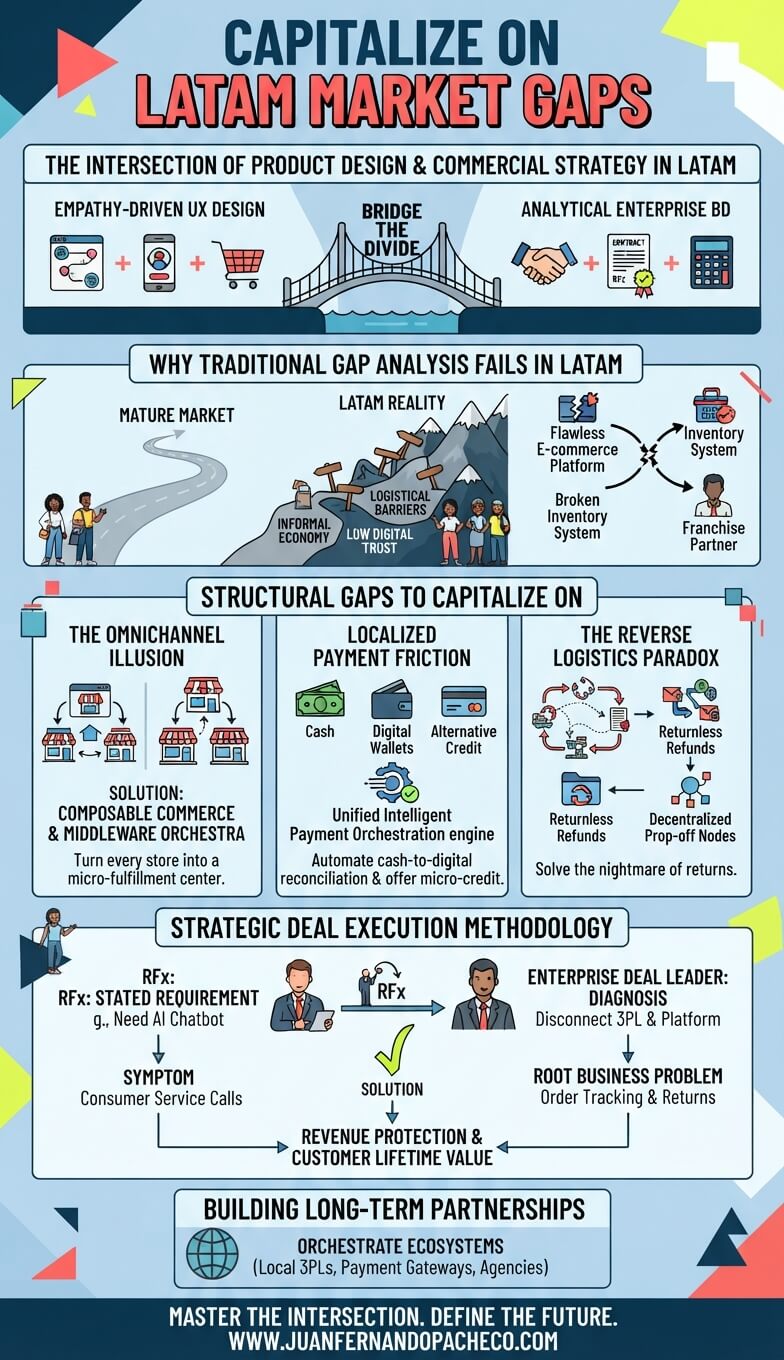
The intersection of product design and commercial strategy
Over the past two decades, my career has spanned the entire lifecycle of technology product creation and commercialization. I began my journey deep in the trenches of user experience and product design, obsessing over the micro-interactions that dictate whether a consumer completes a purchase or abandons a digital cart.
Today, as a strategic product and deal leader focused on scaling technology revenue across LATAM, my day-to-day reality revolves around high-stakes RFx execution, enterprise architecture negotiations, and closing multi-million-dollar technology deals with the region’s largest retail conglomerates.
At first glance, these two worlds—the empathy-driven discipline of UX design and the hard-nosed, analytical realm of enterprise business development—might seem disconnected. In reality, they are two sides of the same coin. The most lucrative enterprise technology opportunities in Latin America are not found by simply chasing global software trends or copying models built for the United States or Europe.
They are found by rigorously identifying the friction points that plague the local consumer and the local retail operator, and then architecting commercial solutions that bridge those divides.
The LATAM retail sector is a landscape of profound contradictions and immense potential
It is a region characterized by rapid mobile adoption, deeply entrenched informal economies, complex geographical barriers, and a consumer base that is simultaneously highly demanding and inherently cautious regarding digital trust. For global and regional technology vendors, understanding these nuances is no longer optional; it is the fundamental baseline for market entry and revenue growth.
In this post, I will explore the methodology behind identifying structural LATAM retail market gaps. More importantly, I will shows up how to translate those identified gaps into a winning commercial strategy, ensuring that your technology solutions do not just participate in the market, but actively define the future of retail in the region.
Whether you are a product strategist, a business development director, or an enterprise technology vendor, mastering this intersection of user-centric gap analysis and high-stakes deal execution is the key to sustainable revenue growth over the next five years and beyond.
Why traditional gap analysis fails in LATAM
In mature markets, identifying a market gap often involves looking at a competitor’s feature matrix, finding a missing module, and building a slightly better version of it. In Latin America, this approach is a recipe for failure. Traditional gap analysis assumes a baseline of infrastructure, logistical maturity, and financial inclusion that simply does not exist uniformly across the region.
When we talk about LATAM retail market gaps, we are not talking about the absence of a specific AI-driven recommendation engine or a marginal improvement in a loyalty program interface. We are talking about structural voids. A structural void occurs when a fundamental consumer need cannot be met because the underlying infrastructure—be it logistical, financial, or technological—fails to support it.
For example, a retail giant in Mexico might have a state-of-the-art e-commerce platform built by a top-tier global agency. The user interface is flawless. However, if the underlying inventory management system cannot accurately reflect the stock levels of a franchise partner in a secondary city like Guadalajara, the consumer experience breaks down the moment they attempt to buy online and pick up in-store.
The gap is not in the frontend design; the gap is in the fragmented enterprise architecture that fails to accommodate the decentralized nature of LATAM retail expansion.
To capitalize on these opportunities, technology leaders must adopt a dual-lens approach. The first lens is rooted in user experience: mapping the end-to-end customer journey to identify where friction, frustration, and abandonment occur. The second lens is rooted in commercial strategy and RFx analysis: observing what retail executives are desperately trying to buy, and more importantly, why the solutions they are currently purchasing are failing to deliver the promised return on investment.
Bridging user experience and high-stakes RFx execution
One of the most valuable assets in my commercial toolkit is the ability to read a Request for Proposal (RFP) or a Request for Information (RFI) and see the human friction hiding behind the technical jargon. High-stakes RFx execution is not merely about responding to a checklist of technical requirements; it is about diagnosing the root business problem that prompted the retailer to issue the document in the first place.
Enterprise retail conglomerates in countries like Colombia, Chile, and Ecuador issue massive, complex RFx documents when they are experiencing severe operational pain. However, because these documents are often compiled by procurement departments or mid-level IT managers, the stated requirements frequently address the symptoms rather than the disease.
Consider a common scenario
A major retail chain in Bogota issues a multi-million-dollar RFP for a new, AI-powered customer service chatbot and a revamped mobile application. The procurement team has listed hundreds of technical requirements regarding natural language processing, cloud hosting, and UI responsiveness. A standard technology vendor will simply price out the software licenses, estimate the implementation hours, and submit a competitive bid.
A strategic deal leader, however, looks at the market gap through the lens of user experience and operational reality.
Why does the retailer need a massive investment in customer service automation?
When you analyze the actual user journey of their customer base, you discover that the primary driver of customer service calls is not product inquiries, but order tracking and return status updates. The root cause is not a lack of chatbot technology; the root cause is a severe disconnect between their third-party logistics (3PL) providers and their customer-facing digital platforms.
The real LATAM market gap here is a lack of unified, real-time logistical visibility
By pivoting the conversation during the RFx process, the strategic vendor stops selling a chatbot and starts selling a unified logistics data lake and an API orchestration layer that integrates local delivery fleets directly into the consumer’s mobile app. This shifts the vendor’s positioning from a commoditized software provider to a strategic transformation partner.
The deal size increases, the stickiness of the product deepens, and the vendor solves a structural gap that will plague the retailer for years if left unaddressed.
This methodology of bridging UX realities with commercial execution is how you win enterprise deals in Latin America. You must be willing to challenge the RFP, redefine the problem statement, and propose a solution that addresses the structural void, not just the stated technical requirement.
Structural gaps that persist across economic cycles
To build an evergreen commercial strategy, you must focus on gaps that are deeply embedded in the socio-economic and geographical fabric of the region. Trends fade, but structural realities persist.
Over the next half-decade, the most lucrative enterprise technology investments in the LATAM retail sector will be directed toward solving three fundamental structural gaps: the omnichannel illusion, localized payment friction, and the reverse logistics paradox.
The omnichannel illusion and inventory fragmentation
The term “omnichannel” has been thrown around boardrooms from São Paulo to Monterrey for over a decade. Yet, for the vast majority of retailers in the region, true omnichannel commerce remains an illusion. The consumer sees a unified brand, but the backend operation is a fractured network of siloed legacy systems, disparate point-of-sale (POS) terminals, and disconnected warehouse management systems.
In Latin America, retail expansion has historically been driven by aggressive physical footprint growth, often through franchising models or acquisitions of local regional chains. When a retail conglomerate acquires a smaller chain in Ecuador, they inherit a completely different technology stack, a different inventory taxonomy, and different logistical protocols. Integrating these systems is a massive capital expenditure that is often delayed in favor of more visible, consumer-facing marketing initiatives.
The market gap here lies in composable commerce and middleware orchestration
Retailers do not necessarily need to rip and replace their entire legacy ERP systems—a process that is too risky and expensive in volatile macroeconomic environments. Instead, they desperately need agile middleware layers that can pull inventory data from a 20-year-old on-premises server in a physical store and expose it via API to a modern cloud-based e-commerce storefront in real time.
From a commercial perspective, technology vendors who can offer low-code integration platforms, robust API management, and edge-computing solutions for physical stores will find massive success. The value proposition is not just “better software”; it is the ability to turn every physical retail location into a localized micro-fulfillment center without requiring a complete overhaul of the enterprise architecture.
This directly addresses the LATAM consumer’s demand for immediate gratification while circumventing the region’s notoriously difficult long-distance logistics networks.
Friction in localized payment and credit ecosystems
Financial inclusion and payment preferences in Latin America are unique. While credit card penetration has grown, a vast portion of the population remains unbanked or underbanked, relying heavily on cash, localized digital wallets, and alternative credit models. Furthermore, the B2B side of retail—specifically the relationship between major retailers and their vast networks of informal or semi-formal suppliers and franchisees—is riddled with payment friction.
The market gap is not simply about integrating another payment gateway
The gap is the lack of unified, intelligent payment orchestration that can dynamically adapt to the consumer’s profile and the macroeconomic environment.
Consider the rise of “buy now, pay later” (BNPL) and alternative credit scoring in the region. Retailers are sitting on mountains of first-party transactional data, yet they lack the machine learning infrastructure to use this data to offer instant, localized micro-credit to their consumers at the point of sale.
A consumer might be rejected by a traditional bank for a credit card, but the retailer’s own data shows they have bought groceries and electronics consistently on a weekly basis for three years.
Enterprise technology vendors who can provide secure, compliant, and AI-driven credit scoring engines that integrate seamlessly into the retail checkout flow are solving a massive structural void.
Furthermore, on the operational side, automating the reconciliation of cash payments made at local convenience stores (like OXXO in Mexico or Baloto in Colombia) back to the retailer’s central ledger is a massive pain point.
Technologies that automate cash-to-digital reconciliation, reduce fraud, and provide real-time liquidity insights to the CFO’s office represent highly lucrative, evergreen market gaps.
The last-mile and reverse logistics paradox
If forward logistics in Latin America are difficult, reverse logistics (the process of handling returns) are a nightmare. The geographical sprawl of cities like Mexico City, combined with unpredictable traffic patterns, a lack of standardized addressing systems in certain areas, and high rates of cash-on-delivery, makes returning a purchased item incredibly costly and operationally complex.
As a result, many LATAM retailers have implemented draconian return policies that severely damage the user experience and erode consumer trust. The consumer is forced to travel to a specific physical store, wait in line, and argue with customer service to process a return for an item bought online. This friction directly suppresses digital conversion rates.
The market gap here requires a combination of advanced routing algorithms, predictive analytics, and decentralized physical infrastructure. Enterprise technology solutions that enable “returnless refunds” based on predictive product value and logistics cost models are becoming essential.
Furthermore, software that enables retail networks to utilize partner locations (such as local pharmacies or corner stores) as decentralized drop-off nodes for returns solves a massive last-mile gap.
When engaging in RFx processes with retail giants, I always look for the hidden pain of reverse logistics. If a retailer is asking for warehouse automation software, I will pivot the conversation to how we can use predictive AI to reduce the return rate before the item even leaves the distribution center by analyzing sizing data, regional preferences, and historical return triggers.
Capitalizing on this gap means selling revenue protection and customer lifetime value, not just warehouse efficiency.
Capitalizing through strategic deal execution
Identifying the LATAM retail market gaps is only the first step. The true commercial challenge lies in how you structure, position, and negotiate your technology offerings to capture these opportunities. Selling enterprise software in Latin America requires a deep understanding of local corporate governance, macroeconomic risk tolerance, and the intricate dynamics of the regional C-suite.
Redefining the enterprise value proposition
When you present a solution to a chief information officer (CIO) or a chief digital officer (CDO) in the LATAM retail sector, you must speak their specific language of risk and reward. Technology budgets in the region are heavily scrutinized, and the appetite for experimental, unproven tech is significantly lower than in Silicon Valley or London.
To capitalize on the identified market gaps, your value proposition must be anchored in operational resilience and immediate cost mitigation. If your software solves the omnichannel inventory gap, do not pitch it as a tool to “increase digital engagement.” Pitch it as a mechanism to “reduce out-of-stock penalties from franchise partners and decrease dead inventory holding costs by fifteen percent.”
As a former product designer, I have found that mapping the enterprise user journey is just as critical as mapping the consumer journey.
- Who inside the retail organization is suffering the most from the current structural gap?
- Is it the supply chain manager who spends ten hours a week on manual spreadsheets to reconcile physical store stock with the central database?
- Is it the marketing director who cannot launch targeted regional campaigns because the customer data platform is siloed by country?
By identifying the internal enterprise user and quantifying their daily friction, you build a business case that the C-suite cannot ignore. You transition from being a line-item expense in the IT budget to a strategic enabler of operational efficiency. This is the cornerstone of successful high-stakes deal leadership.
Structuring deals for macroeconomic resilience
Latin America is a region of immense opportunity, but it is also subject to currency volatility, shifting import/export regulations, and fluctuating inflation rates. A major mistake that global technology vendors make is attempting to force rigid, multi-year, US-dollar-denominated SaaS contracts onto LATAM retail conglomerates without accounting for local economic realities.
To truly capitalize on market gaps, your commercial strategy must include flexible, macroeconomic-resilient deal structuring. This involves a deep understanding of local tax incentives for technological modernization, currency hedging strategies, and outcome-based pricing models.
For instance, instead of demanding a massive upfront capital expenditure (CAPEX) for a new unified commerce platform—which might be rejected by a risk-averse board of directors during an election year or a period of high inflation—structure the deal as a phased operational expenditure (OPEX).
Tie the software licensing fees to transaction volumes or specific performance metrics, such as the reduction in cart abandonment rates or the increase in buy-online-pickup-in-store (BOPIS) utilization.
This outcome-based approach aligns your company’s revenue growth directly with the retailer’s success in closing the market gap. It demonstrates a level of commercial partnership and risk-sharing that local competitors and rigid global vendors simply cannot match. Furthermore, when managing complex RFx executions across borders—say, a deal that covers operations in both Colombia and Ecuador—working with local legal and financial experts to structure cross-border data compliance and localized invoicing is non-negotiable.
The vendor who makes the procurement process frictionless for the retailer’s legal and finance teams often wins the deal, regardless of minor discrepancies in software pricing.
Building long-term enterprise partnerships
In the LATAM retail sector, business is deeply relational. High-stakes deals are rarely closed purely on the strength of a slide deck or a software demo. They are closed through trust, localized presence, and a demonstrated commitment to the region’s long-term growth.
Capitalizing on market gaps requires building ecosystems. No single technology vendor can solve the entirety of the structural voids in the Latin American retail sector.
The most successful commercial leaders act as orchestrators, bringing together best-in-class local partners—such as regional 3PLs, local payment gateways, and specialized implementation agencies—to deliver a comprehensive solution.
When you enter an RFx process, showcasing your network of local alliances proves to the retailer that you understand the market and have the on-the-ground support necessary to ensure successful deployment.
A global AI inventory forecasting tool is useless if the vendor does not understand the localized nuances of supply chain disruptions during regional holidays or local labor strikes. By integrating local expertise into your commercial offering, you de-risk the project for the enterprise buyer and create a highly defensible competitive moat.
Final thoughts on long-term value creation
The Latin American retail sector is currently undergoing a profound metamorphosis. The legacy systems and fragmented operational models of the past twenty years are colliding with the demands of a highly connected, mobile-first, and deeply discerning consumer base. The friction generated by this collision creates the LATAM retail market gaps that represent the most significant technology revenue opportunities of the next decade.
As strategic product and deal leaders, our mandate is to look beyond the surface-level requests of the market. We must utilize the empathy and analytical rigor of user experience design to uncover the true pain points of the consumer and the retail operator.
We must then leverage our commercial acumen, our mastery of high-stakes RFx execution, and our understanding of local macroeconomic realities to architect solutions that are not just technologically advanced, but structurally transformative.
Whether you are designing a new digital product, structuring a complex enterprise software deal, or mapping out a five-year go-to-market strategy for the region, remember this: the companies that will dominate the LATAM retail landscape are not those that simply sell software.
They are the companies that successfully bridge the gap between global technological capability and the deeply localized, complex, and beautifully chaotic reality of the Latin American market.
By focusing on evergreen structural voids—unified commerce architectures, intelligent localized payments, and predictive logistics—you ensure that your commercial strategy remains relevant, resilient, and highly profitable, regardless of the short-term fluctuations of the market cycle. The gap is there. The strategy is clear. The opportunity is waiting to be capitalized.