Quarterly targeting for LATAM business leaders
Introduction: the reality of technology scaling in Latin America
For over two decades, I have operated at the intersection of user experience, product strategy, and high-stakes business development across Latin America. From my early days designing digital interfaces for regional banks to my current role driving multi-million-dollar enterprise technology deals across Mexico, Colombia, Peru, Chile, Argentina, Brazil, and Ecuador, one truth has remained constant: the Latin American market does not forgive rigid, static planning.
LATAM is a region of immense technological appetite and profound complexity. It is a landscape where rapid digital transformation collides with shifting macroeconomic realities, intricate local regulations, and unique cultural approaches to business relationships.
For global and regional technology leaders, the traditional approach to revenue forecasting—setting a static annual target and hoping the market cooperates—is a recipe for missed quotas and strained client relationships.
To truly scale technology revenue in this region, business leaders must adopt a dynamic, continuous approach to pipeline management and product delivery. LATAM tech growth forecasting is not merely an exercise in spreadsheet modeling; it is a strategic discipline that requires aligning high-stakes procurement cycles, complex legal frameworks, and agile product roadmaps into a cohesive quarterly execution engine.
In this post, I will deconstruct the methodologies required to forecast, target, and capture technology growth in Latin America. Whether you are navigating a complex request for proposal (RFP) for a tier-one financial institution or aligning cross-functional engineering teams across ten different countries, the principles of quarterly targeting remain your most reliable compass.
By bridging the gap between commercial promises and product realities, we can build resilient revenue engines that thrive on the region’s volatility rather than falling victim to it.
The fallacy of the static annual plan in emerging markets
In mature markets, an annual strategic plan can often serve as a reliable roadmap for the next twelve months. Market conditions are relatively stable, regulatory frameworks are predictable, and procurement cycles follow established historical patterns. Latin America, however, operates on a different frequency.
Consider the variables that a business development manager or product leader must account for in this region
Currency fluctuations can instantly alter the total cost of ownership for an enterprise software deployment. Shifts in government mandates can introduce new data sovereignty laws overnight, forcing a complete architectural pivot for a cloud-based solution.
Inflationary pressures in certain markets can cause enterprise clients to freeze budgets in Q2, only to release them with aggressive deployment timelines in Q4.
When you rely on a static annual plan, you inherently assume that the market will wait for your internal timelines. It will not. If your forecasting model does not account for regional volatility, your quarterly revenue recognition will consistently slip. This is why the most successful technology firms in LATAM have abandoned the illusion of the rigid annual plan in favor of rolling quarterly targets.
Quarterly targeting allows organizations to absorb macroeconomic shocks, pivot resources toward emerging opportunities, and recalibrate their high-stakes RFx (request for information, quote request, request for proposal) strategies based on real-time market intelligence.
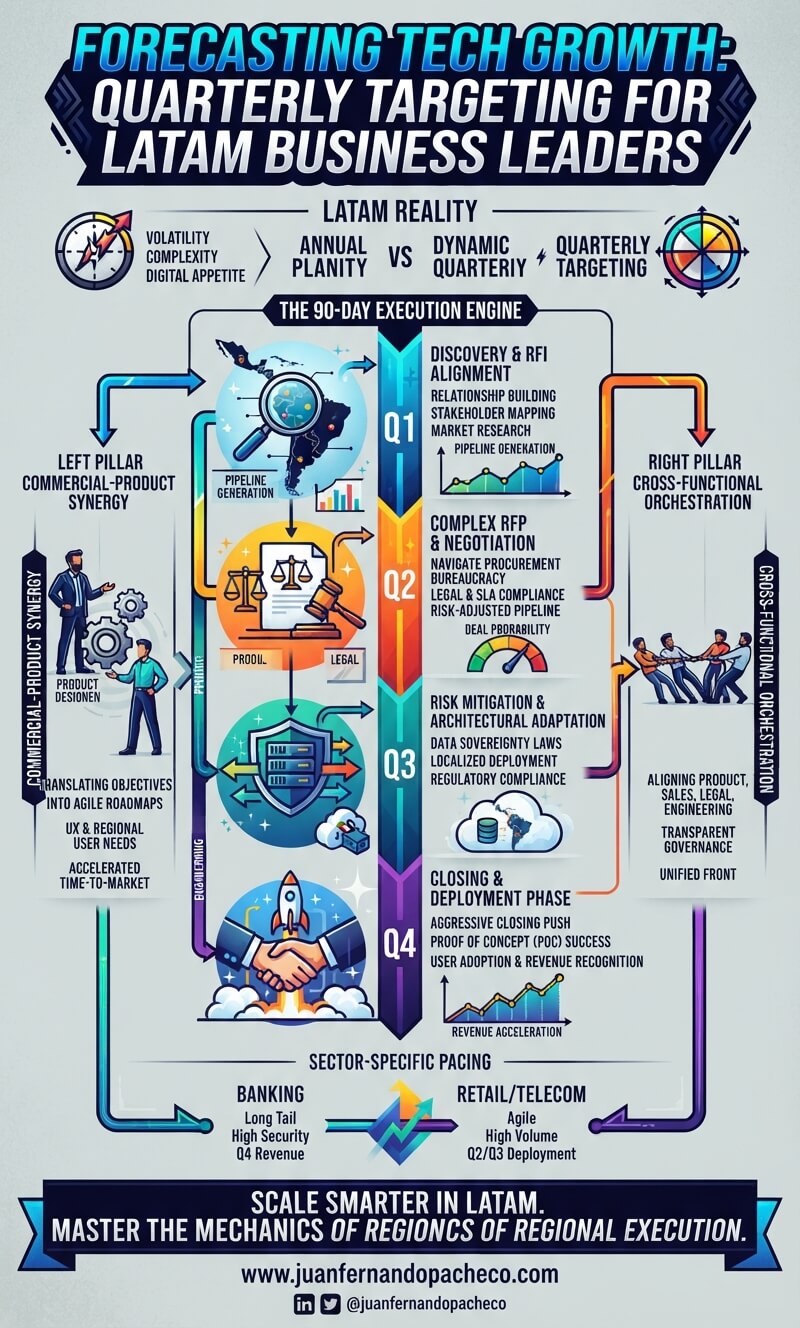
It shifts the organizational mindset from passive waiting to active adaptation. By breaking down annual revenue goals into agile, 90-day execution sprints, leaders can align their sales, legal, and engineering teams to address the immediate realities of the market while keeping the long-term strategic vision intact.
Mapping the high-stakes RFx lifecycle to quarterly realities
At the core of enterprise technology revenue in LATAM lies the high-stakes RFx execution process. Securing multi-million-dollar contracts with top regional brands in banking, finance, retail, and telecommunications is rarely a transactional event; it is a grueling, multi-phased marathon that requires meticulous forecasting and risk mitigation.
To accurately forecast tech growth, business leaders must map the regional RFx lifecycle to their quarterly targets. In Latin America, enterprise procurement is deeply conservative and highly scrutinized.
Decision-makers are not just buying software or IT services; they are mitigating institutional risk. Therefore, the sales cycle is elongated and heavily gated.
The discovery and RFI phase (Q1 alignment)
The first quarter of the year in LATAM is often defined by relationship building, market research, and the issuance of requests for information (RFI).
During this phase, enterprise clients are identifying gaps in their current infrastructure and exploring potential solutions. For a business development manager, Q1 forecasting should not be heavily weighted toward closed-won revenue.
Instead, the focus must be on pipeline generation, stakeholder mapping, and positioning your organization as a trusted advisor.
The metric of success in Q1 is the quality of the pipeline and the depth of C-level engagement, which will mature into tangible revenue in subsequent quarters.
The complex RFP and negotiation phase (Q2 and Q3 alignment)
As the year progresses, RFIs mature into formal requests for proposal (RFP) and requests for quote (RFQ). This is where the true complexity of LATAM deal execution reveals itself. Forecasting revenue in Q2 and Q3 requires a deep understanding of the client’s internal procurement bureaucracy.
You must account for the time it takes to navigate complex legal clauses, enterprise security requirements, and stringent service level agreement (SLA) negotiations.
In my experience, deals often stall in this phase not because the technology is lacking, but because the vendor failed to anticipate the legal and operational risk mitigation required by the client’s procurement board.
Accurate forecasting during these quarters requires a “risk-adjusted” pipeline model. You must assign probability weightings to deals based on your organization’s ability to meet local compliance mandates and negotiate favorable uptime and penalty clauses.
If your legal and solutions architecture teams are not aligned with your sales team during Q2, your Q3 revenue forecast will inevitably collapse.
The closing and deployment phase (Q4 alignment)
The final quarter is characterized by aggressive closing pushes and the initiation of complex deployment phases. However, in LATAM, a signed contract does not immediately equate to recognized revenue.
Stringent SLA negotiations and operational risk mitigation mean that the initial milestones for revenue recognition are often tied to successful proof of concept (POC) deployments or initial user adoption metrics.
Forecasting for Q4 must therefore be deeply integrated with your delivery and engineering teams to ensure 100% on-time delivery of initial milestones.
Navigating regional labyrinths: compliance, data sovereignty, and legal risk
You cannot forecast technology revenue in Latin America without becoming an amateur expert in regional compliance and data sovereignty.
The regulatory landscape across Mexico, Colombia, Peru, Chile, Argentina, Brazil, and Ecuador is a patchwork of local policies designed to protect citizen data and ensure national security.
For technology leaders, these regulations are not just legal hurdles; they are fundamental variables in your quarterly forecasting model.
When a major banking client in Brazil or Colombia issues an RFP for a new digital transformation initiative, their primary concern is often data localization. They need guarantees that sensitive financial data will remain within national borders, or at least within jurisdictions that meet strict reciprocal privacy standards.
If your proposed solution relies on a global cloud architecture that routes data through servers in North America or Europe, your deal will face intense scrutiny, leading to prolonged legal reviews and delayed revenue recognition.
Conversely, if your solutions architecture team has preemptively designed a localized deployment model that guarantees data sovereignty, you drastically reduce the friction in the procurement process.
Furthermore, government mandates frequently impact IT procurement budgets and timelines. A sudden shift in local tax policy or a new regulatory mandate from a national financial superintendent can force a bank to reallocate its Q3 technology budget toward mandatory compliance reporting, effectively killing your forecasted deal for a new customer experience platform.
By maintaining a continuous dialogue with local legal experts and industry regulators, business leaders can anticipate these shifts and adjust their quarterly targets before the market shock occurs.
Mitigating these operational and legal risks early in the sales cycle is the only way to protect your revenue pipeline from sudden, unforecastable evaporation.
Commercial-product synergy: where user experience meets revenue
One of the most critical failures in enterprise technology sales is the disconnect between what is promised in the boardroom and what is delivered by the engineering team.
As someone who has spent the first half of my career as a senior UX designer and product owner, and the second half as a business development manager, I have learned that commercial success is entirely dependent on commercial-product synergy.
LATAM tech growth forecasting is fundamentally flawed if it only tracks signed contracts
True revenue scaling is dependent on user adoption. You can sell a multi-million-dollar core banking modernization project, but if the user interface is unintuitive and the internal bank staff refuses to adopt the new workflow, the client will withhold final milestone payments, and the inevitable upsell opportunities will vanish.
Translating client objectives into Agile product roadmaps is the bridge between commercial promises and realized revenue. When business development and product teams operate in silos, sales teams tend to overpromise features to win the RFx, while product teams build rigid, slow-moving roadmaps that fail to address the client’s immediate market pressures.
By integrating these functions, we can accelerate time-to-market by 20% and boost user adoption by 15%.
How does this impact quarterly forecasting?
When your product team is deeply embedded in the pre-sales process, they can accurately estimate the engineering effort required to deliver the MVP (minimum viable product).
This prevents the sales team from selling vaporware and ensures that the revenue tied to deployment milestones is actually achievable within the targeted quarter.
Furthermore, by focusing on user story mapping and user-centered design, we ensure that the technology we deploy actually solves the regional complexities and user needs of the Latin American market, securing long-term retention and recurring revenue streams.
Streamlining the proof of concept to accelerate time-to-market
In high-stakes enterprise deals, the proof of concept (POC) is the crucible where forecasts are either validated or destroyed. LATAM clients, particularly in the highly competitive telecommunications and retail sectors, are increasingly demanding to see working models of proposed solutions before committing to multi-year contracts.
Historically, POC development has been a major bottleneck
Engineering teams, already burdened with existing delivery commitments, treat POCs as low-priority distractions. This results in bloated development cycles, missed quarterly targets, and frustrated clients who take their business to more agile competitors.
To protect your quarterly revenue targets, business leaders must champion streamlined POC development and execution. In my experience, focusing on MVP efficiency and leveraging reusable architectural components can reduce customer request resolution and POC delivery times by up to 30%.
When you can deploy a high-fidelity, functional POC within a 30-day window, you dramatically shorten the sales cycle. This velocity allows you to pull revenue forward from future quarters into the current one. It also builds immense trust with C-level executives and board members.
If a regional retail leader sees their specific market gaps addressed in a tangible, working prototype rather than a static slide deck, the transition from RFP evaluation to contract signing accelerates significantly.
Forecasting must account for POC velocity; if your internal engineering bandwidth cannot support rapid prototyping, your ability to capture mid-year market opportunities will be severely constrained.
Sector-specific pacing: banking, retail, and telecommunications
LATAM is not a monolith, and neither are its industry verticals. Accurate LATAM tech growth forecasting requires a nuanced understanding of the specific buying cycles, regulatory pressures, and user demands inherent to different sectors.
A blanket approach to quarterly targeting will fail because a tier-one bank in Ecuador operates on a completely different procurement rhythm than a telecommunications giant in Mexico.
The banking and finance sector
The financial sector in Latin America is characterized by extreme regulatory scrutiny, legacy system entanglement, and a desperate need for digital omnichannel experiences.
Procurement cycles here are long, heavily gated by risk management committees, and deeply focused on security and uptime SLAs. Forecasting in this sector requires a long-tail approach.
Revenue recognition is often back-loaded to the end of the fiscal year, following intense periods of compliance auditing and security penetration testing. Business leaders must align their Q1 and Q2 efforts on navigating the legal and security RFx requirements, reserving Q3 and Q4 for the complex integration and deployment phases that trigger milestone payments.
The retail and telecommunications sectors
Conversely, the retail and telecom sectors are driven by consumer acquisition, churn reduction, and rapid time-to-market. These clients are less tolerant of year-long procurement cycles.
They need solutions that can be deployed in time for regional shopping events like Cyber Monday, Hot Sale, or local holiday seasons.
Forecasting for these verticals requires intense agility. Quarterly targets must be aligned with the client’s marketing and product launch calendars. If your Agile product roadmaps cannot deliver customer-facing features within a 90-day sprint, you will miss the window of opportunity, and the deal will be lost to a faster, more responsive local competitor.
Understanding these sector-specific pacing dynamics allows business development managers to stagger their pipeline. By balancing the long-tail, high-value deals of the financial sector with the rapid-deployment, high-volume opportunities in retail and telecom, leaders can create a smoothed, predictable quarterly revenue stream that is resilient to sector-specific downturns.
Building the cross-functional engine for deal execution
You cannot scale revenue across ten different countries operating as a lone wolf. The most sophisticated forecasting model in the world is useless if your internal organization is fractured.
Exceeding KPIs and scaling revenue over a multi-year horizon requires the orchestration of a massive, cross-functional engine comprising Product, Sales, Legal, Engineering, and Operations.
In a region as diverse as LATAM, stakeholder alignment is the ultimate competitive advantage. When a complex RFQ is issued by a multinational client operating across Colombia, Peru, and Chile, the response cannot be siloed. The sales team must understand the local labor laws impacting IT outsourcing in each country.
The legal team must understand the technical limitations of the proposed cloud architecture. The engineering team must understand the commercial penalties tied to the SLA negotiations.
As a strategic leader, my role is to act as the translator and aligner of these diverse factions. This involves rigorous backlog prioritization. When engineering resources are constrained, how do we decide which product features get built first? The answer must be tied directly to the quarterly revenue targets and the strategic value of the client relationship.
By implementing transparent, cross-functional governance, we ensure that every department understands how their daily output impacts the regional revenue goals. This alignment mitigates operational risks, ensures 100% on-time delivery, and creates a unified front when facing the client’s procurement board.
The relational currency of LATAM business development
No discussion on business strategy in Latin America is complete without addressing the cultural foundation of commerce in the region: relationships. In LATAM, trust is a tangible currency that directly impacts forecasting accuracy.
In North America or Europe, a deal might be won primarily on the basis of technical superiority and price. In Latin America, while those factors are necessary, they are not sufficient.
Enterprise technology deals are deeply personal. C-level executives and board members are taking significant career risks when they award a multi-million-dollar digital transformation contract to a vendor.
They need to know that when the inevitable operational crisis occurs at 2:00 AM on a Sunday, the vendor’s leadership will answer the phone and take ownership of the problem.
Forging strong connections through face-to-face meetings, consistent engagement, and a genuine commitment to the client’s mission is what separates a forecasted deal from a closed deal.
When you have built deep relational capital with regional decision-makers, you gain access to critical, off-the-record market intelligence. You learn about budget shifts before they are announced. You understand the internal political dynamics that will affect the RFP evaluation.
This intelligence allows you to adjust your LATAM tech growth forecasting with a level of precision that competitors, who rely solely on formal CRM data, simply cannot match. Business development in this region is about cultivating partnerships, not just closing transactions.
Future-proofing your strategy through continuous adaptation
The technology landscape is evolving at a breathtaking pace. The tools we use today—cloud computing, artificial intelligence, advanced data analytics—will inevitably be replaced by new paradigms over the next five to ten years.
However, the strategic framework required to scale technology revenue in Latin America will remain evergreen.
Complexities of regional data sovereignty, the necessity of high-stakes RFx execution, the critical importance of commercial-product synergy, and the absolute requirement for cross-functional alignment are permanent fixtures of the LATAM business environment.
Leaders who will dominate the market in the future are not necessarily those who chase the newest technological hype, but those who master the mechanics of regional execution.
Adopting a rolling quarterly targeting model, business leaders can build organizations that are highly responsive to market shocks.
By insisting on user-centered product design, they ensure that the technology they sell actually drives value and adoption. By respecting the legal, regulatory, and cultural nuances of countries from Mexico to Argentina, they build resilient pipelines that can weather economic storms.
Conclusion: leading through continuous adaptation
Forecasting tech growth in Latin America is an exercise in managed volatility. It requires the analytical rigor to dissect complex RFx requirements, the strategic vision to align Agile product roadmaps with commercial goals, and the emotional intelligence to navigate the deeply relational nature of regional business.
As we look toward the future of digital transformation across Mexico, Colombia, Peru, Chile, Argentina, Brazil, and Ecuador, the mandate for business leaders is clear. We must abandon the rigid dogmas of the past and embrace a fluid, quarterly execution model that respects the unique realities of our market.
By bridging the gap between user needs, business goals, and regional complexities, we do more than just hit our quarterly targets. We build the foundational infrastructure that will drive the Latin American economy forward for decades to come.
The opportunity is vast, the challenges are complex, and for those willing to master the art of strategic alignment, the potential for scalable, sustainable growth is limitless.