The 10 types of micromanagers who think they’re helping, and the trust habits that actually scale teams
Late one evening, in a conference room in Bogotá, I watched a regional vice president rewrite the executive summary of a proposal his own team had already validated with legal, with pricing, and with the client’s technical evaluators.
The deal was a multi-year contract with one of the largest banks in the region. The deadline was the next morning. And the most senior person in the room was changing punctuation at midnight. He was not sabotaging the deal. He was helping. At least, that is what he believed, and that belief is exactly the point.
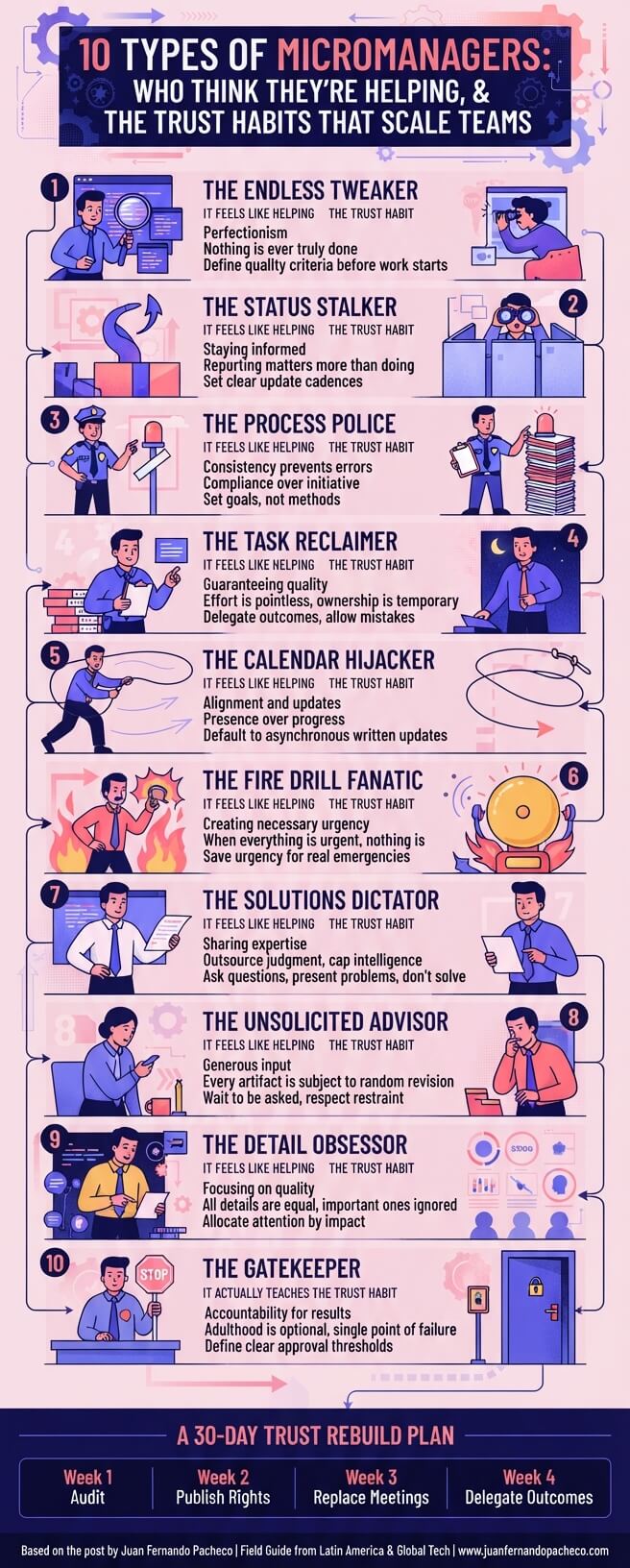
A widely shared infographic by Dora Vanourek captures the whole problem in six words:
They all think they’re helping.
She catalogs ten types of micromanagers, from the endless tweaker to the gatekeeper, and the unifying thread is not malice, not ego, and not incompetence.
It is sincerity. The micromanager experiences control as care. That is why micromanagement survives every management trend, every agile transformation, and every leadership offsite. You cannot train it away with a workshop, because it does not feel like a problem to the person doing it.
I have spent more than twenty years in technology, starting as a web designer in Quito, moving through UX, solutions architecture, product ownership, and eventually business development across Latin America for a global IT services firm.
I have led RFI, RFQ, and RFP processes for banks, retailers, and telcos in more than ten countries. And I will be honest with you:
I have been micromanaged, I have micromanaged, and I have slowly, painfully learned to stop.
This post is the field guide I wish someone had handed me earlier. It is written to be useful whether you read it today or five years from now, because the tools we use will keep changing, but the physics of trust will not.
Why “helping” is the most dangerous disguise in management
Micromanagement persists because it works, briefly.
The anxious check-in produces an immediate answer. The rewritten slide looks better to your eye. The imposed process avoids one mistake this sprint. Practitioner literature, including work published by Harvard Business Review, repeatedly points to the same root causes:
anxiety, a need to feel connected to the work, and low trust in the team.
The same literature reminds us that people have strong negative emotional and physiological reactions to unwanted help, and that it can erode relationships and performance. The invoice for control always arrives late, and it arrives to someone else.
In commercial work, the math is brutal and simple
If every proposal, every estimate, and every architecture decision has to pass through one brain, your pipeline is capped by that brain’s calendar. I have seen multi-million-dollar regional pipelines stall, not because the team was weak, but because one approval bottleneck made speed impossible.
The opposite is also true
When I learned to define outcomes, set thresholds, and let capable teams run, we cut customer request resolution time by thirty percent, accelerated time-to-market by twenty percent, and lifted user adoption by fifteen percent on solutions serving millions of banking users. Those numbers were not produced by more control. They were produced by less.
How to read this list
Read the ten types of micromanagers below as a mirror, not a weapon. Most experienced leaders will recognize themselves in at least three, and I include myself in that sentence.
For each type, I describe the behavior, why it feels like helping, what it actually teaches your team, and the trust habit that replaces it. The fixes follow Vanourek’s framework; the field notes come from two decades of deals, designs, and deliveries across Latin America.
1. The endless tweaker
You spend hours perfecting work that is already good. The deck is approval-ready, but you do one more pass. The screen already tested well with users, but the spacing feels wrong to you. It feels like helping because you genuinely believe in excellence.
It is actually teaching your team that “done” is whatever mood you are in tonight, so nothing is ever truly done. In proposal work, I have watched endless tweakers burn the last calm hours before a submission on cosmetic changes while the pricing model sat unvalidated.
The fix is to not confuse personal preferences with quality. Define the quality criteria before the work starts, separate objective defects from taste, and when only taste remains, ship. Perfect is a direction for iteration, not a gate for delivery.
2. The status stalker
You “just check in” constantly; otherwise you get anxious. A message Monday morning, another Tuesday afternoon, an “any update?” dropped into the team chat while the owner is in deep work. It feels like helping because staying informed is a legitimate leadership duty.
It is actually teaching your team that reporting on work matters more than doing it, and that your anxiety is their responsibility. During complex RFx responses, I learned that every unplanned check-in costs far more than the information it retrieves, because context switching taxes the exact people you most need focused. The fix is to set clear expectations once and trust your team to update you.
Agree on the cadence, the format, and the escalation triggers, then honor the silence in between. Visibility should be a system the team runs, not a surveillance project the manager runs.
3. The process police
You create rigid procedures for everything: templates for updates, formats for meetings, mandatory steps for decisions nobody will remember. It feels like helping because consistency prevents errors, and in regulated industries like banking, some rigor is genuinely non-negotiable. Data sovereignty, local policy, security clauses, SLA penalties: those rails matter.
But rails are not the road
When process stops guarding outcomes and starts replacing judgment, it teaches your team that compliance is the job and that initiative is a risk. The fix is to set goals and let your team decide the how. Reserve mandatory process for the few places where regulation, security, or irreversible risk demands it; everywhere else, state the outcome and the deadline, then get out of the way of the method.
4. The task reclaimer
You take back delegated tasks because no one can do it as well as you. The analyst’s model had rough edges, so you rebuild it at midnight. It feels like helping because the deliverable improves and the deadline is safe. It is actually teaching your team that effort is pointless, because ownership is temporary and the boss will finish the job anyway.
Every reclaimed task is a double payment: you pay tonight in your own hours, and you pay for months in a team that stops stretching.
The fix is simple to say and hard to live: mistakes are how people grow. Budget for the learning curve the way you budget for licenses and travel, delegate outcomes rather than tasks, and accept a first delivery at eighty percent of your personal standard, because the remaining twenty percent is the price of building a team that will someday exceed it.
5. The calendar hijacker
You schedule unnecessary meetings to stay “in the loop”: the sync about the sync, the thirty-minute call that two written lines would have covered, the status theater where each person speaks for ninety seconds. It feels like helping because alignment is real and misunderstandings are expensive, especially across countries and time zones.
It is actually teaching your team that presence matters more than progress, and fragmenting the deep work hours where proposals, architectures, and designs actually get produced.
The fix is to trust updates, because not every task needs a meeting. Default to asynchronous written updates, keep meetings as the exception reserved for debate, decision, and emotion, and when you feel the urge to convene, ask yourself what decision this meeting will make. If you cannot name one, cancel it and read the update instead.
6. The fire drill fanatic
You create fake urgency to make people work harder. Everything is critical, every request is “for yesterday,” every minor client comment becomes an all-hands emergency. It feels like helping because urgency produces adrenaline and adrenaline produces speed, and speed feels like leadership. It is actually teaching your team to discount everything you say, because when everything is urgent, nothing is.
I have seen teams ignore a genuine production incident in a bank because the same red-alert language had been spent all quarter on preferences.
The fix is to save urgency for real emergencies. Name the true priority explicitly, protect the team’s sense of alarm the way you would protect a fire extinguisher, and review whether your “emergencies” of last month mattered at all. Most did not.
7. The solutions dictator
You tell people exactly how to solve problems instead of letting them think. You hand over the architecture, the wording, the step-by-step, and you are surprised when the team behaves like order-takers. It feels like helping because your experience is real and the shortcut is tempting.
It is actually teaching your team to outsource its judgment to you, which means you become the ceiling of the team’s intelligence.
The fix is to present problems, not solutions, because that is how people grow. Describe the outcome, the constraints, and the definition of success, then ask questions instead of issuing answers:
- What options do you see,
- What would you recommend,
- What do you need from me?
In deal teams, this single habit is the difference between a leader who carries the team and a leader the team carries.
8. The unsolicited advisor
You give constant “helpful” advice no one asked for: drive-by comments in design reviews, suggestions dropped into documents you do not own, tips delivered in the corridor. It feels like helping because your intentions are generous and your experience is relevant.
It is actually teaching your team that every artifact is subject to random revision from above, so why invest conviction in anything? Advice imposed is advice resisted; advice invited is advice absorbed.
The fix is to wait to be asked, because your team knows where to find you. Make your availability explicit, keep your opinions private until requested, and when you are asked, answer the question that was asked rather than the ten questions you prefer. Restraint, in this case, is not silence. It is respect.
9. The detail obsessor
You waste hours on minor details that do not affect the outcome: the appendix formatting, the icon style, the fourth decimal of a projection nobody will act on. It feels like helping because details are where quality lives, and you are a quality person.
It is actually teaching your team that all details are equal, which guarantees the important ones get underfunded. In high-stakes proposals, I learned to ask one question before polishing anything: will it matter in a week? If not, let it go. If yes, ask whether it matters to the client’s decision, or only to your comfort.
The fix is to allocate attention by impact, not by anxiety. Decide which details are load-bearing and defend those fiercely, and give the rest a timebox and a goodbye.
10. The gatekeeper
Everything needs your approval because you do not trust your team: the email to the client, the slide order, the discount within policy, the hire, the holiday. It feels like helping because you are accountable for the results and accountability is heavy.
It is actually teaching your team that adulthood is optional, and building yourself into the single point of failure for an entire region. I have watched gatekeepers become the reason deals slip: not because the team was slow, but because the approver was on a flight.
The fix is to define what actually needs approval, and the hint is that it is less than you think. Publish a short list of decisions that truly require you, typically those involving irreversible commitments, policy exceptions, or material commercial risk, and pre-approve everything else with clear thresholds. Trust with boundaries scales; approval without boundaries does not.
The pattern underneath all ten
Look closely, and you will see one wound wearing ten costumes. Every type on this list is an anxiety-management strategy: the manager’s nervous system outsources its calm onto the team’s autonomy. That is why the fix is never “try harder to be nice.”
The fix is architecture. Clear goals replace the solutions dictator.
A clear update cadence replaces the status stalker and the calendar hijacker. Clear approval thresholds replace the gatekeeper. A clear definition of done replaces the endless tweaker and the detail obsessor. A clear priority replaces the fire drill fanatic.
Trust is not a mood you generate at an offsite; it is a set of visible, durable agreements that let capable adults spend their energy on the work instead of on you.
And in multicultural environments like Latin America, where relationships and hierarchy carry real weight, explicit agreements matter even more, because they convert implicit power into shared clarity.
A 30-day trust rebuild plan
If you recognized yourself above, do not despair; you are in excellent company. Recovering micromanagers often become the best delegators, because they know exactly where the traps are.
Here is a simple thirty-day plan I have used and coached.
- Week one: audit. List everything you touched last week and mark what genuinely required you; most leaders find a number below twenty percent, and it is humbling.
- Week two: publish decision rights. Write down what needs your approval, what needs your opinion, and what is fully autonomous, then share it and invite the team to correct it, because they know your habits better than you do.
- Week three: replace two recurring status meetings with written asynchronous updates, and keep only meetings that make decisions.
- Week four: delegate one meaningful outcome end to end, with public ownership and private patience, and when a mistake happens- and it will- debrief it without blame and without reclaiming.
Then measure what changes: cycle time, quality, energy in the room, and the hours you recovered for work only you can do, like strategy, relationships, and the next big deal.
Helping is what the helped person says it is
The subtitle of Vanourek’s infographic is the whole lesson: they all think they’re helping. But help is defined by the receiver, not the giver. If your team experiences your involvement as control, then control is what it is, regardless of your intentions.
Twenty years of technology work across Latin America have convinced me that the scarce resource in leadership is not intelligence, not effort, and certainly not urgency. It is trust. Trust is the infrastructure that lets speed, adoption, and revenue scale, and it is built in small, unglamorous moments: the check-in you did not send, the slide you did not rewrite, the meeting you cancelled, the mistake you let happen and debriefed with care. Markets will change.
Tools will change. The types of micromanagers will not. Be the leader whose team grows, not the one whose team shrinks to fit their anxiety.
Web references and books that reinforce this post
Web references:
- Harvard Business Review, “how to help (without micromanaging)” — research on why unwanted help erodes trust and performance.
- Harvard Business Review, “the anxious micromanager” — on anxiety as the engine behind checking in too often and over-advising.
- Harvard Business Review, “how to stop micromanaging your team” — on breaking the control habit.
- Harvard Business School Online, “how to stop micromanaging your employees” — on micromanagement as a top driver of resignation and lost creativity.
- Dora Vanourek, “10 types of micromanagers — they all think they’re helping” — the infographic that frames this post.
Books:
- “Turn the ship around: a true story of turning followers into leaders” by L. David Marquet — the classic on intent-based leadership and moving from giving answers to building judgment.
- “Multipliers: how the best leaders make everyone smarter” by Liz Wiseman — on leaders who amplify talent versus the diminishers who become the ceiling of the team.
- “Radical candor: be a kick-ass boss without losing your humanity” by Kim Scott — on caring personally and challenging directly, the antidote to drive-by advice.
- “The trusted advisor” by David Maister, Charles Green, and Robert Galford — essential for anyone in client-facing roles; trust as the core commercial asset.
- “Drive: The surprising truth about what motivates us” by Daniel Pink — on autonomy, mastery, and purpose as the real engines of performance.
- “The culture map: breaking through the invisible boundaries of global business” by Erin Meyer — for leaders working across cultures, where hierarchy and feedback styles shape how control is felt.