Respect is never demanded
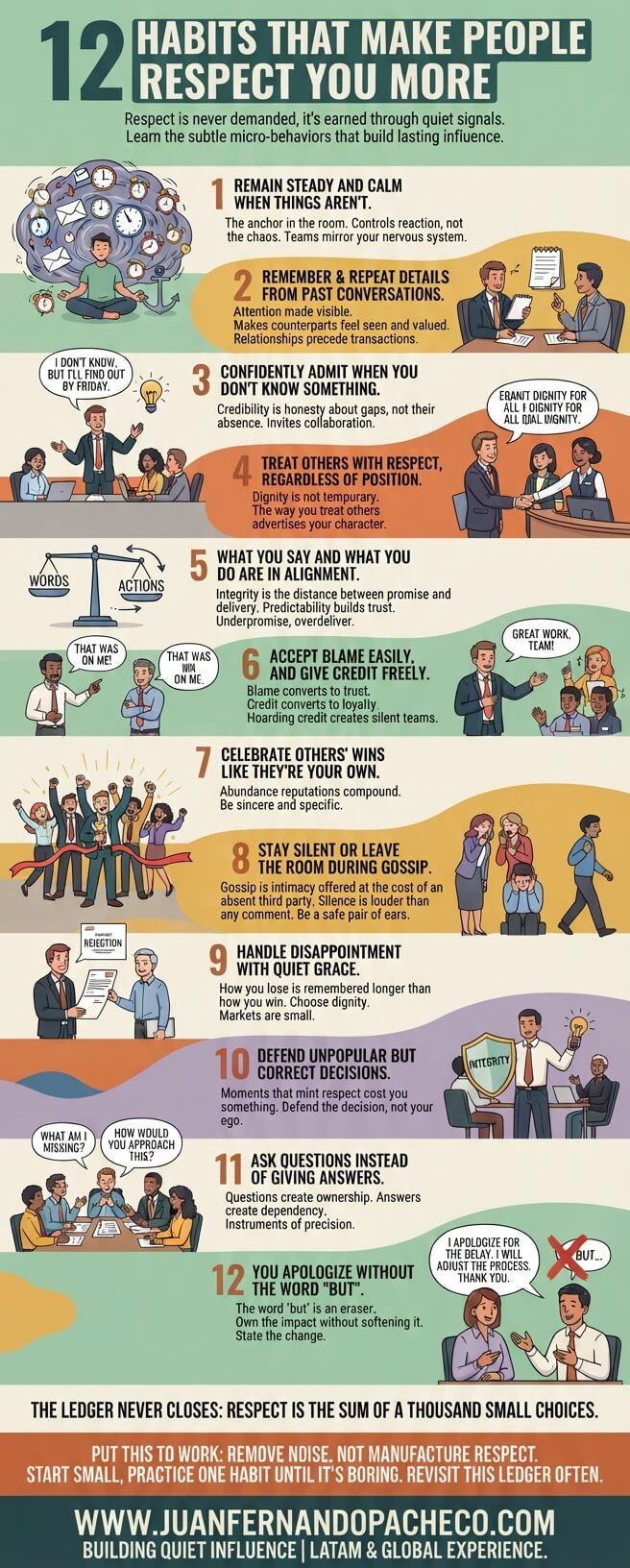
Some time ago, a simple diagram crossed my desk. It listed 12 subtle habits that make people secretly respect you more, and it never once mentioned titles, charisma, or power. I have spent more than two decades in rooms where respect is the real currency: negotiation tables for multi-year technology contracts, war rooms after a failed release, research sessions where a user decides whether to trust you with the truth. And I can tell you the diagram is right. Loud signals fade in a week; quiet signals compound for years.
In my work across Latin America, from banking programs to public procurement, I have watched brilliant strategists lose a room over small behaviors, and quieter colleagues win lasting influence without raising their voice. Respect behaves less like a verdict and more like a ledger. Every interaction makes a small deposit or withdrawal, and most people never see the balance until the day they need to draw on it.
This post translates those 12 habits into the language of real working life. I will share what I learned on both sides of the table, as a designer, as an architect, and as the person accountable for the deal. Nothing here depends on a specific tool, title, or year. Read it today or reread it in five years; the habits will still be doing their quiet work.
Why subtle habits beat loud signals
We overrate dramatic gestures and underrate repetition. A charismatic keynote is forgotten in a month; the colleague who stayed calm in every crisis becomes the person everyone calls during the next one. Leadership research describes the same pattern from different angles: trust and respect accumulate through consistent, observable micro-behaviors, not through declarations. In procurement, we formalize this idea as past performance. In human relationships, it is called reputation.
The good news is that subtle habits are trainable. You do not need a promotion to practice them. You need repetition and a little self-awareness. Below are the 12 habits from the diagram, each with what it looks like in practice and why it quietly deposits into your ledger.
Habit 1: you remain steady and calm when things around you aren’t
In every serious negotiation I have led, there is a moment when the email chain turns hostile, a penalty clause appears, or a deadline collapses. The person who regulates their reaction first becomes the anchor of the room. Calm is not passivity; it is the space between stimulus and response where choice lives. Teams mirror the nervous system of their leader: escalate, and they escalate; slow down, and they slow down.
In practice, this habit looks like a pause before replying to a harsh message, naming the problem without naming a villain, and lowering your voice when others raise theirs. It also looks like preparation, because calm is often clarity that arrived early. You cannot control markets, clients, or regulators, but the tone you bring is always yours. Over time, people notice that storms do not move you, and they start bringing you their storms. That is respect.
Habit 2: You remember and repeat details from past conversations
Few things open a counterpart’s posture faster than hearing their own words returned with care. When you say “last quarter you told me your real fear was data sovereignty, so let’s start there,” the conversation changes. You have proven you listened when you did not need anything. In user research, the same habit unlocks truth: a participant who hears their exact phrase repeated leans in and tells you what they were holding back.
The mechanics are humble. Keep a small notebook or a simple note in your customer relationship manager: names of family members, constraints mentioned in passing, promises made. Review it before every meeting. This is not manipulation; it is attention made visible. In cultures like ours across Latin America, where relationships precede transactions, this habit is almost the whole game. People forgive a bad price; they rarely forgive being forgotten.
Habit 3: You confidently admit when you don’t know something
Early in my career, I sat across from a bank’s security officer and felt the temptation to bluff. It is a dangerous temptation, because experts smell invention, and procurement committees include more experts than you think. The turn came when I said, “I don’t know; give me until Friday and I will bring you a verified answer.” The room relaxed. Credibility is not the absence of gaps; it is honesty about where they are.
A confident “I don’t know” does three things at once. It protects the other party from your guesses, it signals that your yes and your no are reliable, and it invites collaboration. The dangerous person in any deal is the one who cannot afford to be wrong; the trusted advisor is the one who can. Admit the gap, commit to a date, deliver on that date. Repeat the cycle a few times, and you become the person whose answers are taken as fact.
Habit 4: You treat others with respect, regardless of position
Every deal has invisible decision makers: the analyst who drafts the evaluation, the assistant who schedules the committee, the junior engineer who tests your proof of concept. Treat them as gatekeepers and you miss the point. They are not gates; they are people, and the way you treat them is the truest advertisement of your character. Executives watch this closely, because it predicts how you will treat them the day they stop being useful to you.
The habit is simple: identical courtesy in the lobby and in the boardroom. Learn names, thank people specifically, and never spend status you have not earned. In practice, I have seen more deals saved by a respected analyst than by a discounted price. Positions are temporary assignments. Dignity is not.
Habit 5: what you say and what you do are in alignment
In service contracts, we call this the service level agreement; in personal reputation, it is called integrity. It is simply the distance between your words and your actions, measured over time. If you promise a follow-up on Tuesday, send it on Tuesday. If you claim quality, let your calendar and your budget show it. People do not demand perfection; they demand predictability. A predictable colleague, even a limited one, is easier to trust than a brilliant one whose words and behavior never quite match.
Alignment also means saying less. The smaller the gap between promise and delivery, the larger your credibility. Underpromise and overdeliver is a cliché precisely because it works. Every kept word is a deposit, and after enough deposits people start lending you the benefit of the doubt in difficult rooms. That loan is respect.
Habit 6: you accept blame easily, and give credit freely
After a painful incident in a delivery I was accountable for, the shortest sentence in the language did the most work: “that was on me.” No timeline of excuses, no distributed blame. The client exhaled, and the relationship survived. Weeks later, when the recovery went well, the longest sentences did their work too: naming, in writing, each person who made the turnaround possible, one by one.
The arithmetic of this habit is counterintuitive and reliable. Blame you accept does not accumulate on you; it converts into trust. Credit you give away does not diminish you; it converts into loyalty. Leaders who hoard credit and export blame end up presiding over silent teams that hide bad news until it becomes fatal news. The habit starts small: in your next retrospective, own the failure first and out loud, and attribute the success to specific names. Watch what happens to the room.
Habit 7: You celebrate others’ wins like they’re your own
Scarcity is the default setting in competitive environments: someone else’s win feels like your loss. Respect flows the other way. When a peer lands a major account, and you are the first to celebrate with sincerity, two things happen. The peer learns they are safe with you, and everyone watching learns your ego is not the center of gravity. In cross-functional teams of product, sales, legal, and engineering, this habit is the glue that turns a group of departments into a team.
Real celebration is specific and public. Not “good job,” but “the way you restructured that clause saved the margin and the relationship.” And it must be real: applause with an asterisk is flattery, and people detect it instantly. Abundance reputations compound. The person who lights other candles is the one everyone wants in the room when their own moment arrives.
Habit 8: You stay silent or leave the room during gossip
Gossip is a strange transaction: the speaker offers you intimacy, but the price is paid by an absent third party, and the debt is always yours. Anyone who gossips to you will gossip about you. That is not cynicism; it is pattern recognition. So the quiet habit is refusal without theater. You do not lecture; you simply do not feed it. Change the subject, offer a kinder interpretation, or physically leave. Silence in that moment is louder than any comment.
People notice who does not join in. Over time, you become what every organization needs and rarely produces: a safe pair of ears. Executives confide in safe people. Clients bring real problems to safe people. The cost is a few awkward seconds now and then; the return is a reputation that travels ahead of you into rooms you have not entered yet.
Habit 9: You handle disappointment with quiet grace
You will lose deals you deserved. Promotions will go to someone else. A proposal you built for months will end in a two-line rejection email. How you lose is remembered longer than how you win, because winning is easy to celebrate and losing reveals what is underneath. Quiet grace does not mean pretending not to care; it means feeling the blow fully and choosing dignity as your response.
In practice: thank the committee sincerely, ask for feedback you will actually use, and congratulate the winner without acid. Then do the private work so the disappointment does not harden into bitterness. Markets are smaller than they look, and today’s evaluator is tomorrow’s client. I have been invited back into processes precisely because of how we lost the previous one. Grace under loss is a long game, and the long game is the only game worth playing.
Habit 10: You defend unpopular but correct decisions
Calm is not the same as soft. There are moments when the room wants a comfortable answer and the correct one costs you: insisting on a compliance requirement that shrinks the margin, defending a colleague who is being unfairly blamed, telling a client that the cheaper option is the wrong one. These are the moments that mint respect, because everyone knows the price of saying the right thing when it is unpopular.
The habit has discipline. Defend the decision, not your ego. Bring evidence, invite scrutiny, and separate the person from the problem. And know the difference between an unpopular correct decision and an unpopular personal preference: the first deserves your spine, the second deserves your curiosity. When you are known as someone who holds the line for the right reasons, people stop testing your line and start borrowing it.
Habit 11: You ask questions instead of giving answers
My years in user experience left me with one permanent conviction: the quality of your questions determines the quality of your relationships and of your results. Answers create dependency; questions create ownership. When a client says “we need this feature by Friday,” the expert rushes to answer, while the advisor asks “what happens on Friday if we don’t?” and suddenly the real constraint, the real risk and the real deal are on the table.
Questions also protect respect subtly: they assume the other person has something worth drawing out.”What am I missing?” “How would you approach this?” “What would make this acceptable to your board?” These are not signs of weakness; they are instruments of precision, and they let counterparts adopt the solution as their own, which is the only kind of adoption that lasts. Tell people what to do, and you earn compliance; ask them well, and you earn commitment.
Habit 12: You apologize without the word “but”
The word “but” is an eraser. “I’m sorry I missed the deadline, but the vendor…” deletes everything before it and replaces the apology with a defense. People do not need you to be perfect; they need to know that you can see the impact you caused. A clean apology has three parts: name the impact without softening it, own the cause without outsourcing it, and state the change you will make. Then stop talking.
I have delivered clean apologies to clients after real failures and watched hostility drain out of the room in seconds, not because the apology fixed the failure, but because it restored the only thing that can carry a relationship through failure: trust. The same applies at home. Children, partners, and friends keep ledgers too. An apology without “but” is one of the cheapest and most powerful deposits a human being can make. Practice it until it is your default.
How to put this to work without becoming someone else
A warning before you practice: these habits are not a costume. Performed without sincerity, each one becomes its own parody, calm as coldness, questions as interrogation, apology as ritual. The point is not to manufacture respect but to remove the noise that prevents people from seeing the respectable person already there. Start small. Pick one habit, only one, and practice it for a month until it is boring. Then pick the next. In a year you will have rebuilt the quiet infrastructure of your reputation.
And reread this page from time to time. Not because the habits change, but because you change. New roles bring new temptations, more status, more speed, more pressure, and each one taxes a different habit. The ledger never closes. That is not bad news; it means every single day, in meetings that feel unimportant, you get to make another small deposit that your future self can draw on.
Respect is never loud. It is the sum of a thousand small choices that nobody applauds in the moment and everybody remembers later. Keep your ledger in order, and the rooms will take care of themselves.
Web references
- Harvard Business Review, “Do your employees feel respected?” — a useful reminder that respect consistently tops what employees say matters most to them at work.
- Harvard Business Review, “What people get wrong about psychological safety” — on the environment that respectful, candid cultures create.
- Harvard Business School Working Knowledge, “Four steps to build the psychological safety that high-performing teams need today” — practical steps that pair well with habits 6, 8, and 11.
- Jim Collins, “Level 5 leadership” — the classic framing of personal humility combined with indomitable will, the executive version of this post.
Books that reinforce the post
- “Humble Inquiry: the gentle art of asking instead of telling,” by Edgar H. Schein — the deepest treatment I know of habit 11.
- “The speed of trust: the one thing that changes everything,” by Stephen M.R. Covey — The Economics of Habits 3, 5, and 12, in business language.
- “Dare to lead: brave work. Tough conversations. whole hearts,” by Brené Brown — the research backbone for habits 6, 9, and 10.
- “Never Split the Difference: Negotiating as if your life depended on it,” by Chris Voss and Tahl Raz — listening, calm, and questions under maximum pressure.
- “Extreme Ownership: How U.S. Navy SEALs Lead and Win,” by Jocko Willink and Leif Fabin — habit 6 taken to its logical conclusion.
- “How to Win Friends and Influence People,” by Dale Carnegie — The original evergreen manual for habits 2, 4, and 7.
- “Good to Great: Why some companies make the leap… and others don’t,” by Jim Collins — Where level 5 leadership, humility plus will, was first described.