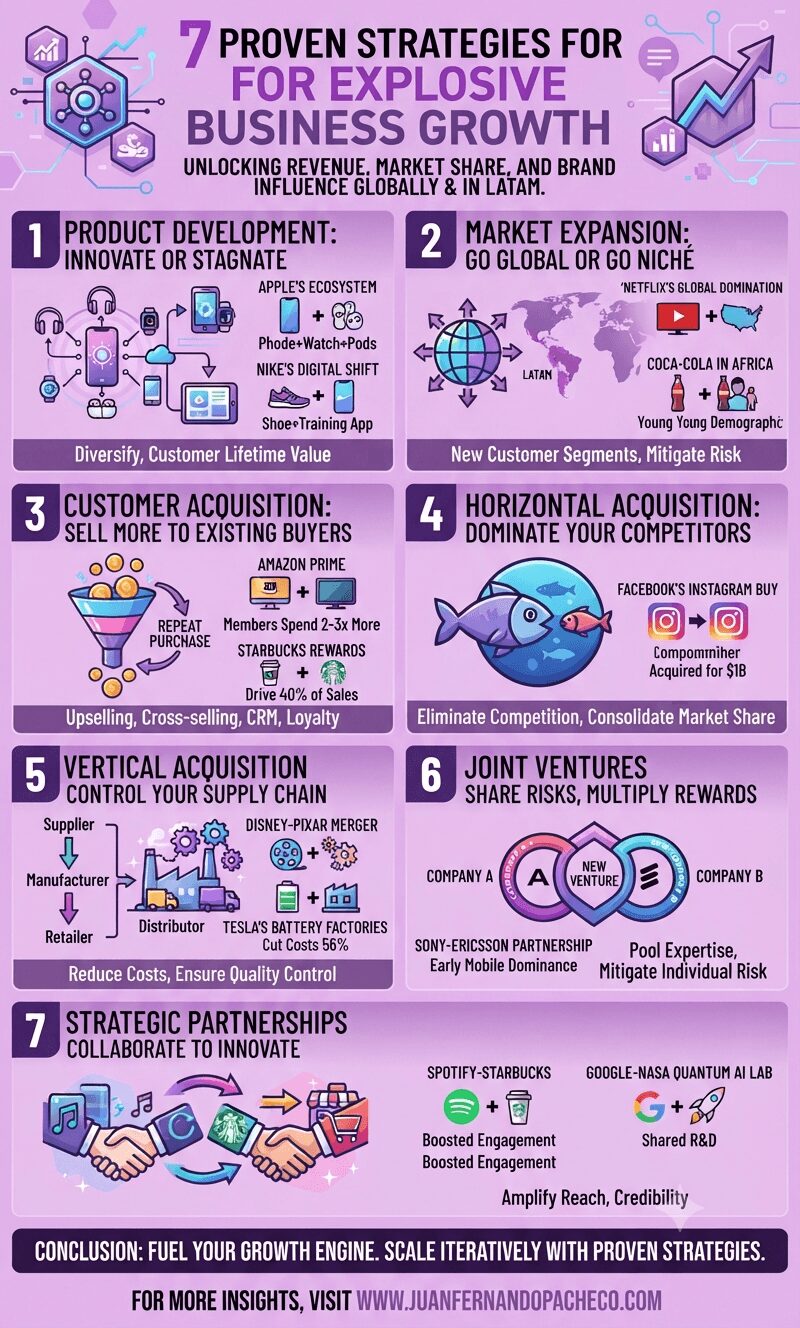
An infographic titled "7 Proven Strategies for Explosive Business Growth," presented in a professional purple-themed layout. It details seven numbered sections with icons and examples: 1. Product Development (Apple, Nike), 2. Market Expansion (Netflix, Coca-Cola), 3. Customer Acquisition (Amazon Prime, Starbucks), 4. Horizontal Acquisition (Facebook/Instagram), 5. Vertical Acquisition (Disney/Pixar, Tesla), 6. Joint Ventures (Sony-Ericsson), and 7. Strategic Partnerships (Spotify/Starbucks, Google/NASA). The bottom includes a conclusion and the URL www.juanfernandopacheco.com.

Explosive growth isn’t accidental—it’s engineered through strategic choices. Whether through acquisitions, partnerships, or product innovation, each strategy offers unique advantages.

Start with one tactic, measure results using KPIs, and scale iteratively. For tailored guidance, explore tools like SEMrush for SEO optimization or McKinsey’s Growth Framework for strategic planning.
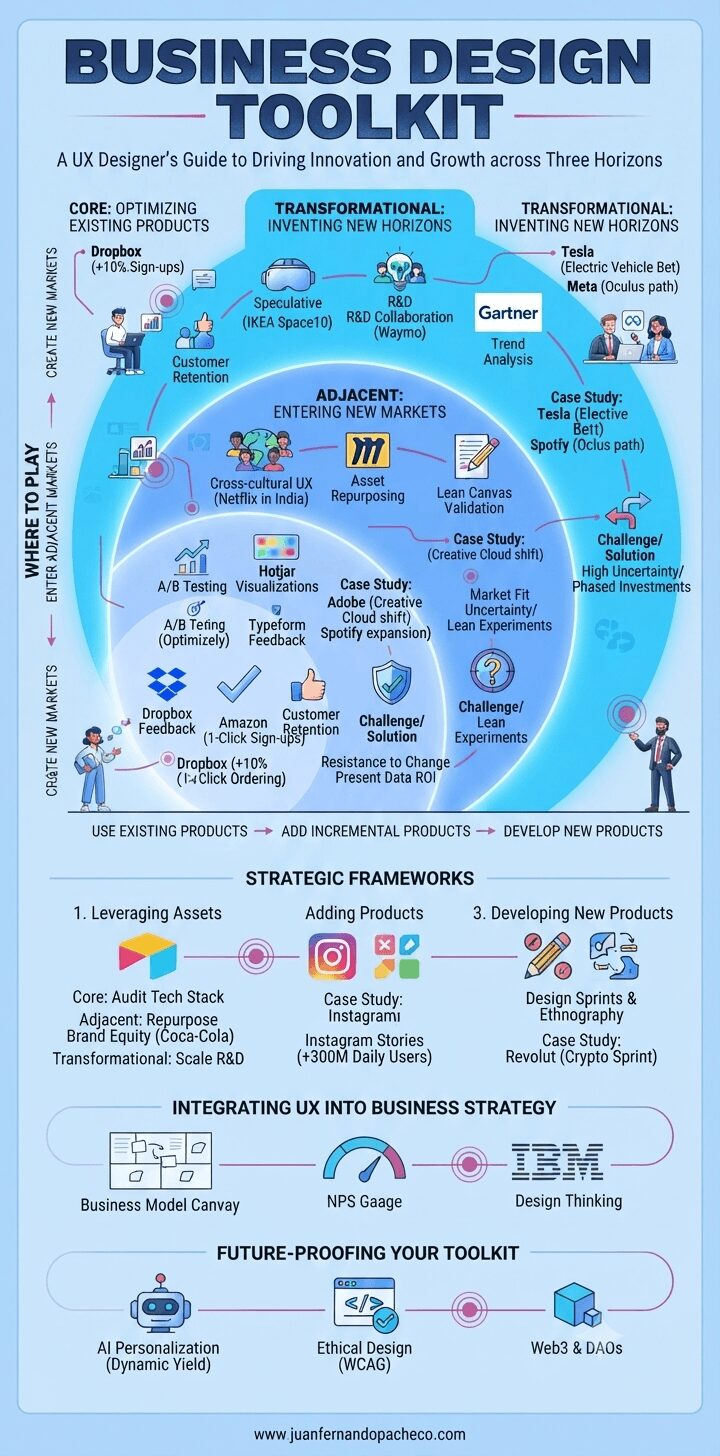
An infographic titled "Business Design Toolkit" on a light blue background, illustrating the Three Horizons framework for innovation (Core, Adjacent, Transformational), strategic frameworks, and tactics for integrating UX into business strategy. The design includes icons, flowcharts, and labels connecting UX design methods to business growth outcomes, with a footer reference to www.juanfernandopacheco.com.

A business design toolkit is not static—it evolves with market shifts and technological advancements. By mastering Core optimization, Adjacent expansion, and Transformational disruption, UX designers can become strategic partners in driving sustainable growth.

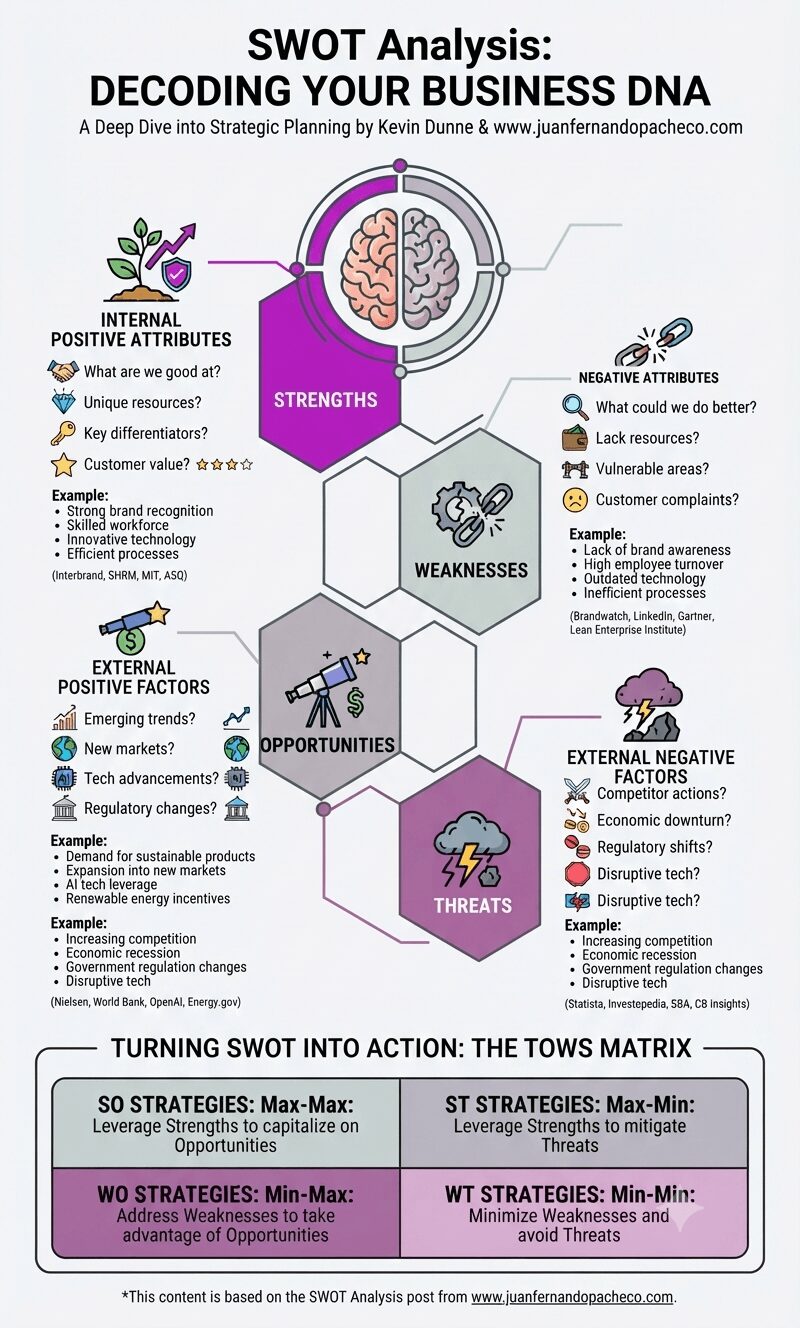
A vertical infographic titled "SWOT Analysis: Decoding Your Business DNA" featuring a central diagram of a brain split into internal (Strengths, Weaknesses) and external (Opportunities, Threats) factors. The top left shows 'Strengths' (plant, shield, gear) with examples like strong brand and skilled workforce. The top right shows 'Weaknesses' (broken gear, chain) with examples like high turnover and outdated tech. The bottom left shows 'Opportunities' (telescope, rising star) with examples like new markets and AI. The bottom right shows 'Threats' (storm cloud, lightning) with examples like recession and competition. A large bottom section outlines "The TOWS Matrix" with SO, ST, WO, and WT strategies. The design uses a modern palette of teals, lavender, and magentas on a light gray background.

A SWOT analysis is a powerful tool for understanding your organization’s current position and charting a course for future success. By systematically analyzing your strengths, weaknesses, opportunities, and threats, you can develop targeted strategies that leverage your competitive advantages and mitigate potential risks.

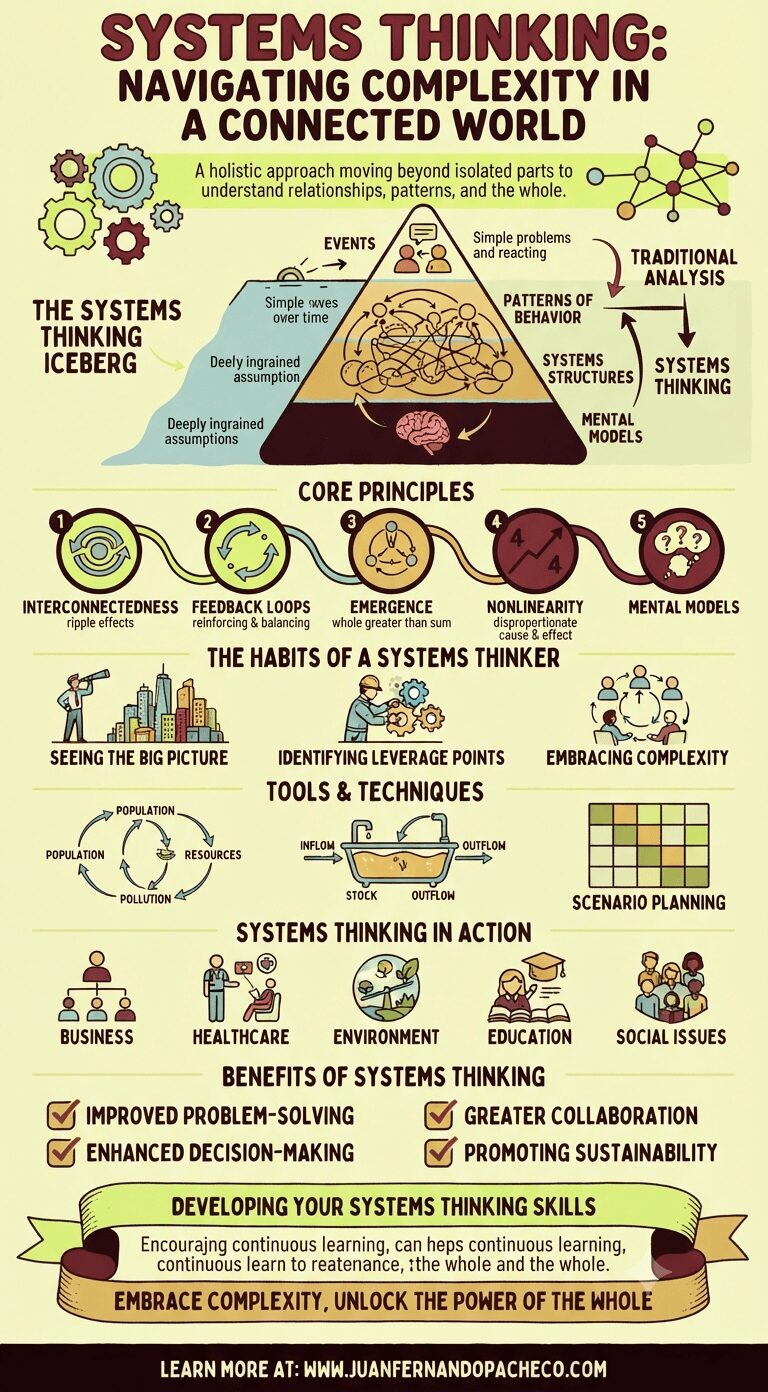
An infographic titled "Systems Thinking: Navigating Complexity in a Connected World," featuring a "Systems Thinking Iceberg" diagram that contrasts traditional analysis with systems thinking, followed by sections on core principles, habits, tools, applications, and benefits, all presented in an illustrative, illustrative style with a light cream and maroon color palette.

In a world characterized by complexity and rapid change, systems thinking is no longer a luxury, but a necessity.

By understanding the interconnectedness of systems and developing the skills to think holistically, we can unlock the power of the whole and create a more sustainable and prosperous future.

An infographic titled "BUSINESS MODEL ARCHETYPES: Understanding the Seven Fundamental Business Personalities" on a light purple background. It features a central, stylized, branching structure labeled "ECOSYSTEM" that connects to seven circular diagrams, each detailing a specific business model archetype: Product, Service, Marketplace, Subscription, Community, Ecosystem (central core), and On-Demand, complete with characteristics and examples. The footer includes the website "www.juanfernandopacheco.com".

Understanding and leveraging the right business model archetype can significantly impact an organization’s success. By identifying where a company fits within these archetypes, businesses can refine their strategies, optimize operations, and uncover new growth opportunities.

Whether you’re an entrepreneur, a product strategist, or a business development leader, recognizing these archetypes can serve as a powerful strategic tool to stay ahead in a competitive market.

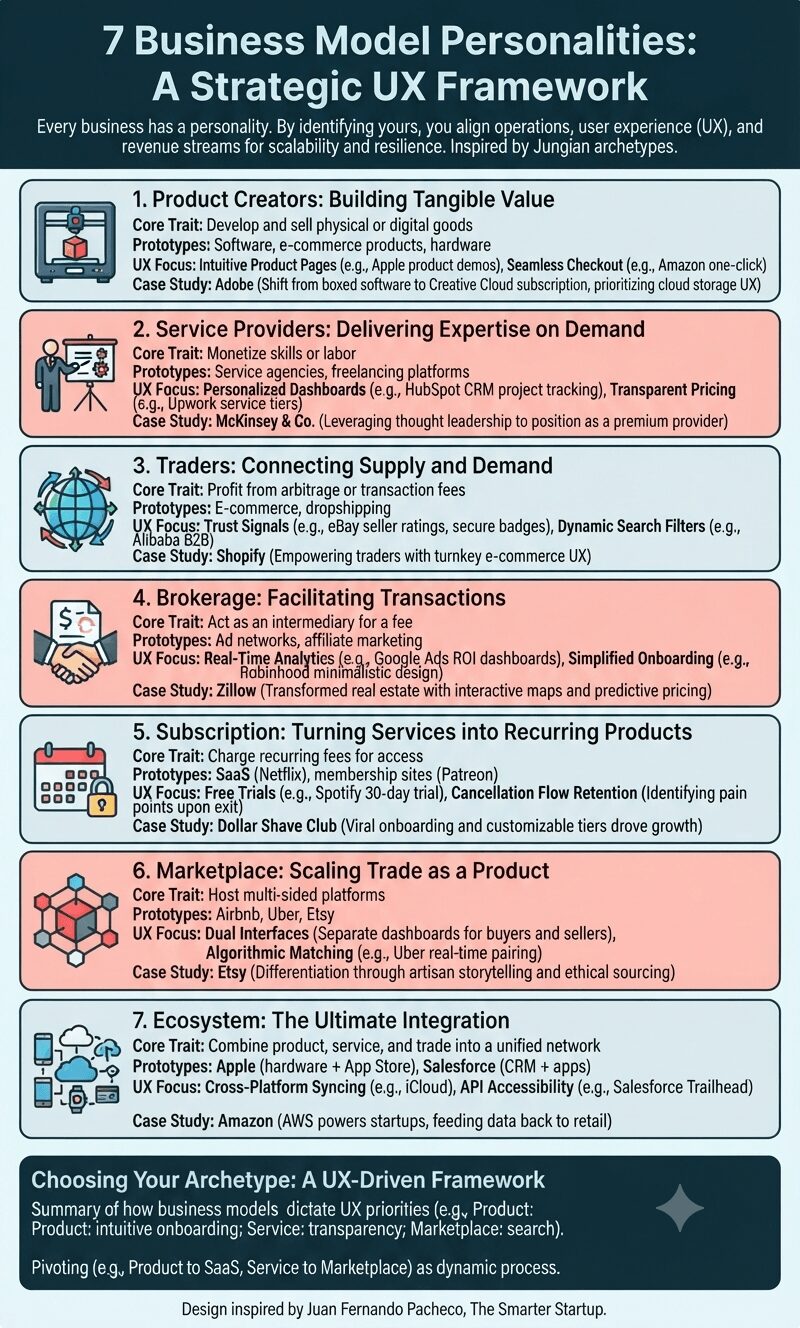
"Infographic titled '7 Business Model Personalities: A Strategic UX Framework' on a light background, detailing seven archetypes—Product Creators, Service Providers, Traders, Brokerage, Subscription, Marketplace, and Ecosystem—each with an icon, core traits, prototypes, UX focus, and a real-world case study."

Every business operates like a machine—input resources, process value, and output profits. But without a clear “instruction manual,” even brilliant ideas risk failure.

Inspired by Carl Jung’s personality archetypes, the 7 Business Model Personalities framework offers a strategic lens to align your operations, user experience (UX), and revenue streams.