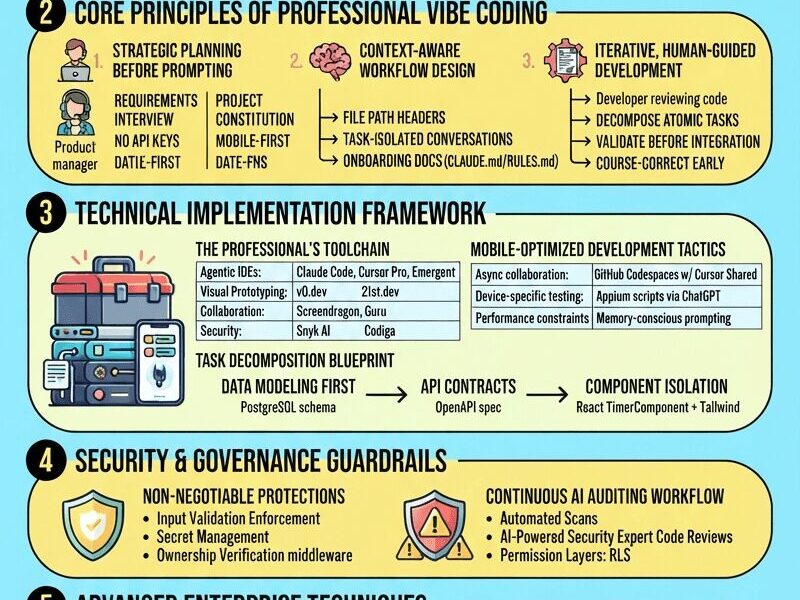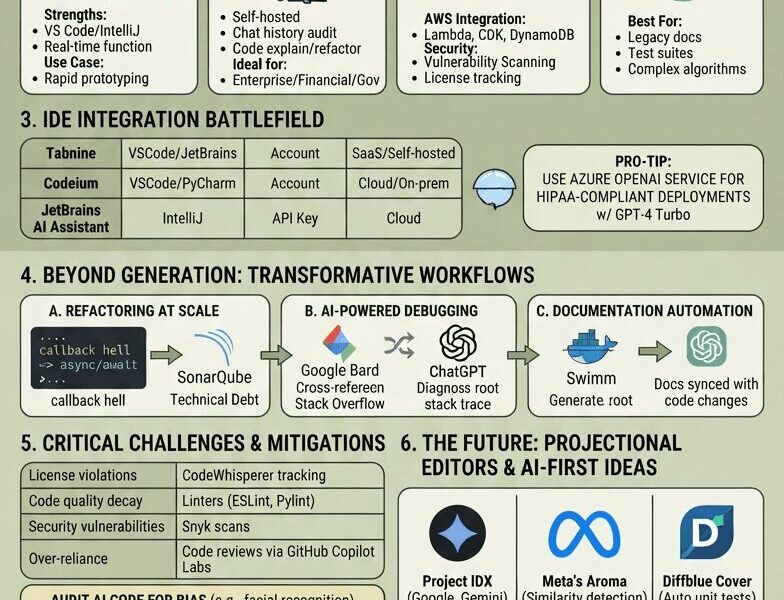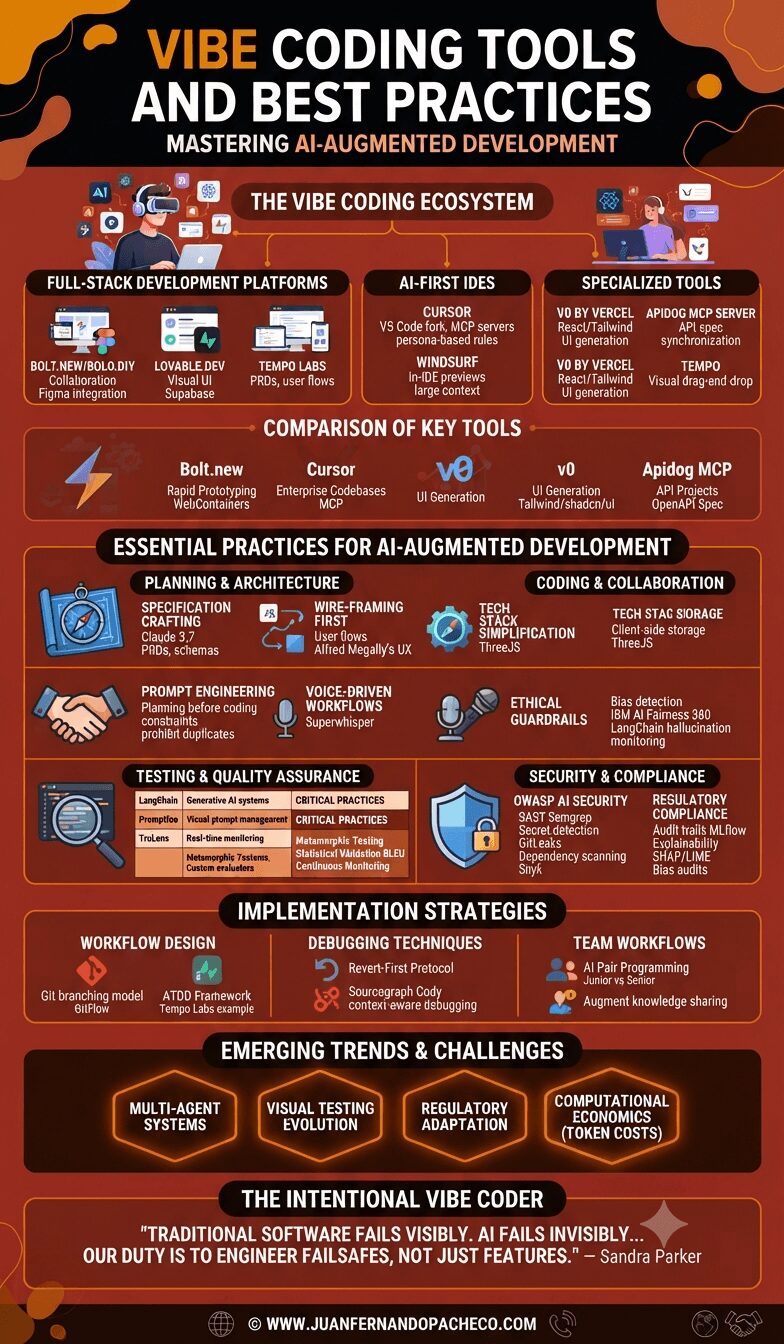
Mastering AI-Augmented Development
Introduction: The New Development Paradigm
Vibe coding transforms natural language into functional code through AI-powered tools, creating a paradigm shift where developers prioritize intention over implementation.
Coined by Andrej Karpathy, this approach enables programmers to “vibe” with their creative flow rather than wrestle with syntax. As a UX designer and solutions architect, I’ve witnessed how this evolution democratizes development while introducing new challenges in quality control and workflow design.
Core Vibe Coding Tool Ecosystem
Full-Stack Development Platforms
Bolt.new/bolt.diy: StackBlitz’s AI-powered environment enables browser-based full-stack development with real-time collaboration. Unique features include Figma design imports and GitHub integration.
Lovable.dev: Optimized for non-coders, its visual UI editor allows targeted AI modifications via element selection. Integrated with Supabase for auth/database operations.
Tempo Labs: Generates Product Requirement Documents (PRDs) and user flow diagrams alongside code with experimental GitHub import functionality.
AI-First IDEs
Cursor: A VS Code fork supporting MCP servers for tool orchestration with persona-based coding through
.cursorrulesconfiguration.Windsurf: Features in-IDE app previews and excels at context retention for large codebases.
Specialized Tools
v0 by Vercel: Generates production-ready React/Tailwind UI code from text prompts.
Apidog MCP Server: Bridges API documentation with AI coding environments through OpenAPI spec synchronization.
Tempo: Visual drag-and-drop editor for React that syncs with Storybook and GitHub.
Comparison of Key Tools
| Tool | Primary Use Case | Standout Feature |
|---|---|---|
| Bolt.new | Rapid prototyping | WebContainers (Node in browser) |
| Cursor | Enterprise codebases | MCP server integration |
| v0 | UI generation | Tailwind/shadcn/ui optimization |
| Apidog MCP | API-driven projects | OpenAPI spec caching |
Essential Practices for AI-Augmented Development
Planning & Architecture
Specification Crafting: Use Claude 3.7 to generate PRDs with clear feature descriptions, database schemas, and milestone definitions.
Wireframing First: Map user flows before coding to surface logic gaps early, as emphasized in Alfred Megally’s UX principles.
Tech Stack Simplification: Avoid over-engineering. Client-side storage often suffices for vibe-coded apps, as demonstrated by ThreeJS-based implementations.
Coding & Collaboration
Prompt Engineering Essentials:
Always require: “Explain your plan before coding”
Constraint templates: “Implement simplest testable version using [specified stack]”
Non-negotiables: Prohibit duplicate code and enforce environment separation
Voice-Driven Workflows: Tools like Superwhisper maintain creative flow through natural language coding.
Ethical Guardrails: Implement bias detection with IBM’s AI Fairness 360 and hallucination monitoring via LangChain.
Testing & Quality Assurance
AI testing requires specialized approaches:
Testing Framework Comparison
| Framework | Primary Strength | Best For |
|---|---|---|
| LangChain | Custom evaluators | Generative AI systems |
| Promptfoo | Visual prompt management | Multi-model comparison |
| TruLens | Real-time monitoring | Production deployments |
Critical Testing Practices:
Metamorphic Testing: Validate logical consistency across input variations
Statistical Validation: Use distribution checks (BLEU scores) instead of exact-match assertions
Continuous Monitoring: Track model decay via Elasticsearch log analysis
Security & Compliance
OWASP AI Security Essentials:
SAST scans with Semgrep
Secret detection via GitLeaks
Dependency scanning with Snyk
Regulatory Compliance: For high-risk systems:
Maintain audit trails with MLflow
Implement explainability layers (SHAP/LIME)
Conduct third-party bias audits
Implementation Strategies
Workflow Design
ATDD Framework:
# Tempo Labs implementation
generate_acceptance_tests(
    specification="User authentication flow",
    scenarios=["Password reset", "Account lockout"],
    coverage_threshold=90
)
Branching Strategy: Adopt GitFlow with protected
mainbranches and AI development branches.
Debugging Techniques
Revert-First Protocol: When AI breaks code:
Immediate rollback via version control
Isolate changes in feature branches
Query AI: “Diagnose regression in [file] between versions X-Y”
Context-Aware Debugging: Use Sourcegraph’s Cody for codebase-aware issue resolution.
Team Workflows
AI Pair Programming:
Junior developers: AI handles 70% implementation with human architecture review
Senior developers: Automate boilerplate (tests/docs) saving 6+ hours weekly
Knowledge Sharing: Augment’s codebase indexing enables team-wide context sharing.
Emerging Trends & Challenges
Multi-Agent Systems: Specialized AI agents collaborating on security, quality, and specification validation.
Visual Testing Evolution: Tools validating UI against real user journeys rather than DOM structures.
Regulatory Adaptation: Documentation frameworks like Model Cards for compliance.
Computational Economics: Balancing token costs against technical debt accumulation.
Conclusion: The Intentional Vibe Coder
Vibe coding augments human creativity rather than replacing developers. The most successful practitioners:
Master fundamentals before automating
Treat AI as a collaborative partner
Implement rigorous validation guardrails
“Traditional software fails visibly. AI fails invisibly by presenting wrong answers confidently. Our duty is to engineer failsafes, not just features.” – Sandra Parker
Starter Toolkit:
Prototyping: Bolt.new + v0
Production: Cursor + Apidog MCP
Testing: LangChain + Promptfoo
Database: ElasticSearch + Python client
The future belongs to developers who blend intuition with AI, ship responsibly, and evolve continuously.