The big idea strategy: six checks to build and sell ideas that endure
Most strategy documents are forgotten before they are finished.
The analysis is solid, the market data is current, the financial model balances. And still nothing happens. The teams never rally, the budget never moves, and a year later the same problems sit on the same agenda, only older.
I have watched this pattern for more than twenty years, from the design studio to the boardroom. I have seen brilliant product roadmaps die in silence, and multi-million dollar enterprise deals collapse under two hundred slides that said nothing memorable. I have also seen the opposite: a small team with a modest budget outperform a competitor with every advantage, simply because their strategy had a center of gravity.
That center of gravity is the big idea.
It is the central, unifying concept of a strategy; it gives it purpose, momentum and difference. Without it, a strategy is a list. With it, a strategy becomes a story people can repeat, defend and execute.
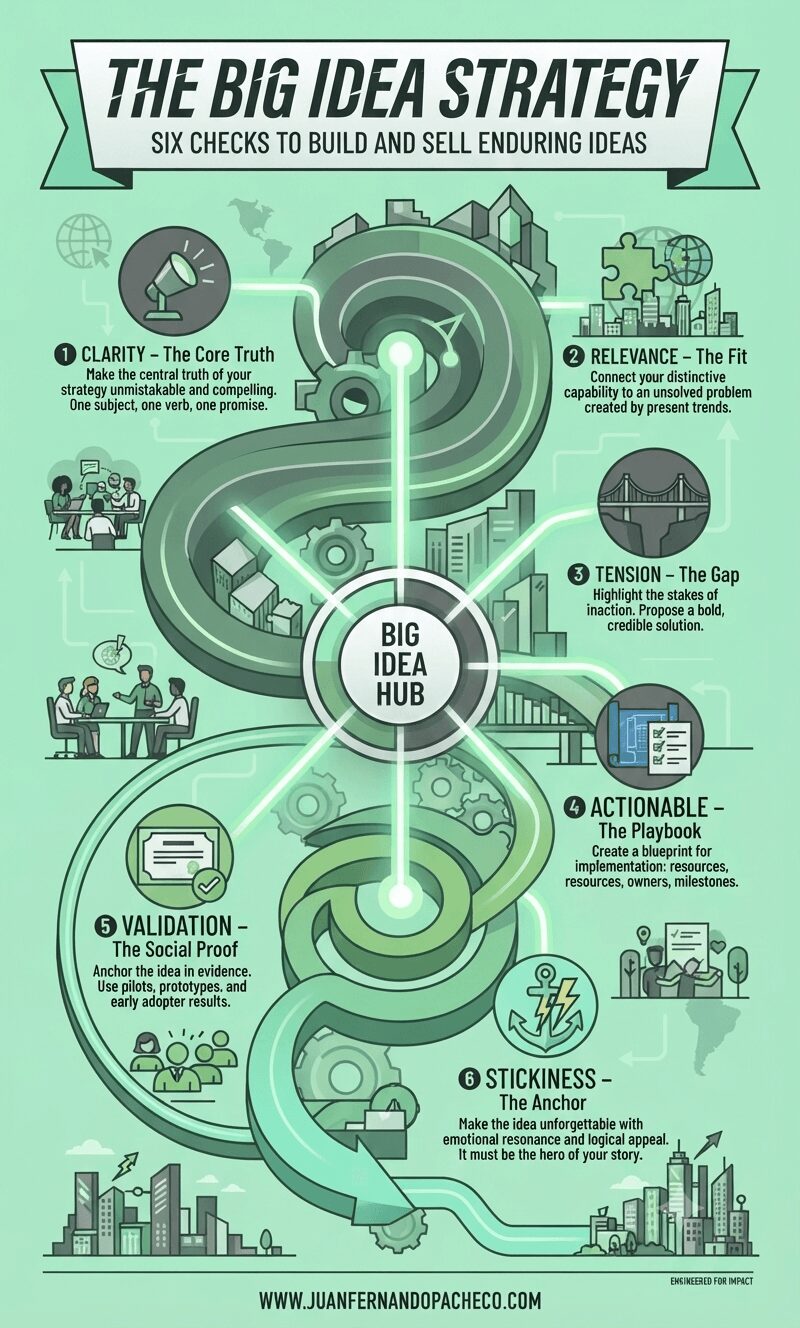
In this post, I share the big-idea strategy framework I use to build and test the central concept, whether the strategy in question is a product roadmap, a market entry plan, or a response to a high-stakes RFP. Four checks build the idea; two checks sell it. Apply them in order, and refuse to move on until each one passes.
What a big idea is, and what it is not
A big idea is not a goal.
“Grow revenue in the region” is a goal. “Become the number one platform for digital banking” is an ambition. The big idea is the concept that makes the goal achievable and the ambition believable: an insight about the world, combined with a distinctive way to act on it, that nobody else in your market can claim as convincingly as you can.
A simple test is this.
If a competitor can copy your strategy slide word for word and nothing in it feels wrong, you do not have a big idea; you have a category standard. A big idea creates difference by design. It chooses, excludes, and commits.
A second test is repetition.
In a complex organization, your strategy will be communicated by other people, in rooms you are not in. Procurement officers will summarize it for evaluation committees; executives will summarize it for boards. If the idea cannot survive that telephone game, it is not simple enough yet.
That is why the framework treats the big idea as both an engineering problem and a communication problem. You build it rigorously, then you sell it deliberately.
Two halves: build and sell
The six checks split into two groups.
Clarity, relevance, tension, and the playbook belong to the build half: they make the idea true, timely, sharp, and executable. Validation and stickiness belong to the sell half: they make other people believe it and remember it.
Most teams over-invest in one half. Analysts build a perfect idea nobody feels, and it dies in a deck. Marketers sell a sticky slogan with nothing underneath, and it dies in due diligence. The framework only works when both halves pass.
1. Clarity – the core truth
Clarity demands one thing: make the central truth of your strategy unmistakable and compelling. If a reader finishes your document and cannot say what your strategy is in one sentence, the idea fails the first check.
Clarity is hard because it forces choices.
A sentence can hold one subject, one verb, one promise. The moment you add “and also”, clarity dissolves. Most strategy documents are unclear not because the writers are bad at writing, but because leadership has not agreed on what matters most. The fuzzy sentence is a symptom of an unresolved debate.
In enterprise deals, we call this the win theme.
Before writing a single page of a proposal, we agree on one sentence that captures why the client should choose us over the alternative. Every section must serve that sentence; any paragraph that does not advance it gets cut, no matter how much effort went into producing it.
The discipline:
Write the strategy as one sentence, in plain language, with no jargon. Test it on someone outside the project. If they need a second explanation, go back. Clarity is not the absence of complexity; it is the mastery of it.
2. Relevance – the fit
Relevance makes the big idea feel inevitable, as if tailor-made for the moment. A clear idea that is not relevant is a solution in search of a problem.
The discipline is to study the trends shaping your industry and, more importantly, the unmet needs those trends create. Every shift in regulation, technology, customer behavior, or the economy leaves someone with a problem that the market does not solve well. The relevant big idea connects your distinctive capability to that unsolved problem.
Note that this is not about predicting the future
It is about reading the present carefully. The trends that matter are already visible: in the client’s annual report, in the questions buyers ask in the first meeting, in the complaints your support team logs every week. You do not need a crystal ball. You need attention.
In commercial work, relevance is the difference between pushing a product and answering a need. A client does not buy a platform; they buy relief from the pressure they have right now – a regulator’s deadline, a cost line under attack, a competitor moving faster.
Frame the idea against their moment, not your launch calendar, and remember that relevance expires: an idea that would have worked the same way five years ago is a truth, not a fit.
3. Tension – the gap
Tension is the delta between now and the future, and it is the engine of urgency. A strategy without tension is a strategy nobody feels compelled to fund. The check asks you to highlight the stakes and propose a bold, yet credible, solution.
There are two failures here.
The first is playing it safe: an idea so modest that the gap between today and tomorrow disappears, and with it any reason to act. The second is playing it incredible: a moonshot the organization silently dismisses because nobody believes it can be done. The productive zone is boldness with credibility – a gap big enough to matter, a bridge solid enough to cross.
In deals, tension is the cost of inaction.
Every procurement process exists because somebody decided the status quo is no longer acceptable. The proposals that win articulate that gap better than the client did: what continues to leak, in money, risk or time, if nothing changes; what becomes possible if the right move is made now.
Tension also protects a strategy from internal complacency.
A roadmap that names the gap – “our clients onboard in eleven days; the best in the market does it in one” – creates an energy a roadmap of initiatives never will.
Ask:
What does the world look like in three years if we do nothing? If that picture does not hurt a little, the tension is too weak. If the solution you propose does not feel a little uncomfortable, the boldness is too small.
4. Actionable – the playbook
An idea that cannot be implemented is a wish.
The fourth check demands a blueprint: the sequence of moves, the resources, the owners, and the milestones that bring the idea to life. It must be something you can actually implement, with the constraints you actually have.
This is where many big ideas die, because the jump from concept to execution is where optimism meets reality. The playbook does not need to be a complete project plan; it needs to be credible. What is the first move? What do you stop doing to free capacity? Which capability is missing, and how do you close it – build, buy, or partner? What will you see in ninety days that tells you the idea is working?
In enterprise technology, the playbook is the difference between a promise and a contract. Clients do not sign promises. They sign service levels, delivery schedules, governance models, and penalty clauses. A proposal with a bold win theme must translate it into concrete commitments: who does what, by when, with which guarantees. The same logic applies to any strategy: the boldness lives in the idea; the credibility lives in the playbook.
A good habit is to end every strategy document with the first three moves, named with owners and dates. If you cannot name them, the idea is not actionable yet, and the framework is telling you to keep working before asking anyone for budget.
5. Validation – the social proof
Now we cross from build to sell.
Validation anchors the big idea in evidence, because people rally behind what they can believe. However clear, relevant, tense, and actionable the idea is, a new audience will ask the same quiet question: who says?
Validation comes in layers.
The strongest is proof from the outside world: clients who adopted early, results that were measured and can be repeated, third parties that checked the work. The next layer is proof from the inside: pilots, prototypes and proofs of concept that show the idea survives contact with reality. Even a small, honest experiment is worth more than a large, untested assumption.
In complex sales, this check is non-negotiable.
Buyers in regulated industries – banking, insurance, public sector – are professionally cautious, because their careers sit on the line in every large decision. A proposal that brings evidence – references, case studies, measurable outcomes from comparable work – removes risk from the evaluator’s decision. A proposal without evidence transfers risk to them, and people rarely vote for personal risk.
The durable discipline is to build validation before you need it.
Run the pilot before the big pitch. Publish the result before the big meeting. Highlight the early adopters, because nothing makes an idea feel safer than seeing someone respected already walking the path. If you are missing evidence, go and generate it; that is cheaper than losing the deal or the year.
6. Stickiness – the anchor
The final check is stickiness.
For a big idea to endure, it needs both emotional resonance and logical appeal. Logic makes people nod; emotion makes them move. The idea must survive the corridor conversation and the board meeting where your slide is number eleven of forty. Make it the hero of your story.
Stickiness is often confused with a slogan, but it is deeper.
A sticky idea has a simple structure: a familiar truth, a surprising twist, a concrete image. It is easy to say and hard to forget. It gives the organization a common language, a shorthand that carries the whole strategy in a few words.
In my own work, stickiness is the last filter on any win theme.
We ask: will the evaluation committee repeat this phrase when we leave the room? If the phrase is generic – “excellence”, “innovation”, “partnership” – it will not survive, because every competitor says it. If it is specific and slightly provocative, it travels.
To build stickiness, borrow from storytelling.
Name the hero – and note that in a deal the hero is the client, while your idea is the tool that helps them win. Name the obstacle. Show the transformation. Keep the language concrete: numbers, images, verbs. Abstract nouns are where stickiness goes to die. And honor the double requirement: emotion plus logic. A sticky idea that fails the first four checks is propaganda; a validated idea that is not sticky is a secret.
Putting the six checks to work
Treat the framework as a gate, not a workshop exercise.
Draft the big idea in one sentence. Run it through the six checks in order and score each honestly: pass, fail, or not yet known. Fix the weakest check first, because the chain holds at its weakest link.
Use it for diagnosis too.
When a strategy, product, or proposal is struggling, the checks tell you where. Clear but not relevant? You have a well-expressed answer to a question nobody asks. Relevant and tense but not actionable? Urgency without a vehicle. Actionable and validated but not sticky? A good plan nobody remembers. Each failure has a different remedy, and naming the failure correctly saves months.
Finally, use it for alignment.
In cross-functional teams – product, sales, legal, engineering, operations – the six checks give a neutral vocabulary for disagreement. Instead of debating opinions, the team debates checks: do we pass tension? Do we pass validation? Strategy stops being a political contest and becomes an engineering review.
The idea is the strategy
After many years of designing products, architecting solutions, and leading deals across Latin America, I am convinced that the difference between strategies that move markets and strategies that gather dust is rarely the quality of the analysis. It is the quality of the idea at the center, and the discipline used to build it and sell it.
- Clarity makes it unmistakable.
- Relevance makes it inevitable.
- Tension makes it urgent.
- The playbook makes it real.
- Validation makes it believable.
- Stickiness makes it unforgettable.
Six checks, two halves, one idea worth rallying behind. Write it in one sentence, test it against the six, then go and execute it – and let the market answer.