Stop playing the wrong game
Most strategy reviews I have sat through in twenty years of product and deal work — from a startup pivot to a nine-figure enterprise pursuit — collapse for the same quiet reason.
The team built a good strategy for the wrong market.
- They planned meticulously where the market rewards speed.
- They moved fast where the market rewards scale.
- They tried to orchestrate partners in an arena that only respects price.
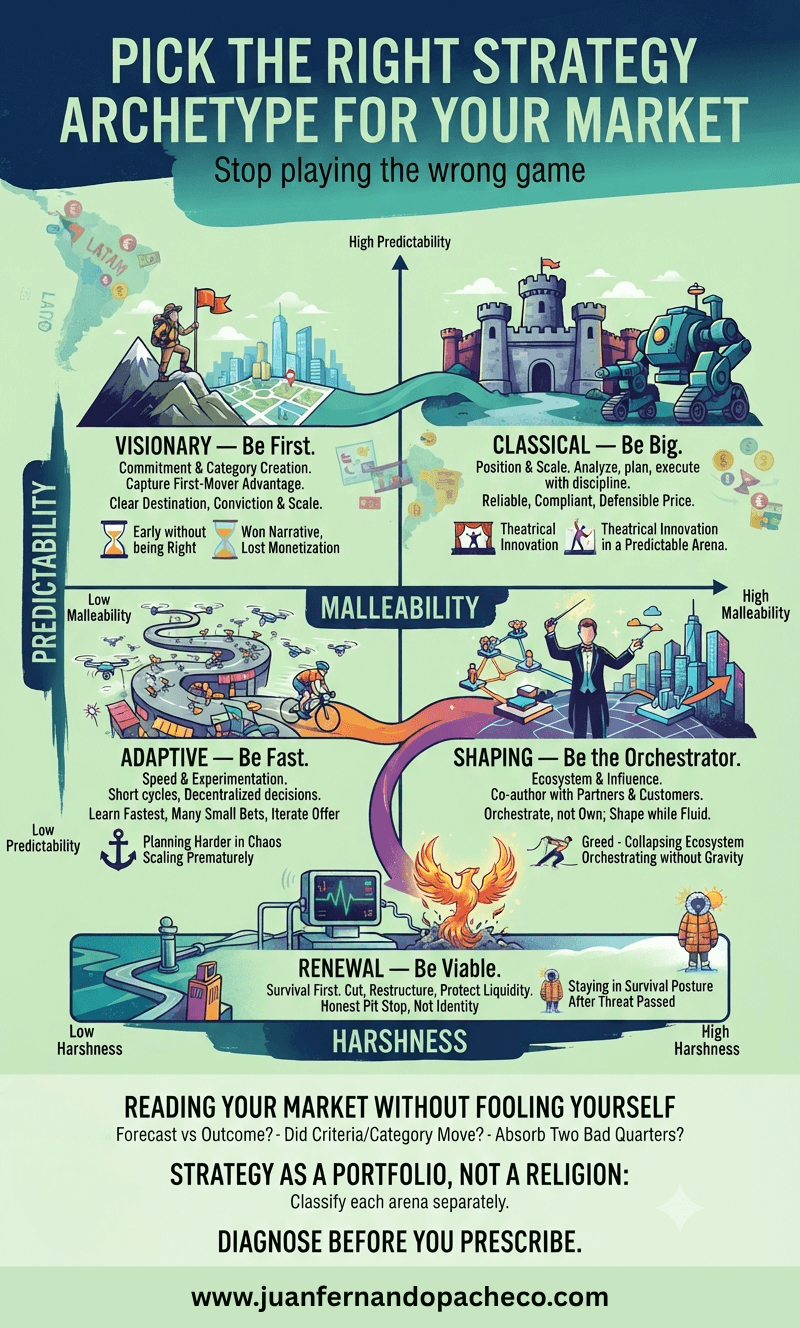
The strategy was not weak; the diagnosis was. That is the insight behind the line “your strategy needs a strategy“, coined by Reeves, Haanes and Sinha, and it is why I keep a simple diagram on my wall that sorts five strategic plays along two axes — predictability and malleability — with a third condition, harshness, standing guard over all of them.
In this post, I want to unpack that diagram the way I actually use it
As a commercial leader selling technology into Latin America, and as a student of why some deals glide while equally good teams bleed. Everything below is deliberately evergreen. Currencies will move, governments will turn, platforms will rise and fall, but the discipline of matching your play to your environment does not expire.
The two questions that decide the play
Before any annual plan, market entry or major pursuit, I force one honest hour on two questions.
The first is predictability
How well can you actually forecast this market — its demand, its budgets, its competition, its regulation? The test is historical: if your last three forecasts were comfortably right, you sit at the predictable end.
If your last three plans were rewritten by events you never modeled, you are in unpredictable territory, and any strategy that leans on long-range planning is borrowing confidence it does not have.
The second is malleability
Can you, alone or with partners, change the rules of the game — define a category, move a buyer’s evaluation criteria, influence how a regulation is framed? Some markets are fixed arenas: the walls are built, the referee is hired, and you compete inside them. Others are soft clay: the category is unwritten, the standards are unset, and a determined player with the right allies can literally author the game.
Cross those two answers, and you get four environments, each with a natural play.
Then ask a third, brutal question: how harsh is the environment?
If survival itself is in doubt, if losses are structural and liquidity is thin, none of the four plays apply yet. You enter renewal, survive first, and choose your play later.
The five plays, in the language of people who sell
Classical — be big.
When the market is predictable, and you cannot reshape it, the winning logic is position and scale. You analyze, you plan, you build cost and scale advantages, and you execute with discipline year after year. In enterprise technology, this is the mature deal space: standardized infrastructure, conventional outsourcing, specifications everyone already knows.
The buyer is not asking for poetry; they are asking for reliability, coverage, and a defensible price. Your RFx answer in a classical arena is a machine — compliant, credible, optimized, zero drama. The classic failure mode is theatrical innovation where the buyer wants predictability, or leaving margin on the table because you never took scale seriously.
Visionary — be first.
When you can see the destination clearly, and the market is shapeable enough to let you build it, the play is commitment. You create a new space or category and capture the first-mover advantage before consensus arrives. This is the founder’s play, and inside large firms it is the bet on an offering the market has not yet learned to request.
The discipline is to pair conviction with a machine that scales what you prove; vision without execution is a documentary about someone else’s future. The failure mode is being early without being right, or winning the narrative and losing the monetization.
Adaptive — be fast
When you can neither forecast nor control, advantage becomes short-lived by definition, and the edge goes to whoever learns fastest. You run many small experiments, keep cycles short, decentralize decisions, and let a pipeline of cheap bets discover what works. Anyone selling technology in volatile economies knows this play in their bones: budgets freeze mid-quarter, currencies move, policy turns. The adaptive deal team runs more, smaller pursuits, adapts the offer per vertical, and treats every lost RFx as paid tuition. The failure mode is planning harder inside chaos, or scaling a bet before the signal deserves it.
Shaping — be the orchestrator
The rarest and most interesting quadrant: unpredictable, yet shapeable. You cannot forecast the future, but you can co-author it with an ecosystem — partners, platforms, customers, even regulators. You orchestrate instead of owning, and you shape the proposition while the market is still fluid.
In enterprise deals, shaping is the work that happens before the RFP exists: convening the ecosystem, co-investing with partners, setting the evaluation criteria that will later favor your architecture. The failure mode is greed — capturing too much value too early and collapsing the ecosystem — or orchestrating without gravity, calling meetings that nobody needs to attend.
Renewal — be viable
When harshness is high, the objective narrows to survival. You cut to buy time, restructure the portfolio, protect liquidity, and pivot only once viability is restored. In deal language, renewal is the quarter you stop chasing trophy logos, shrink the pipeline to what can actually close, and renegotiate the delivery footprint.
Renewal is honest and sometimes heroic, but it is a pit stop, not an identity. The failure mode is staying in survival posture after the threat has passed, exporting caution into a market that now rewards growth.
Reading your market without fooling yourself
The framework is simple; the honesty is not
Teams routinely flatter their own market into the quadrant where their favorite strategy lives. A few blunt probes help.
- For predictability, compare the last three forecasts with the last three outcomes, and count how often budgets froze mid-cycle.
- For malleability, ask whether you have ever moved a buyer’s criteria, a category’s definition, a regulator’s frame — and had it stick. Most teams discover their malleability is lower than their ambition.
- For harshness, ask whether you could absorb two bad quarters without existential decisions; if not, renewal is not one option among five, it is your current address.
One more discipline: treat strategy as a portfolio, not a religion
Different segments of the same company can sit in different quadrants. Your enterprise accounts may be a classical arena while your mid-market is adaptive and your innovation line is visionary.
The mature move is to label each arena separately and run the matching play in each, instead of forcing one corporate slogan onto five different realities.
What changes in your next RFx
Now make it operational.
Before the next big pursuit, classify the arena and let the archetype set the posture.
- In a classical RFx, win on scale and precision: your proposal is an instrument of compliance and credibility, and your pricing tells a story of structural advantage.
- In an adaptive one, refuse the monolithic answer: iterate the offer, keep pursuit cycles short, and learn something from every loss.
- In a visionary arena, notice that you should rarely be responding at all — you should have created the category earlier, so the RFx never gets to define you.
- In a shaping arena, remember that the real work happened months before publication; if you are arriving only now, orchestrate what remains orchestrally — the clarification questions, the benchmarks, the partner coalition. And if you are
- In renewal, answer only the deals that keep you viable and say no to everything else, without apology. A pipeline is a promise about your environment; the archetype tells you which promises are honest.
Why Latin America teaches this better than any MBA
I learned most of this selling across Mexico, Colombia, Ecuador and the wider region, because Latin America is a natural laboratory of low predictability and real malleability.
Elections reset rules, currencies reprice deals, and yet — precisely because so few categories are fully settled — a player with courage and partners can still author markets in a way that is harder in more defended economies.
Adaptive and shaping plays show up there weekly, while the classical muscle, trained on stable markets, keeps losing its grip. The leaders who win in the region are not the ones with the biggest plan; they are the ones who switch plays fluidly, almost casually, as conditions change.
And here is the evergreen twist
Under stress, every market becomes Latin America for a while. Harshness can visit any P&L, unpredictability has migrated into every forecast, and the diagram that explains Bogotá or Quito also explains a disrupted industry anywhere.
The mistakes that keep repeating
Five errors show up again and again
- Defaulting to classical because planning feels like management, even when the market stopped rewarding plans.
- Calling a visionary commitment what is really an adaptive experiment — or the reverse — and mis-sizing the bet.
- Attempting to shape without gravity, convening ecosystems around assets nobody wants.
- Staying in renewal after viability returns, so caution becomes culture.
- And switching archetypes mid-play, which customers and partners experience as inconsistency, the fastest way to spend trust.
The antidote in every case is the same
Diagnose the environment out loud, name the play, and let everyone — from the sponsor to the delivery team — know which game is being played this quarter.
Diagnose before you prescribe
The promise of the framework is modest and profound at once
There is no best strategy, only the strategy that fits your environment. So diagnose before you prescribe.
- Be big where the market is stable.
- Be first where it is clear and shapeable.
- Be fast where it is chaotic and fixed.
- Be the orchestrator where it is chaotic and soft.
- Be viable where it is cruel.
And when the environment moves — it will — change your play with it, without ego. That single discipline will still be useful in five years, which is exactly what evergreen strategy should mean.