A strategic guide to winning high-stakes tech deals
In the world of enterprise technology, the request for proposal (RFP) is often misunderstood as a mere bureaucratic hurdle. It is viewed by many sales and engineering teams as a tedious paperwork exercise, a box-checking marathon that stands between them and a signed contract.
But after more than 20 years of transforming user needs, business goals, and regional complexities into scalable IT products and services,
I can tell you that this perspective is fundamentally flawed.
The RFP is not a hurdle; it is a battlefield. It is the crucible where multi-million-dollar contracts are forged, and where the difference between a generic vendor and a strategic partner is permanently decided.
Throughout my career, which has spanned from senior UX design and solutions architecture to business development and strategic deal leadership across Latin America, I have led end-to-end RFI, RFQ, and RFP processes for top regional and global brands.
Whether dealing with the stringent regulatory environments of the banking and finance sectors in Colombia and Mexico, or the complex telecommunications landscapes in Brazil and Chile, the core truth remains the same:
High-stakes IT procurement is an exercise in extreme alignment.
You must align technical capabilities with commercial realities, legal constraints with operational bandwidth, and your product roadmap with the client’s long-term vision.
This guide is designed to be an evergreen resource for product leaders, business development managers, and solutions architects.
The tools and technologies we use will inevitably evolve over the next five to ten years, but the psychology of enterprise procurement, the necessity of risk mitigation, and the mechanics of complex deal execution will remain constant.
Here is how you decode the enterprise RFP and build a strategy that wins.
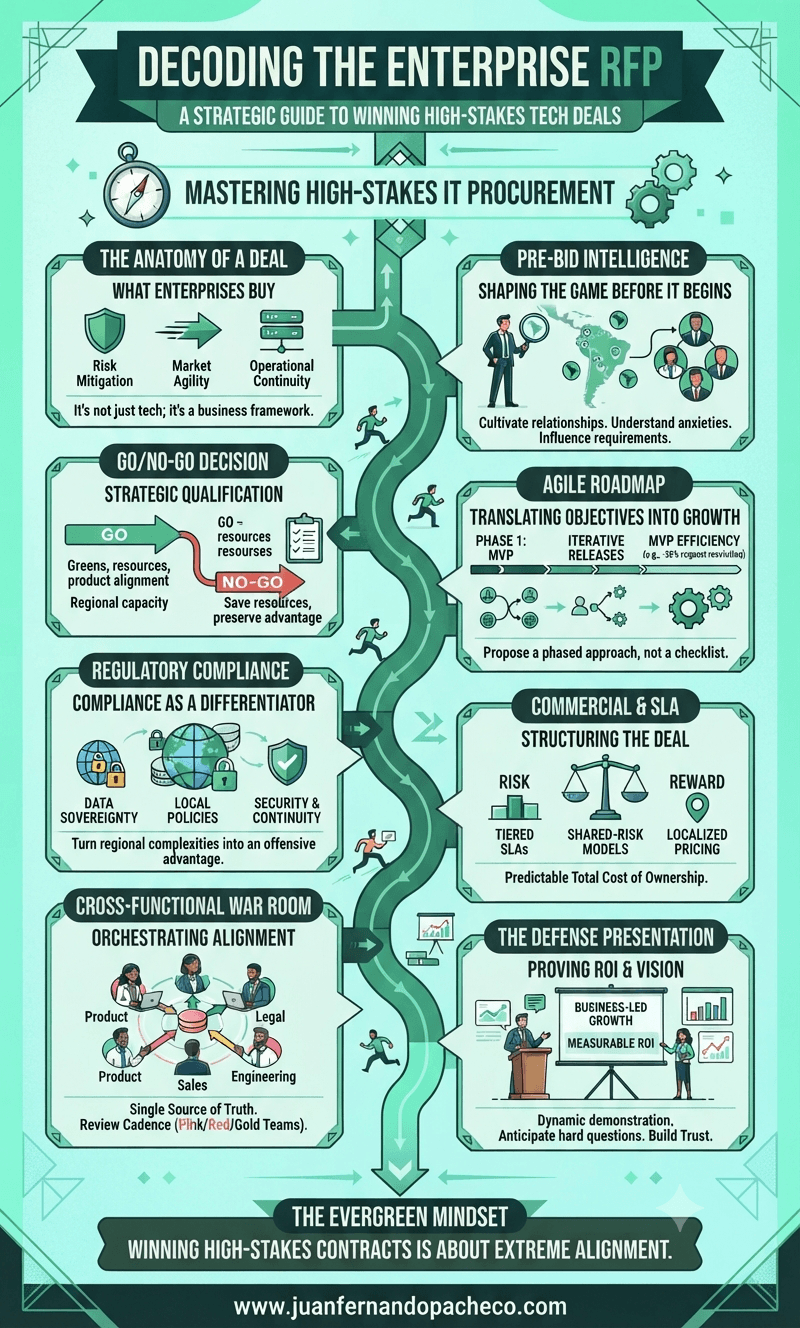
The anatomy of a high-stakes technology procurement
To win a high-stakes deal, you must first understand what the enterprise is actually buying.
They are not buying software licenses, cloud infrastructure, or agile development squads. They are buying risk mitigation, market agility, and operational continuity.
When a major financial institution issues a complex RFP, they are usually responding to market pressure, a regulatory mandate, or a critical legacy system failure.
A high-stakes technology procurement is characterized by several unforgiving factors.
- First, there is the presence of complex legal clauses and enterprise security requirements. These are not negotiable in the traditional sense; they are binary gates that can instantly disqualify a technically superior proposal.
- Second, there is the reality of government mandates and data sovereignty. Across Latin American markets, and indeed globally, data residency laws dictate where information can be stored, processed, and backed up.
- Third, there is the stringent negotiation of service level agreements (SLAs), where uptime guarantees, response times, and financial penalties carry massive operational weight.
When you approach an RFP with this anatomy in mind, your entire response strategy shifts.
You stop selling features and start selling a comprehensive risk-management framework wrapped in a technology solution. You begin to read the RFP not as a list of demands, but as a map of the client’s deepest organizational anxieties.
Pre-bid intelligence and the go/no-go decision
The most critical phase of the RFP process happens before the document is even published.
In high-stakes RFx execution, waiting for the official release to start your market research is a recipe for failure. By the time an RFP drops, the incumbent vendor or a highly engaged competitor has likely already spent months shaping the requirements, subtly steering the technical specifications toward their unique differentiators.
True enterprise RFP strategy begins with pre-bid intelligence.
This involves cultivating relationships with C-level executives, board members, and key subject matter experts long before a formal procurement process begins.
It means facilitating face-to-face meetings with senior management to understand their strategic initiatives and pinpointing market gaps that your organization is uniquely positioned to fill.
Once the RFP is released, the immediate next step is not to assemble a writing team
But to execute a ruthless go/no-go decision matrix. Bidding on a complex enterprise deal requires a massive mobilization of internal resources, including product, sales, legal, engineering, and operations.
You must evaluate the strategic fit of the opportunity.
- Does this deal align with our long-term product roadmap?
- Do we have the regional capacity to support the stringent SLAs required?
- Are the legal and compliance risks within our acceptable threshold?
A strategic leader knows that a well-reasoned “no-go” decision saves the company hundreds of hours and preserves resources for deals where you have a distinct, defensible advantage.
If the decision is a “go”, you move forward with total commitment, treating the pursuit as a high-priority internal product launch.
Translating business goals into agile product roadmaps
One of the most significant advantages a deal leader can possess is a deep background in product management and user experience. Early in my career, I spent years as a UX designer and product owner, mapping user journeys and building minimum viable products.
This background is invaluable when decoding an enterprise RFP because it allows you to view the procurement document through the lens of user story mapping and commercial-product synergy.
An enterprise RFP is, at its core, a massive collection of user stories generated by the client’s stakeholders.
However, these requirements are often bloated, contradictory, or focused on legacy workflows rather than future-state efficiencies. Your job is to translate these raw client objectives into an agile product roadmap that demonstrates clear business-led growth.
Instead of simply agreeing to every line item in the technical requirements matrix, a winning strategy involves proposing a phased, agile approach. You show the client how you can deliver a high-impact minimum viable product (MVP) that accelerates their time-to-market, followed by iterative releases that boost user adoption.
In my experience managing deals across the banking and finance sectors
Proposing a streamlined proof of concept (POC) development process can reduce customer request resolution times by up to 30 percent. By presenting a roadmap that prioritizes backlog items based on actual business value rather than arbitrary technical checklists, you position your organization as a strategic partner.
You are no longer just an outsourced development team; you are an extension of their product management office, focused on MVP efficiency and scalable IT architecture.
Navigating regulatory compliance and data sovereignty
In the current geopolitical and technological landscape, you cannot separate technology deployment from regulatory compliance. This is especially true when scaling tech revenue across diverse LATAM markets like Mexico, Colombia, Peru, Chile, Argentina, and Brazil. Each of these nations has its own evolving framework regarding data privacy, financial regulations, and government mandates.
Responding to an RFP from a regional bank or a telecommunications giant
Your proposal must explicitly address data sovereignty.
- Where will the cloud infrastructure be hosted
- Who has access to the encryption keys?
- How does your solution ensure compliance with local policies regarding cross-border data flows?
Many vendors treat compliance as a defensive checklist, attaching generic ISO or SOC2 certifications in an appendix.
A strategic enterprise RFP strategy turns compliance into an offensive differentiator.
You map out exactly how your architecture mitigates operational and legal risks for the client. You detail your incident response protocols, your data localization strategies, and your adherence to regional banking superintendencies.
Furthermore, you must address enterprise security requirements not just as IT problems, but as business continuity imperatives. By demonstrating a proactive approach to regulatory compliance, you alleviate the anxiety of the client’s legal and risk management teams, who are often the hidden decision-makers in the procurement process.
Mitigating these risks upfront is a key factor in ensuring 100 percent on-time delivery and long-term contract stability.
Structuring the commercial response and SLA negotiation
The commercial section of an RFP is where the theoretical value of your technology meets the hard reality of the client’s budget and risk tolerance. High-stakes deals are rarely won on the lowest price; they are won on the most predictable total cost of ownership and the most robust service level agreements.
Stringent SLA negotiation is a hallmark of complex deal execution.
Clients will demand aggressive uptime guarantees, rapid response times for critical incidents, and severe financial penalties for non-compliance. A mature business development manager does not simply accept these terms to win the deal, nor do they push back so hard that they lose the opportunity. Instead, they structure a commercial response that aligns risk with reward.
This involves tiered SLA models that differentiate between standard operational issues and critical business-impacting outages. It involves proposing shared-risk models where your organization’s compensation is partially tied to the successful adoption and performance of the deployed solution. This commercial-product synergy proves to the client that you have skin in the game.
Pricing strategy must reflect the true cost of the regional complexities involved.
Delivering high-quality services across multiple Latin American countries requires localized support teams, bilingual engagement managers, and an understanding of local labor laws and market rates. Your commercial response must highlight these value propositions and winning themes, showing the client that they are paying for a localized, resilient delivery engine, not just a remote, generic helpdesk.
Orchestrating the cross-functional war room
A winning RFP response is never the work of a single salesperson or a lone solutions architect
It requires the orchestration of a cross-functional war room, bringing together product, sales, legal, engineering, and operations. As a deal leader, my primary role is often that of an internal diplomat and project manager, ensuring stakeholder alignment and backlog prioritization.
The first step in orchestrating this effort is establishing a single source of truth.
This means creating a centralized repository for all client communications, requirement clarifications, and internal assumptions. When dealing with top regional brands, the volume of technical questions generated during the RFP clarification period can be overwhelming.
Coordinating relationship-building efforts with relevant partners, subject matter experts, and engagement managers ensures that everyone is well-informed about critical issues.
Next, you must enforce a rigorous review cadence.
The proposal creation process must be treated with the same discipline as a software release cycle. You need pink team reviews to assess the initial strategy and compliance, red team reviews to challenge the value propositions from the perspective of the client’s evaluation committee, and gold team reviews to finalize the pricing and executive summary.
Throughout this process, the deal leader must routinely report and measure progress against quarterly targets with regional and industry leaders.
By maintaining strict project management discipline over the RFP response, you ensure that the final submission is not only compliant but cohesive, compelling, and delivered flawlessly on time.
The defense presentation and proving ROI
Submitting the document is only the end of the first act
In high-stakes tech deals, the RFP defense presentation is where the actual winning happens. This is your opportunity to move from the written page to face-to-face meetings with senior management and board members.
The defense presentation should not be a repetitive reading of your executive summary
It must be a dynamic demonstration of your commercial-product synergy and your deep understanding of the client’s mission. This is where your background in design thinking and user-centered experiences becomes a massive advantage. You must design the presentation experience just as carefully as you design a software interface.
Focus on the narrative of business-led growth
Show the client exactly how your solution translates their strategic objectives into measurable ROI. Use data from your market research to highlight the gaps you have pinpointed and the specific initiatives you will spearhead to drive their solution development.
Anticipate the hardest questions regarding legal clauses, operational risks, and integration challenges
Address them proactively during the presentation. When C-level executives see that you have already thought through the darkest corners of the implementation process, their trust in your organization solidifies. You transition from a vendor trying to secure a purchase order to a trusted advisor ready to manage a multi-year strategic partnership.
The evergreen mindset for complex deal execution
The landscape of enterprise technology will continue to shift. Artificial intelligence, edge computing, and decentralized architectures will introduce new complexities into the RFP process. Government mandates will evolve, and the economic tides of the LATAM region will rise and fall.
The fundamental principles of high-stakes IT procurement remain immutable
Enterprises will always seek partners who can navigate regional complexities, mitigate operational and legal risks, and translate technical capabilities into scalable business growth.
By mastering the art of pre-bid intelligence, leveraging commercial-product synergy, and orchestrating cross-functional alignment, you build an enterprise RFP strategy that is resilient against the test of time.
Winning multi-million-dollar contracts is not about luck, and it is not about having the lowest hourly rate
It is about the relentless pursuit of alignment between your organization’s capabilities and the client’s deepest strategic needs. As you approach your next complex deal, remember that the RFP is not a barrier to entry. It is an invitation to prove that you are the strategic leader the market has been waiting for.