Negotiating SLAs and penalties in complex IT procurement
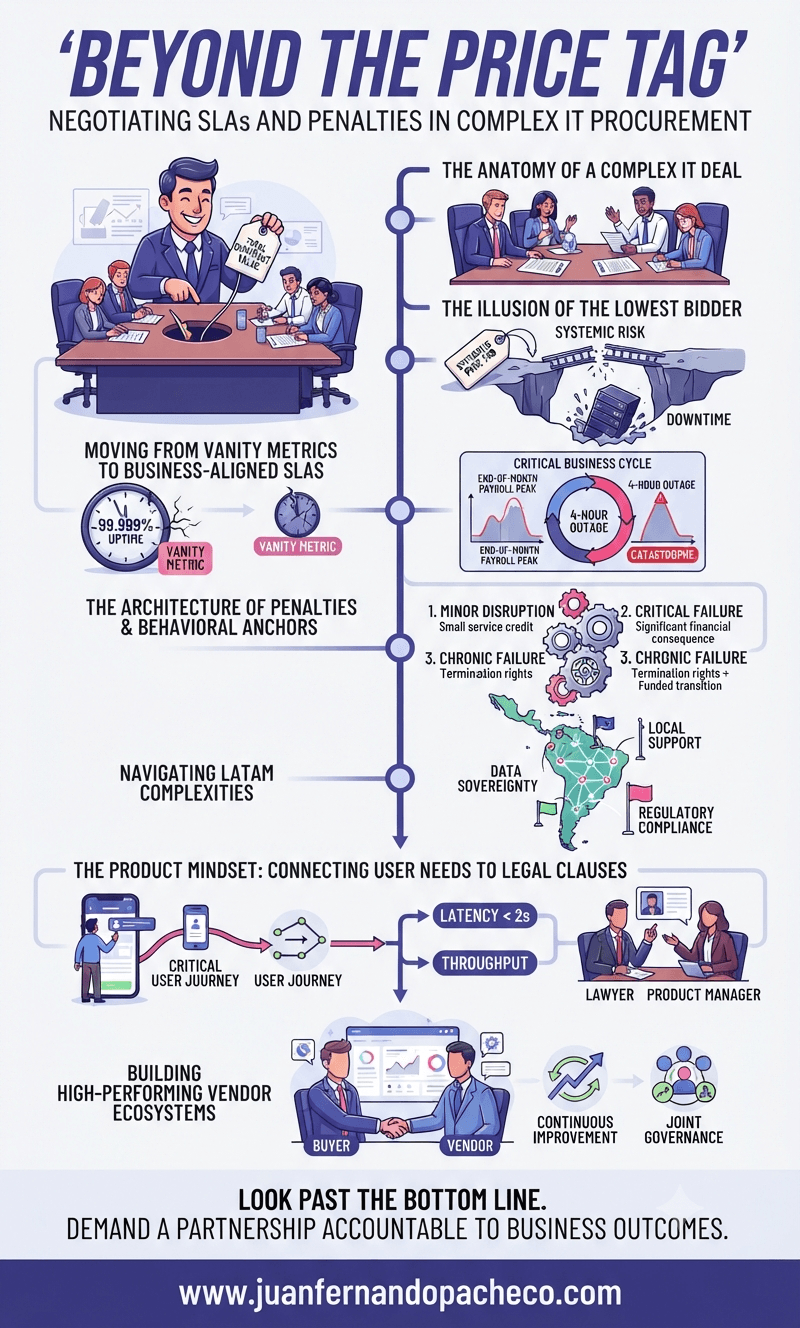
The anatomy of a complex IT deal
In the high-stakes arena of enterprise technology procurement, the boardroom often fixates on a single, glaring number
The total contract value
As a business development manager and strategic product leader who has spent over two decades navigating complex RFx processes across Latin America, I have sat in countless negotiation rooms where the commercial proposal takes center stage.
C-level executives and procurement teams battle over licensing fees, implementation costs, and maintenance percentages. Yet, in this relentless pursuit of upfront savings, organizations frequently overlook the true determinant of long-term value and risk.
The real battlefield is not the price tag
It is the intricate web of service level agreements and the penalty clauses that enforce them.
When you are procuring mission-critical infrastructure for a regional bank in Colombia, a core processing system for a telecommunications giant in Mexico, or a digital transformation platform for a retail conglomerate in Brazil, you are not simply buying software or hardware.
You are buying operational resilience, regulatory compliance, and customer trust
A multi-million-dollar contract secured at a twenty percent discount is a catastrophic failure if the accompanying service level agreements lack the teeth to protect the business during a critical outage.
This post explores the strategic mechanics of negotiating SLAs and penalties, drawing on years of experience aligning product roadmaps, legal frameworks, and enterprise security requirements to ensure on-time delivery and sustainable business growth.
The landscape of enterprise IT has shifted dramatically over the last twenty years
We have moved from purchasing perpetual on-premise licenses to consuming dynamic, cloud-based services and AI-driven platforms. However, the fundamental commercial mechanics of risk allocation remain unchanged. The vendor wants to maximize their margin and limit their liability.
The buyer wants to maximize system availability and shift operational risk to the provider. Bridging this gap requires a deep understanding of both the technology stack and the commercial realities of the market.
It requires a leader who can speak the language of the engineer, the lawyer, and the CFO simultaneously.
The illusion of the lowest bidder
In any formal request for proposal process, there is a natural gravitational pull toward the lowest commercial bid. Procurement teams are often incentivized to demonstrate immediate cost savings, and vendors are acutely aware of this dynamic.
To win the deal, aggressive vendors will strip out risk contingencies, under-resource the proposed engineering teams, and offer aggressively optimistic delivery timelines. They submit a highly attractive price tag, knowing that the operational risks are being quietly transferred to the buyer.
This creates a dangerous asymmetry
The vendor secures the revenue, while the buyer inherits the systemic risk. In the banking and finance sectors, where I have focused much of my career, the cost of downtime is not merely an IT inconvenience; it is a direct threat to market stability and regulatory standing.
If a payment gateway fails during peak transaction hours, the resulting financial losses, customer churn, and regulatory fines will eclipse the initial savings negotiated on the software license within minutes. Therefore, strategic deal execution requires shifting the conversation from total cost of ownership to total cost of risk.
We must evaluate vendors not just on what they charge, but on how much of our operational risk they are willing to contractually absorb.
I often advise C-level stakeholders to view the initial price tag as merely the cost of entry
The true cost of the solution will only be revealed during the first major operational incident. If a vendor has priced their solution so low that they cannot afford to maintain a robust, redundant infrastructure, they are essentially gambling with your business continuity.
When the inevitable failure occurs, a weak penalty clause will offer you a negligible service credit that does nothing to offset the millions of dollars lost in abandoned shopping carts, halted wire transfers, or damaged brand reputation. True commercial synergy is achieved when the vendor’s financial success is inextricably linked to your operational stability.
Moving from vanity metrics to business-aligned service levels
One of the most common pitfalls in IT procurement is the reliance on vanity metrics. The classic example is the pursuit of “five nines” or 99.999 percent uptime. On paper, this looks like a robust guarantee of reliability.
Standard uptime calculations are often averaged over a calendar month or a quarter
This mathematical smoothing hides the devastating reality of when the downtime actually occurs. A system can achieve 99.999 percent uptime over a month but still experience a complete four-hour outage during the end-of-month payroll processing window or a major e-commerce holiday sale. For the business, that four-hour window is the only time that matters.
To negotiate effectively, we must demand business-weighted service level agreements
This means tying performance metrics directly to critical business cycles rather than arbitrary calendar periods. In my experience leading cross-functional teams across multiple LATAM countries, we have found success by defining “business hours” based on peak transaction volumes rather than standard working hours.
Furthermore, we must distinguish between system availability and system performance
A cloud application might be technically “up” and accessible, but if the latency is so high that a bank teller cannot process a customer request in real-time, the system is functionally useless.
By incorporating latency thresholds, transaction throughput rates, and API response times into the core agreement, we bridge the gap between IT operations and actual user experience.
This approach requires a deep understanding of user story mapping and product design
When we build Agile product roadmaps, we identify the critical user journeys that drive adoption and revenue. These same user journeys should dictate the strictest service level agreements.
If a specific feature is identified as the primary driver of customer retention, the underlying infrastructure supporting that feature must be held to the highest standard of availability and performance.
We cannot apply a blanket SLA to an entire enterprise platform; we must apply surgical precision to the components that actually drive business value.
The architecture of penalties and behavioral anchors
Penalties, often structured as service credits, are frequently misunderstood as mere financial rebates for poor performance. In a mature procurement strategy, penalties should be viewed as behavioral anchors designed to align the vendor’s operational priorities with the buyer’s business continuity.
If a vendor knows that a minor service disruption will result in a negligible credit that is easily absorbed by their profit margin, they have no financial incentive to invest in redundant infrastructure or proactive monitoring.
Effective negotiation of penalties requires a tiered approach that escalates in severity based on business impact
Minor disruptions that do not halt core operations should trigger standard service credits. However, critical failures that impact end-users or breach data security must trigger severe financial consequences, potentially including uncapped liabilities for specific breach scenarios.
It is also vital to negotiate “chronic failure” clauses
If a vendor consistently misses their targets over consecutive quarters, the buyer must have the right to terminate the contract for cause without incurring early termination fees, alongside the right to demand a funded transition plan to a new provider.
Another powerful, yet underutilized, mechanism is the “earn-back” clause
This allows a vendor to reclaim lost service credits if they sustain exceptional performance over a subsequent, extended period. This fosters a partnership mentality rather than a purely adversarial one, incentivizing the vendor to not only fix the immediate issue but to fundamentally improve their underlying service delivery architecture
Applying design thinking to contract negotiation means understanding the vendor’s operational constraints and creating mechanisms that reward proactive problem-solving rather than just punishing reactive failures.
We must also carefully structure the liability caps
Vendors will universally push to cap their total liability at a percentage of the contract value, often limited to the fees paid in the preceding twelve months.
While this is standard for general commercial disputes, it is entirely inappropriate for scenarios involving gross negligence, intellectual property infringement, or breaches of data privacy.
In high-stakes IT procurement, carving out uncapped liability for data breaches and regulatory violations is non-negotiable. The penalty for losing millions of customer financial records cannot be capped at the cost of a single year of software licensing.
Navigating regional complexities and data sovereignty
Executing complex deals across Latin America introduces a unique layer of complexity that global templates often fail to address. The region is a mosaic of evolving regulatory frameworks, strict government mandates regarding data sovereignty, and diverse local policies.
When negotiating with multinational vendors, it is imperative to ensure that the service level agreements explicitly account for these regional nuances.
For instance, if a financial institution in Ecuador or Peru is procuring a cloud-based customer relationship management system, the contract must clearly define where the data resides and how it is transmitted across borders.
If a vendor routes data through a jurisdiction that violates local banking regulations, the resulting compliance breach is far more damaging than a standard server outage.
In these scenarios, standard performance penalties are insufficient
The agreement must include specific indemnification clauses and severe penalties for regulatory non-compliance, ensuring that the vendor bears the financial brunt of any fines levied by local authorities due to their architectural decisions.
Mitigating these operational and legal risks is a non-negotiable aspect of high-stakes RFx execution in emerging markets.
Furthermore, local policies often dictate stringent requirements regarding local support and incident response times
A global vendor might offer a standard SLA that routes all tier-three support tickets to a centralized hub on another continent. For a critical banking infrastructure in Colombia, this is unacceptable.
The SLA must mandate local language support, in-country engineering presence, and guaranteed response times that align with local business hours and regulatory reporting deadlines. Scaling technology revenue across LATAM requires respecting these local realities and forcing global vendors to adapt their operational models to meet regional demands.
The product mindset: connecting user needs to legal clauses
My career began in user experience and product design, and I have always believed that the best commercial agreements are built on a deep understanding of the end-user.
Too often, legal teams draft service level agreements in a vacuum, disconnected from the actual product roadmaps and user stories that define how the technology will be consumed.
Translating client objectives
When we translate client objectives into Agile product roadmaps, we identify the minimum viable product and the critical user journeys that drive adoption. We focus heavily on MVP efficiency and streamlined POC development. This same product mindset must be applied to procurement.
If a user story dictates that a mobile banking app must load in under two seconds over a standard 4G connection, the SLA must include strict latency and bandwidth guarantees from the cloud provider. If the backend API fails to deliver the data within that window, the user experience is degraded, even if the server is technically “online.”
By integrating product management disciplines into the procurement process, we ensure that the legal contract reflects the commercial reality of the product. This synergy not only accelerates time-to-market but significantly boosts user adoption, as the technology performs reliably exactly when and where the user needs it most.
I have seen countless IT projects fail not because the code was bad, but because the underlying infrastructure SLAs did not support the performance requirements defined by the UX designers. Bridging the gap between product, sales, legal, and engineering is the hallmark of a strategic deal leader.
Orchestrating cross-functional alignment
The successful negotiation of complex IT contracts cannot be siloed within the procurement or legal departments. It requires the orchestration of product, sales, engineering, and operations teams.
As a deal leader, one of my primary responsibilities is to drive stakeholder alignment before the request for proposal is even issued.
We must conduct internal workshops to define our risk appetite
What is the actual financial impact of a one-hour outage? What are our regulatory reporting deadlines? By quantifying these risks internally, we can provide our legal and procurement teams with the precise parameters needed to negotiate effectively. We treat contract clauses with the same rigor as backlog prioritization in software development.
We identify the “must-haves” that protect the core business, the “should-haves” that improve operational efficiency, and the “nice-to-haves” that can be traded away during the final stages of negotiation to secure a better commercial price.
This disciplined, analytical approach ensures that we do not concede critical operational protections just to close a deal faster. It also ensures that the internal engineering teams are fully aware of the SLAs they are inheriting.
There is nothing more frustrating for an internal operations team than to discover, post-signature, that the legal department agreed to a four-hour resolution time for a critical system failure, when the business reality requires a fifteen-minute resolution.
By involving engineering and operations in the RFx process from day one, we ensure that the commitments made to the business are actually achievable and properly resourced.
Building high-performing vendor ecosystems
Ultimately, the goal of negotiating service level agreements and penalties is not to trap a vendor in a punitive contract, but to establish the foundation for a high-performing, transparent partnership. The most successful long-term technology relationships are built on shared metrics, open-book reporting, and joint governance committees.
I advocate for the inclusion of continuous improvement clauses within the agreement.
Technology evolves rapidly, and a service level metric that was considered world-class five years ago may be entirely inadequate today. By establishing a governance framework that requires the vendor to regularly benchmark their performance against industry standards and propose architectural upgrades, we ensure that the purchased solution remains competitive and secure over its entire lifecycle. This proactive approach reduces customer request resolution times and minimizes the need for contentious dispute resolutions down the line.
A strong partnership also requires transparency
The SLA must include provisions for real-time dashboard access, allowing the buyer to monitor system performance independently of the vendor’s monthly reports. Trust is essential in any business relationship, but in high-stakes IT procurement, verification is mandatory. When both parties are looking at the same data in real-time, conversations shift from arguing over whether an SLA breach occurred to collaboratively solving the root cause of the performance degradation.
The strategic imperative for modern leaders
In conclusion
Mastering the commercial and legal mechanics of IT procurement is a defining characteristic of modern technology leadership. The price tag on a proposal is merely the cost of admission to the partnership.
The true value, and the true risk, is codified in the service level agreements and the penalty structures that govern the daily reality of the technology in operation.
Moving beyond vanity metrics
By aligning penalties with behavioral incentives, respecting regional regulatory complexities, and grounding legal clauses in sound product design principles, we transform procurement from a cost-center exercise into a strategic driver of enterprise resilience.
Whether you are scaling revenue across diverse markets or securing the digital infrastructure of a major financial institution, the discipline you apply to the fine print will ultimately determine the success of your grandest strategic initiatives.
The next time you find yourself in a high-stakes negotiation
Look past the bottom line. Demand a partnership that is accountable, resilient, and fundamentally aligned with your most critical business outcomes.
The future of your enterprise depends not just on the technology you buy, but on the commercial framework that sustains it.