Navigating government mandates in LATAM RFx
Latin America offers massive growth opportunities for global technology firms.
The region presents unique regulatory challenges for foreign vendors, and tech leaders must understand local laws to win enterprise contracts. Procurement processes now heavily scrutinize data handling practices, and government mandates dictate where companies store and process information.
Ignoring these rules leads to immediate disqualification during complex bidding cycles.
Business development managers face a difficult reality every day
While clients demand cutting-edge cloud solutions alongside strict local compliance, you cannot separate product strategy from regional legal frameworks. High-stakes procurement cycles expose every weakness in your architecture.
That’s why buyers evaluate your ability to mitigate operational and legal risks.
My experience across Mexico, Colombia, and Brazil reveals a clear trend
Regulatory bodies constantly tighten their grip on digital information. Financial institutions and government agencies lead this aggressive charge. They require absolute certainty regarding domestic data residency. Winning multi-million-dollar contracts requires deep regional expertise.
Let’s explore how successful leaders navigate this complex landscape.
Understanding data sovereignty in Latin America
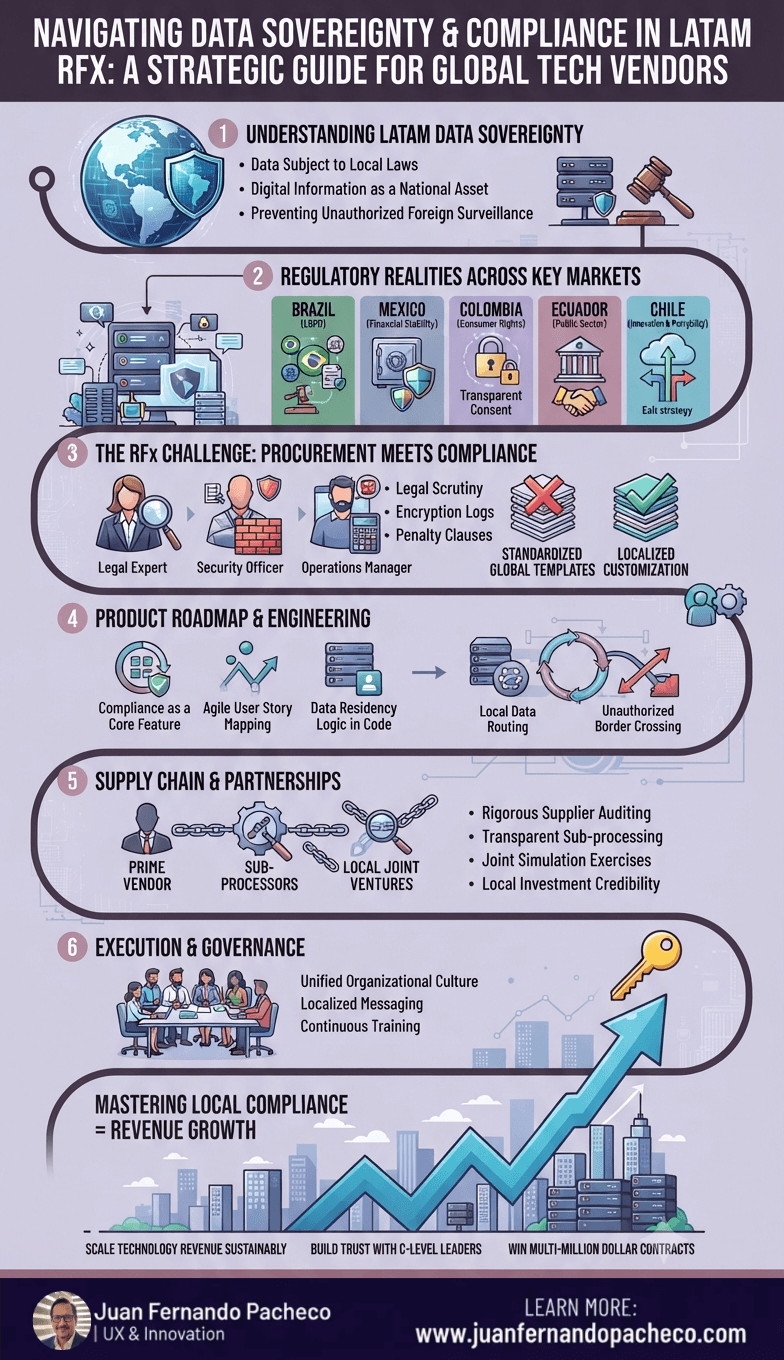
Data sovereignty means information remains subject to local laws
The physical storage location determines the applicable legal jurisdiction, and global cloud providers initially promised completely borderless infrastructure; however, regional governments quickly rejected this borderless technological approach.
Leaders in the region view digital information as a national asset.
Protecting citizen privacy drives much of this new legislation
Governments also want to prevent unauthorized foreign surveillance, and local authorities demand the ability to audit domestic servers, because they need immediate access during national security investigations. This reality forces global tech vendors to adapt their models.
Vendors must build local data centers or partner with regional providers
This necessary shift increases operational costs significantly, prompting product managers to factor these costs into their pricing models; on the other hand, agile roadmaps must include specific compliance milestones.
Time-to-market accelerates only when teams respect local boundaries.
Financial institutions enforce the strictest requirements across the region
Banks handle millions of daily transactions across multiple countries in the geo. Central banks mandate rigorous disaster recovery protocols, and they dictate exact geographic distances between primary and backup nodes. Your proposed architecture must satisfy these stringent spatial requirements.
Cross-border data transfers require explicit legal mechanisms
Companies must prove they maintain adequate protection levels abroad. Standard contractual clauses often fail to satisfy local regulators, and tech leaders must engineer robust localization features directly into their platforms.
The RFx challenge: procurement meets compliance
Request for proposal documents reflect these strict national priorities
Usually, buyers embed complex legal clauses directly into technical requirements, and evaluators score proposals based on architectural compliance. A brilliant user interface cannot save a non-compliant backend infrastructure.
- Procurement teams assemble diverse evaluation committees for major deals.
- Legal experts scrutinize your data processing agreements closely.
- Security officers demand detailed encryption and access control logs.
- Operations managers calculate the financial impact of potential downtime.
You must address every stakeholder concern within your initial submission.
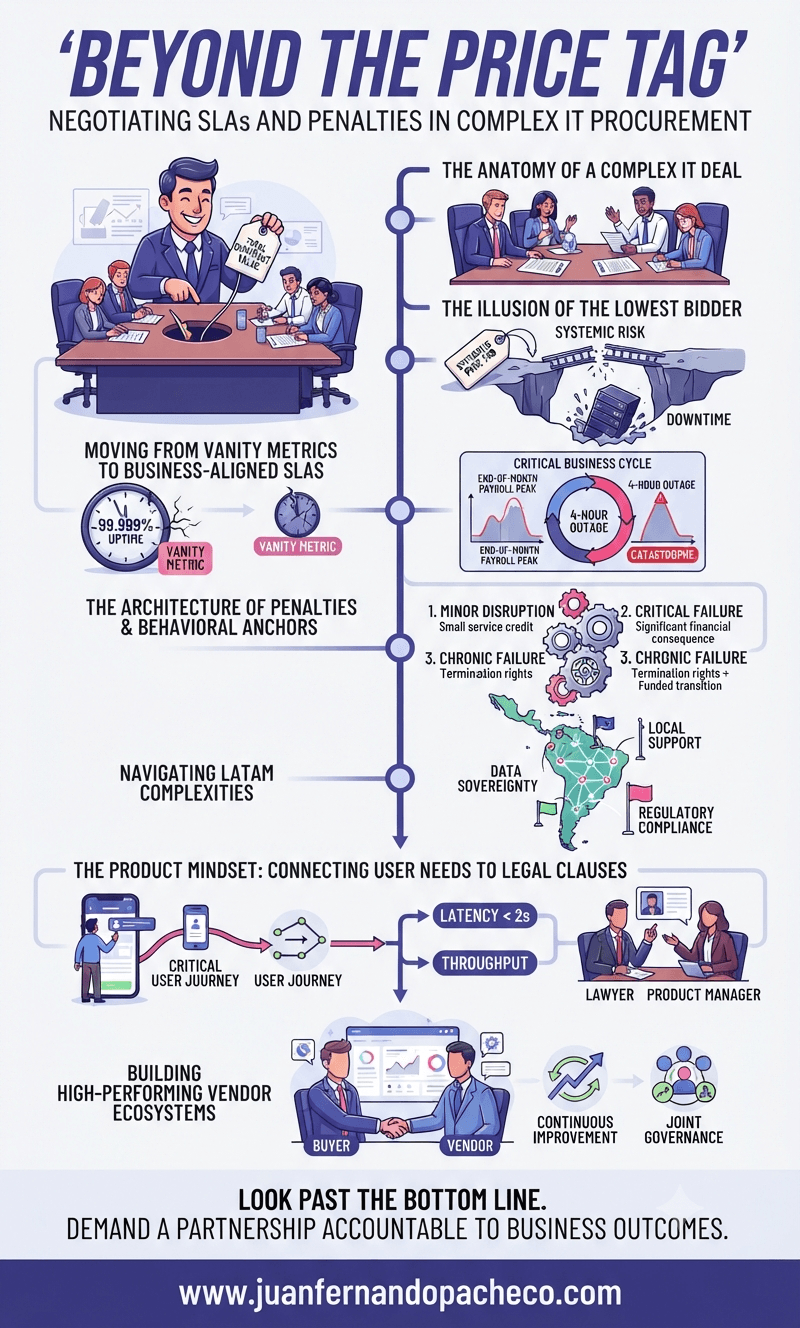
Negotiating service level agreements becomes highly contentious quickly
RFP’s owners demand severe financial penalties for compliance breaches. Consider uptime guarantees mean little if the system violates privacy laws, and IT vendors must accept significant liability policies to secure the final signature.
Many global firms fail during this critical evaluation phase since they submit standardized global templates instead of localized/customized responses, and evaluators instantly recognize these generic and lazy proposals.
Such mistakes destroy trust with C-level decision-makers immediately, and here’s where you must demonstrate a profound understanding of local business realities.
Successful deal execution requires intense cross-functional alignment
- Sales teams cannot make promises that engineering cannot deliver.
- Product owners must translate legal mandates into actionable user stories.
- Legal departments must approve every technical workaround before submission.
This synergy accelerates the entire procurement lifecycle dramatically.
Regional variations in digital legislation
Every country enforces its own unique regulatory framework
Brazil pioneered comprehensive data protection legislation in the region
Their laws closely mirror strict European privacy standards. Financial regulators there demand strict segregation of sensitive databases, and technology vendors must prove continuous compliance through regular audits.
Mexico approaches digital sovereignty through financial stability lenses
The central bank enforces rigorous cybersecurity guidelines constantly, and banks must report security incidents within extremely tight windows; here’s where vendors must provide dedicated local support teams for rapid response.
Outsourcing core banking functions requires explicit regulatory approval beforehand.
Colombia focuses heavily on consumer rights and digital transparency
Superintendents actively penalize companies for mishandling citizen information, and E-commerce platforms face intense scrutiny regarding payment gateways. Proposals must highlight robust consent management architectures prominently, since buyers prioritize vendors offering granular user control features.
Ecuador maintains strict public sector procurement rules today
Government agencies prioritize domestic technology partnerships heavily, and foreign vendors must establish strong local joint ventures. These partnerships facilitate knowledge transfer and local job creation, and bidders must clearly articulate their long-term regional investment strategies.
Chile promotes digital innovation while protecting critical infrastructure
Their financial regulators encourage cloud adoption cautiously, and vendors must demonstrate clear exit strategies and data portability. Lock-in fears heavily influence enterprise buying decisions today, and Agile product roadmaps must emphasize open standards and interoperability.
Aligning product roadmaps with regulatory realities
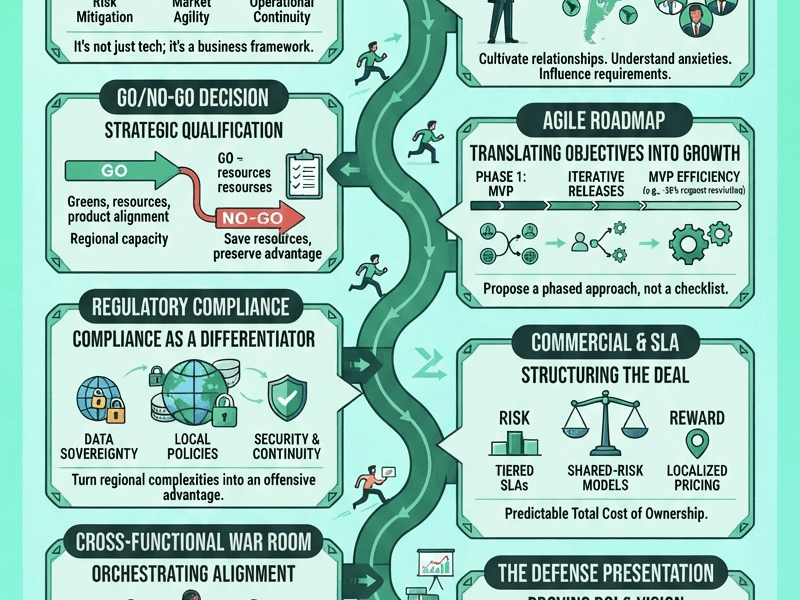
Product leaders must treat compliance as a core feature
Regulatory adherence directly impacts user adoption and trust; you cannot bolt on privacy controls after the initial launch, and engineering teams must embed data residency logic into the core codebase.
Agile methodologies support this complex integration perfectly
Teams can break down massive legal documents into manageable tasks, while user story mapping helps visualize complex compliance workflows clearly, and Product owners prioritize these stories alongside standard feature requests.
This simple approach ensures continuous delivery of compliant software increments.
Proof of concept phases require careful strategic planning
Buyers want to see tangible evidence of your capabilities, and usually request PoCs; that’s why a well-streamlined execution reduces customer request resolution times significantly. You must demonstrate local data routing during live demonstrations, and showing real-time compliance builds immense confidence with technical evaluators.
Building high-performing teams remains crucial for long-term success
- Engineers need specialized training regarding regional privacy laws.
- Security champions must participate in every sprint planning session.
- Cross-training prevents dangerous knowledge silos within your organization.
A unified team mitigates operational risks effectively every day.
Minimum viable products must satisfy baseline legal requirements
Launching a non-compliant pilot program invites severe regulatory backlash, and that’s the reason why Product Managers must define strict boundaries for initial releases. This discipline protects the company from costly early mistakes, and smart scoping ensures rapid market entry without legal exposure.
Securing the broader technology supply chain
Enterprise buyers scrutinize your entire partner ecosystem closely
You cannot guarantee data sovereignty if your sub-processors fail. Procurement teams demand complete transparency regarding third-party dependencies, and hiding subcontractors guarantees an immediate rejection during technical evaluations.
Vendors must implement rigorous supplier auditing programs continuously
Regular assessments verify partner compliance with local mandates, and you must possess the legal right to audit these downstream providers; usually, contracts must explicitly define data handling responsibilities across the chain. Ambiguity creates massive liability for the prime contractor.
Sub-processors often utilize global cloud infrastructure unknowingly
A minor configuration error can route sensitive data overseas, and technical architects must enforce strict network routing policies. Automated monitoring tools detect unauthorized cross-border transfers instantly, and a rapid remediation plan prevents minor issues from becoming major scandals.
Financial institutions demand explicit approval for every sub-processor
Banks and financial institutions around LATAM maintain exhaustive registries of authorized technology partners; adding a new vendor to the ecosystem requires lengthy regulatory notification periods. Product managers must design flexible architectures supporting multiple backend providers, with this modularity simplifying future vendor transitions significantly.
Incident response plans must encompass the entire supply chain
A breach at a minor partner impacts your primary contract; that’s the sad truth. Joint simulation exercises test collective response capabilities thoroughly, and buyers reward vendors demonstrating mature collaborative security practices.
Proactive supply chain management heavily influences enterprise buying decisions.
Structuring fair and enforceable service agreements
Service level agreements define the commercial relationship boundaries
Buyers use these documents to enforce strict regulatory compliance, and standard global templates rarely satisfy sophisticated regional procurement teams. You must customize every metric to reflect local operational realities.
Uptime guarantees require careful geographical scoping upfront
A regional internet outage differs vastly from a global platform failure. Contracts must clearly define force majeure events within local contexts, and vendors need protection against unpredictable regional infrastructure instability.
Clear definitions prevent endless disputes during service interruptions.
Financial penalties for compliance breaches escalate rapidly
Regulators impose massive fines for unauthorized data transfers, and buyers attempt to pass these entire financial burdens onto vendors; that’s why negotiators must establish reasonable liability caps based on contract value. Unlimited liability policies expose technology firms to catastrophic financial risks.
Response time metrics demand localized support commitments
Global help desks cannot resolve urgent regional compliance issues quickly, and buyers expect dedicated local engineers speaking native languages fluently; staffing these local teams increases your operational baseline costs. Accurate project estimates must incorporate these specific regional expenses.
Audit rights form the cornerstone of trust relationships
Government agencies retain the right to inspect your physical facilities, and you must define reasonable notice periods and access boundaries. Unrestricted surprise audits disrupt normal business operations severely, and balanced agreements protect both buyer interests and vendor operational stability.
Managing cross-border data transfers securely
Global operations necessitate occasional international information exchanges
Complete data localization remains practically impossible for multinational corporations, and tech leaders must implement secure transfer mechanisms carefully; that’s why encryption protocols protect sensitive information during transit continuously.
Legal teams draft specific agreements governing these international movements
Standard contractual clauses provide a baseline legal framework globally, and regional authorities often demand supplementary technical safeguards locally, and vendors must document every cross-border transfer meticulously.
- Automated logging systems track information flows across geographic boundaries.
- Auditors review these logs during routine compliance inspections regularly.
- Missing records trigger severe regulatory penalties immediately.
- Engineering teams must build robust tracking features natively.
Anonymization techniques reduce the regulatory burden significantly
Stripping personal identifiers allows safer international analytical processing; that’s why Product Managers should prioritize these privacy-enhancing technologies heavily.
Smart data minimization strategies simplify complex compliance architectures greatly.
Leveraging local partnerships for market entry
Foreign companies often lack deep regional regulatory expertise initially
Strategic joint ventures bridge this critical knowledge gap effectively, especially with local partners who understand unwritten bureaucratic rules intimately; these relationships accelerate the complex vendor registration processes significantly.
Domestic firms possess existing certifications required by government agencies
Borrowing these credentials allows faster entry into regulated markets, and global vendors bring advanced technological capabilities to the partnership; this is the kind of symbiotic relationship that creates highly competitive joint proposals.
Procurement committees favor bidders demonstrating strong local economic commitment
Job creation remains a major priority for regional politicians, highlighting that local hiring plans improve your overall proposal score, and of course, commercial leaders must weave these narratives into every pitch.
Empowering your organization for complex deal execution
Internal alignment dictates your external market success entirely
Sales representatives must understand basic data residency principles and cannot promise borderless cloud solutions to regulated entities; targeted training programs prevent dangerous commercial misrepresentations early.
Engineering teams require deep immersion in regional security standards
Local encryption mandates often exceed baseline international requirements; that is, developers must understand specific key management protocols thoroughly. Code reviews must specifically check for compliance vulnerabilities. Continuous education keeps technical staff ahead of evolving threats.
Legal departments bridge the gap between code and commerce
Translating dense government mandates into actionable engineering requirements proves difficult. Regular workshops foster mutual understanding between lawyers and developers, and shared vocabularies accelerate the entire product development lifecycle.
Unified teams navigate complex legal clauses much more effectively.
Marketing departments must localize their messaging appropriately
Global campaigns often miss subtle regional cultural nuances, and highlighting local data centers resonates strongly with domestic buyers. Case studies featuring regional success stories build immediate credibility, and authentic storytelling differentiates your brand from distant global competitors.
Leadership must champion this localized mindset continuously
Celebrating regional compliance victories reinforces desired organizational behaviors, and rewarding teams for successful high-stakes procurement executions motivates everyone. Remember, a unified corporate culture ultimately scales technology revenue sustainably.
Demonstrating capabilities through targeted pilot programs
Written proposals only convince buyers partially
Enterprise clients demand tangible proof before signing massive contracts, and proof of concept phases validate your architectural claims directly. These controlled environments simulate real-world regulatory pressures accurately.
Buyers design specific test scenarios targeting your weakest assumptions
Evaluators attempt to force data across unauthorized geographic boundaries, and your system must block these transfers automatically and log the attempts. Successful demonstrations prove your automated compliance controls work flawlessly.
Streamlined execution reduces customer request resolution dramatically
You must deploy these localized environments rapidly:
- Pre-configured infrastructure templates accelerate the initial setup phase significantly.
- Agile teams iterate based on immediate evaluator feedback continuously.
Rapid adjustments showcase your organizational flexibility and technical depth.
Minimum viable products for these pilots require strict scoping
Focus entirely on the core compliance mechanisms under evaluation. Extraneous features distract evaluators from your primary value proposition, and clean, focused demonstrations leave lasting positive impressions on technical committees.
Post-pilot reviews provide invaluable strategic intelligence
Evaluators share detailed feedback regarding your system performance, and product owners incorporate these insights directly into final roadmaps.
This continuous improvement loop guarantees the final production release satisfies everyone. Smart pilot management secures long-term enterprise partnerships reliably.
Adapting to the evolving digital landscape
Regulatory environments will only become more complex over time
Governments continuously introduce new frameworks for emerging technologies, and Artificial Intelligence and machine learning face intense scrutiny in the near future; that’s why tech leaders must anticipate these shifts well in advance.
Continuous market research identifies upcoming legislative trends early
Pinpointing regulatory gaps allows you to develop proactive solutions, and forward-thinking vendors build adaptable architectures ready for future mandates. This agility provides a massive competitive advantage during future bidding cycles.
Stakeholder alignment remains your most powerful strategic asset
Regular engagement with regional industry leaders provides critical insights, and participation in local technology chambers shapes future policy discussions.
Active involvement positions your company as a trusted regional advisor.
Ultimately, scaling technology revenue requires immense patience
Complex deal execution tests every aspect of your organization, and success demands a perfect blend of technical excellence and commercial acumen.
Mastering local compliance transforms regulatory hurdles into powerful sales enablers.