Building robust C-level relationships in Latin American markets
Global technology firms frequently misjudge the region. Executives fly into Mexico City expecting immediate contract signatures. They bring polished pitch decks to boardrooms. Presenters showcase impressive ROI models on large screens. Yet, many lucrative deals inevitably stall. Why does this frustrating pattern occur? The answer lies in human connection.
Building robust C-level relationships in Latin American markets requires deep cultural empathy. Buyers here prioritize trust over transactional efficiency. My two decades in strategic product leadership taught me this vital lesson. High-stakes RFx processes demand patience and psychological insight. You simply cannot automate genuine trust. Software scales easily across borders. Human relationships require deliberate, daily cultivation.
Let’s explore the mechanics of regional enterprise deal-making
I will uncover the unwritten rules of executive engagement, while technology revenue grows when leaders align commercial strategy with local nuances.
Foreign vendors must abandon rigid global playbooks as a regular practice and begin to understand that success demands localized execution and profound respect.
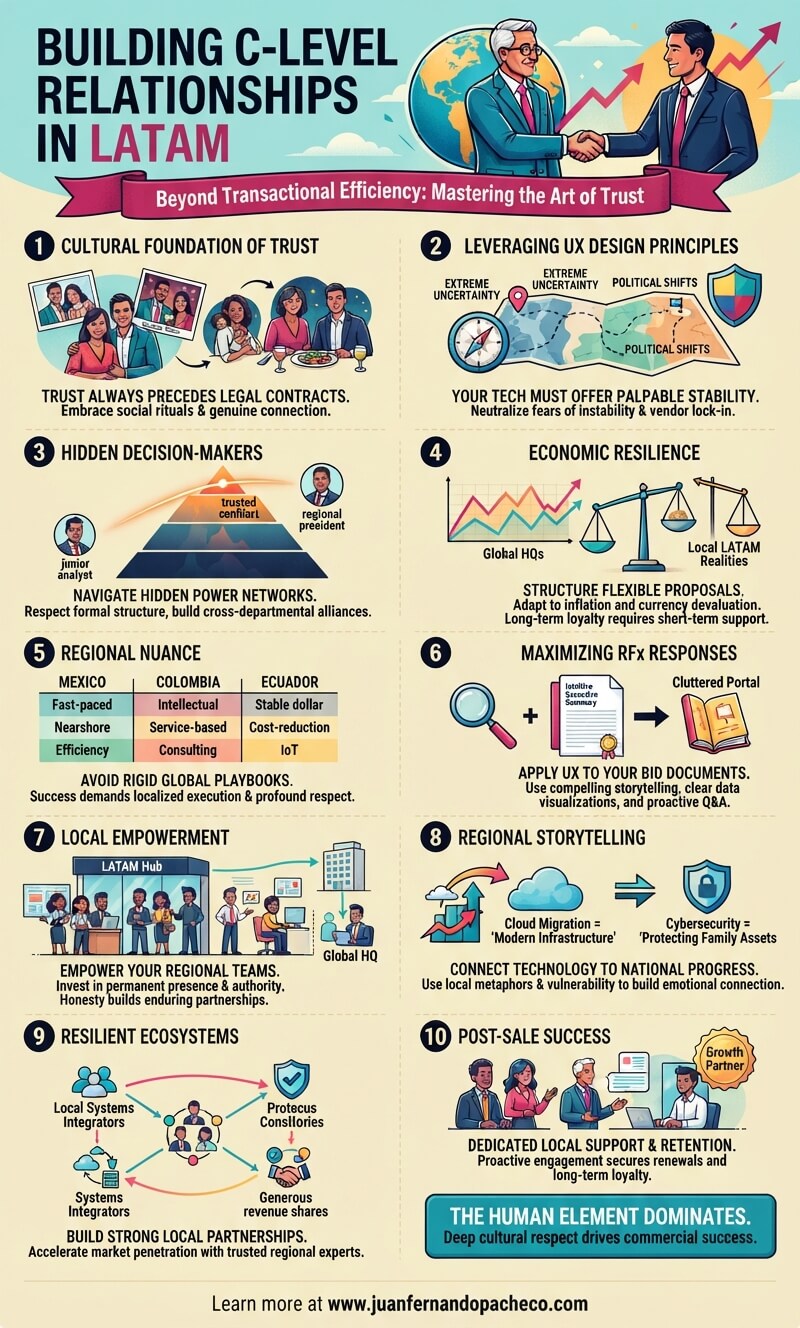
Understanding the cultural foundation of executive trust
Business professionals in this region value personal connections deeply
Western corporate culture often separates professional and personal lives; however, Latin American executives seamlessly blend these spheres. A successful vendor eventually becomes a trusted personal advisor, and developing this profound transformation takes considerable time.
Meetings often begin with extended conversations about family
Foreign sales teams frequently rush this social phase. Aggressive reps want to reach the agenda quickly, and this impatient behavior shows blatant disrespect to local hosts. It permanently damages the nascent partnership, and you must embrace the social ritual completely.
Trust always precedes the legal contract
Signed documents merely formalize an existing mutual understanding. A formal agreement holds little weight if relationships fracture, because local leaders remember how you treated them during negotiations, and they recall your behavior during moments of operational crisis.
Empathy bridges the gap between global tech solutions and local realities
My background in UX design heavily influences my commercial strategy, because usually I view the executive buyer as the primary user.
- What friction points exist in their daily operational life?
- How does macroeconomic volatility affect their stress levels?
Addressing these human elements creates immense competitive advantage.
Leveraging product design principles in B2B sales
Product designers obsess over frictionless user journeys
Business development leaders must adopt this exact mindset. The executive journey here in LATAM involves navigating extreme uncertainty, and political shifts create constant operational anxiety for local boards.
Your technology solution must offer palpable stability
Pitching disruptive innovation often frightens conservative regional directors, because they prefer predictable outcomes over radical digital transformation. Frame your value proposition around comprehensive risk mitigation, and show how your platform protects their core revenue streams.
Active listening separates average vendors from strategic partners
Ask probing questions about their legacy system challenges, and listen carefully to the unspoken fears in their responses. Do they worry about severe vendor lock-in? Catastrophic implementation failures often keep executives awake at night; that’s why you should tailor your RFx responses to neutralize these specific anxieties.
Data analytics strongly support your empathetic approach
Use market intelligence to anticipate their hidden pain points, and present valuable insights before they even articulate the problem. This proactive stance establishes your undeniable authority. It positions your firm as an indispensable intellectual partner.
Applying UX research methodologies to enterprise discovery
User experience researchers conduct extensive contextual inquiries
Business developers must adopt these exact investigative techniques, spending entire days observing your clients in their natural environments, watching how their teams interact with legacy software, noticing the frustrating workarounds they use daily.
Shadowing operational staff reveals hidden enterprise pain points
C-suite executives often lack visibility into these granular issues, and bringing these observations to the boardroom shocks senior leaders because they appreciate vendors who understand ground-level realities. This deep empathy differentiates you from superficial competitors.
Create detailed user personas for every stakeholder involved
Map out their specific daily frustrations and motivations
- Financial directors obsess over long-term cost predictability.
- Information technology leaders worry constantly about system downtime.
Tailor your messaging to address these distinct psychological profiles.
Navigating complex hierarchies and hidden decision-makers
Corporate structures here often feature steep organizational hierarchies
The regional president typically holds absolute authority. However, informal power dynamics complicate the official org chart. Identifying the true decision-makers requires sharp observation skills.
Junior analysts might conduct the initial technical vetting
They filter vendors based on basic compliance metrics, but the final budget approval rests with a tight-knit circle, and sometimes a trusted confidant wields massive unseen influence. Smart deal leaders quietly map these hidden networks.
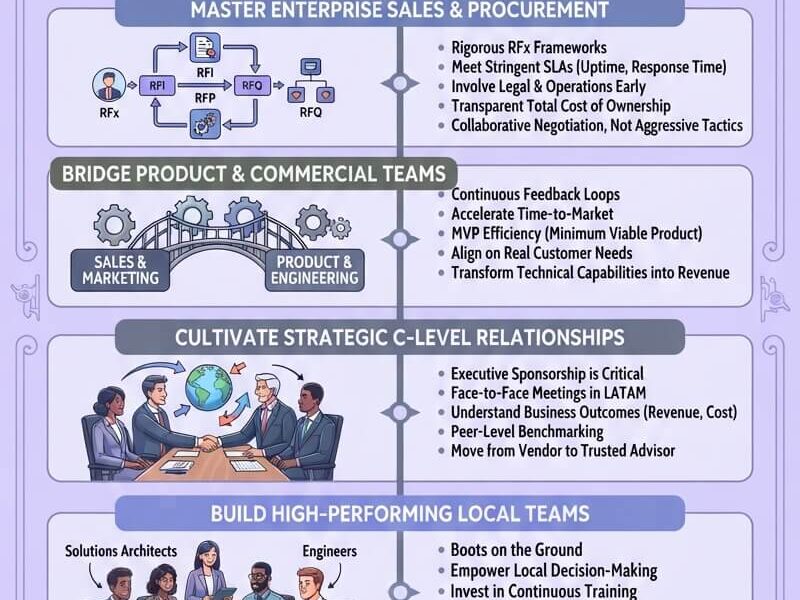
High-stakes RFx execution demands patience through bureaucratic layers; public sector procurement processes involve strict compliance rules, and these frameworks exist to ensure basic transparency. Yet, human relationships dictate who wins the final award, and a compliant bid merely gets you started. Relationship capital pushes you across the finish line.
Never bypass the established chain of command
Doing so causes immediate offense among senior staff. Respect the formal hierarchy while building cross-departmental alliances. Cross-functional alignment secures your proposal against internal sabotage.
Macro-economic resilience and enterprise tech adoption
Emerging markets experience wild economic fluctuations
In LATAM, currency devaluations happen rapidly and unpredictably, and inflation constantly erodes operational budgets across the region. C-suite executives must navigate this financial chaos daily.
Your commercial proposals must account for this volatility
Rigid multi-year pricing models often scare local buyers; they fear locking into unfavorable exchange rates. Offer flexible payment structures tied to local currencies, propose scalable licensing models that adjust to revenue dips.
Financial flexibility demonstrates profound market understanding, and it shows you respect their unique economic realities. Global HQs often demand standardized global pricing, while local deal leaders must push back against this rigidity. Empower your regional teams to negotiate creative terms.
Long-term viability requires absorbing short-term economic pain
True partners restructure contracts during severe recessions. They extend payment terms to help clients survive. This loyalty guarantees preferential treatment during economic recoveries. Clients remember who supported them during dark times.
Mexico, Colombia, and Ecuador: a comparative analysis
Regional nuances demand highly tailored engagement strategies
- Mexico features a highly industrialized, nearshore economy because proximity to the United States heavily influences corporate culture. Mexican executives appreciate fast-paced, data-driven discussions. Manufacturing hubs in Monterrey demand robust supply chain solutions; they value efficiency alongside relationship building.
- Colombia presents a vastly different commercial landscape. Bogotá hosts a highly sophisticated, service-oriented economy. Colombian leaders value deep intellectual debates. Fintech companies in Bogota drive massive digital adoption. They expect vendors to provide strategic consulting alongside software. Superficial sales pitches fail miserably in this market.
- Ecuador operates with distinct regulatory and economic constraints. Dollarization creates unique financial stability but limits monetary flexibility. Local executives prioritize operational cost reduction above all else. Agricultural enterprises require precise IoT tracking capabilities. Vendors must prove immediate bottom-line impact. Grand digital transformation visions often fall flat here.
Recognizing these subtle differences separates amateurs from experts. A successful pitch in Monterrey fails in Medellin. Deal leaders must customize their value propositions meticulously. Research the specific regional economic drivers before traveling.
Structuring high-stakes RFx responses for maximum impact
Procurement portals often restrict submission formats strictly
Vendors must paste text into tiny, unformatted boxes, and this limitation destroys visual hierarchy and narrative flow; that’s why smart deal leaders find creative ways around these constraints.
Include compelling executive summaries as separate PDF attachments, and use striking typography and generous white space to guide the reader’s eye toward your core value propositions. Highlight key differentiators using bold, contrasting colors. Make the document skimmable for exhausted evaluators.
Storytelling transforms dry technical specifications into compelling narratives
- Describe a similar client facing identical operational challenges.
- Explain the step-by-step journey toward digital transformation.
- Quantify the exact financial impact of your solution
Numbers grounded in realistic scenarios build immense credibility.
Anticipate evaluator objections before they even form, dedicate specific sections to risk mitigation strategies, and provide detailed contingency plans for potential implementation delays. This transparency reduces perceived vendor risk significantly, and it proves your team possesses deep operational maturity.
Practical execution strategies for global technology leaders
Foreign executives must adapt their communication styles immediately
Directness often translates as aggression in these cultures; the best recommendation is to adopt a more diplomatic, nuanced tone. Frame criticisms as collaborative suggestions for improvement, and use conditional language to soften harsh demands.
Language barriers present hidden obstacles during negotiations
Even fluent English speakers appreciate localized marketing materials. Translate your core value propositions into flawless regional Spanish, and avoid generic global templates entirely; best practice is to localize your case studies to feature regional success stories.
Networking extends far beyond the corporate boardroom
In some cases, you can ask for an invite to key stakeholders to exclusive industry dinners, or attend local cultural events with your clients. Share meals without discussing business agendas, keeping these informal settings reveal true character. They forge bonds that survive competitive bidding wars.
Consistency builds unshakeable confidence over time.
- Deliver on every minor promise you make.
- Arrive early to every scheduled meeting.
- Respond to urgent emails within hours.
These micro-interactions accumulate into massive trust reserves, and when a crisis hits, clients rely on proven reliability.
Managing complex RFx processes with cultural intelligence
Procurement departments enforce rigid evaluation matrices
They assign scores to technical capabilities and pricing models, and vendors often obsess over optimizing these spreadsheets. This analytical focus blinds them to the emotional context.
Decision-makers experience deep fatigue during lengthy evaluations, and buyers review dozens of identical vendor proposals. Your submission must stand out visually and narratively; that’s why you should apply UX design principles to your bid documents.
- Create intuitive executive summaries for busy readers.
- Use clear data visualizations to explain complex architectures.
Clarify ambiguities proactively during the bidding phase
Local procurement rules often contain frustrating contradictions; that’s why you should submit thoughtful questions during the official Q&A periods. This simple thing demonstrates thoroughness and deep engagement. It also forces the buyer to interact directly with your team.
Negotiation phases require extreme emotional intelligence
Pushback on pricing is standard procedure in LATAM markets. Do not react defensively to aggressive counteroffers. Acknowledge their strict budget constraints politely, and offer creative financing structures to bridge the gap. Propose phased implementations to ease cash flow burdens.
Cross-border team alignment and local empowerment
Global headquarters often misunderstand regional realities
Distant executives demand aggressive quarterly revenue targets, and this pressure encourages destructive discounting tactics. Such desperation destroys long-term viability in emerging markets, and local buyers easily recognize and exploit this weakness.
Sustainable technology revenue requires a patient capital approach
Invest heavily in permanent local presence
- Hire regional talent who deeply understand cultural nuances
- Establish physical offices in key hubs like Guadalajara
Proximity demonstrates serious, long-term commitment to the market.
Empower your local deal leaders completely
They need authority to make rapid decisions, and bureaucratic delays from distant HQs kill momentum. Trust your regional experts to navigate complex negotiations, and support them with robust global technical resources.
Internal alignment prevents mixed messaging during deals
Sales teams and delivery units must collaborate seamlessly, and promising unrealistic timelines destroys credibility instantly. Ensure your technical architects validate all commercial commitments; just keep in mind:
Honesty builds enduring enterprise partnerships.
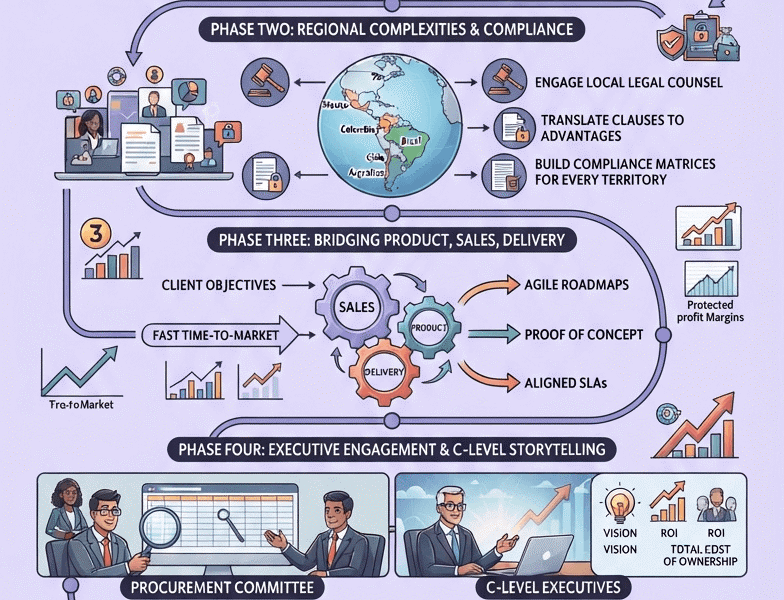
Navigating compliance and anti-corruption frameworks gracefully
Global corporations enforce strict anti-bribery policies worldwide
Local business customs sometimes blur ethical lines slightly. Foreign executives must maintain absolute moral clarity and never compromise their corporate integrity for quick wins.
Declining inappropriate requests requires immense diplomatic skill, as blunt refusals cause deep personal offense here. Frame your refusal around strict global audit requirements, and blame distant compliance officers for your rigid boundaries. This tactic preserves the personal relationship while enforcing rules.
Transparency builds unshakeable trust over long sales cycles
Document every interaction and financial commitment meticulously. Invite clients to visit your global headquarters, and show them your robust corporate governance structures; customers respect vendors who operate with absolute integrity.
Mastering the art of regional executive storytelling
Data alone rarely convinces skeptical regional boards
Human brains process narratives much faster than raw statistics, and masterful deal leaders weave compelling stories around their technology; they connect digital transformation to national progress.
- Highlight how your solutions empower local workforces.
- Discuss automation as a tool for human elevation.
- Explain how upskilling programs accompany your software deployments.
This narrative aligns perfectly with regional development goals, and it positions your company as a positive societal force.
Use local metaphors to explain complex technical architectures
- Compare cloud migration to building modern infrastructure.
- Relate cybersecurity protocols to protecting valuable family assets.
These analogies make abstract concepts immediately tangible, and they bridge the gap between IT departments and executive boards.
Invite your own global executives to share personal journeys
Vulnerability builds deep emotional connections across cultures, and admitting past failures and the valuable lessons learned after that. This authenticity shatters corporate stereotypes completely. It invites reciprocal honesty from your prospective clients.
Building resilient ecosystems with local partners
Foreign technology firms rarely succeed completely alone
Strategic local partnerships dramatically accelerate market penetration, and best practice is to identify regional systems integrators with established government connections; these partners navigate complex bureaucratic mazes effortlessly.
Channel partnerships require careful alignment of incentives. Global vendors often aggressively squeeze local margins. This greed destroys long-term collaborative potential. Offer generous revenue shares to motivate local teams. Provide extensive technical training and marketing support.
Joint value propositions resonate strongly with regional buyers
Clients prefer buying global technology backed by local support, and they want someone to call when systems crash locally. Structure your partnerships to guarantee rapid response times. This hybrid model satisfies both technical and emotional requirements.
Post-sale success and customer retention strategies
Signing the contract represents only the beginning
True partnerships emerge during complex deployment phases, since global vendors often celebrate prematurely after winning deals. Usually, they immediately shift focus to new logo acquisition. This negligence destroys hard-earned executive trust.
Assign dedicated customer success managers locally
These professionals must speak the native language fluently, understand the country’s cultural and political factors, and visit the client site weekly during onboarding. Proactive support prevents minor issues from escalating, and it demonstrates ongoing commitment to their operational success.
Quarterly business reviews require strategic preparation
It is not just about presenting basic system usage metrics or connecting software adoption directly to their strategic goals. Show how your platform mitigated recent economic risks, and position your firm as an indispensable growth partner.
Executive sponsors change roles frequently in emerging markets
New leaders often inherit existing vendor contracts, and they actively evaluate whether to renew or replace you. Maintain continuous relationships with rising corporate stars, and nurture these connections long before they reach the C-suite.
Concluding thoughts on regional market leadership
Enterprise deal-making demands a holistic approach
Technical superiority guarantees nothing without human alignment, while building robust C-level relationships in Latin American markets remains an art form. It requires immense patience and strategic foresight.
Technology evolves at an astonishing pace globally, and artificial intelligence will soon automate many procurement tasks. Algorithms will evaluate basic compliance metrics instantly. However, machines cannot replicate genuine human trust.
The fundamental desire for reliable partnership will endure
Leaders who master this human element will dominate; my journey across diverse regional markets confirms this truth. Commercial success always follows deep cultural respect.
- Treat your buyers as complex individuals navigating difficult environments.
- Support their personal and professional ambitions actively.
- Watch your technology revenue scale to unprecedented heights.