The negotiation habit that closes enterprise deals.
Some years ago I walked into the fourth review meeting of a technology RFP for a large bank in LATAM. On paper, everything was fine:
- our proposal was technically strong,
- our price was competitive,
- our legal team had accepted most clauses.
And still the deal did not move. Every meeting ended with the same phrase:
“We will review internally and get back to you.”
That day I decided to stop presenting
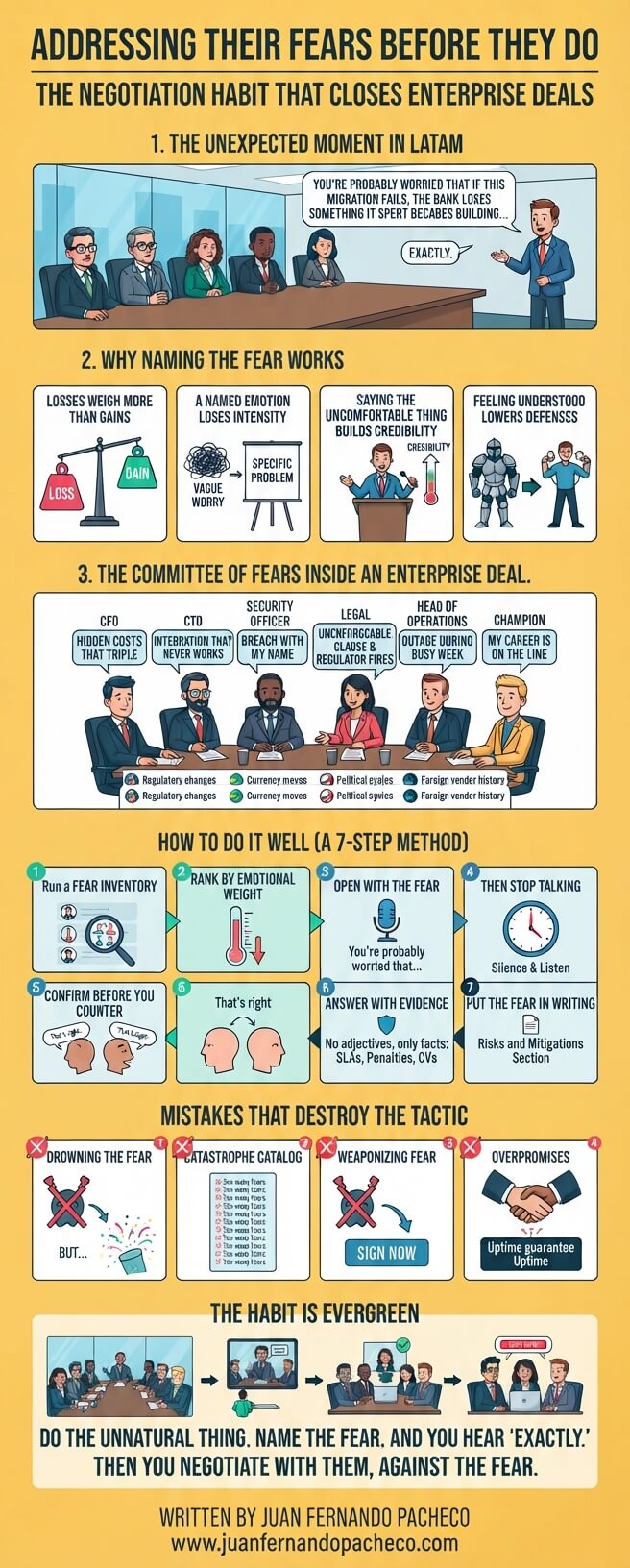
I looked at the room — the CTO, the head of operations, the legal counsel, the security officer — and said something I had never said in a review meeting before:
“You’re probably worried that if this migration fails, the bank loses something it spent decades building, and the people in this room will be the ones asked to explain it.”
Nobody looked at their notes. The CTO leaned back, removed his glasses, and said one word:
“Exactly.”
What followed was the first honest conversation of the entire process. We talked about rollback plans, migration windows, who gets called at 3 a.m. if something breaks, and the penalties we were willing to sign. Six weeks later, we signed. Not because the price changed — it did not — but because the real objection finally had a seat at the table.
That is the habit this post is about. It is the secret to how experienced CEOs and deal leaders negotiate:
Address their fears. Name their biggest worry about the deal before they do.
What the third secret actually says
The idea is short enough to fit on a card:
Name their biggest worry about the deal before they do
When you voice their concerns first, they feel understood and drop their defenses. This builds immediate trust and credibility. Start with a simple phrase: “You’re probably worried that…” For example: “You’re probably worried this acquisition will destroy your company culture and eliminate jobs…”
That is all. No framework acronym, no thirty-slide methodology
Yet most commercial teams never do it. We walk into meetings armed with benefits, roadmaps, case studies, and discounts, while the person across the table silently rehearses the worst case. The gap between what we present and what they fear is where deals go to die.
A fear that is not named does not disappear
It goes underground. It becomes “legal is still reviewing,” postponed meetings, and a competitor winning with a worse offer that simply felt safer.
The fear drives the decision whether you discuss it or not. The only question is whether you put it on the table, or let it negotiate against you in private.
Why naming a fear first works
Four forces sit behind this habit, and none depends on technology, industry, or era. That is why the tactic stays useful forever.
First, losses weigh more than gains
Decades of decision research, popularized by Daniel Kahneman, show that people feel a loss roughly twice as strongly as an equivalent gain.
In a deal, your client is not weighing your benefits against your price; they are weighing what they could lose — uptime, reputation, budget, their position — against the comfort of doing nothing.
A proposal that only talks about gains speaks a different language from the person evaluating it. Naming the possible loss first shows you speak their language.
Second, a named emotion loses intensity
A vague worry fills the whole room. Said out loud, precisely and calmly, it becomes a specific item two parties can examine together. Negotiators who label the counterpart’s fears instead of ignoring them consistently see tension drop and cooperation rise. It is the difference between a monster in the dark and a problem on the whiteboard.
Third, saying the uncomfortable thing first builds credibility
Research on the “stealing thunder” effect shows that a party that discloses a weakness before the opponent does is perceived as more credible and trustworthy.
The same applies in commercial negotiation. If you name the risk before the client names it, you stop being a vendor hiding something and become the most honest person in the room. Honesty is the scarcest resource in any evaluation process.
Fourth, feeling understood lowers defenses
Every experienced mediator knows that a party who feels heard becomes less rigid. When you voice the other side’s concern better than they could voice it, you signal that you stood in their shoes long enough to know what keeps them awake. Defenses drop because there is nothing left to defend against.
Put the four together — loss aversion, emotional labeling, preemptive honesty and felt understanding — and you have a habit that creates in minutes the trust that others try to build in months.
The committee of fears inside an enterprise deal
In a consumer sale, you may face one fear
In an enterprise deal, and especially in a regulated RFx process, you face a committee of fears. Each stakeholder carries a private worst case, and each one can stop the deal without ever saying the reason out loud.
- The CFO fears the hidden cost that triples in year two
- The CTO fears the integration that never talks to the core system.
- The security officer fears the breach with their name in the report.
- Legal fears the clause that turns out unenforceable, and the regulator is not in the room — which is exactly why data sovereignty and local compliance weigh so much in Latin American deals.
- The head of operations fears the outage during the busiest week of the year.
And the middle manager who championed you carries the quiet thought they will never type in an email: if this vendor fails, I am the one who recommended them.
In LATAM markets, there are extra layers:
- Regulatory changes that arrive overnight,
- Currency moves that destroy a budget in one quarter,
- Political cycles that restart every long-term contract, and the historical memory of foreign vendors that promised the world and left.
Many fears your client carries are not about you. They are about everyone who came before you, and you inherit them the moment you sit down.
This is why a proposal that only lists benefits answers none of the real questions
The evaluation committee does not score your slides; they score their relief. The vendor that names and treats each fear, stakeholder by stakeholder, starts to look like the safe choice before the price is even opened.
How to name fears without amplifying them
Naming fears is powerful, and like anything powerful, it needs method. Done badly, it sounds like a horror story or a manipulation trick. Done well, it sounds like leadership. Here is the sequence I have used for years in enterprise and RFx negotiations.
1. Run a fear inventory before the meeting.
For every stakeholder in the room, write the worst case they are privately rehearsing. Use what you know: the incident history of their previous vendor, the questions they asked twice, the clauses their legal team always touches, the mandates from the regulator.
If you can, ask a friendly contact one simple question: “What is the thing nobody wants to say in front of the committee?” The answers are gold.
2. Rank by emotional weight, not by probability.
A low-probability disaster with high emotional weight — a public outage on payday, a data leak in the news — outranks a probable but mild inconvenience. You are not doing risk management; you are doing emotional mapping.
Pick the top two or three fears, never more. A meeting where you list ten disasters sounds like you are selling insurance against yourself.
3. Open with the fear, not with the slide.
Early in the conversation, calmly, say it: “You’re probably worried that…” and finish the sentence with their worst case, in their words, without drama and without minimizing.
“You’re probably worried that we win this deal, staff it with juniors, and you never see the senior team again.”
Say it the way a doctor says, “This part will hurt a little” — with respect and without fear.
4. Then stop talking.
This is where most people fail. After naming the fear, pause. Let them confirm it, correct it, expand it. Do not interrupt; do not rush to reassure.
The fear needs air. If you name it and immediately cover it with “but don’t worry,” you just told them their concern is an obstacle to your pitch instead of a legitimate point.
5. Confirm before you counter.
Summarize what you heard until the other side says “that’s right,” not just “yes.” “That’s right” is the sound of feeling understood. Only then move to your response.
6. Answer with evidence, not adjectives.
Never answer a fear with an adjective. “Reliable,” “robust,” “world-class” reassure nobody, because every vendor uses them. Answer with evidence:
- The penalty clause you are willing to sign,
- The rollback points in the migration plan,
- The reference client of similar size,
- The local data residency architecture,
- The named senior team with CVs attached.
Fear is concrete; the antidote must be concrete too.
7. Put the fear in writing.
In an RFx response, include a risks and mitigations section that names the concerns before the evaluators name them. In the contract, put the SLA, the penalties, the data sovereignty clauses, the exit and transition assistance terms.
A fear addressed out loud creates trust in the room; a fear addressed in writing creates trust in the file that circulates for six months after you leave. In enterprise deals, the file is your real negotiator.
Scripts you can adapt
A few openings I have used or heard used well, generic enough for any industry:
- On change and jobs: “You’re probably worried this acquisition will destroy your company culture and eliminate jobs.” Then show the transition plan and what it does with those roles.
- On execution: “You’re probably worried that the team that sells you is not the team that delivers.” Then attach the named delivery team to the proposal.
- On lock-in: “You’re probably worried that in year three, once switching hurts, we will raise prices.” Then offer the exit clause before they ask for it.
- On compliance: “You’re probably worried that our architecture collides with local data rules that have not even been written yet.” Then show the residency and sovereignty design.
- On career risk, the deepest one: “You’re probably worried that choosing us is a personal bet, and that if we fail, the failure has your name on it.” Then make the governance, reporting and escalation paths protect the sponsor as much as the client.
Notice the pattern: name the fear precisely, pause, confirm, and only then bring evidence. The sentence “you’re probably worried that…” is not a trick. It is a door you hold open for the other side to walk through.
Mistakes that destroy the tactic
The same tool that builds trust can burn it. Four mistakes ruin this habit.
- The first is naming the fear and immediately drowning it in reassurance. “You’re probably worried about X, but don’t worry, we are the best.” The “but” deletes the empathy; the other side hears that you named the fear only to dismiss it.
- The second is turning the inventory into a catastrophe catalog. List every possible disaster and you stop sounding like an honest partner and start sounding like a warning label. Two or three fears named with precision beat ten named with noise.
- The third is using fear to pressure a close. “You’re probably worried about doing nothing while your competitor moves, so sign today.” That is fear as a weapon, and weapons produce resistance — or worse, a signature followed by regret and a hostile relationship.
- The fourth is overpromising after naming the fear. If you name the outage fear and then commit to an uptime you cannot sustain, you used trust as bait. The deal may close; the relationship will not survive the first incident.
And one general warning: do it once and you are clever; do it at every stage, and you are trusted. Fears mutate. The fear at RFP stage is selection. At contract stage it is the fine print. At go-live it is the switch. At renewal it is the price.
Keep naming the fear of the moment.
Why this stays useful for the next five years and beyond
The tools around negotiation keep changing. Meetings move from boardrooms to video calls, proposals move from paper to portals, drafting moves from humans to software.
None of that touches the mechanism behind this habit, because the mechanism is human wiring: loss aversion, threat detection, the need to feel understood.
A client may evaluate your proposal on a screen that did not exist five years ago, and the private question will still be the same — what do I lose if this goes wrong, and who gets blamed?
That is what makes the habit evergreen. Channels change; fears do not. Whoever names the fear first names the real agenda of the meeting, and whoever names the real agenda tends to run the meeting.
Put it into practice this week
Before your next deal conversation, take fifteen minutes and do three things.
- One, write the fear inventory: for each person in the room, one sentence with their private worst case.
- Two, choose the single heaviest fear and write your opening line: “You’re probably worried that…”
- Three, prepare one piece of concrete evidence — a clause, a plan, a reference, a name — that answers that fear with facts instead of adjectives.
Then, in the meeting, say the line early, pause, listen, confirm, and answer with the evidence. Watch the posture of the room. Watch how much more they tell you. Watch the questions change from interrogation to co-design.
Final thought
The best negotiators I have met in twenty years across Latin America are not the ones who win arguments. They are the ones who lower the threat level in the room. They understand that every “no” is a fear wearing a costume, and every stalled deal is a worry nobody named.
So do the unnatural thing. Walk into your next meeting and say the thing they are afraid of, before they do. Say it with respect, say it with evidence ready, say it — and then stop talking.
You will hear the most beautiful word in negotiation, the one that CTO said to me years ago: “exactly.” And from that moment you will not be negotiating against them. You will be negotiating with them, against the fear.
References and further reading
Books that reinforce this post
- Never Split the Difference, by Chris Voss and Tahl Raz — the source of labeling fears out loud and of the “that’s right” moment.
- Thinking, Fast and Slow, by Daniel Kahneman — loss aversion and why losses dominate decisions.
- How to Win Friends and Influence People, by Dale Carnegie — see the other side’s point of view before you present your own.
- Crucial Conversations, by Kerry Patterson, Joseph Grenny, Ron McMillan and Al Switzler — making it safe to talk about what matters most.
- Influence: The Psychology of Persuasion, by Robert Cialdini — honesty and credibility as engines of persuasion.
Web references
- Program on Negotiation at Harvard Law School — the leading academic hub on negotiation theory and practice.
- Daniel Kahneman Showed Negotiators a More Rational Path — PON article on loss aversion applied to negotiation.
- Harvard Business Review, negotiation strategies topic page — evergreen articles on dealing with tough negotiators and complex deals.
- Stormy Weather: Testing “Stealing Thunder” as a Crisis Communication Strategy — the research on why disclosing a weakness first builds credibility.
- Why the “Stealing Thunder” Theory of Crisis Comms Requires Focus and Intent — a readable practitioner view of the same effect.