Some years ago, in the final review of a multi-million-dollar proposal for a regional bank, a junior analyst sat quietly for forty minutes. Near the end, almost as an afterthought, she mentioned that the penalty clause we were about to accept could wipe out the deal’s entire margin if a single integration slipped.
She was right. We rewrote the clause, protected the deal, and I left the room with a question that has never left me since: what else had she not said, and how many others had chosen silence?
That question is the seed of this post
- I have watched teams lose deals and lose years, not for lack of talent but for lack of a climate where talent can speak.
- I have also seen the oppositeteams that surface risks early, debate fiercely, commit fully, and deliver under some of the toughest contractual conditions in banking and public sector work.
The difference between the two is rarely strategy or charisma. It is whether the leader has solved the tension between psychological safety and high standards.
Most leaders treat that tension as a trade-off
Be kind and risk mediocrity, or be demanding and risk silence.
Elite leaders refuse that deal. They build environments where people feel safe to contribute fully and are held to relentlessly high standards at the same time.
Safety to speak, standards to win. Both are non-negotiable. What follows is a practical, evergreen playbook for doing exactly that, whether you lead a deal team, a product squad, or an entire region.
The false trade-off at the heart of leadership
Psychological safety, in its simplest definition, is a shared belief that the team is safe for interpersonal risk-taking
Raising a half-formed idea, a difficult question, or an unpopular view without fear of humiliation or punishment. It is not about being nice, and it is not about lowering the bar. It is about making candor possible, because in knowledge work, candor is how risk travels upward before it becomes cost.
Standards are the other half of the equation
The non-negotiable expectations of quality, rigor, and follow-through that a team holds itself to. In my world, that is the uptime commitment we sign into a service level agreement, the compliance review we do not skip, the proposal we do not ship until the winning theme is sharp.
Standards are not pressure for its own sake; they are the promise a team makes to its client and to itself.
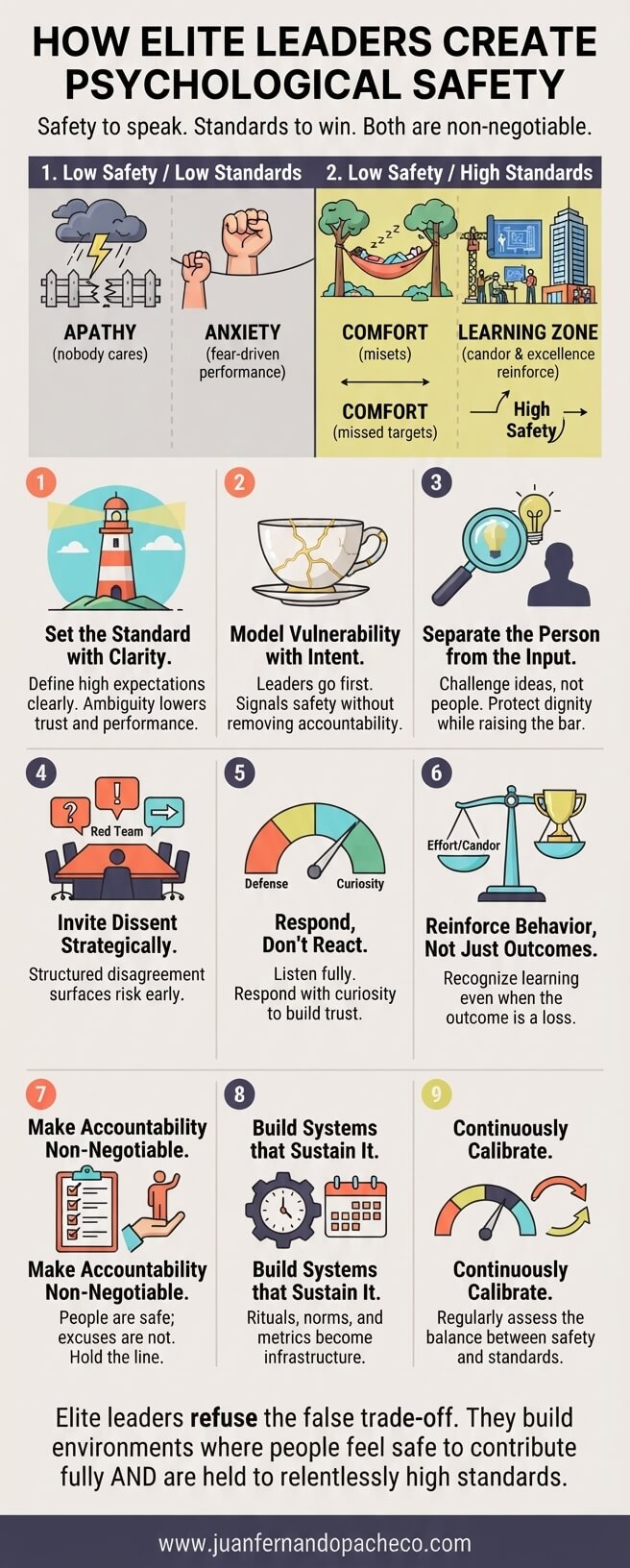
Place safety and standards on two axes and four climates appear
- Low safety with low standards produces apathy: nobody speaks, and nobody cares.
- Low safety with high standards produces anxiety: performance exists, but it runs on fear and information hides.
- High safety with low standards produces comfort: people love the team and miss the target.
Only high safety with high standards creates the learning zone, the place where candor and excellence reinforce each other, which is exactly what large studies on team effectiveness, from academic research to Google’s Project Aristotle, keep confirming.
The nine practices below are how leaders build that zone and, harder, how they keep it.
Nine practices that hold both lines
1. Set the standard with clarity
Ambiguity is the silent killer of trust and performance
When expectations are vague, people spend energy guessing instead of executing, and every surprise turns into a personal judgment. Clear standards are therefore an act of respect: they tell people exactly what the game is so they can play it with confidence.
- In deal work, I learned to publish the definition of a good deal before a pursuit begins: which risks we will not take, which margins we will not cross, which quality gates every deliverable must pass.
- In product teams, the equivalent is a visible definition of done and a roadmap the team actually believes.
Clarity removes the need to read the leader’s mood. It replaces fear of the person with respect for the standard, and that is the foundation every other practice stands on.
Try this
Write down the three standards that matter most for your team this quarter, then check whether each one is observable, measurable, and known by everyone without asking.
2. Model vulnerability with intent
Psychological safety is set by the first person who admits a mistake in the room, and that person has to be the leader.
When a leader says “I was wrong,” “I do not know,” or “I need your help,” it signals that fallibility is survivable. Done with intent, vulnerability does not remove accountability; it makes learning visible.
I have opened deal reviews by owning one of my own misses:
- A regulatory constraint I underestimated,
- A client signal I misread.
The effect is immediate. Shoulders relax and the real issues surface. The intent is what separates this from therapy: it is disclosure for learning, always paired with “and here is what I will do differently.” Vulnerability without that second half is just noise; with it, it is leadership.
Try this
In your next team meeting, name one real mistake you made recently and one thing it changed in how you lead. Keep it brief, factual, and forward-looking.
3. Separate the person from the input
High standards require hard challenges, and hard challenges become unsafe the moment they attach to identity.
Elite leaders are surgical here: they challenge ideas, assumptions, and evidence, never the dignity of the person offering them. “This estimate worries me; walk me through the assumptions” is a very different sentence from “you are always optimistic.”
In cross-functional teams that mix sales, legal, engineering, and operations, this discipline is what keeps debate productive. A pricing view from finance and a risk view from architecture are inputs to stress test, not territories to defend.
When people watch their ideas get attacked hard while their dignity stays fully protected, they bring bigger ideas next time. Raise the bar and protect the person, always in the same breath.
Try this
Adopt one team norm in writing: we attack assumptions, not authors. Use it explicitly in your next debate and watch the temperature change.
4. Invite dissent strategically
Waiting for spontaneous dissent is naive.
In many corporate and national cultures, hierarchy and harmony weigh against open disagreement, and the quietest person in the room is often the one holding the most expensive information.
Elite leaders do not hope for dissent; they design it. Structured disagreement surfaces risk early, while it is still cheap to fix.
Before submitting a high-stakes proposal, I run a pre-mortem
Assume we lost this deal six months from now, then ask the room what killed it. I also assign a rotating red team whose explicit job is to break the plan.
Because dissent is scheduled and assigned, nobody pays a social price for it, and the quiet analyst from my opening story gets a formal moment to save the margin. Dissent by design beats dissent by accident, every time.
Try this
Add one pre-mortem or red team slot to every major decision on your calendar this quarter. Make disagreement an agenda item, not an accident.
5. Respond, don’t react
The culture of a team is written in the three seconds after someone speaks up.
A raised eyebrow, a defensive justification, a “let us not go there again,” and the room learns that candor has a cost. Elite leaders train themselves to respond with curiosity instead of reacting with defense, because the messenger is always watching to see whether the channel is safe.
An engineer once told me, two weeks before signature, that a committed response time was not achievable. My first instinct was frustration; what I said was, “Thank you for flagging it now; show me the data.” We renegotiated the service level agreement on honest numbers, and the relationship grew stronger, not weaker.
The client trusted us more because we corrected course before the contract, not after the failure. Every bad news message you receive is a test of whether your safety is real.
Try this
The next time someone brings bad news, say one sentence before anything else: thank you for telling me. Then ask two questions before you give one opinion.
6. Reinforce behavior, not just outcomes
Teams do not follow what you say; they follow what you reward.
If only closed deals and shipped features get celebrated, people learn to hide the messy middle: the risks, the near misses, the lessons. Elite leaders recognize candor, learning, and excellence even when the outcome is a loss, because culture follows what you reinforce.
I make a point of celebrating the pursuit, not only the win
The team that surfaced a fatal risk early, even when we withdrew from the bid; the colleague whose compliance concern slowed us down and saved us. And when we win, I name the behaviors that produced the win, so success becomes repeatable instead of mythical.
Outcomes are partly luck; behaviors are fully teachable. Reward the behaviors and the outcomes will compound on their own.
Try this
In your next review, recognize one person publicly for a behavior you want to multiply, such as early escalation or honest forecasting, regardless of the result it produced.
7. Make accountability non-negotiable
Here is where the model is most misunderstood.
Psychological safety is not permission to underperform. The same leader who says “bring me any problem without fear” must also say “and we will honor every commitment we make.” Without that second half, safety decays into comfort, and your best performers, the people who care most, are the first to leave.
Holding the line looks like this
Clear owners, visible deadlines, and consequences that are fair, consistent, and explained. When a milestone slips, the safe and demanding leader asks two questions in order.
- First, “What in our system allowed this?” with genuine curiosity and no blame.
- Second, “What is your plan to recover the commitment?” with full seriousness.
People are safe; excuses are not. That distinction, repeated over time, is what turns a friendly team into a trusted one.
Try this
Review one slipping commitment on your plate today. Separate the conversation about the person, respectful and curious, from the conversation about the commitment, firm and explicit, and have both.
8. Build systems that sustain it
No leader’s mood, however good, can carry a culture alone
Cultures survive when they are encoded in rituals, norms, and metrics that repeat week after week, so the system works even on the days the leader is tired, remote, or new. Elite leaders turn safety and standards into infrastructure.
Practical infrastructure I have relied on includes a standing risk radar in every weekly deal cadence, where anyone can add an item without permission; retrospectives that end with one changed norm instead of a list of complaints; quality gates that no title can bypass; and onboarding sessions where new hires learn, in their first week, how we disagree, how we escalate, and how we own results. What is scheduled survives; what is improvised dies. If a practice depends on your energy, it is a habit, not a system, and habits leave with the person who holds them.
Try this
Pick one ritual that currently depends on you, and write it down as a simple, repeatable agenda with an owner who is not you.
9. Continuously calibrate
The balance between safety and standards is not a setting; it is a dial, and teams drift
A hard quarter can push you toward anxiety; a comfortable streak can slide you toward comfort. Elite leaders assess the balance regularly, in the same way they review revenue or quality, and they adjust one thing at a time.
I use two pulse questions in retrospectives, anonymously when needed
- “In the last weeks, did you hold back anything you thought was important?” and
- “In the last weeks, did we accept work below our standard?”
The pattern of answers tells me which line is eroding. Then I adjust: more modeled vulnerability if safety is low, more visible accountability if standards are soft. Adjust, improve, repeat. Calibration is not a sign the system failed; it is the system working as designed, because no team stands still in a moving market.
Try this
Add those two pulse questions to your next retrospective, and commit in public to one adjustment based on what you hear.
Bringing it home: safety to speak, standards to win
Let me close with the sentence that ties it all together:
Elite leaders create environments where people feel safe to contribute fully, and are held to relentlessly high standards.
Everything else in this post is technique in service of that idea.
If you lead a team, a deal, a product, or a family, you are always broadcasting two messages:
what happens here when someone speaks up, and what happens here when someone underperforms.
The nine practices are simply ways of making sure both answers build trust. Speaking up is safe, and underperforming is not the norm.
You do not choose between kindness and excellence; you owe your team both, at the same time, every day.
Years from now, the tools we use and the markets we serve will look different, but the human equation will not. Teams that can say the hard thing early and deliver the hard thing on time will still win.
Start with one practice this week, then another. The standard you walk past is the standard you set, and the silence you tolerate is the silence you get.
Choose instead to build rooms where the truth speaks early, and the bar stays high. That is how good teams become elite ones, in any decade, in any market, under any leader who decides that both lines are non-negotiable.
References and further reading
Web references:
- Edmondson, A. — “High-performing teams need psychological safety. Here’s how to create it.” Harvard Business Review.
- Google re:Work — “Understand team effectiveness“, the guide built on Project Aristotle, which found psychological safety to be the strongest predictor of team effectiveness.
- Harvard Business Review — “Creating psychological safety in the workplace“, podcast conversation with Amy Edmondson on the origin and practice of the concept.
hbr.org - Edmondson, A. — ongoing articles, resources, and talks on psychological safety, including her TEDx talk “Building a psychologically safe workplace.“
Books that reinforce the post:
- Amy C. Edmondson — “The fearless organization: creating psychological safety in the workplace for learning, innovation, and growth” (Wiley). The definitive book on the subject, and the backbone of this post.
- Kim Scott — “Radical candor: be a kick-ass boss without losing your humanity.” The clearest framework for pairing care personally with challenge directly.
- Daniel Coyle — “The culture code: the secrets of highly successful groups.” A field guide to the rituals that turn safety and standards into culture.