The difference is what they architect, not where they sit
In every complex organization I have worked with — banks, retailers, telecoms and public entities across Latin America and beyond — there is a quiet confusion between two roles that sound interchangeable: the business architect and the enterprise architect.
I have seen that confusion in org charts, RFx responses, transformation programs, and job descriptions. And I have seen what it costs: proposals that optimize one department and ignore the rest, roadmaps that look brilliant inside a domain and collapse at the seams, and change programs that deliver local wins while the company keeps operating as four or five disconnected businesses under one logo.
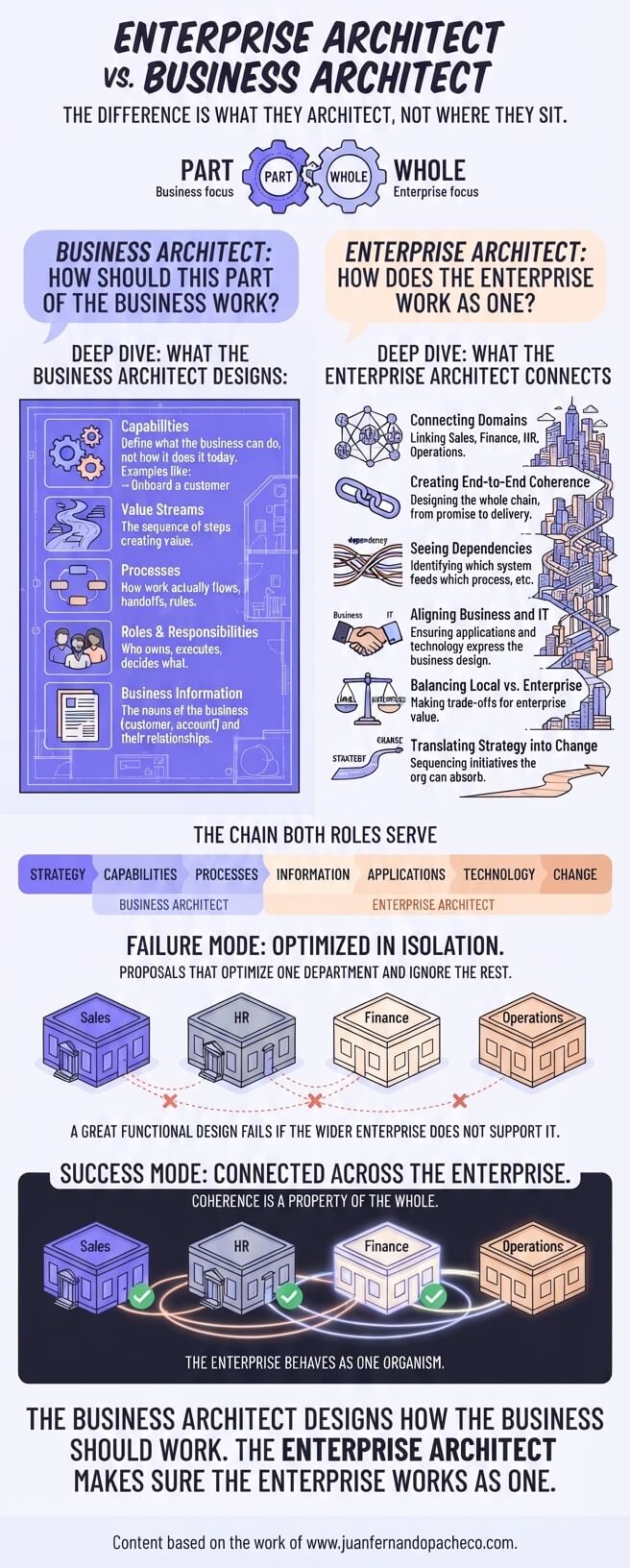
The diagram I am commenting on captures the distinction in a single line I now use in my own work: the difference isn’t where they sit; it is what they architect. That sentence is worth unpacking.
Once you understand it, several practical decisions become clearer — who to involve in a deal, which role to hire first in a transformation, how to split responsibility inside a cross-functional team, and how to read a proposal to see whether its author understood the client as a business or as a collection of systems.
I write this post to stay useful for years, not months. Frameworks will evolve, and tools will change, but the tension between making one part of a business excellent and making the whole business coherent is permanent. That tension is the subject of this post.
Two questions, two jobs
The cleanest way to separate the two roles is by the question each one answers
- The business architect asks: how should this part of the business work?
- The enterprise architect asks: how does the enterprise work as one?
The questions look similar, but they produce different artifacts, different meetings, and different kinds of value.
- The first question leads into the anatomy of a business domain: its capabilities, its value streams, its processes, its roles and responsibilities, its business information.
- The second leads into the anatomy of the whole: the dependencies between domains, the seams between systems, and the places where a decision in one corner of the company creates cost or risk in another.
Neither question is more senior. They are different scopes of design, and as in any design discipline, the scope defines the job.
- A business architect who keeps zooming out until everything is about integration stops designing the business.
- An enterprise architect who keeps zooming in until everything is about one domain stops connecting the enterprise.
Maturity in either role is knowing which question is on the table today.
What the business architect designs
The business architect designs how a business domain works
A domain is a meaningful piece of the organization — sales, finance, human resources, operations, or, in the world I know best, a banking segment such as retail banking, payments, or credit.
The raw material of the role is:
- Capabilities: what the business can do, expressed independently of how it does it today. “Onboard a customer”, “price a loan,” and “settle a payment” are capabilities. They are stable over time, which makes them the right anchor for strategy conversations.
- Value streams: the sequence of steps that creates value for a customer or stakeholder, from the first trigger to the delivered outcome.
- Processes: how work actually flows, with its handoffs, rules, and exceptions.
- Roles and responsibilities: who owns, executes, and decides what, because a process without an owner is a wish.
- Business information: the nouns of the business — customer, account, policy, invoice, claim — and how they relate, before anyone starts talking about databases.
Done well, this work produces functional coherence
The domain makes sense internally. Its capabilities map to its strategy, its value streams flow without dead ends, its processes are owned, and its information is defined once and shared.
That is a rare achievement. Most organizations have never seen a clean picture of even one domain, which is why they keep reorganizing the boxes instead of redesigning the work.
The trap is that functional coherence is local. A domain can be beautifully designed and still fail because the rest of the enterprise does not support it. That is where the second role enters.
What the enterprise architect connects
The enterprise architect designs the coherence of the whole. The raw material of this role is not any single domain but the relationships between domains, and between the business and its technology:
- Connecting domains: sales, finance, human resources and operations do not live in separate companies; someone has to draw the lines between them and make those lines work.
- Creating end-to-end coherence: a promise made in sales becomes an obligation in operations, a receivable in finance and a staffing question in human resources; someone has to design that chain as one thing.
- Seeing dependencies: which system feeds which process, which regulation constrains which product, which legacy platform is quietly holding up three revenue lines.
- Aligning business and IT: making sure the application and technology portfolio actually expresses the business design, instead of accumulating as historical sediment.
- Balancing local and enterprise value: sometimes the right decision for one domain is the wrong decision for the company, and someone has to own that trade-off out loud.
- Translating strategy into change: turning intent into a sequenced portfolio of initiatives the organization can actually absorb.
Done well, this work produces end-to-end coherence
The enterprise behaves as one organism. Decisions propagate correctly, dependencies surface before they become incidents, and investment flows to the places where it creates enterprise value rather than local comfort.
The enterprise architect is not the police of standards, as the caricature goes, but the person who keeps the whole legible while everyone else is busy making their part work.
The chain both roles serve: from strategy to change
There is a simple chain that places both roles: strategy, capabilities, processes, information, applications, technology, change.
- Strategy says where the organization is going.
- Capabilities say what it must be good at to get there.
- Processes say how the work flows. Information says what the business needs to know.
- Applications say which software supports that knowledge and work.
- Technology says which platforms run those applications.
- Change says how the organization moves from here to there without breaking.
The business architect lives mostly in the first half of the chain — strategy, capabilities, processes, information — with deep attention to one domain.
The enterprise architect works across the full chain, from strategy to technology, with attention to the handoffs: where capabilities become applications, where information becomes data models, where strategy becomes a change portfolio.
This is also why the enterprise architect is usually the role that translates strategy into change. Strategy fails when it never becomes a connected set of changes across capabilities, systems, and people; keeping that translation honest is the job.
Artifacts: what each role leaves on the table
Artifacts are where the work becomes visible
- The business architect leaves capability maps that name what the business does independently of the org chart; value stream maps that show how value reaches the customer; process definitions with owners; a business information model that defines the nouns everyone argues about; and a trace from strategy to capability, so investment conversations happen in a stable language.
- The enterprise architect leaves dependency maps that show which domain, application, and platform leans on which; principles that make the next thousand decisions cheaper; an application and technology portfolio with honest fitness ratings; roadmaps that sequence change across domains; and a running translation of strategy into initiatives, with trade-offs written down instead of whispered.
Notice what both sets have in common: they are design artifacts, not reports. They exist to change decisions, not to decorate meetings.
Optimized in isolation, disconnected in reality
Here is the failure mode I have seen most often in my career, and the one the diagram names precisely: optimized in isolation, disconnected in reality.
Imagine a bank that redesigns retail onboarding
The new journey is elegant: fewer steps, better conversion, higher adoption. The business architect did superb work inside the domain. Then the journey meets the rest of the enterprise.
- The core banking platform cannot support the new product configuration.
- The risk engine needs data the journey never captures.
- The regulator requires records stored in the country, and the chosen cloud region does not allow it.
The service levels promised to the customer cannot be honored by the operations team downstream. The design was excellent; the outcome is a delay, a penalty, or a quiet rollback.
I have reviewed dozens of proposals and RFx responses that made exactly this mistake at the commercial level: a perfect answer for one department, with no story for the dependencies. In high-stakes procurement — banking and the public sector especially — the evaluation committee includes the people who own those dependencies: legal, security, operations, technology.
A proposal that optimizes the visible domain and ignores the invisible chain reads as naive, and naive loses deals. Inside the organization, the same logic applies: a transformation that optimizes domains without connecting them produces the warning picture — four boxes, each excellent, connected by nothing.
The uncomfortable truth is that a great functional design can still fail if the data, applications, technology, and wider enterprise do not support it. Coherence is a property of the whole, not of the parts.
Why deal teams and buyers should care
I review and lead complex technology deals for a living, so let me translate the distinction into commercial language. Every RFx contains two implicit questions from the buyer: do you understand my business domain, and do you understand my enterprise?
- The first question is answered by the functional story — capabilities, processes, outcomes, adoption, the value proposition in the language of the domain.
- The second is answered by the end-to-end story — integration, data sovereignty, security, service levels, legal clauses, penalties, change management.
A vendor that answers only the first sounds like a product demo. A vendor that answers only the second sounds like an infrastructure catalog. The vendors that win, and then deliver, answer both in one narrative.
The same applies on the buy side
An evaluation committee that scores only the functional answer buys local optimization and inherits enterprise debt for a decade.
In my experience, the most expensive clause in a contract is not the penalty clause; it is the dependency nobody priced. Both architectural lenses are, in the end, risk management instruments.
The real distinction, in one line
So the distinction is not business versus technology, and it is not junior versus senior.
It is this: business architecture creates functional coherence, and enterprise architecture creates end-to-end coherence.
The business architect designs how the business should work. The enterprise architect makes sure the enterprise works as one.
Once you accept that, the rivalry between the two communities dissolves. They are two scopes of the same discipline: the deliberate design of the organization.
- A transformation with only business architecture produces beautiful maps the systems cannot execute.
- A transformation with only enterprise architecture produces system diagrams the business never owned.
You need both, in sequence and in conversation.
Three misconceptions that keep organizations stuck
Three misconceptions keep organizations stuck on this topic.
- The first is that enterprise architecture is just IT architecture with a better title. In practice, an enterprise architect who cannot speak to capabilities and value streams will never align business and IT, because half of that sentence will be missing. The role is defined by the alignment, not by the technology side alone.
- The second is that business architecture is strategy consulting without the slides. In practice, business architecture is design, not advice: it leaves behind owned, executable models of how a domain creates value, and those models keep working long after the consultants leave.
- The third is that one role can simply absorb the other. In a small organization, one person may wear both hats, but the scopes remain distinct, and the moment the organization grows, the unattended scope is the one that fails first. I have watched it happen in both directions.
How the two roles work together in practice
In practice, the collaboration follows a simple rhythm
- The business architect defines what the business must do and how value flows inside the domain.
- The enterprise architect takes that design and tests it against the whole: the dependencies, the portfolio, the constraints, the budget cycle.
The business architect pushes for the best design of the domain; the enterprise architect pushes for the best trade-off for the enterprise. Handled professionally, that tension is not dysfunction — it is governance.
In deal work, I use the same rhythm commercially.
- The business architect’s lens shapes a value proposition that speaks to the client’s capabilities and value streams.
- The enterprise architect’s lens prices the real scope: integrations, compliance constraints, data rules, service levels, change.
Deals won on the strength of the domain answer and lost in delivery almost always skipped the second lens.
Which one do you need, and when?
A few rules of thumb for leaders, kept deliberately simple so they age well:
- If a domain does not know what it does or for whom, start with business architecture: capabilities, value streams, and a clear picture of how value is created.
- If the domains collide — duplicated systems, broken handoffs, strategy that never becomes change — you need enterprise architecture.
- If you are running a transformation, you need both: business architecture to define the target, enterprise architecture to sequence the journey across systems and people.
- If you are buying technology through a complex RFx, insist on both lenses in every proposal: a functional story for the domain and an end-to-end story for integration, security, compliance and operations.
- If you can hire only one first, hire against your most painful symptom: unclear business model, business architect; fragmented enterprise, enterprise architect — and plan for the second seat within the year.
A note for practitioners
If you are building a career in either discipline, the durable advice is also simple.
- Business architects should learn enough technology to keep their designs executable: applications, data, integration, and the economics of platforms.
- Enterprise architects should learn enough business to keep their coherence work relevant: capabilities, value streams, and the language of executives.
The best people I have worked with in more than two decades of product, design, and deal work are bilingual in exactly this sense — they can design a domain, and they can read the whole. That combination never goes out of style.
Final thoughts
Tools will change. Technologies will arrive and fade. The tension between the part and the whole will not change.
The business architect designs how the business should work; the enterprise architect makes sure the enterprise works as one.
Teams that understand that sentence — and staff, fund, and govern accordingly — turn strategy into change instead of turning it into slides.
References and further reading
Web references:
- The Open Group — the TOGAF standard, one of the most used enterprise architecture methods in the world
- The Business Architecture Guild — the BIZBOK guide, the primary body of knowledge for the business architecture profession
- Zachman International — the Zachman framework, a foundational schema for organizing enterprise architecture artifacts
- Gartner — enterprise architecture insights, definitions, and leadership guidance
Books that reinforce this post:
- Ross, J. W., Weill, P. and Robertson, D. — Enterprise architecture as strategy: creating a foundation for business execution (Harvard Business School Press). The classic argument that architecture is a strategic asset, not a technical chore
- Ulrich, W. and McWhorter, N. — Business architecture: the art and practice of business transformation. A grounded view of how business architecture drives enterprise transformation
- Lankhorst, M. — Enterprise architecture at work: modelling, communication and analysis (Springer). A practical treatment of enterprise modelling and how architecture communicates across the organization:
If you take one sentence from this post into your next deal, program, or hiring conversation, take this one: design the part well, and connect the whole on purpose.