Learn these or stay stuck at the same revenue
There is a meeting that repeats itself in every company that sells anything
The quarter stalls, the pipeline gets reviewed, the market gets blamed, and the number still does not move. I have been in that room as a designer defending a user flow, as an architect defending a solution, and as a business development leader defending a technology revenue forecast across Latin America.
Twenty years of tenders, negotiations, and cross-functional teams taught me a simple and uncomfortable truth: revenue plateaus are rarely market problems. They are maturity problems. The market sets the game’s difficulty.
Your maturity in leadership sets the score you are able to reach inside it.
The maturity I mean here has nothing to do with age, title, or tone of voice. It is a set of observable behaviors under pressure. It is what you do in the five seconds after a hostile message lands, in the hour after a failure becomes public, in the week after a client tears apart work you loved.
Those small moments compound the way interest compounds
invisibly at first, then all at once, into trust, into deal velocity, into margin, into revenue. Immature leaders leak value in those moments. Mature leaders capture it, and their competitors never quite understand why.
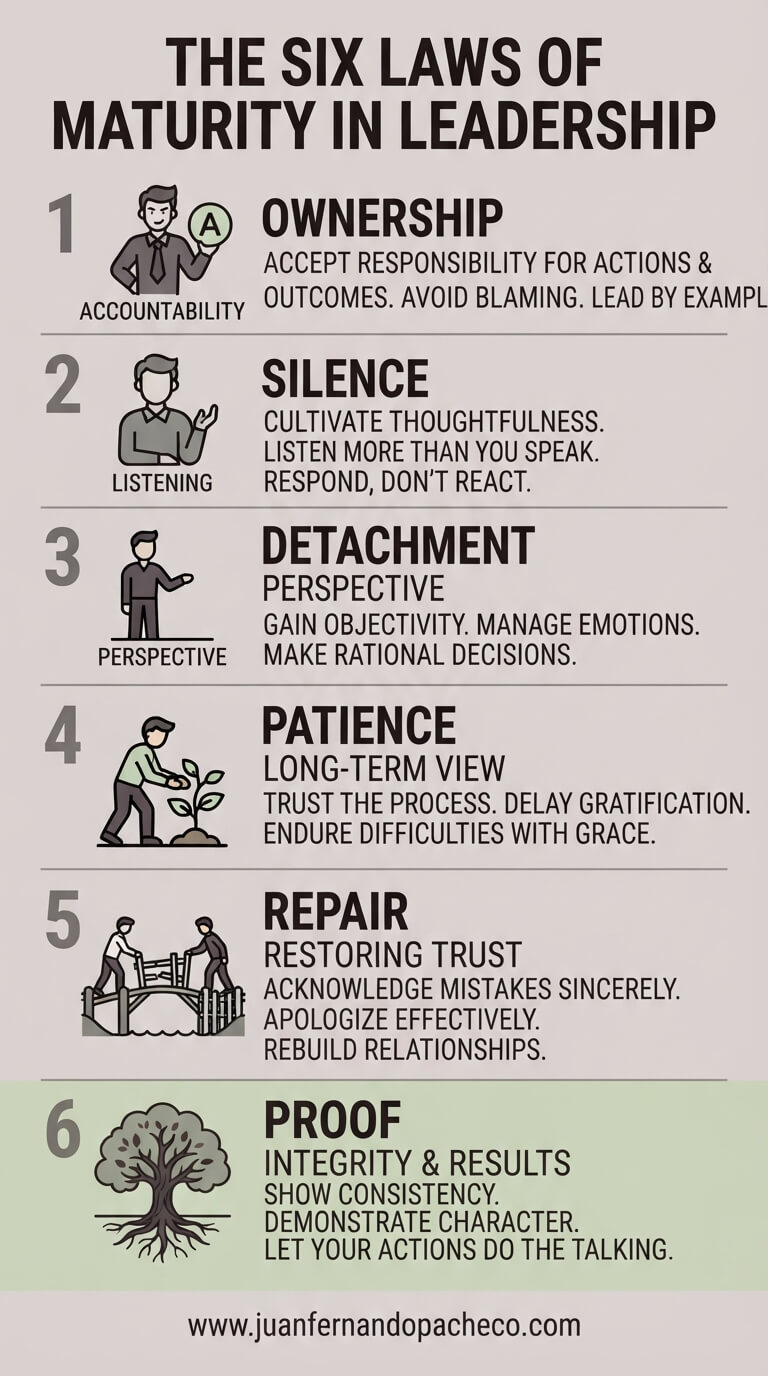
The frame that follows is six laws
Each one names a moment every leader faces and defines the mature response to it:
- who takes responsibility when something breaks,
- what you do in the gap between a trigger and a response,
- how you separate your ego from the business,
- what decides your timeline,
- what you fix when performance drops, and
- what you point to when someone asks if it is working.
None of these laws depends on a platform, a methodology, or an economic cycle. That is exactly why they are worth writing down: they will be as true in five years as they are today.
1st law: ownership — who takes responsibility when something breaks
Immature: blames the team or the market.
Mature: checks the system first.
Early in my career in deal execution, a proposal for a major banking client nearly went out incomplete because a dependency between the legal review and the pricing sheet collapsed at the last hour.
The immature version of that story wrote itself in the room within minutes: legal was slow, sales was optimistic, the client’s timeline was unreasonable. Every sentence was true, and every sentence was useless.
Blame produces information about people, and people you cannot change. Ownership produces information about systems, and systems you can.
The mature question was different: what let it happen?
Once we asked that, the answer appeared in an afternoon. Approvals traveled through a single person at each step, nobody owned the interface between steps, and there was no checkpoint able to catch a missing piece before the deadline.
That is not a people problem.
That is an architecture problem, and architectures can be redesigned. We rebuilt the review chain with parallel checks and a named owner for every handoff, and the same team that had “failed” started shipping clean proposals on time.
Ownership is also a commercial weapon.
In any tender or negotiation, the client is quietly auditing how you behave when something breaks, because something always breaks after the contract is signed. The leader who says “this is mine, here is what we will do” becomes the leader the client wants on the other side of a multi-year agreement. Blame makes you a risk. Ownership makes you an asset.
Action: next time something fails, write down what let it happen before you write down who caused it. You will notice that the first list is long, fixable and permanent, while the second is short, emotional and temporary.
2nd law: silence — what you do in the gap between a trigger and a response
Immature: reacts to every message the second it lands.
Mature: waits, decides, then speaks once.
Every leader I have worked with, in Ecuador, Mexico, Colombia, or Brazil, carries the same device in the same pocket, and every device promises the same illusion: that speed of reply equals quality of leadership. It does not. Reacting to every message the second it arrives means your agenda is being written by whoever is loudest at that moment, and your most expensive thinking is being done in public, one improvised answer at a time.
In high-stakes commercial work, this becomes expensive fast.
I have watched a single defensive email, sent sixty seconds after a provocative client message, undo weeks of careful negotiation. And I have watched the opposite: a leader read the same message, close the laptop, take ten minutes, and answer once with a short, calibrated note that moved the deal forward. The difference between those two leaders was not intelligence or experience. It was ten minutes of silence. The gap between a trigger and a response is not empty time. It is the workspace where judgment happens.
Silence is not avoidance, and it is not slowness.
It is the discipline of speaking once with your full authority behind it, instead of five times with none. Teams calibrate to their leader’s rhythm. A leader who reacts instantly teaches the team to react instantly, and the whole organization starts thinking out loud. A leader who waits, decides, and speaks once teaches the organization to do the same, and suddenly meetings get shorter and decisions stick.
The channels will change. Email today, chat tomorrow, something else in five years. The gap does not change. Leaders who master the gap can be dropped into any channel, any crisis, any negotiation, and remain dangerous.
Action: before replying to anything urgent, wait ten minutes. Then answer. Urgency is a feeling. Deadlines are facts. The two are rarely related.
3rd Law: detachment — how you separate your ego from the business
Immature: reads feedback as a personal attack.
Mature: reads feedback as data about the output.
There is a kind of pain every builder knows
You spend weeks shaping a product roadmap or a commercial proposal; you present it with conviction, and the client dismantles it in ten minutes. I have been there more times than I can count, and for years I felt every redline as a verdict on me.
The feedback was about the document, but I heard it as being about my identity. That is the immature pattern, and its cost is not only emotional. While your ego is on the table, you pay to protect it: in concessions you should not make, in scope you absorb, in margin you give away.
Detachment changes the economics of the room.
When a procurement committee criticized a solution I believed in, the mature move was to ask one question before defending anything: what is the useful part of this? In one memorable case, the useful part was a concern about data residency hidden inside what sounded like a general complaint about pricing.
Once extracted, that single signal reshaped the offer, satisfied a regulatory mandate, and saved a contract worth millions. The criticism was poorly delivered, emotionally loaded, and absolutely correct. Only a detached leader could hear it.
Feedback is market data wearing an emotional costume.
Your team’s friction reports, your client’s complaints, your boss’s awkward comments: strip the costume and you hold cheap, early intelligence about your output. The leader who can separate “I” from “the work” receives a continuous stream of free consulting that the offended leader never receives.
Action: next time you get criticized, ask “what is the useful part of this?” before you react. Even if the answer is five percent, take the five percent and let the rest go.
4th law: patience — what decides your timeline: facts or discomfort
Immature: forces a decision before the data is ready.
Mature: lets the facts set the pace.
Every quarter has its pressure cooker
A forecast to defend, a board waiting, a competitor rumored to be moving. In those moments, the immature leader forces the decision, not because the evidence is ready, but because the discomfort is not bearable.
I have seen go or no-go calls forced without a confirmed budget line, without compliance sign-off, without a clear acceptance criterion, simply because sitting with uncertainty hurt more than deciding badly.
The relief is immediate, and the bill arrives later, as rework, as penalties, as churn.
Patience, in the mature sense, is not slowness and it is not indecision. It is the discipline of letting the evidence set the pace of the decision instead of letting your nerves set it. In tender processes, this is especially visible. The client’s procurement machine has its own clock: internal approvals, legal reviews, committee sessions.
The vendor who pushes to accelerate out of anxiety reads as desperate, and desperation is the most expensive smell in any negotiation. It invites the client to press on price, because pressure on price is what desperate counterparts accept.
The practical test is brutally simple
Name the missing data. Before any big call, list the one piece of information that would most change your decision, and go get it — or consciously decide without it, aware of the risk you are carrying.
If you cannot name the missing data, your urgency is emotional, and the mature move is to slow down, not speed up. Facts set the pace. Discomfort only sets the noise.
Action: before your next big call, name the one piece of missing data. If it changes the decision, fetch it. If it does not, your impatience was just fear in a hurry.
5th law: repair — what you fix when performance drops
Immature: replaces the person and hopes it is different this time.
Mature: checks the process the person was working inside.
When a delivery team starts missing service levels, the cheapest story is always the same
The wrong person is in the seat. Replace them and hope. I have watched that movie enough times to know how it ends. The new person arrives with energy, inherits the same ambiguous handoff between sales and delivery, the same unclear acceptance criteria, the same understaffed checkpoint, and six months later performs exactly like the predecessor. Rotating people inside a broken process does not remove the failure. It rotates it.
The mature question is structural
What did the system make easy to get wrong? In one engagement, the visible symptom was late deliverables, and the visible culprit was a project lead.
The real cause lived three steps upstream
Deals were being sold with promises the delivery model could not keep, and nobody owned the translation between the commercial commitment and the execution plan. Fixing the lead would have changed nothing. Fixing the handoff changed everything, and the same “underperforming” team recovered its service levels within two quarters.
This law matters most as teams grow and spread across countries
You cannot manage a cross-functional organization by swapping humans at every dip. You manage it by fixing interfaces: the points where one team’s output becomes another team’s input.
Hiring is expensive, onboarding is slow, and morale pays a hidden tax every time a person is treated as the failure instead of the symptom. Process repair is cheaper, faster, and it compounds.
Action: map the last three steps before the failure and fix the weakest one first. You will almost always find that the weakest step is an interface nobody owns.
6th law: proof — what you point to when someone asks if it is working
Immature: sells the track record.
Mature: lets this quarter’s numbers answer.
Walk through any sales floor, and you will hear the same vocabulary
leader, best in class, world class, proven. Adjectives are the currency of the immature leader, because adjectives are cheap to produce and impossible to verify. The track record is the same: a story about the past, told by the person who benefits from it. Committees, boards and clients have heard all of it before, and they have learned to discount it on sight.
Proof is a different discipline
Keeping current evidence within arm’s reach. Not the case study from the golden year, but this quarter’s numbers. When we stopped opening conversations with claims and started opening them with measurements — resolution times down by a third, adoption up by double digits, delivery on time, every time — the quality of the conversation changed.
Clients stopped negotiating against our adjectives and started planning with our numbers. Claims depreciate the moment they leave your mouth. Evidence appreciates every time it is verified.
There is a stronger effect too
A leader who insists on current numbers changes what the organization pays attention to. Teams optimize what their leader measures and what their leader repeats in public. When proof becomes the standard, the organization quietly rebuilds itself around producing proof, and that is when revenue starts to compound without heroics.
Action: replace one claim in your next pitch with one number. Then do it again next week. Within a month your conversations will sound different, and so will your results.
Putting the six laws to work as one system
Read separately, the six laws look like six virtues
Read together, they are one operating system. Ownership and repair point your attention at the system instead of at people. Silence and patience regulate your tempo, so that nerves never set the clock. Detachment and proof regulate your ego, so that feedback becomes data and claims become evidence.
A leader who practices one law is better. A leader who practices the six becomes a different kind of commercial asset: calm in negotiation, surgical in failure, credible in the room where the budget is decided.
The way to build this is not a transformation program
It is drills. Take one law per week. Use the action line as your daily exercise: write what let it happen, wait ten minutes, ask for the useful part, name the missing data, map the last three steps, replace one claim with one number.
Six weeks, six laws, repeated until they are boring. Boring is the goal. Maturity is simply excellence that has become habit.
Conclusion: revenue is a lagging indicator
Here is the sentence I started with, now earned
learn these or stay stuck at the same revenue.
Revenue is a lagging indicator of behavior, and behavior is a lagging indicator of maturity. You cannot argue a number up in a review.
You can only behave your way there, decision by decision, message by message, failure by failure. The market will keep changing. Currencies, regulations, platforms, and cycles will do what they always do.
The six laws will still be standing when the noise settles, because they are not about the market. They are about you. Start this week. The revenue will notice before your title does.
References and further reading
Books that reinforce the six laws
- Man’s search for meaning, by Viktor Frankl — the source of the idea that between stimulus and response there is a space, and in that space lies our freedom to choose; the foundation of law 2.
- Thinking, fast and slow, by Daniel Kahneman — why we react before we think, and how to slow the reaction down when it matters; laws 2 and 4.
- Extreme ownership, by Jocko Willink and Leif Babin — ownership as a daily discipline, not a slogan; law 1.
- Ego is the enemy, by Ryan Holiday — the hidden cost of ego and the practice of detachment; law 3.
- The effective executive, by Peter Drucker — deciding on facts, managing your own effectiveness, and letting evidence set the pace; laws 4 and 6.
- Out of the crisis, by W. Edwards Deming — the classic argument that performance lives in the system, not in the person; law 5.
- The fifth discipline, by Peter Senge — systems thinking for leaders who want to fix structures instead of blaming people; laws 1 and 5.
- Measure what matters, by John Doerr — why current evidence and clear objectives beat stories and adjectives; law 6.
web references
- Harvard Business Review, leadership topic — a permanent shelf of articles on leadership behavior under pressure.
- Manage your energy, not your time, by Tony Schwartz and Catherine McCarthy (Harvard business review) — a useful companion to law 2 and the discipline of the pause.
- McKinsey & Company, people and organizational performance insights — ongoing research on leadership, talent and organizational health.
- Center for Creative Leadership, articles on leadership development — practical, research-backed pieces on self-awareness and leader maturity.