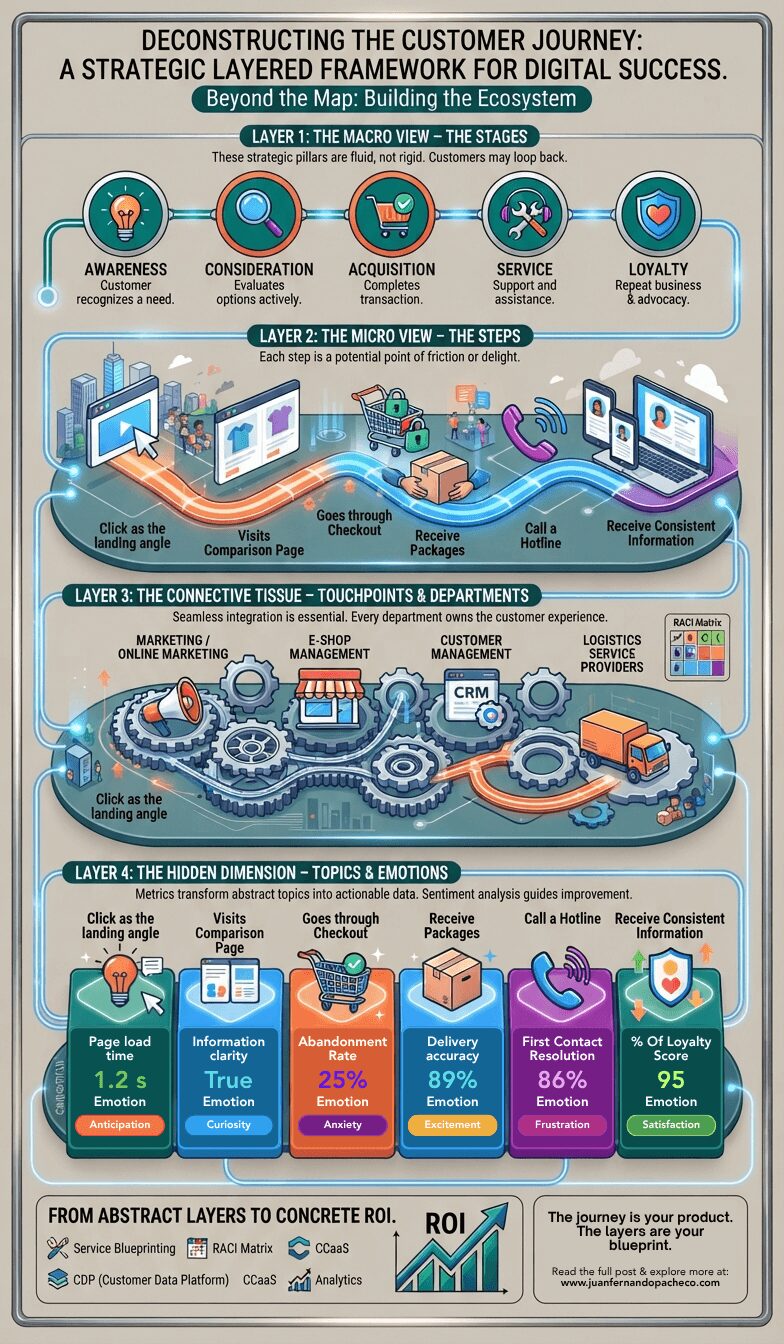
An infographic titled "Deconstructing the Customer Journey: A Strategic Layered Framework for Digital Success." It presents a four-layer model showing how different departments (Marketing, E-Shop, Customer Management, Logistics) and their respective touchpoints (Ads, Website, Hotline, Delivery) interact across the five customer journey stages (Awareness, Consideration, Acquisition, Service, Loyalty). The bottom section details how these interactions generate specific topics, KPIs (like Cart Abandonment Rate and First Contact Resolution), and emotions, leading to concrete ROI. References to "www.juanfernandopacheco.com" and "Bright Vessel" are visible at the bottom.

Customer Journey Layers is more than a diagram; it’s a philosophical shift from a customer-centric mindset to a customer-centric operating model. It acknowledges that every digital experience is a manifestation of your internal architecture—your technology, your processes, and your organizational alignment.
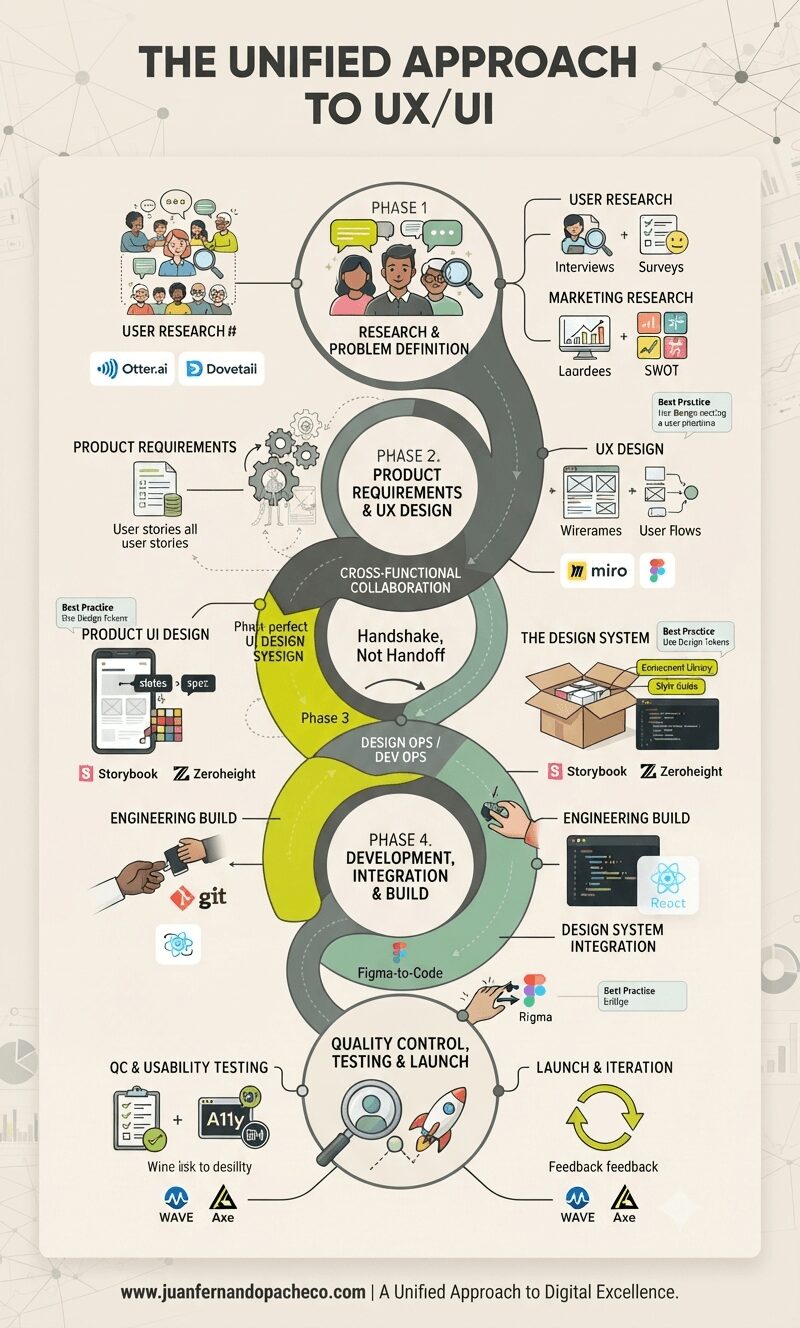
A detailed vertical infographic titled "THE UNIFIED APPROACH TO UX/UI" displaying a five-phase product development lifecycle pipeline. It shows interconnected stages from Research & Definition to Launch & Iteration, highlighting key activities, deliverables, team roles, and tools (such as Figma, React, Otter.ai, and WAVE) against a cream (#f2e9dc) background. A central winding path emphasizes collaboration and the concept of "Handshake, Not Handoff." The footer includes the URL "www.juanfernandopacheco.com".

The “Experience Design Framework” illustrates that consistency is not a superficial concern.

It is the tangible result of a deeply integrated, user-centric, and collaborative process. It is the quality that allows users to build a confident mental model of your product, leading to reduced cognitive load, increased efficiency, and greater trust.