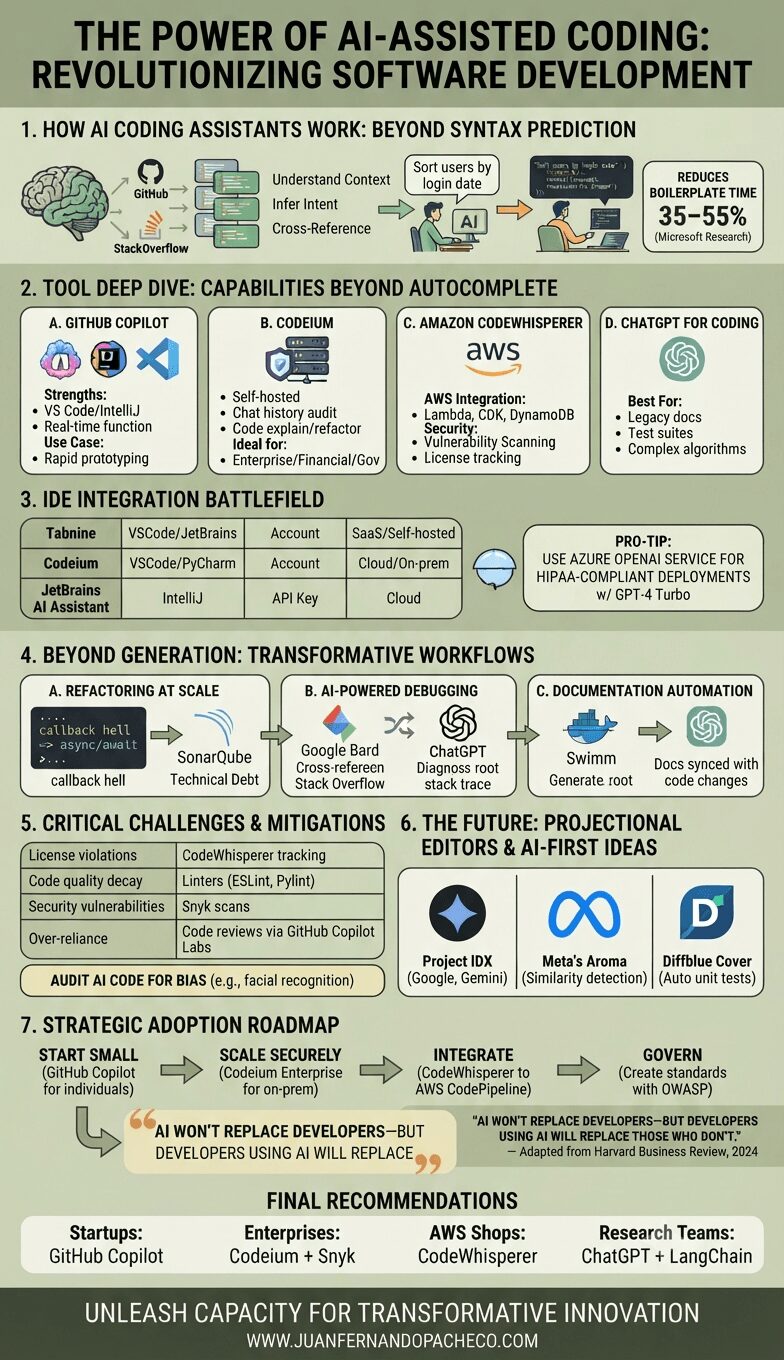
A detailed infographic titled "The Power of AI-Assisted Coding: Revolutionizing Software Development" using a green and orange color palette. The image is structured in seven sections: 1. How AI Coding Assistants Work (Beyond Syntax Prediction), 2. Tool Deep Dive (GitHub Copilot, Codeium, AWS CodeWhisperer, ChatGPT), 3. IDE Integration Battlefield, 4. Beyond Generation (Refactoring, Debugging, Documentation), 5. Critical Challenges & Mitigations, 6. The Future (AI-First IDEs), and 7. Strategic Adoption Roadmap. It includes a quote from Harvard Business Review and final recommendations for different team types, ending with the URL WWW.JUANFERNANDOPACHECO.COM.

The rise of generative AI has ignited a paradigm shift in software engineering. By 2025, 80% of developers will use AI coding tools daily (Gartner, 2023), transforming how we design, write, and maintain software.

These tools aren’t just autocomplete on steroids—they’re collaborative partners that augment human creativity with machine-scale pattern recognition.
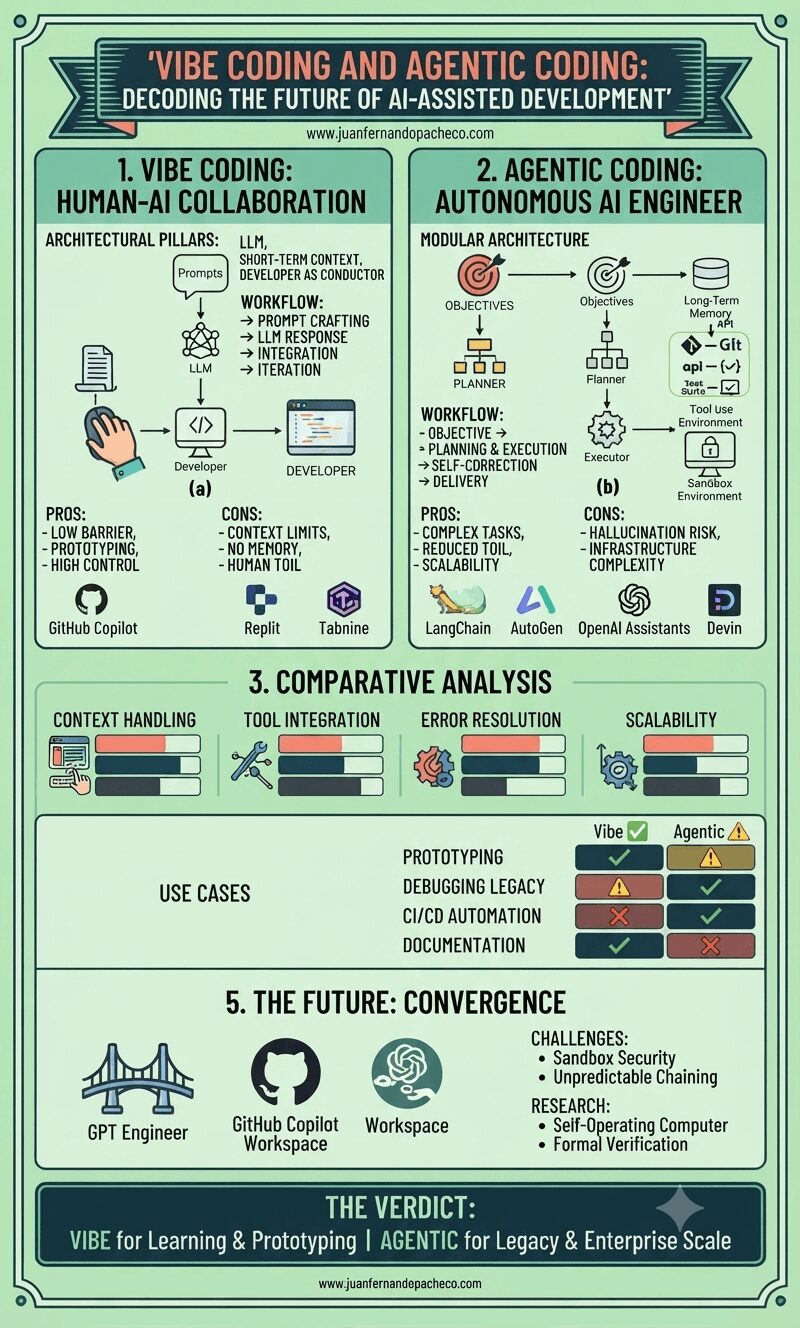
An infographic titled 'Vibe Coding and Agentic Coding' comparing two paradigms of AI-assisted software development across architecture, workflows, pros/cons, tools, and future convergence. The graphic includes detailed diagrams, a comparative analysis, use-case matrices, and logos for tools like GitHub Copilot, LangChain, and Devin.

Vibe Coding democratizes AI assistance, augmenting developers’ creativity without disrupting workflows.

Agentic Coding, however, is poised to revolutionize software engineering by automating entire pipelines—akin to an “AI workforce.” While Vibe suits daily coding, Agentic shines in systematic, tool-heavy environments.

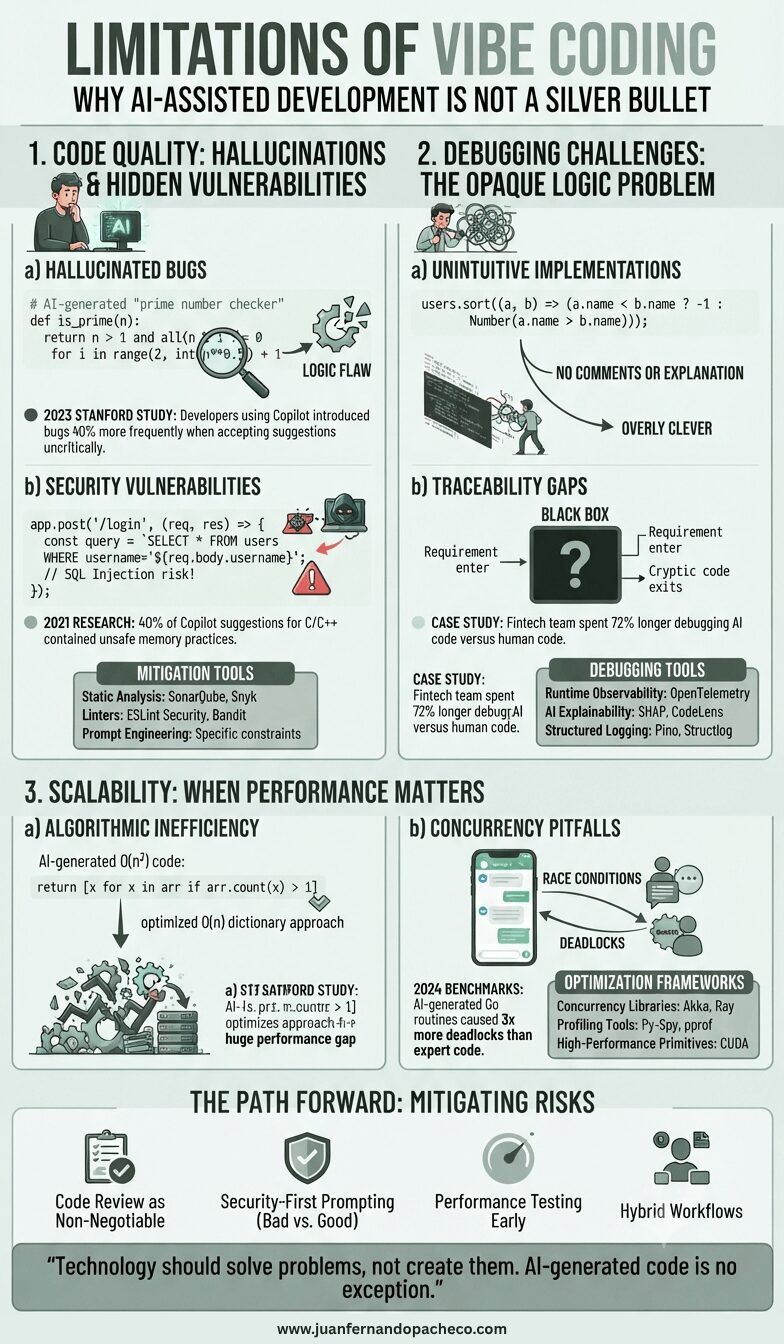
An infographic titled "Limitations of Vibe Coding," presented in a vertical format with three main sections: Code Quality, Debugging Challenges, and Scalability. Each section details AI-assisted development risks using text, code snippets, data points from studies (Stanford, 2023; Fintech team, 2024), and tool recommendations (Snyk, OpenTelemetry, Akka). The bottom section outlines mitigation strategies and includes the quote: "Technology should solve problems, not create them. AI-generated code is no exception." and the URL www.juanfernandopacheco.com.

Vibe coding accelerates development but at the cost of technical debt, security gaps, and scalability cliffs. As I’ve advised LATAM teams:

Use AI as a collaborator, not a replacement.

Pair it with rigorous review, observability, and domain expertise. The future of coding isn’t human vs. machine—it’s human + machine, with clear boundaries.

“Technology should solve problems, not create them. AI-generated code is no exception.”

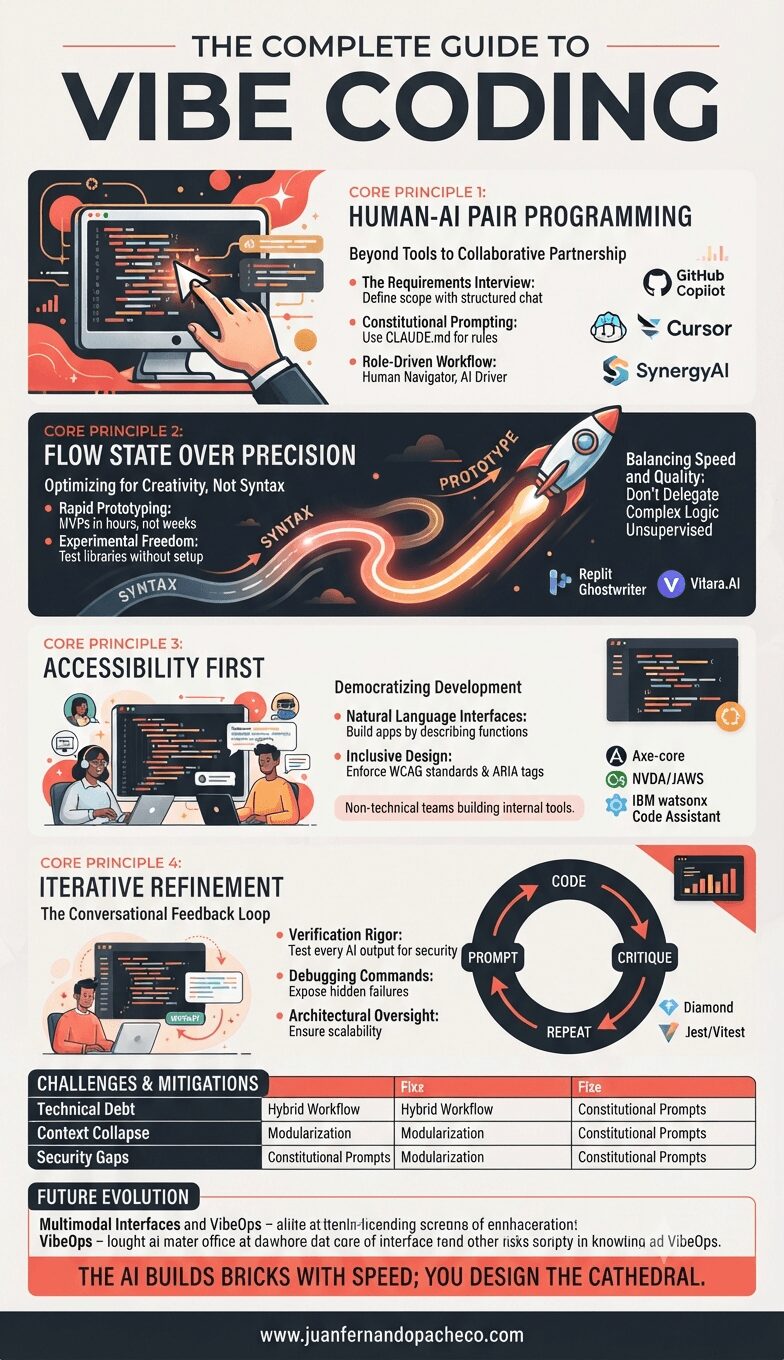
An infographic titled "THE COMPLETE GUIDE TO VIBE CODING," presenting a structured overview of AI-driven software development. The visual is divided into four main sections: "Human-AI Pair Programming," "Flow State Over Precision," "Accessibility First," and "Iterative Refinement." Each section uses diagrams, icons, and bullet points to explain core principles, practices, and lists relevant tools like GitHub Copilot and Replit. The bottom includes a challenges matrix and future predictions, with the quote, "THE AI BUILDS BRICKS WITH SPEED; YOU DESIGN THE CATHEDRAL." The background is light beige with accents of deep red and dark charcoal.

Coined by AI researcher Andrej Karpathy in 2025, vibe coding transcends traditional programming by treating natural language as the primary interface between human intent and machine execution.

For UX designers and architects like us, this represents more than a productivity boost—it’s a fundamental shift in how we translate vision into reality.