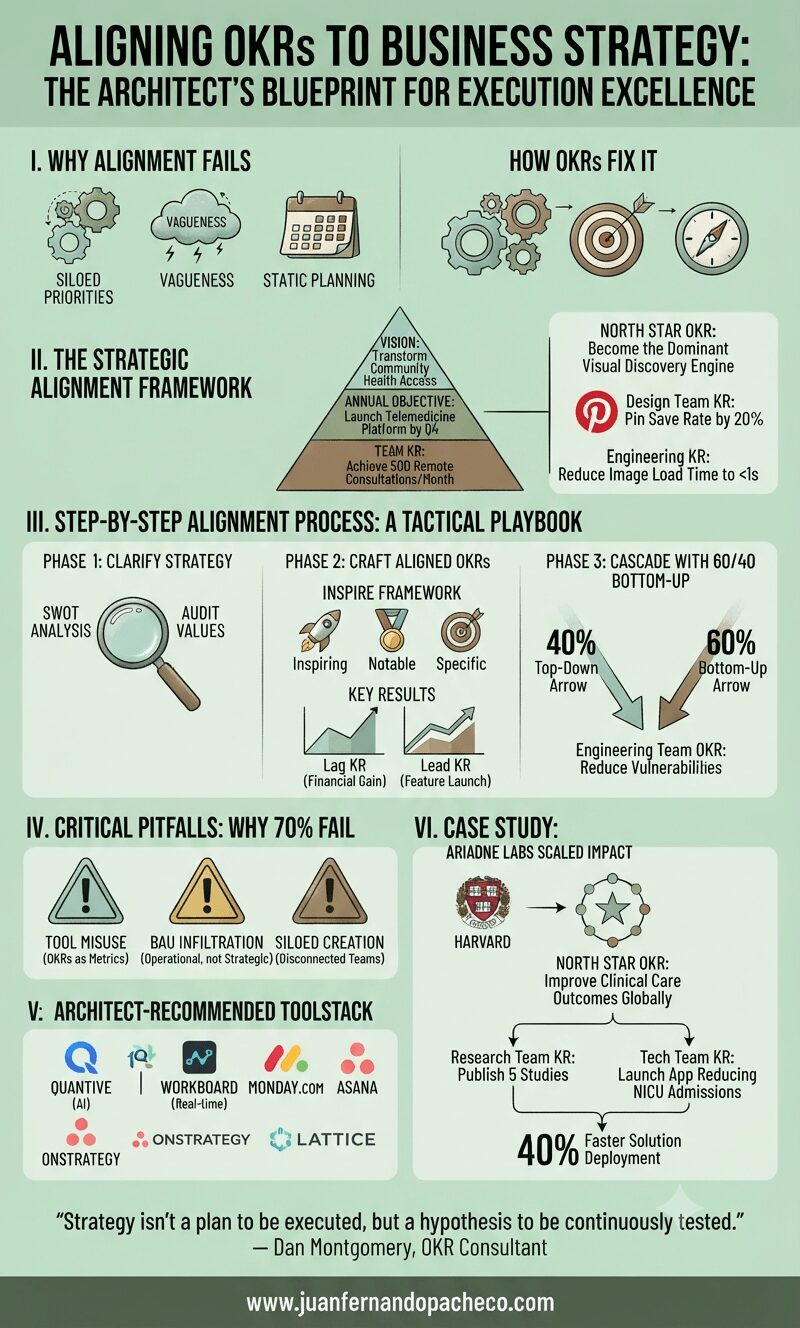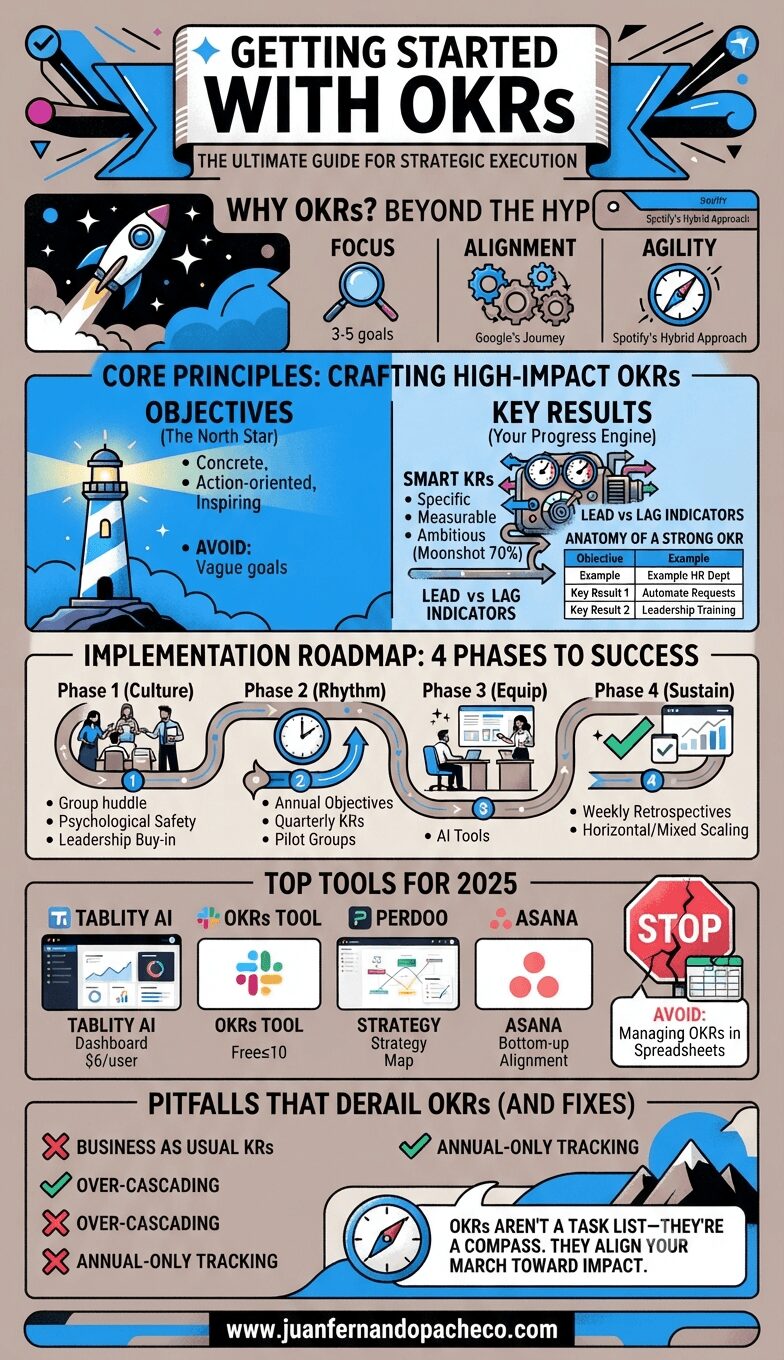
An infographic titled "Aligning OKRs to Business Strategy: The Architect’s Blueprint for Execution Excellence" in a vertical format, featuring a light green background and organized into six main sections. Section I contrasts "Why Alignment Fails" (siloed priorities, vagueness, static planning) with "How OKRs Fix It." Section II shows an "OKR Pyramid" cascading from vision to team KRs, and "North Star OKRs" for Pinterest. Section III is a "Tactical Playbook" with three phases: Clarify Strategy, Craft Aligned OKRs (INSPIRE framework, lead/lag indicators), and Cascade with 60/40 Bottom-Up input. Section IV lists "Critical Pitfalls: Why 70% Fail" (Tool Misuse, BAU Infiltration, Siloed Creation). Section V recommends a "Toolstack" of software including Quantive, Asana, and Lattice. Section VI details a "Case Study" of Ariadne Labs. The bottom features a quote by Dan Montgomery and the URL www.juanfernandopacheco.com.

In dynamic markets, OKRs are your compass. They translate vision into measurable bets, empowering teams to innovate within strategic boundaries.

As Andy Grove proved at Intel: Alignment isn’t about everyone doing the same thing—it’s about everyone contributing to the same outcome.
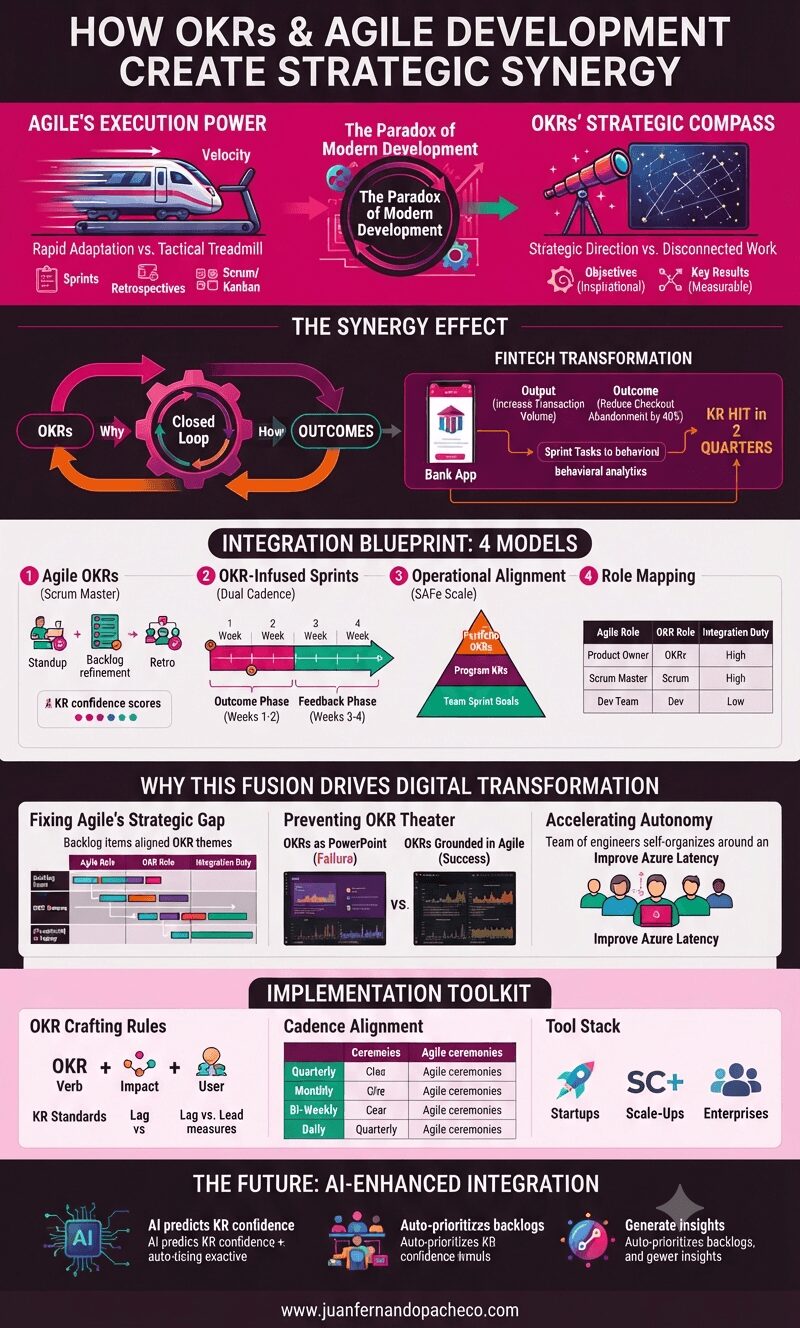
A vertical infographic titled "How OKRs and Agile Development Create Strategic Synergy" on a dark background. It details the fusion of Agile execution power and OKR strategic compass through a closed-loop cycle, leading to a fintech transformation. It presents four integration models: Agile OKRs, OKR-Infused Sprints, Operational Alignment (SAFe), and Role Mapping. It also covers why the fusion drives digital transformation, a toolkit for implementation (crafting rules, cadence, tool stacks), and the future of AI-enhanced integration.

Agile is the engine that propels your product forward; OKRs are the GPS ensuring you’re heading toward value. By embedding objectives into sprint rhythms, teams shift from “Did we ship?” to “Did it matter?” As John Doerr reminds us: “Measures matter more when they’re counterintuitive.”

Start your integration with one pilot team—measure their KR impact versus control groups. In 2025’s AI-driven chaos, this fusion isn’t just optimal; it’s existential.
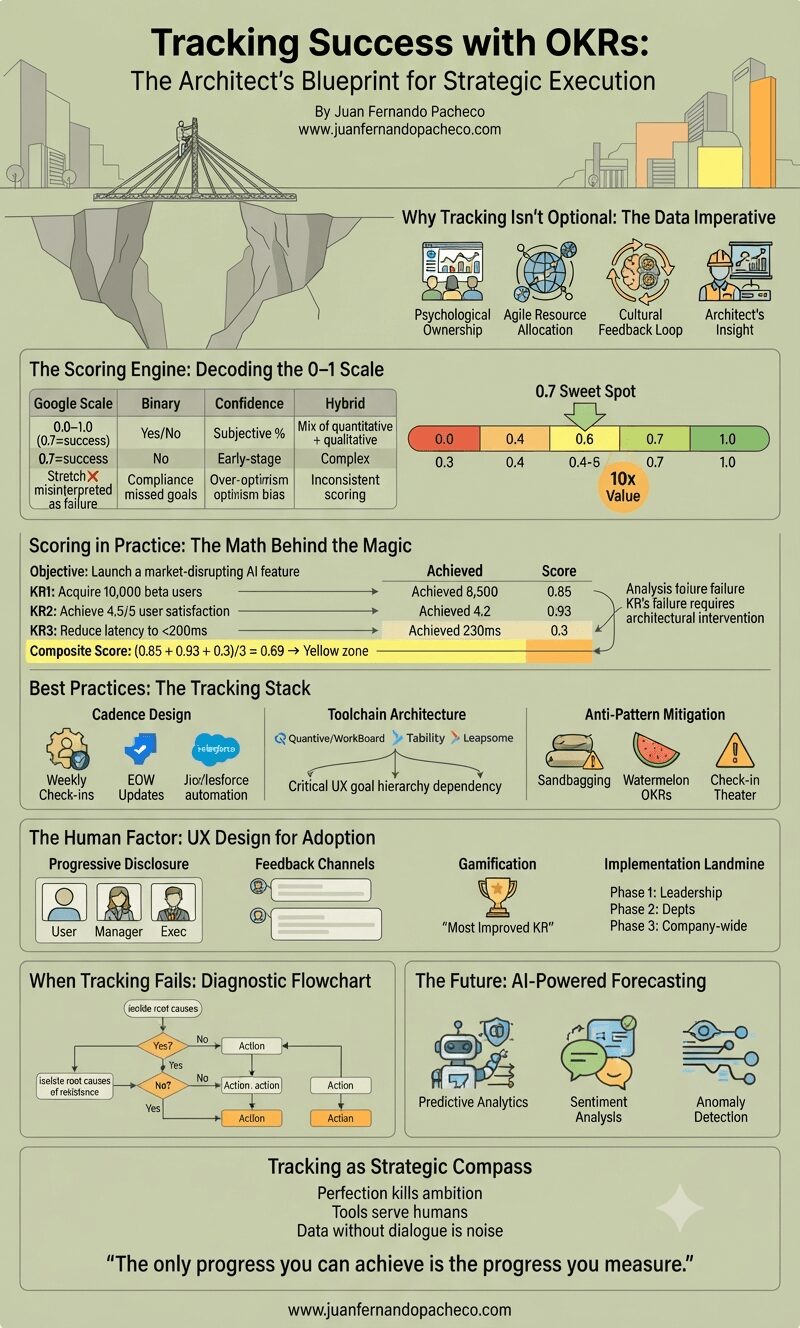
An infographic titled "Tracking Success with OKRs: The Architect’s Blueprint for Strategic Execution" by Juan Fernando Pacheco. The image presents a comprehensive guide to OKRs, covering the importance of tracking, scoring methodologies (including the 0.7 sweet spot), practical math examples, a best practices toolkit for cadence and tools, user experience considerations for adoption, a diagnostic flowchart for failures, and the future of AI-powered forecasting. It uses illustrations, comparison tables, and clear data visualizations against a sage-green background with a bridge metaphor at the top.

The chasm between ambition and execution isn’t due to lack of effort—it’s a systems design problem. Objectives and Key Results (OKRs) bridge this gap, but only when tracked with surgical precision.

Let’s deconstruct how elite teams instrument their goal-tracking systems.