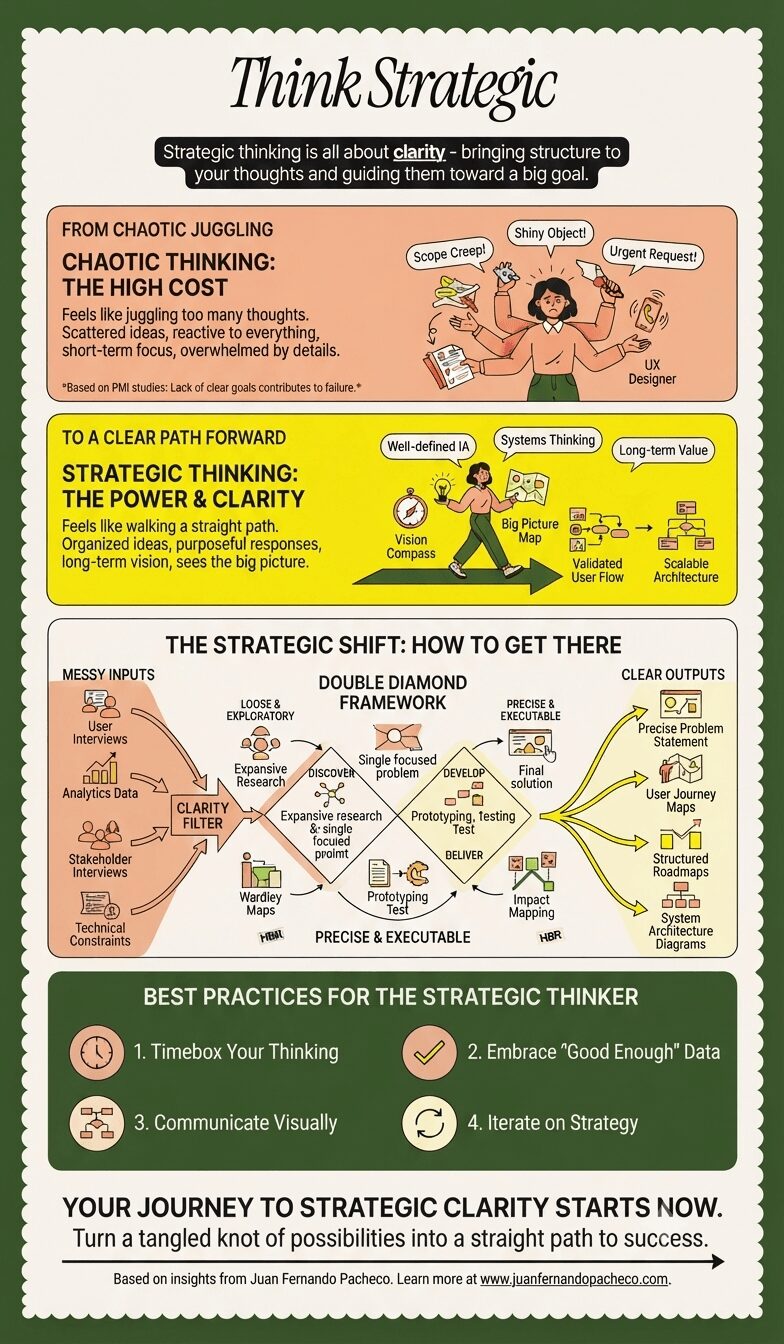
An infographic titled "Think Strategic" featuring an olive green background, illustrating the transition from messy, reactive thinking to structured strategic clarity using the Double Diamond framework and best practices for global digital products.

The journey from messy to clear thinking is a discipline. It’s a commitment to moving beyond the comfortable chaos of reaction and into the disciplined clarity of purpose. It’s the difference between juggling blindly and walking purposefully toward a known destination.

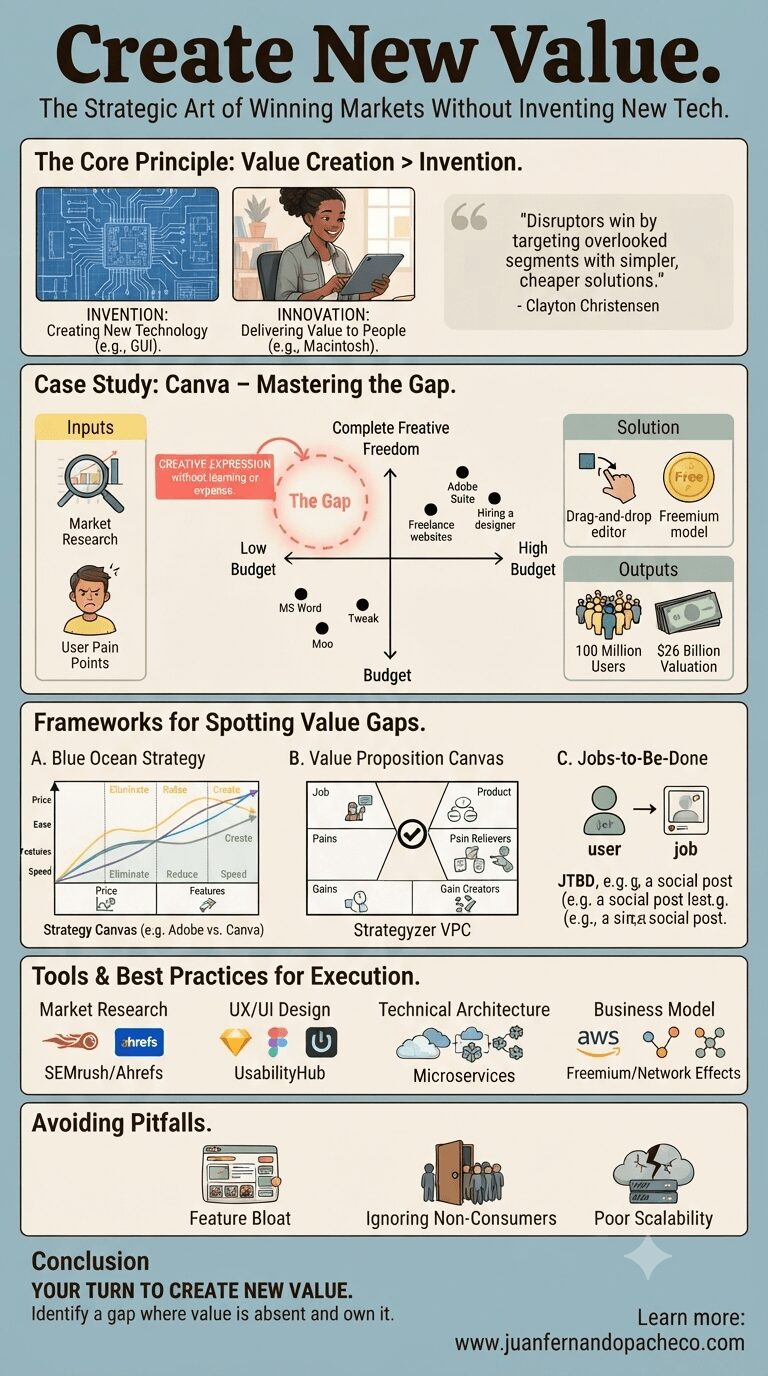
A comprehensive business infographic titled "Create New Value. The Strategic Art of Winning Markets Without Inventing New Tech." The image is divided into stacked sections: "The Core Principle: Value Creation > Invention," a detailed "Case Study: Canva – Mastering the Gap" (including a 2x2 positioning map, inputs, outputs, and UX insights), "Frameworks for Spotting Value Gaps" (Blue Ocean Strategy, Value Proposition Canvas, Jobs-to-Be-Done), "Tools & Best Practices for Execution" (Market Research, UX/UI Design, Technical Architecture, Business Model), and "Avoiding Pitfalls" (Feature Bloat, Ignoring Non-Consumers, Poor Scalability). The infographic uses diagrams, charts, and icons, concluding with a call to action and the URL "www.juanfernandopacheco.com."

Visionaries spot gaps in the market—unmet needs others overlook—and craft solutions so elegantly aligned with those gaps that they carve out entirely new categories.

Let’s dissect this with surgical precision, using real-world examples, battle-tested frameworks, and actionable tools. By the end, you’ll see how to identify and own your “white space” in any market.
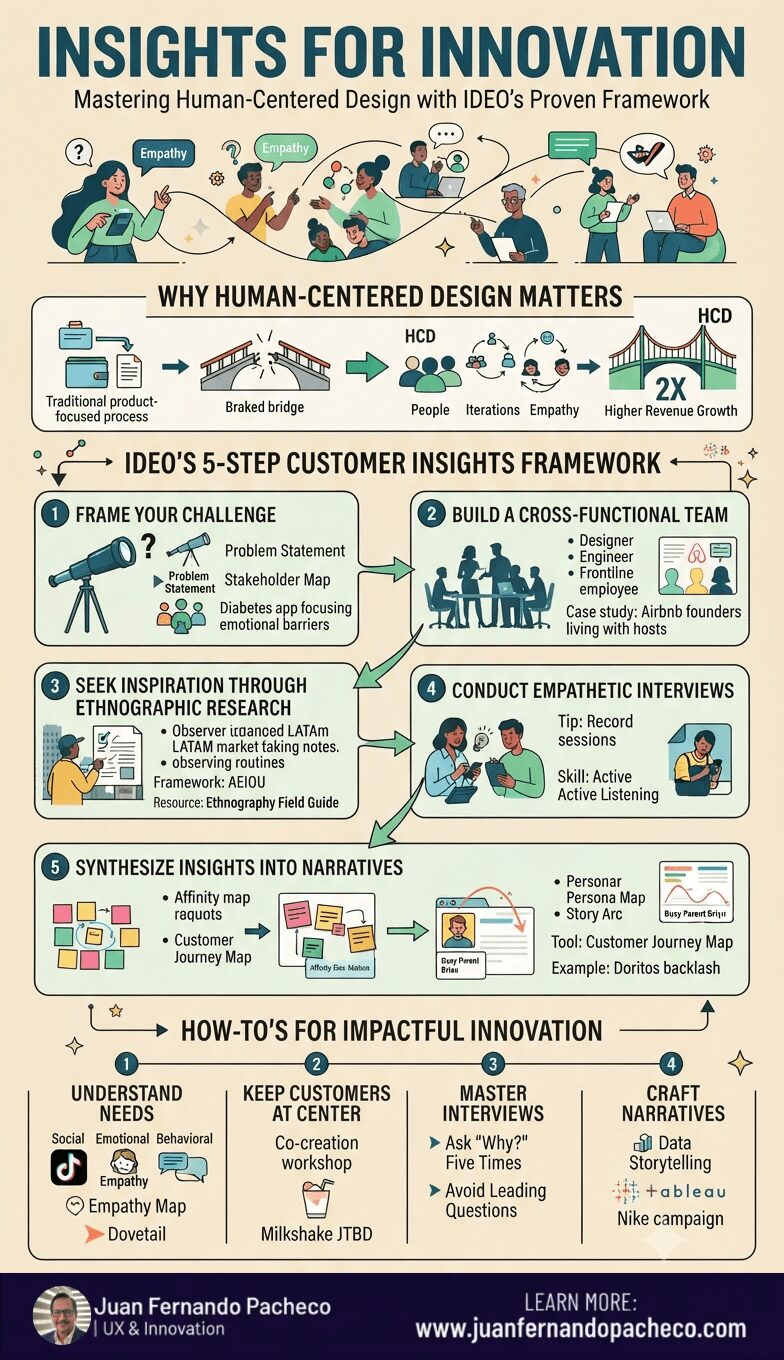
An infographic titled "Insights for Innovation: Mastering Human-Centered Design with IDEO’s Proven Framework" in a vertical format. It features a five-step visual guide on a light beige background, using illustrations and icons to explain the design thinking process. The steps include: 1. Frame Your Challenge, 2. Build a Cross-Functional Team, 3. Seek Inspiration Through Ethnographic Research, 4. Conduct Empathetic Interviews, and 5. Synthesize Insights into Narratives. Below the framework, a "How-To's for Impactful Innovation" section outlines four additional pillars. The bottom of the image displays the URL "www.juanfernandopacheco.com".

Insights for Innovation isn’t a checklist—it’s a mindset. By grounding every decision in empathy, curiosity, and storytelling, you’ll build products that don’t just solve problems, but enrich lives. Ready to start? Dive deeper with IDEO’s Design Thinking Resources and remember: The next breakthrough lies in the stories your customers haven’t told you yet.
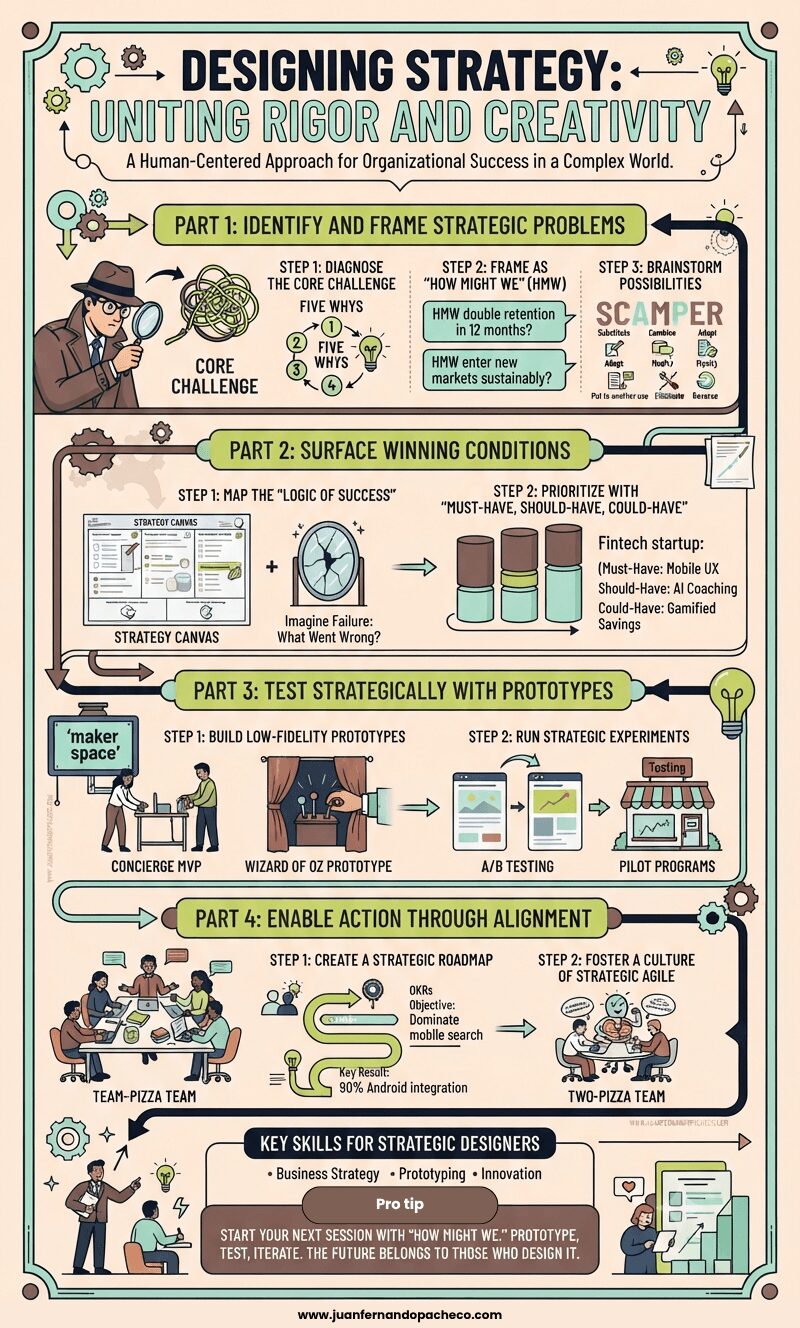
A comprehensive vertical infographic titled "Designing Strategy: Uniting Rigor and Creativity" set against a light peach background with a dark green border. It presents a four-part framework for organizational success using illustrations, icons, and text. Part 1 shows identifying problems with a detective and the Five Whys. Part 2 covers winning conditions using a Strategy Canvas and prioritization matrix. Part 3 illustrates low-fidelity prototypes and experiments like A/B testing. Part 4 details alignment through roadmaps and agile teams. The bottom section lists key skills and a call to action, with references to www.juanfernandopacheco.com.

Designing strategy isn’t a one-time event—it’s a cycle of learning, adapting, and evolving. By blending analytical tools with creative methods, leaders can build strategies resilient enough for today’s volatility and visionary enough for tomorrow’s opportunities.

Start your next strategic session with a “How Might We” question. Then prototype, test, and iterate. The future belongs to those who design it.