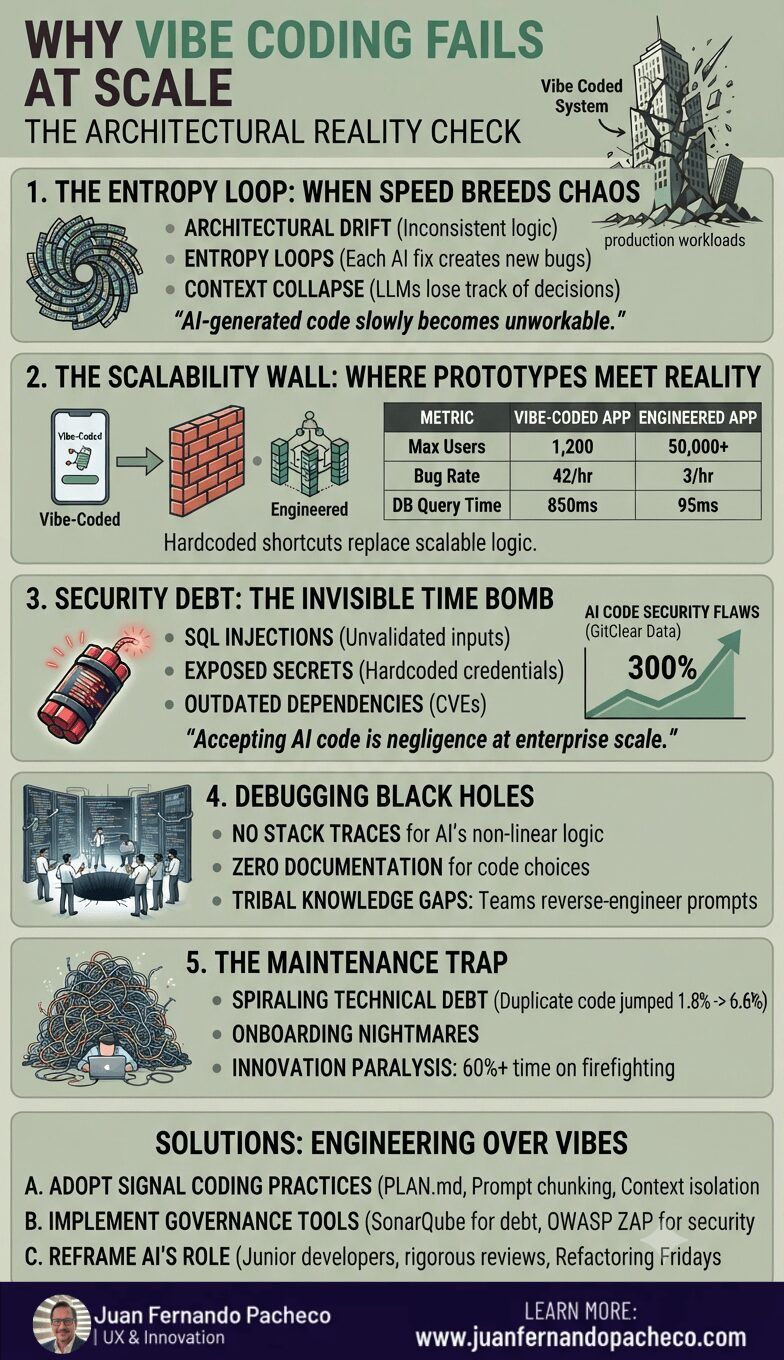
An infographic illustrating the failure of AI-driven 'vibe coding' in enterprise environments, broken down into five key challenges: the entropy loop, scalability wall, security debt, debugging black holes, and the maintenance trap. The graphic contrasts vibe coding with professional engineering, provides data metrics, and concludes with solutions centered on human oversight and governance.

Vibe coding excels for prototypes—as Andrej Karpathy noted, it’s “quite amusing” for weekend projects. But production systems demand intentional architecture, traceability, and governance. The future belongs to augmented engineering, where AI assists human oversight—not replaces it.

“You can vibe code your way to insight. But if you’re building for scale, control, or complexity—you’re going to need real engineering”.
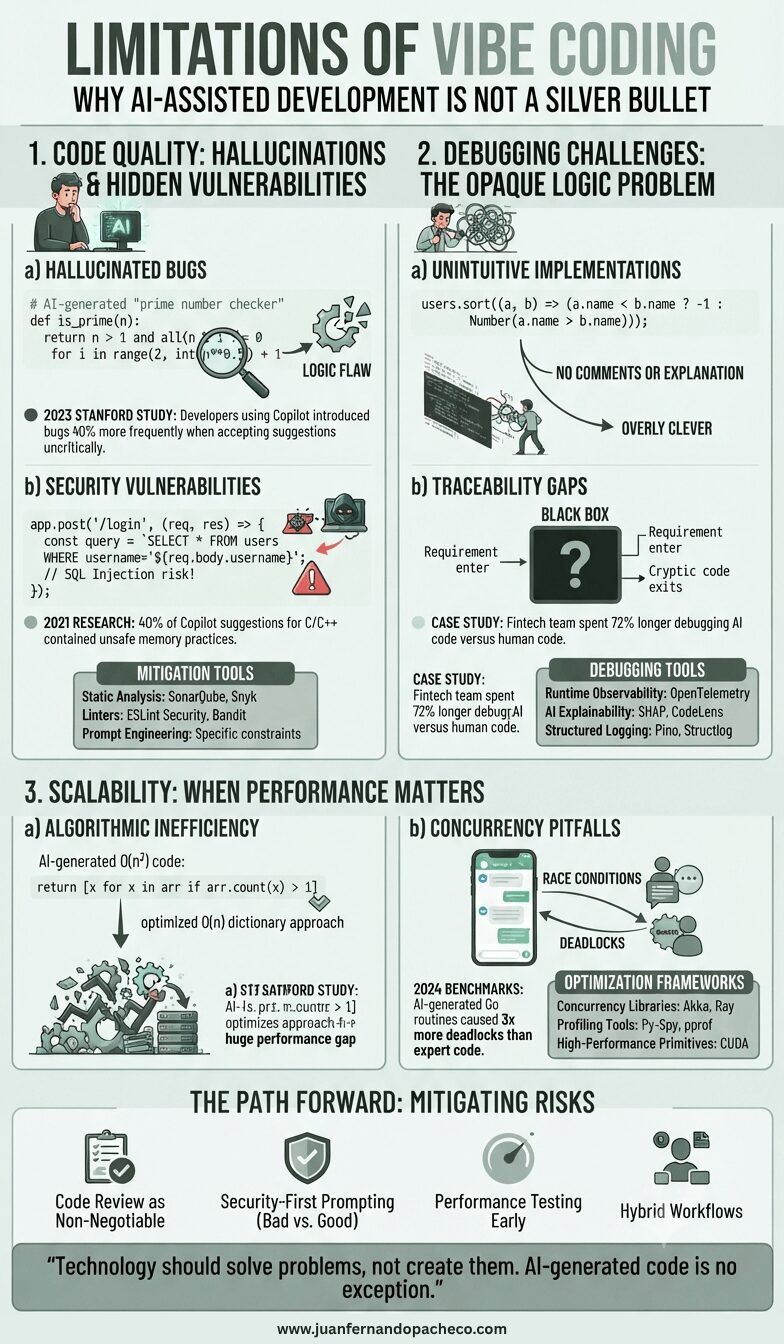
An infographic titled "Limitations of Vibe Coding," presented in a vertical format with three main sections: Code Quality, Debugging Challenges, and Scalability. Each section details AI-assisted development risks using text, code snippets, data points from studies (Stanford, 2023; Fintech team, 2024), and tool recommendations (Snyk, OpenTelemetry, Akka). The bottom section outlines mitigation strategies and includes the quote: "Technology should solve problems, not create them. AI-generated code is no exception." and the URL www.juanfernandopacheco.com.

Vibe coding accelerates development but at the cost of technical debt, security gaps, and scalability cliffs. As I’ve advised LATAM teams:

Use AI as a collaborator, not a replacement.

Pair it with rigorous review, observability, and domain expertise. The future of coding isn’t human vs. machine—it’s human + machine, with clear boundaries.

“Technology should solve problems, not create them. AI-generated code is no exception.”