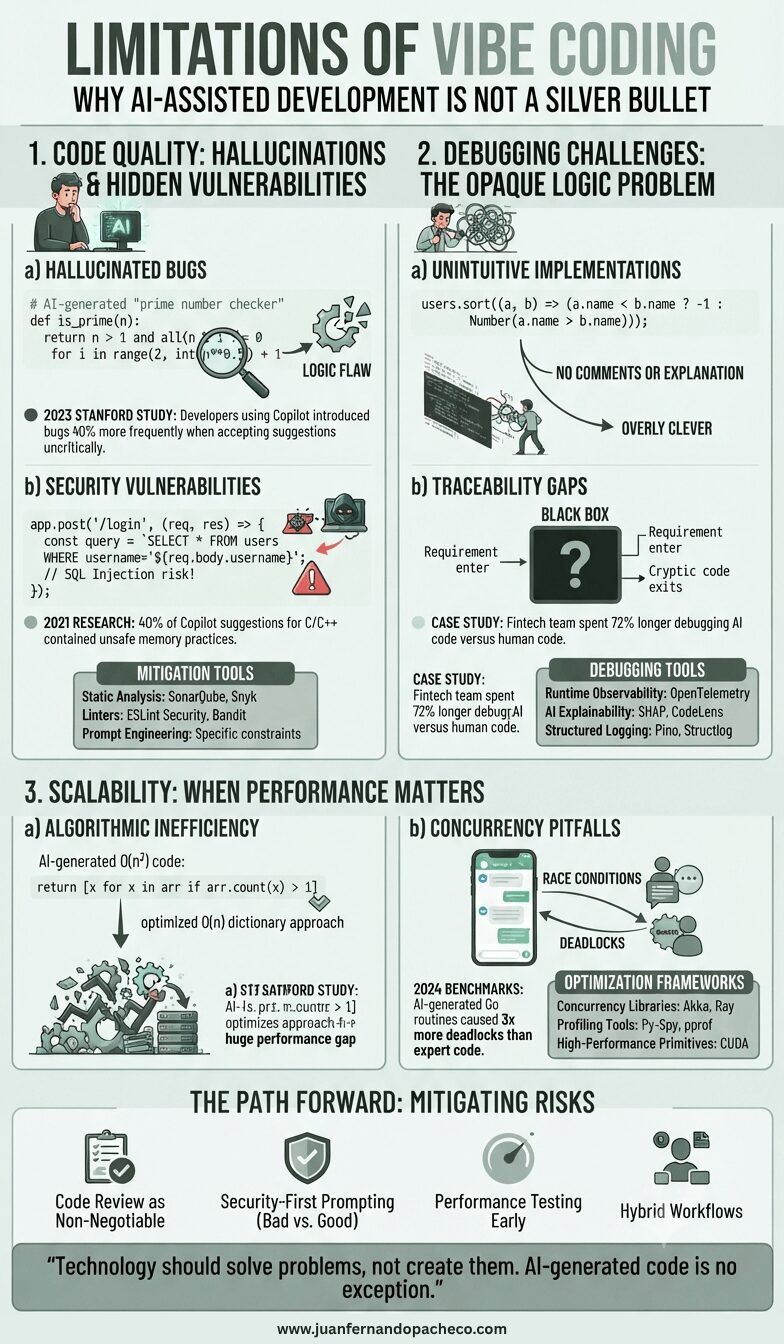
An infographic titled "Limitations of Vibe Coding," presented in a vertical format with three main sections: Code Quality, Debugging Challenges, and Scalability. Each section details AI-assisted development risks using text, code snippets, data points from studies (Stanford, 2023; Fintech team, 2024), and tool recommendations (Snyk, OpenTelemetry, Akka). The bottom section outlines mitigation strategies and includes the quote: "Technology should solve problems, not create them. AI-generated code is no exception." and the URL www.juanfernandopacheco.com.

Vibe coding accelerates development but at the cost of technical debt, security gaps, and scalability cliffs. As I’ve advised LATAM teams:

Use AI as a collaborator, not a replacement.

Pair it with rigorous review, observability, and domain expertise. The future of coding isn’t human vs. machine—it’s human + machine, with clear boundaries.

“Technology should solve problems, not create them. AI-generated code is no exception.”
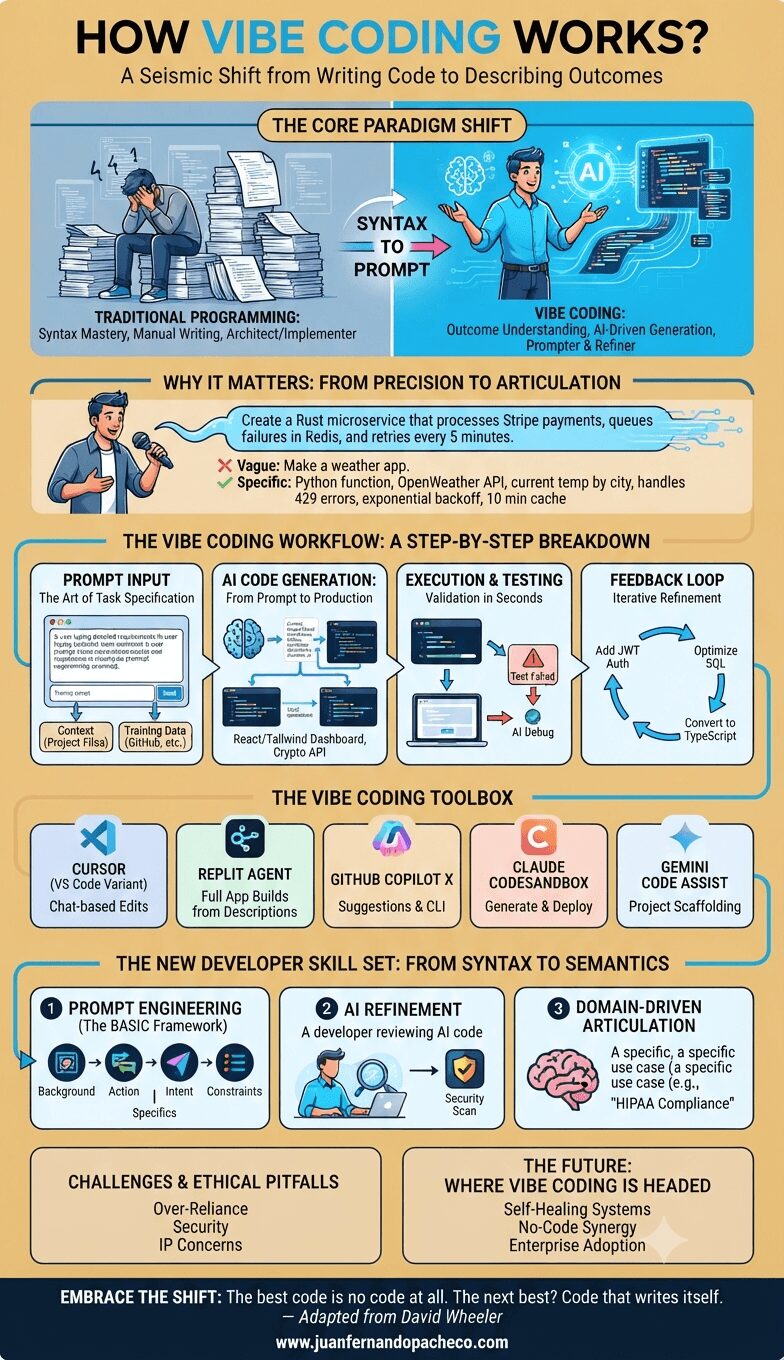
An infographic titled "HOW VIBE CODING WORKS?" with the subtitle "A Seismic Shift from Writing Code to Describing Outcomes." The image is divided into distinct sections detailing the transition from traditional programming to prompt-driven development using AI. Key sections include "The Core Paradigm Shift," "Why It Matters: From Precision to Articulation," "The Vibe Coding Workflow: A Step-by-Step Breakdown," "The Vibe Coding Toolbox" (featuring tools like Cursor, Replit, Copilot, Claude, Gemini), "The New Developer Skill Set," and "The Future." The infographic uses a blue and beige color scheme and concludes with a quote by David Wheeler and the URL www.juanfernandopacheco.com.

Vibe Coding isn’t replacing developers—it’s elevating us. By offloading syntax to AI, we focus on creative problem-solving, architecture, and innovation.

Start small: use GitHub Copilot for boilerplate code, then graduate to building full features with Claude CodeSandbox. The future belongs to those who describe outcomes, not just write instructions.