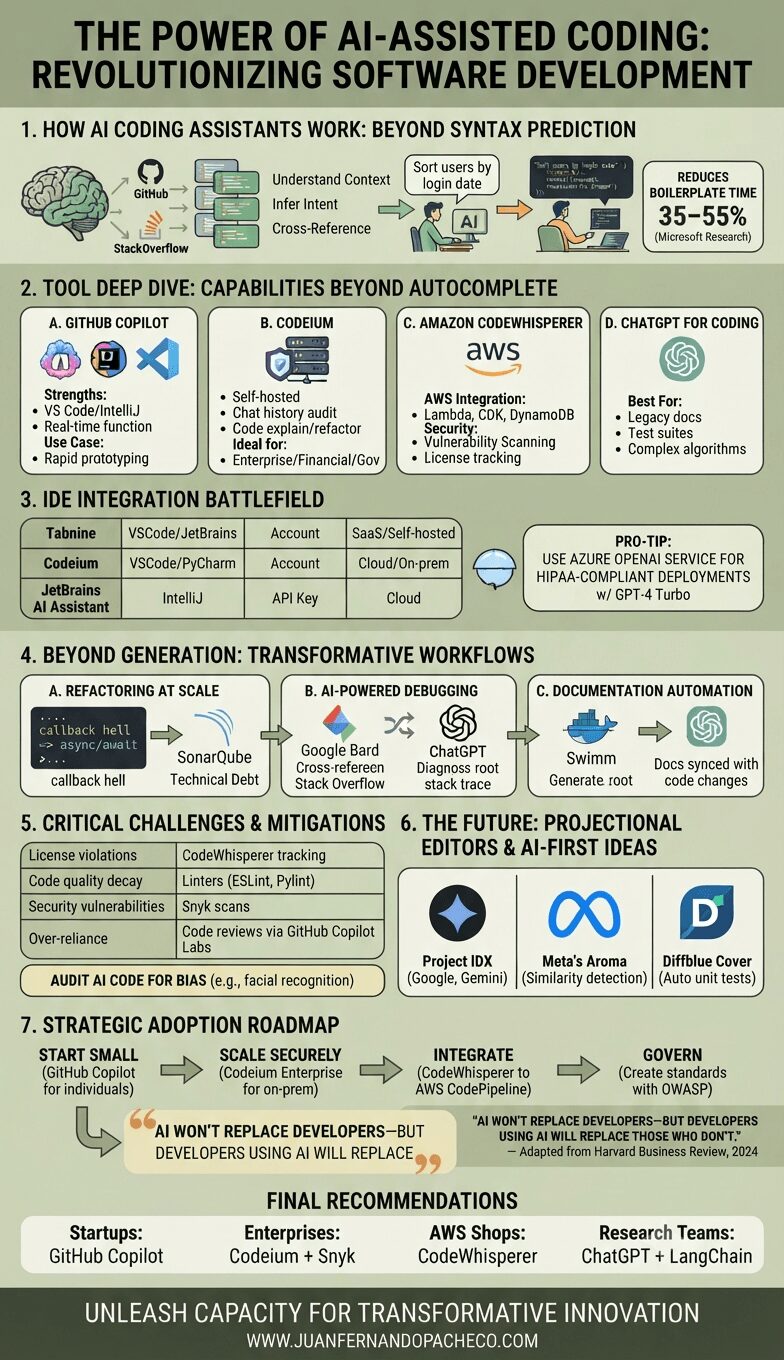
A detailed infographic titled "The Power of AI-Assisted Coding: Revolutionizing Software Development" using a green and orange color palette. The image is structured in seven sections: 1. How AI Coding Assistants Work (Beyond Syntax Prediction), 2. Tool Deep Dive (GitHub Copilot, Codeium, AWS CodeWhisperer, ChatGPT), 3. IDE Integration Battlefield, 4. Beyond Generation (Refactoring, Debugging, Documentation), 5. Critical Challenges & Mitigations, 6. The Future (AI-First IDEs), and 7. Strategic Adoption Roadmap. It includes a quote from Harvard Business Review and final recommendations for different team types, ending with the URL WWW.JUANFERNANDOPACHECO.COM.

The rise of generative AI has ignited a paradigm shift in software engineering. By 2025, 80% of developers will use AI coding tools daily (Gartner, 2023), transforming how we design, write, and maintain software.

These tools aren’t just autocomplete on steroids—they’re collaborative partners that augment human creativity with machine-scale pattern recognition.
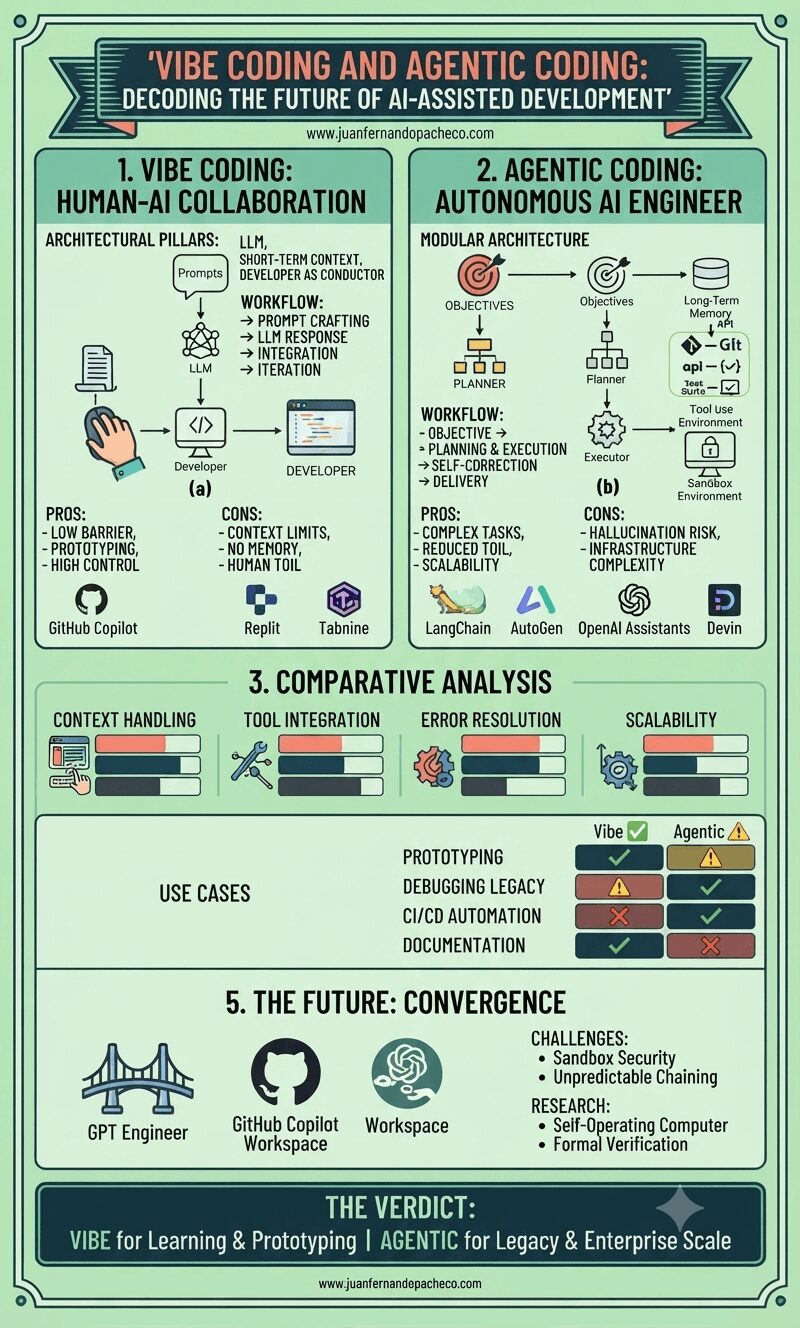
An infographic titled 'Vibe Coding and Agentic Coding' comparing two paradigms of AI-assisted software development across architecture, workflows, pros/cons, tools, and future convergence. The graphic includes detailed diagrams, a comparative analysis, use-case matrices, and logos for tools like GitHub Copilot, LangChain, and Devin.

Vibe Coding democratizes AI assistance, augmenting developers’ creativity without disrupting workflows.

Agentic Coding, however, is poised to revolutionize software engineering by automating entire pipelines—akin to an “AI workforce.” While Vibe suits daily coding, Agentic shines in systematic, tool-heavy environments.