¿Want to keep teams aligned and culture alive? Keep running these five meetings
After more than twenty years of moving from designing screens to designing deals, I can tell you exactly where most teams lose their week:
Not in the work itself, but in meetings about the work.
I have led RFP responses with legal teams sitting in three different countries, negotiated SLA penalties with a bank’s procurement office, and sat through status meetings where twelve people listened to one person read a spreadsheet aloud. That last meeting is the reason people say meetings are a waste of time. But a spreadsheet read aloud was never a meeting. It was an email that got kidnapped.
The teams that consistently deliver, in product, sales, engineering, or operations, do not have fewer meetings than average. They have a designed set of meetings. Each one has a single purpose, a strict format, a clear output, and a fixed cadence.
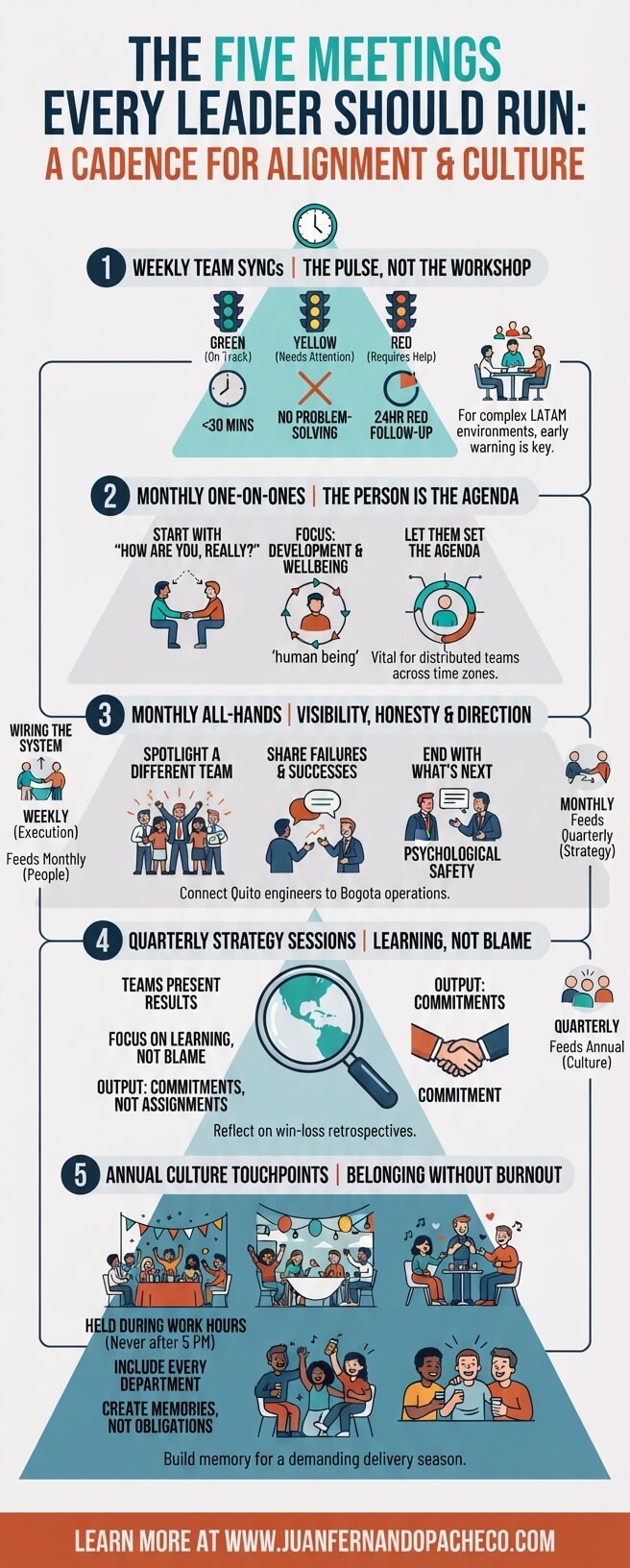
The model I use is a simple pyramid of five meetings every leader should run:
- Weekly team syncs,
- Monthly one-on-ones,
- Monthly all-hands,
- Quarterly strategy sessions, and
- Annual culture touchpoints.
The ideas are not exotic. The discipline is.
This post is my field guide to that discipline, written to be as useful today as it will be five years from now, because human alignment never goes out of style.
The logic of the pyramid: cadence follows scope
The pyramid is not a random list
It encodes a rule that keeps every meeting honest: the less frequently a meeting happens, the bigger the scope it covers.
- Weekly meetings handle execution.
- Monthly meetings handle people and alignment.
- Quarterly meetings handle strategy.
- The annual gathering handles culture.
When a team struggles, it is almost always because one layer is missing, or one layer is doing another layer’s job.
- Skip the weekly sync and surprises arrive late and expensive.
- Skip the one-on-ones, and you will hear about a resignation in the same week you hear about the problem that caused it.
- Skip the all-hands and every team becomes an island with its own rumor mill.
- Skip the quarterly reflection, and you repeat the same mistakes with more energy each time.
- Skip the annual moment of belonging, and you discover that culture was never built, only assumed.
The second rule is that each meeting must refuse work that belongs to another layer. A weekly sync that drifts into strategy debate fails. A quarterly session that reviews individual tasks fails in the opposite direction.
Cadence is a filter: it decides which problem deserves which room.
Internalize that, and the five meetings stop feeling like bureaucracy and start feeling like an operating system.
1. Weekly team syncs: the pulse, not the workshop
The weekly sync is a pulse check
Each team member reports with a traffic-light status: green means on track, yellow means needs attention, red means requires immediate help. The whole sync stays under thirty minutes, nobody problem-solves during updates, and every red gets a follow-up within twenty-four hours. Those three constraints are the entire magic.
The traffic light forces honesty and brevity
You do not need a paragraph to say “yellow: waiting on the client’s security team to approve a data sovereignty clause.” The color carries the emotional weight, and one sentence carries the fact. In deal teams, this is how an RFP deadline, a risky legal clause, or a shaky SLA commitment surfaces in front of everyone in seconds, without a single slide.
The ban on problem-solving protects the group’s attention
The moment two people start debugging an issue that concerns only them, the other six stop listening. The sync records the problem, names an owner, and moves on, and the owner takes it offline. The twenty-four-hour rule for reds is what turns ritual into trust: everyone learns that raising a flag is safe and that help arrives fast.
In a region as operationally complex as Latin America, where a regulatory change in one country can reshape a proposal in another, that early-warning system is worth more than any dashboard.
Run the sync on the same day and hour every week. Resist the temptation to cancel: the week that feels too busy for the sync is the week you need it most.
2. Monthly one-on-ones: the person is the agenda
If the weekly sync belongs to the team, the monthly one-on-one belongs to the person
It is a personal check-in that goes beyond tasks to explore wellbeing, career growth, and developmental feedback. The format matters less than the posture: start with “how are you, really?”, discuss development and not just deliverables, and let the other person set the agenda.
Most managers accidentally turn one-on-ones into a second status meeting
You can tell it has happened when the conversation is ninety percent project updates and ten percent a rushed “so, how are you?” asked while glancing at the clock. The inversion is the point. Projects already have the weekly sync. The one-on-one is the only room where the human being is the agenda: energy levels, friction with a colleague, the ambition to grow toward a product or a commercial role, feedback about your own leadership that you will not hear anywhere else.
Letting them set the agenda is not passivity. It is a signal of ownership and a diagnostic tool. A person who arrives with topics is a person who feels ownership. A person who arrives with nothing three months in a row is also telling you something, and noticing it is your job. In distributed teams spread across countries and time zones, this meeting is where the quiet signals travel: fatigue before burnout, frustration before resignation, an idea before it dies.
I treat the one-on-one as the highest-return meeting on my calendar
Fifteen minutes of real conversation per month prevents the five-hour emergency conversation you never scheduled. And the feedback flows both ways: some of the sharpest insight about my own blind spots has arrived in these small rooms, from people who trusted me enough to say it.
3. Monthly all-hands: visibility, honesty and direction
The monthly all-hands has a different job:
Keep everyone connected to the company’s vision while celebrating team wins and sharing progress updates.
Three habits make it work.
- Spotlight a different team each month
- Share failures alongside successes.
- Always end with what is coming next.
In organizations that span countries, most people never meet most other people
The all-hands is where the engineer in Quito discovers that the support agent in Bogotá unblocked a bank’s go-live, and where the sales team in Mexico City hears the human story behind the number they sold. Rotating the spotlight matters because visibility is oxygen: the teams doing invisible work- security, compliance, operations- need their moment on stage as much as the revenue teams do.
Putting failures next to successes is the cultural lever
An all-hands that only celebrates becomes propaganda, and people stop believing it. When a leader says “this deal died, here is what we learned, here is who worked hard anyway,” two things happen at once: trust goes up, and fear goes down. That is psychological safety built in public, thirty seconds at a time.
And closing with what is next sends everyone back to their desks looking forward instead of backward. Progress updates create pride, the vision creates direction, but the forward look creates momentum. Keep it under an hour and protect it from becoming a leadership monologue: the moment an all-hands is only executives talking at people, it has quietly changed purpose.
4. Quarterly strategy sessions: learning, not blame
Once a quarter, the team zooms out
The strategy session is a big-picture reflection where the group analyzes what worked, what did not, and what it commits to next. Three rules I defend fiercely: teams present their own results, the focus is learning and not blame, and the output is commitments, not just assignments.
Teams presenting their own results changes the emotional texture of the room. When people report on themselves, they tell the truth, including the uncomfortable parts. When a boss reports on them, they defend themselves. Self-reporting converts a review into a reflection. In deal-driven businesses, this is the win-loss retrospective done properly: not “who dropped the ball,” but “which assumption was wrong, and which one changes next quarter?”
The learning-over-blame rule is what makes honesty repeatable
Blame is an information tax: the more you charge, the less you receive. A quarterly session where someone was publicly punished for a red number will produce four quarters of green numbers that are fiction.
And the distinction between commitments and assignments is the difference between ownership and compliance. An assignment is something I give you. A commitment is something you declare in front of your peers, with your name on it. Teams that self-report their next commitments outperform teams that receive top-down task lists, because nobody fights for a plan they did not write. Align those commitments with the quarterly targets your business already tracks and the session pays for itself many times over.
5. Annual culture touchpoints: belonging without burnout
At the base of the pyramid sits the slowest and deepest gathering:
The annual culture touchpoint.
For many companies it is the holiday party. The design principles are the interesting part:
- Hold it during work hours and never schedule it after five in the evening,
- Include every department, and create memories, not new obligations.
Those rules encode a mature idea about culture: belonging must be offered, never extracted. An event after working hours quietly taxes the people with caregiving responsibilities and long commutes, which means the “culture event” ends up building culture for only half the team.
Holding it inside the working day says, in the clearest language a company speaks, that this time matters as much as production time.
Including every department sounds obvious until you remember the contractors, the night-shift support crew, the back office. Culture is either everyone, or it is a club. And “memories, not obligations” is the guardrail against turning celebration into homework: no mandatory performances, no forced games, no speeches that run past the food.
People remember how a company made them feel long after they forget the quarterly numbers, and that memory is what carries a team through a hard delivery season or a demanding negotiation. The annual touchpoint is where that memory is manufactured.
Wiring the five meetings into one system
The system only works as a pyramid. Each layer absorbs the topics that belong to it so the other layers stay light. A career-growth concern raised in a weekly sync gets parked into the next one-on-one. A structural problem heard in a one-on-one gets escalated to the quarterly session. A red flag from the sync gets an owner and a twenty-four-hour follow-up, offline. When you honor those boundaries, meetings get shorter by themselves, because every room stops doing five jobs badly and starts doing one job well.
Two practical notes for teams spread across regions
- First, rotate the pain of time zones: if the weekly sync always lands at seven in the morning for the team on one side of the continent, swap the burden every month. Fairness in small things is what makes fairness in big things believable.
- Second, prune before you plant. Before adding this cadence, cancel the duplicated status meetings it replaces. A new cadence stacked on top of the old meetings is not a system. It is sediment.
Measure the system the way you would measure any product: do reds surface earlier than they used to? Do one-on-ones happen every month, or do they slip? Does all-hands attendance grow or shrink? Do quarterly commitments survive contact with reality? Iterate the format every few quarters and keep what works. The goal was never fewer meetings. The goal was meetings that deserve the human life they consume.
The failure modes to watch
Every layer of the pyramid has a characteristic decay, and knowing them in advance is half the defense. The weekly sync decays into a problem-solving workshop and triples in length. The one-on-one decays into a status report and loses its soul.
The all-hands decays into a monologue where failures get airbrushed out. The quarterly session decays into a blame tribunal or an assignment factory. The annual event decays into an after-hours obligation that excludes the very people culture needs most.
When you notice any of these drifts, name it in the room, correct the format and move on. The cadence is a living product, and you are its product owner.
Closing thoughts
Leadership, at the end of the day, is the design of rooms where human beings align. Five rooms are enough: one for the pulse, one for the person, one for the whole, one for the direction and one for the meaning. Build them with intention, run them with discipline, and they will keep returning value for as long as you lead. Tools will change, markets will change, org charts will change. The meetings every leader should run will not.
References and further reading
Web references
- The original one-page model that inspired this post, the five types of meetings every leader should run, published by Amy Gibson: An entire leadership book in one page.
- “The condensed guide to running meetings,” Harvard Business Review (hbr.org) by Amy Gallo
- “Supercharge your one-on-one meetings,” Harvard Business Review podcast with Steven Rogelberg (hbr.org)
- “How to run a meeting,” Harvard Business Review classic (hbr.org)
- “How to set an effective meeting cadence for thriving teams,” Ninety (ninety.io)
Books that reinforce this post
- “High output management,” Andrew S. Grove, the classic on managerial leverage and on why a manager’s output is the output of their team
- “Death by meeting,” Patrick Lencioni, a fable about fixing the two diseases of bad meetings: lack of conflict and mixed purposes
- “Radical candor,” Kim Scott, for the care personally, challenge directly posture that makes one-on-ones and developmental feedback work
- “The making of a manager,” Julie Zhuo, a practical guide for new leaders on one-on-ones, team health and running meetings
- “Measure what matters,” John Doerr, for the quarterly objectives and key results rhythm that strategy sessions should feed
- “The culture map,” Erin Meyer, essential reading for running this cadence across Latin American and global cultures