The quiet negotiation habit that keeps enterprise deals moving
A colleague recently shared a simple card listing the negotiation secrets that experienced chief executives use almost instinctively. What I saw on that card stopped me cold:
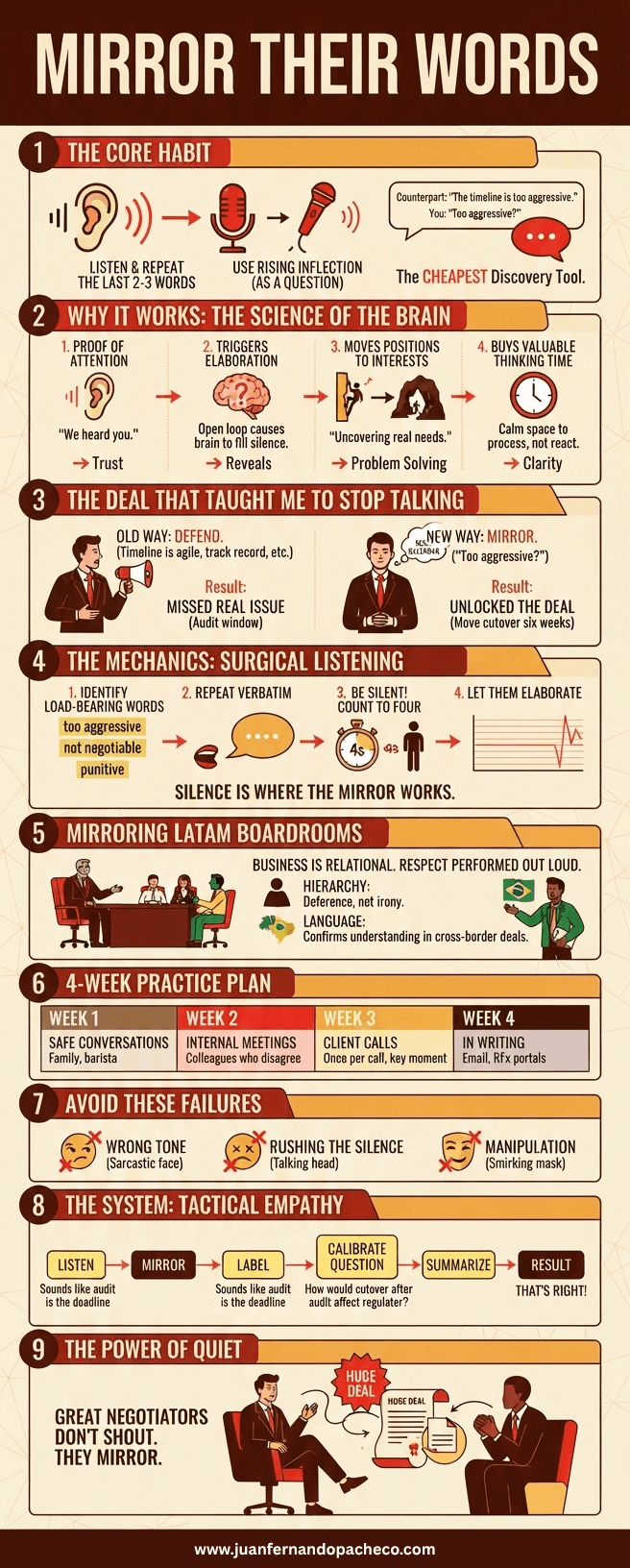
Mirror their words. Repeat their last two or three words as a question to make them elaborate.
People love hearing their own words, and when you mirror them, they explain more and reveal their true priorities and constraints. The tip at the bottom was just as simple: use upward inflection to turn their words into a question. Them: “The timeline is too aggressive.” You: “Too aggressive?”
I have spent more than twenty years in technology, first as a designer and architect, later leading product and business development for enterprise deals across Latin America. I have sat through hundreds of RFI, RFQ, and RFP processes for banks, retailers, and telecoms in Mexico, Colombia, Peru, Chile, Argentina, Brazil, and Ecuador.
And I can tell you that the tiny habit described on that card has saved more deals than any pricing model I have ever built.
This post is my attempt to unpack it completely:
- What mirroring is,
- Why it works on the human brain,
- How to use it at every stage of a complex deal, and
- How to practice it until it becomes invisible
I am writing it as an evergreen piece. The channels we negotiate in will keep changing, but the human need to feel heard will not, so what follows should be as useful five years from now as it is today.
The deal that taught me to stop talking
Early in my business development career, we reached the final round of a competitive RFP for a regional bank. We had a strong solution, a solid delivery team, and a defensible price. In the last meeting, the client’s chief information officer looked at the implementation plan and said, almost as an aside, that the timeline was too aggressive.
I did what most commercial leaders do when they hear an objection: I defended the timeline. I talked about agile delivery, parallel workstreams, and our track record. The CIO nodded politely, the meeting ended, and we lost the deal a few weeks later.
Only in the debrief did I learn the truth
The timeline was never the real problem. The bank was entering a regulatory audit window, and any cutover overlapping that window would require sign-off from a committee that met once a quarter. If we had moved the cutover six weeks and framed the plan around their audit calendar, we would have won.
All of that information was sitting behind the sentence “the timeline is too aggressive,” waiting for one small question to release it. I never gave it that question. I was too busy talking.
The question I should have asked was not even a real question. It was two words and a rising tone: “too aggressive?” That is mirroring, and it remains the cheapest discovery tool ever invented.
What mirroring is, in plain words
Mirroring is the habit of repeating the last two or three words someone just said, with upward inflection, and then staying silent so they elaborate.
- It is not paraphrasing, which filters their meaning through your vocabulary.
- It is not summarizing, which closes a thought. And
- It is certainly not repeating everything they said like a parrot, which becomes annoying in seconds.
Mirroring is surgical listening:
You pick the words that carry the emotional or commercial load, hand them back exactly as spoken, and let the counterpart do the work of unpacking them.
The card I mentioned gets the psychology right:
People love hearing their own words. When a counterpart hears their exact language returned with curiosity, they feel heard without feeling challenged, and they almost always continue talking.
In that continuation lives the gold of any negotiation:
The constraint behind the position, the fear behind the clause, the real budget behind the stated one. In enterprise deals, where every formal document is carefully sanitized, those unplanned sentences are frequently the only place where the truth appears.
Why it works on the human brain
There are four reasons this habit is so disproportionately powerful, and none of them depend on technology, industry, or era, which is exactly why the technique is evergreen.
First, hearing your own words returned to you is proof of attention
Most people in a negotiation are only half-listening while they prepare their next argument. A mirror says, without flattery, “I caught that, and it mattered enough to repeat.” Trust builds from that moment, and trust is the currency every long sales cycle runs on.
Second, mirroring triggers elaboration
A mirror is an open loop, and the human brain dislikes open loops. The counterpart instinctively fills the silence, and in filling it, they clarify, correct, and expand their own statement. “The timeline is too aggressive” becomes “the timeline collides with our audit window,” and a vague objection becomes a solvable problem.
Third, mirroring moves a conversation from positions to interests.
This is the core insight of the Harvard negotiation school. A position is what they demand; an interest is why they demand it. You cannot negotiate sustainably with positions, but a mirror gently pulls the interest to the surface without an interrogation.
Fourth, and this is the benefit nobody mentions, mirroring buys you time
Those few seconds of silence after the mirror are the calmest thinking time you will ever get in a high-stakes meeting. Instead of reacting, you listen, and the deal tells you what it needs.
The mechanics: how to mirror without sounding like a parrot
The technique is simple, but it is not sloppy
After two decades of deals, these are the mechanics I teach my teams. Listen for the load-bearing words. In any sentence, one or two words carry the emotion or the constraint: “too aggressive,” “not negotiable,” “above budget,” “punitive,” “risky.” Those are your mirror candidates, and they are usually, conveniently, at the end of the sentence.
Repeat them verbatim.
Two or three words, with upward inflection so they land as a question. The rising tone is what converts repetition into invitation. A flat tone turns the same words into a challenge.
Then be silent. Count to four in your head
Most professionals panic at two seconds of silence and start talking again, precisely at the moment the counterpart is inhaling to reveal the real constraint. Silence is where the mirror does its work.
Let them elaborate without interrupting, even if you think you already understand
Your interpretation is almost always narrower than their reality. When they finish, reward the effort: nod, take a note, or label what you heard with a phrase like “it sounds like the audit calendar is the real driver.” Only then move on.
Keep the ratio honest
One mirror per conversation is a key that opens a door; five mirrors in ten minutes is a party trick. Use it at the moments that matter.
Mirroring across the life of an enterprise deal
Mirroring is usually taught as a conversation trick for face-to-face moments, but in complex technology deals it earns its keep across the entire deal lifecycle.
In discovery, mirrors replace interrogations
A banking client tells you, “We need to modernize the core.” Instead of launching your standard pitch, you say “modernize the core?” and they explain that the regulator has flagged legacy risk for the second year in a row.
In ninety seconds, you have the winning theme for your proposal, because you now know the deal is about regulatory comfort, not technology fashion.
In RFx question-and-answer rounds, you mirror in writing
Much of a formal procurement process happens by email and portals, and the written mirror is quoting their exact phrase back inside a question.
“You mentioned response times under fifteen minutes; when you say under fifteen minutes, does that apply to priority-one incidents only, or to every ticket?”
Written mirrors do something spoken ones cannot because they create a documented trail of clarified requirements that protects both sides later. I have seen entire SLA disputes never happen because someone mirrored ambiguous language in writing while there was still time to fix it.
In commercial and SLA negotiations, mirrors defuse loaded language
A head of operations says the penalty clause you proposed “feels punitive.” The amateur argues about market standards. The mirror asks “punitive?” and learns that a previous vendor’s failures traumatized his team, and that what he actually wants is a governance forum and early-warning indicators, not a bigger penalty.
You restructure the clause as graduated service credits with joint monthly reviews, and the same person who called your paper punitive now defends it internally.
In legal and compliance discussions, mirrors respect red lines while exploring their shape
“Data sovereignty is not negotiable,” says the client’s counsel. You mirror: “Not negotiable?” She explains that the law requires in-country storage for a specific data class, not for everything. You propose a sovereign data addendum and a local region for that class, keeping your global architecture for the rest. The red line was real; its scope was not. Only the mirror could tell the difference without starting a fight.
And do not forget your internal table
Mirroring works on your own CFO, your legal team, and your delivery leads. When engineering says an estimate is “unworkable,” mirroring “unworkable?” with genuine curiosity will surface the staffing constraint you need to solve, faster than any status report.
Mirroring in Latin American boardrooms
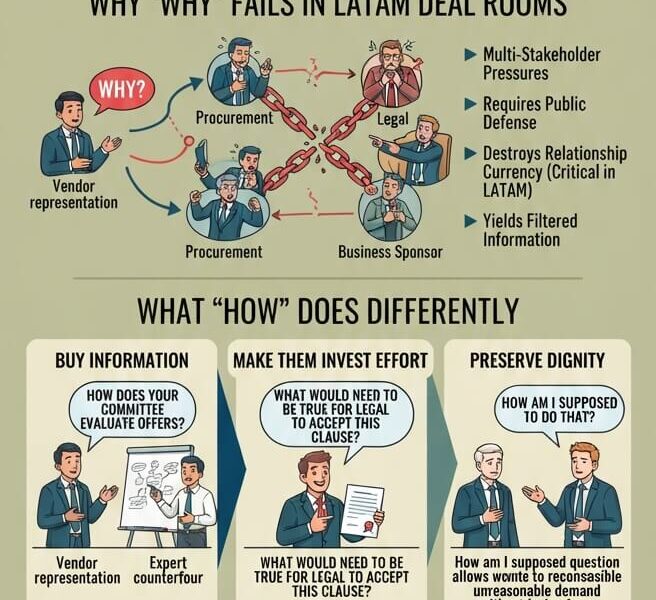
I want to add a regional note, because most negotiation literature is written for North American or European rooms. In Latin America, business is relational before it is contractual. Confidence and trust arrive before the signature, and people decide with whom they want to suffer the inevitable problems of a multi-year contract.
Mirroring fits this culture beautifully, because it is respect performed out loud. In Spanish, “¿demasiado agresivo?” or “¿soberanía de datos?” works exactly as it does in English, as long as the tone is warm and curious. In Portuguese, “muito agressivo?” does the same job.
Two regional nuances matter
- First, hierarchy. In many LATAM boardrooms, the most senior person speaks last, and a mirror aimed at a C-level or board member must carry deference, never irony: you are inviting them to elaborate, not challenging them.
- Second, language. Cross-border deals in our region often run in a second or third language for at least one side. Mirroring the counterpart’s exact words is then a double gift: it confirms you understood what they actually said, and it prevents the false consensus that kills international projects months after signature.
The mistakes that kill the technique
Every powerful habit has a failure mode, and mirroring has three.
The first is tone
The same two words can sound like curiosity or like sarcasm, and the counterpart hears the difference instantly. If your default style is combative, soften your voice before you mirror, or skip the mirror entirely that day.
The second is talking over the silence
The mirror creates a vacuum; if you rush in to fill it with your pitch, you waste the most valuable four seconds in the meeting. Practice the count-to-four rule until it feels natural.
The third is using mirroring as manipulation instead of curiosity
People are excellent at detecting performed listening. If you mirror while secretly rehearsing your counterargument, your face will betray you, and the trust you tried to build will collapse.
The fix is honest: decide, before the meeting, that your goal is to understand their constraints before defending your position. The mirror then becomes an expression of real intent, and it can never sound fake.
Pairing mirroring with the rest of the system
After a mirror has produced elaboration, label the emotion or constraint you heard:
“it sounds like the audit window is the real deadline.”
Labels, like mirrors, make people feel understood and keep them talking. Then ask a calibrated question that hands them part of the problem:
“How would a cutover after the audit look to your regulator?”
Calibrated questions convert revealed constraints into joint problem-solving, which is the heart of win-win negotiation.
Finally, summarize what you heard until the counterpart says “that’s right,” not merely “yes.” That moment of “that’s right” is the cheapest due diligence you will ever run, because it confirms you finally understand the deal they are actually trying to sign.
This combination of listening, mirroring, labeling, and asking is sometimes called tactical empathy in modern negotiation literature, and it rests on older foundations: separating people from problems, and focusing on interests instead of positions.
The vocabulary changes by decade; the human mechanics never do.
A four-week practice plan
If you want this habit to be reliable when a nine-figure deal depends on it, build it in low-stakes rooms first.
- Week one, mirror in safe conversations: with family, with the taxi driver, with the barista. Notice how often people elaborate without being pushed.
- Week two, mirror in internal meetings, especially with people who disagree with you; watch how quickly tension drops when colleagues feel heard.
- Week three, mirror once per client call, only at the moment of the strongest loaded words, and write down what the elaboration revealed.
- Week four, mirror in writing: turn one ambiguous requirement in every RFx you answer into a quoted, mirrored question.
By the end of the month you will have a notebook full of revealed constraints, and the habit will be yours for life.
Why this stays evergreen
I have negotiated in person, by phone, by video, by email, and through procurement portals, and I will probably negotiate with AI-assisted tools before I retire.
Yet in every channel, at some point, a human being decides whether your proposal feels safe. Tools change; that human does not. The need to feel heard is older than writing and will outlive whatever platform we use next year.
That is why a habit as small as repeating two or three words, with a rising tone and four seconds of silence, will keep working in five years exactly as it works today. Great negotiators are not louder than everyone else. They are quieter, and because they are quieter, they leave every meeting knowing more than they arrived with.
So the next time a counterpart across the table says the timeline is too aggressive, resist the ancient urge to defend the timeline. Lean back, smile, and ask: “too aggressive?” Then wait. The deal will tell you what it needs.
References and further reading
Web references
- Harvard Law School, program on negotiation: listening skills for maximum success
- Harvard Law School, program on negotiation: negotiation tips and listening skills
- The Black Swan Group: active listening, what it is and why it matters in negotiating
- MasterClass, Chris Voss teaches the art of negotiation: mirroring chapter
- CMM LLP: take control of your negotiation using active listening techniques
Books that reinforce this post
- Chris Voss and Tahl Raz, Never Split the Difference — the modern source of mirroring, labels, and calibrated questions.
- Roger Fisher, William Ury and Bruce Patton, Getting to Yes — the classic framework of interests over positions
- Edgar H. Schein, Humble Inquiry — the gentle art of asking instead of telling:
- Daniel Kahneman, Thinking, Fast and Slow — why silence and slow questions calm fast, defensive thinking
- Robert Cialdini, Influence: The Psychology of Persuasion — the deeper psychology of rapport and reciprocity