The negotiation habit that disarms skepticism and wins enterprise deals
There is a moment in almost every serious deal when you can feel the room holding its breath. I have lived that moment many times:
- A large bank in Latin America,
- A multi-year contract on the table,
- An RFP process that has already consumed weeks of legal reviews, security questionnaires, and executive meetings.
On paper, everything is fine. In the room, something is off. The CIO glances at the legal director when you mention penalties. The procurement lead writes something down when you say “uptime.” Nobody objects. Everybody doubts.
For most of my early career, I treated that silence as a good sign
No objections meant agreement, I told myself. It took a few lost deals to learn the truth: in complex enterprise sales, the objections that kill you are rarely the ones you hear. They live in side conversations, in message threads between evaluators, in the legal review that happens after your meeting.
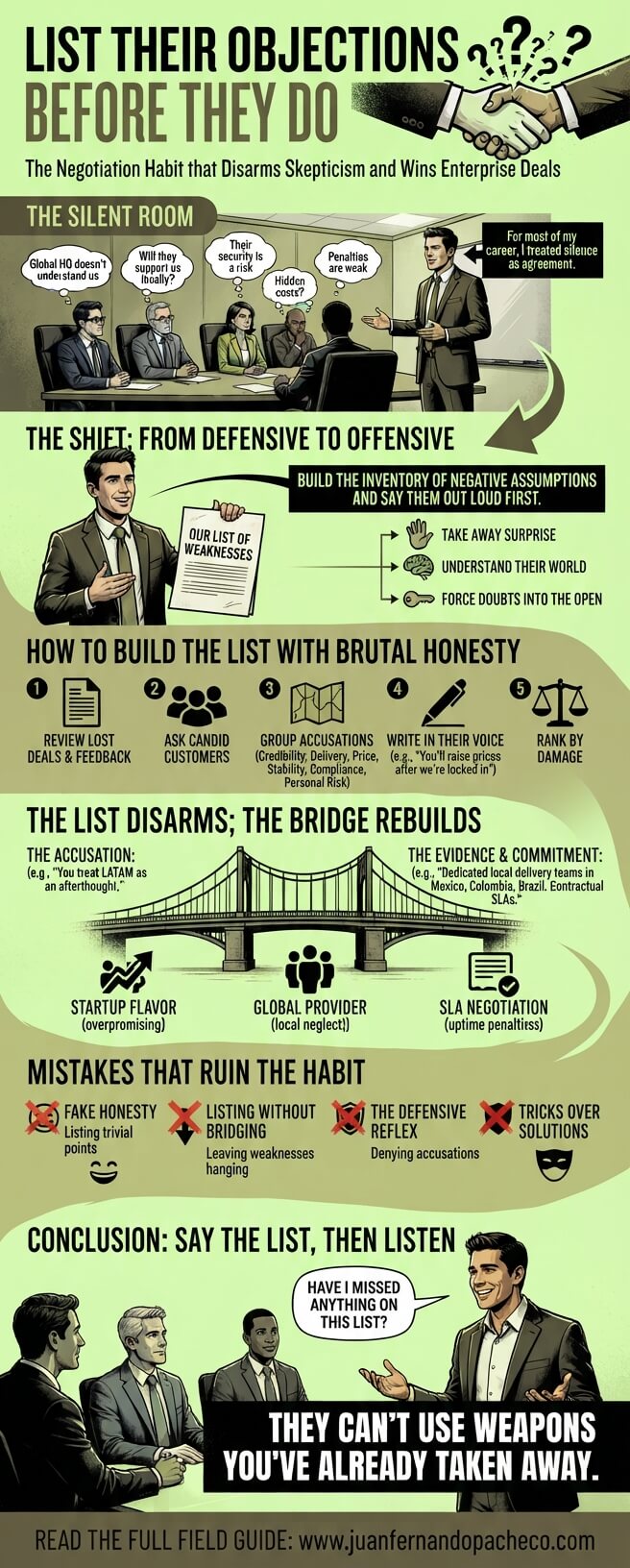
So I changed my approach. In one of those tense boardroom sessions, I opened our presentation by reading out loud the list of reasons the bank should not hire us. I named their worst assumptions about our size, our local support, our penalties, our ability to deliver.
The change in the room was immediate. Shoulders dropped. Someone said,
“Well, we wouldn’t put it that harshly.”
For the first time in the process, we were having an honest conversation. We won that deal, and more importantly, I learned a habit I have used in every high-stakes negotiation since.
Years later, I found that habit written down in a collection of negotiation secrets used by seasoned CEOs.
The seventh secret on the list says it plainly: list their objections.
State all their negative assumptions about you up front, because they can’t use weapons you have already taken away. The tip that comes with it is the whole discipline in four words: be brutally honest.
This post is my field guide to that idea — what it means, why it works, how to apply it in real commercial practice, and why it will keep working whether you read it today or five years from now.
What “list their objections” really means
Most commercial training teaches objection handling: wait for the concern, acknowledge it, answer it. That is a defensive skill. It puts you in the position of a defendant responding to a prosecutor. The habit in the CEO’s list is different.
It is offensive in the best sense: you build the complete inventory of negative assumptions the other side holds about you — your company, your price, your stability, your team, your promises — and you say them out loud before they do.
In negotiation literature, this practice is close to what former FBI hostage negotiator Chris Voss and his Black Swan Group call an accusation audit: voicing the negatives your counterpart is likely harboring before they can voice them themselves.
The Black Swan team is careful to note that this is not a confession and not an exercise in dumping your insecurities on the table; it is a way of clearing the emotional terrain so a real conversation can start.
Done well, it does three things at once:
- It takes away the element of surprise,
- It shows that you understand the other side’s world, and
- It forces hidden doubts into the open where they can actually be addressed.
Notice the shift in posture. Objection handling reacts to what the other side chooses to reveal. Listing their objections first deals with what they have not revealed yet. One waits for weapons to be fired; the other collects the weapons before the fight starts. That is why the original note says, with perfect economy, that they can’t use weapons you have already taken away.
Why listing their objections first works
The habit works because it runs against every script your counterpart expects.
- Attention is the first asset in any negotiation. A buyer in a high-stakes process meets dozens of vendors who all promise, polish, and reassure. When you open by naming the reasons they are skeptical, you break the pattern. Pattern breaks earn attention.
- Second, honesty reads as strength. Only a supplier that is confident about its delivery can afford to speak about its own risks. When you list the worst things they think about you, you signal that you have nothing to hide and enough command of your own operation to discuss its weaknesses calmly. That signal does more for trust than any slide about your values.
- Third, naming an accusation out loud tends to soften it. People have a well-known tendency to retreat from an extreme position once it has been acknowledged openly. Say “you probably think we overpromise and disappear after signing” and the honest buyer will often answer with “well, we don’t assume the worst, but we have been burned before.” You have moved them from prosecutor to witness. The accusation loses its charge the moment it is shared.
- Fourth, and this matters most in complex procurement, the habit gives your counterpart permission to speak about the doubts that never appear in official channels: data sovereignty, political exposure, internal resistance, the personal cost of choosing a vendor that fails. A doubt that is spoken can be answered. A doubt that stays silent decides the deal against you in a corridor.
Finally, the habit protects you from ambush. If the worst assumptions about you have already been said by you, nothing that comes later can surprise you. You control the framing, the timing and the tone, and you enter the rest of the process with the calm of someone who has already heard the worst and is still standing.
Building the list with brutal honesty
The quality of the habit depends entirely on the honesty of the list.
A list of polite, comfortable objections is worse than no list, because it shows that you are still hiding. So build it the way an auditor would.
Start from evidence, not imagination.
Review your lost deals and write the real reasons, not the official ones. Read what the market says about you: review sites, industry forums, the things competitors whisper in the same corridors your buyers walk.
Ask your most candid customers what they doubted before signing.
In my own practice, after years of running RFI, RFQ, and RFP processes across Mexico, Colombia, Peru, Chile, Argentina, and Brazil, I keep a running document of the doubts that repeat by segment, because banks doubt one set of things, retailers another, telecoms another.
Write each item in the other side’s voice, as an accusation, not as a topic.
“Price” is a topic. “You will look cheap today and raise prices after we are locked in” is an accusation. “Security” is a topic. “You are one breach away from becoming our headline” is an accusation. The sharper the sentence, the more useful it is.
Group the accusations so you cover the full risk map of your deal
Credibility and reputation; ability to deliver; price and hidden costs; stability and continuity; compliance, security and legal exposure; and the personal risk your counterpart takes by choosing you.
That last category is the one most vendors forget: in enterprise deals, your buyer is also asking,
“what happens to my reputation if I sign with you and you fail?”
Then rank by damage, not by comfort, and keep the five or seven that hurt most.
For each one, prepare a short bridge: acknowledge the assumption, show the evidence that answers it, and offer a verifiable commitment — a penalty you are willing to sign, a reference they can call, a pilot they can measure.
The list disarms; the bridge rebuilds. Never leave an accusation hanging in the room without its bridge, and never let the bridge erase the honesty of the list.
How to say it out loud without sounding weak
Timing comes first.
The list belongs early in the conversation: in the opening of an executive meeting, in the executive summary of a proposal, in the first page of an RFP response, in the second paragraph of a commercial email. If you wait until the other side raises the doubts, you are handling objections again, not disarming them.
Tone comes second.
Say the list the way a surgeon states the risks of a procedure: calm, specific, without drama and without self-pity. No theatrical humility, no fishing for compliments. You are not confessing sins; you are showing that you see the board exactly as they see it.
A simple structure works in almost any setting.
“In processes like this, decision-makers usually doubt three things about vendors like us. They think X. They think Y. And they think Z. Here is how we address each one, and here is how you can verify it during this process.” Then close with the most valuable question in enterprise sales: “Have I missed anything on this list?” Ask it and stay silent. What comes back is the real agenda of the deal.
In written RFx responses, the same logic applies on paper.
An executive summary that begins with “evaluators reading this document usually assume…” stands out in a stack of proposals that all begin with “we are delighted to present.” The evaluator who reads your own doubts stated clearly, and answered with evidence, starts to experience you as a partner rather than a bidder. That experience is what wins scoring tables that are technically tied.
Examples from the field
The original note gives a startup flavor:
“You probably think we’re another tech startup that overpromises, burns cash and disappears.”
Said out loud at the start of a conversation, that sentence removes the elephant from the room and lets the founder talk about runway, references, and escrow clauses with a calm buyer.
In my own terrain, large technology deals for banks and enterprises across Latin America, the list has its own regional accent. A global provider hears things like:
- “you will treat our market as an afterthought,”
- “decisions about our account will be taken in a headquarters that has never visited us,”
- “you say you comply with local regulation until the regulator proves otherwise,”
- “your local team is thin, and your experts live in another time zone.”
I have learned to say those sentences before my buyers do, and then bridge to what answers them: local delivery teams, data sovereignty architecture, contractual commitments to local policy, escalation paths with names and phone numbers.
In SLA negotiation, the habit is almost mechanical.
“You think our uptime commitments are a sales document, not an operational one. So let’s open the penalty clauses first. Here is the credit we accept for missed response times, here is the uptime we sign, here is what happens if we fail.” When a vendor offers the penalties before the buyer asks, the conversation about trust ends and the conversation about engineering begins. That is the moment a deal becomes real.
And after any public failure — an outage, a delayed launch, a rough audit — the list becomes your re-entry ticket: “You are wondering whether last year’s incident will repeat. Here is the postmortem, here is what changed in our operation, and here is how you can test it in a pilot.” Said first, the incident stops being a weapon and becomes evidence of maturity.
Mistakes that ruin the habit
The habit is powerful and, like anything powerful, it breaks when misused.
The most common mistake is fake honesty: listing three trivial objections to avoid the one that actually decides the deal. Buyers detect that instantly, and the performance confirms their suspicion that you are hiding.
The second mistake is listing without bridging
Dumping accusations and moving on, leaving the room full of your own weaknesses. The list opens the wound; the bridge closes it. Both are mandatory.
The third is the defensive reflex
saying the accusation and immediately denying it with “but that is not true.” The denial cancels the honesty. Acknowledge the assumption as theirs, respect it, and answer it with evidence and commitments, not with indignation.
The fourth mistake is using the habit as a trick while the underlying problem remains.
If the market really believes your local support is thin, the sentence buys you one conversation; only a thicker local team buys you the next deal. Treat the habit as a diagnostic, not as makeup.
And finally, do not turn the list into a ritual you repeat with the same words in every meeting. It works because it is honest and specific to the room you are in. Rewrite it for every deal, every counterpart, every culture.
Why this stays useful no matter when you read it
I write this knowing that the tools around the habit will change
Channels change, buying committees change, software will keep rewriting how proposals are produced and read. None of that touches the habit, because the habit is not about tools.
It is about a constant of human nature: people decide with skepticism first and justification second. Your counterpart will always carry fear — of a bad vendor, of a failed project, of a personal cost — and whoever names that fear respectfully first will be experienced as the safest pair of hands in the room.
That is why this idea is evergreen by design. It does not depend on a platform, a methodology or a market cycle. It depends on empathy, honesty and courage, three assets that do not depreciate.
Whether you are negotiating a core banking transformation, a cloud migration, or a product that does not exist yet, the question in front of you is the same one that was in front of vendors fifty years ago: “Can I trust these people with my risk?”
List their objections before they do, and you answer that question before your first slide.
Conclusion: say the list, then listen
So here is my invitation for your next deal, whatever it is. Before the meeting, write the list of their worst assumptions about you, in their words, ranked by damage.
In the meeting, say the list out loud, early and calmly. Bridge each accusation to evidence and verifiable commitments. Then ask, “Have I missed anything?” and listen.
You will feel the same change I felt in that boardroom: shoulders dropping, honest questions appearing, the conversation finally becoming real. They can’t use weapons you have already taken away. And you, freed from defending yourself, can finally do the job you came to do — building deals that survive signature day.
Web references and books that reinforce this post
Web references:
- What is the Black Swan accusation audit? — the Black Swan Group explains the practice of voicing the negatives your counterpart harbors before they can.
- Why accusation audits are not confessions — a useful clarification that the habit is about clearing terrain, not dumping insecurities.
- How to use an accusations audit to prepare for a negotiation — a practical, step-by-step explanation of building the exhaustive list of negatives.
- How to resolve conflict: Chris Voss’s accusation audit — an applied view of the audit beyond sales, useful for disputes and internal negotiations.
Books:
- Never split the difference — Chris Voss and Tahl Raz. The source of the accusation-audit mindset and of the idea that naming fears builds trust.
- SPIN selling — Neil Rackham. The classic on how serious buyers form concerns in large deals, and why questions beat arguments.
- The Challenger Sale — Matthew Dixon and Brent Adamson. On being the vendor who takes control of the conversation and earns the right to reframe risk.
- Difficult Conversations — Douglas Stone, Bruce Patton and Sheila Heen. On saying the unsaid early while keeping the relationship intact.
- How to win friends and influence people — Dale Carnegie. The oldest ancestor of the habit: see the other side’s point of view first, and state it better than they can.