The negotiation secret that turns resistance into momentum
The meeting where the deal finally moved
Some years ago, in a boardroom in one of the customers, I was losing a deal I thought I had won on paper. We were in the final stage of an RFP with a regional bank, and our proposal was strong: solid architecture, competitive pricing, a team with deep banking experience. I walked in ready to present value propositions, key differentiators, and winning themes. I did exactly that, for forty minutes.
The CIO listened politely and then said, “You’re right.” The procurement director nodded. And nothing happened. No next step, no commitment, no date for legal review. The deal went quiet the way deals go quiet in our region:
Not with a rejection, but with a polite pause that stretches into forever.
A more experienced colleague took the next meeting.
He brought no slides. He opened his notebook and said,
“Before we talk about anything, let me make sure I understand your position.”
Then he spoke for two minutes, and he spoke about them, not about us. When he finished, the CIO leaned forward and said, “That’s right.”
The temperature of the room changed in an instant. Within the hour we were discussing a pilot, a gradual integration, and a path to the board. The contract was signed months later and became one of the largest accounts of my career.
It took me years to name what happened in that room.
Today I call it by the label I give it in my own playbook of negotiation secrets: confirm their concerns. Paraphrase the other side’s position so accurately and so completely that the only honest answer is “that’s right.” Not “you’re right.” That small difference is the subject of this post, and it is one of the most reliable deal-moving disciplines I know.
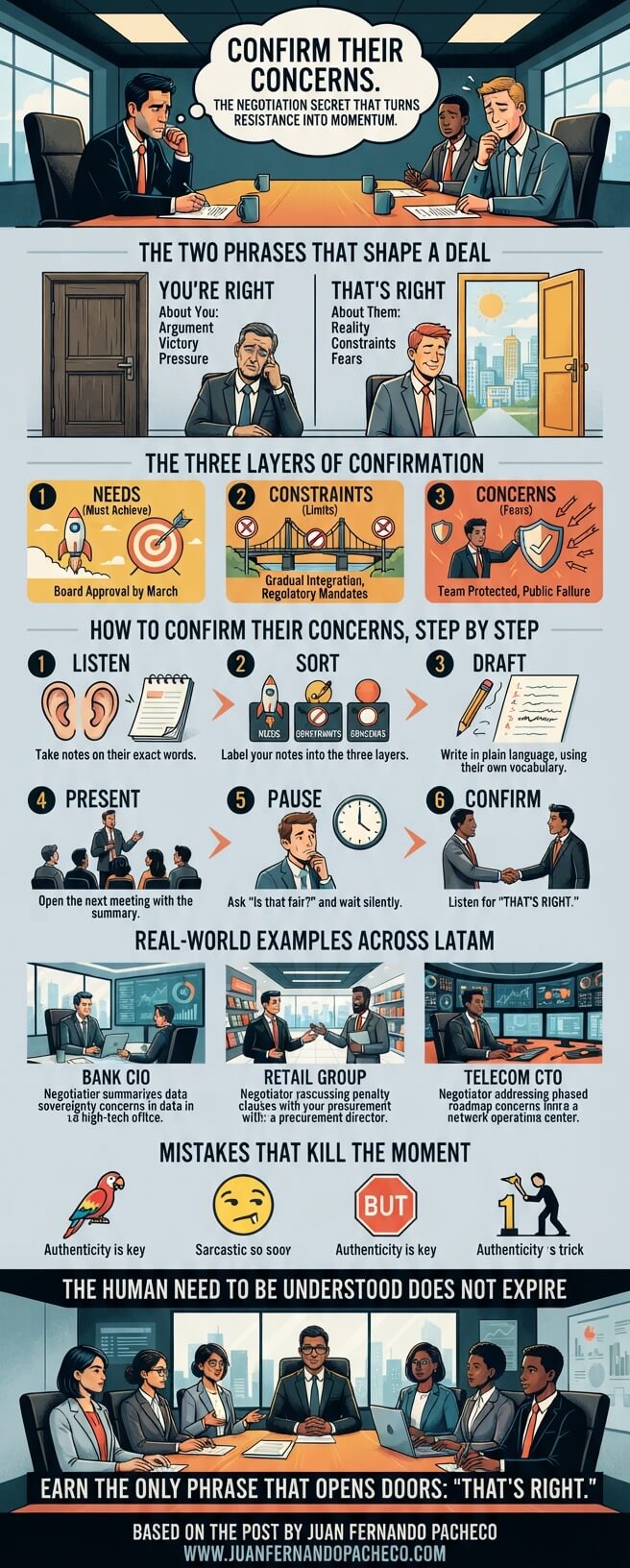
“you’re right” closes doors; “that’s right” opens them
The two phrases sound almost identical, which is why so many commercial people confuse them, and why so many deals die politely.
When a counterpart says “you’re right,” they are usually not agreeing with you.
They are ending the conversation. “You’re right” is what people say to make a persistent vendor go away: it is a concession, a sign of defeat, or simply a shield, and it rarely leads to movement.
You leave the meeting feeling victorious, and the counterpart leaves feeling pushed. The Black Swan Group, Chris Voss’s firm, calls this the seduction of “you’re right”: it feels like progress while it kills the deal.
“That’s right” is the opposite
It is what a person says when they hear their own position described more clearly than they could describe it themselves. According to Chris Voss, the former FBI hostage negotiator, getting to “that’s right” is the real goal of a negotiation, because it means the counterpart feels truly understood, not dodged or defeated.
When someone says “that’s right,” the struggle in their head goes quiet. They feel understood, and that feeling creates momentum and a psychological agreement to move forward. That is exactly the idea behind the sixth secret in the series that inspired this post: paraphrase their position so accurately that they say “that’s right.”
Notice where each phrase points
- “You’re right” is about you: your argument, your victory, your pressure.
- “That’s right” is about them: their reality, their constraints, their fears, finally seen.
One closes the door while keeping up appearances; the other opens it for real. Every deal leader should learn to tell them apart by ear, because the future of a negotiation hides in that difference.
Why confirmation works when persuasion fails
Most negotiators treat resistance as an information problem
If the other side only had my data, my business case, my discount, they would agree. So they push more content into the room. But resistance is rarely an information problem. It is a protection mechanism. The person across the table is protecting a budget, a reputation, a team, a career, a political balance inside their own organization. Pushing harder against protection only makes it stronger.
Confirmation works because it does something else entirely
It lowers the threat level in the room. Practice and research from the Harvard program on negotiation repeatedly show that active listening and empathy build trust and improve outcomes, because they signal that you are trying to understand, not just to win.
When a person feels heard, the defensive posture relaxes, and only then can they consider new information. Psychologists and negotiation teachers describe the same pattern from different angles: perspective-taking and empathetic listening change the quality of the whole conversation
There is also a deeper reason, and it is the one I want you to keep
Confirmation is not agreement. You can summarize a position you do not share, a constraint you cannot change, a concern you think is exaggerated, and summarize it with total respect. Nothing in “let me see if I understand” commits you to anything.
That is what makes this discipline safe for anyone who carries a quota: you are not conceding price, scope, or service levels; you are simply proving that you understand what those things mean for the other side. And paradoxically, that proof is what makes them willing to negotiate price, scope, and service levels with you.
The three layers: needs, constraints, and concerns
The practical heart of this secret is a simple tip
Summarize their needs, constraints, and concerns completely. Completely is the operative word. Most summaries fail because they cover only one layer, usually the easiest one. Let me define the three.
Needs are what the other side must achieve
Board approval by a certain date, a system live before peak season, uptime that survives an audit, a budget that closes the year clean.
- Constraints are what limit their freedom to say yes: regulatory mandates, data sovereignty rules, legacy cores that cannot be migrated during a closing quarter, internal politics, a team already exhausted by other projects.
- Concerns are what they fear: a public failure, a penalty clause with their signature on it, a vendor that disappears after signing, a project that makes them look bad inside their own company.
Now look at the example that accompanies the secret
“So you need board approval by March, gradual integration, and your team protected?” Three clauses, three layers.
- Board approval by March is a need.
- Gradual integration is a constraint, because their organization cannot absorb a sudden cutover. And
- “your team protected” is a concern: the human fear of being exposed to blame if something breaks.
That single sentence is why the example works. It tells the counterpart
I see what you need, I respect what limits you, and I understand what you are afraid of.
When you summarize only the needs, you sound like a vendor who read the RFP. When you summarize needs and constraints, you sound like a consultant who understands the operation. When you summarize all three layers, you sound like a partner who can be trusted with the deal. The third layer is where “that’s right” lives.
How to confirm their concerns, step by step
This discipline can be learned. It does not require charisma; it requires order. Here is the sequence I use in deals and teach to the teams I lead.
First, listen to their words.
In every meeting, take notes on what they say, not on what you want to answer. Capture the exact language: “we cannot touch the core during audit season” is more valuable than your interpretation, “they have technical limitations.” Their words carry their reality; your interpretations carry your bias.
Second, sort what you hear into the three layers.
After the meeting, spend ten minutes with your notes and label them: needs, constraints, concerns. You will often discover that what sounded like a price objection was actually a concern about internal approval, or that what looked like a delay tactic was a real constraint of their calendar.
Third, draft the summary before the next conversation
Write it in plain language, in their words, without your sales vocabulary. Do not translate “we are afraid of a failed launch” into “the client has change-management challenges.” The first version is human; the second is a diagnosis, and nobody feels understood by a diagnosis.
Fourth, open the next meeting with the summary, not with your agenda
A soft entry works well: “Before we continue, let me see if I truly understand your position.” Then say it slowly, in two or three sentences, covering the three layers.
Fifth, end with a question and stay silent
“Is that fair?” “Am I missing something?” And then wait. The silence is part of the technique; it gives them room to say the words you are looking for.
Sixth, listen for the answer
If you hear “that’s right,” you have earned the right to move the deal forward, and the next question should be collaborative: “So how would you like to proceed?” If you hear “you’re right,” or a cold “yes,” do not advance. Something is missing, usually a concern they have not said out loud. Go back to listening and ask, “What am I not seeing?”
Finally, take it to writing
This works in person, on a video call, and on paper. In an RFP response, open the executive summary with a precise restatement of the client’s position before you present yours. In a difficult email, summarize their last message so well that they cannot disagree with your reading of it.
Written confirmation is one of the most underused tools in complex sales, and it travels well across the many legal and procurement layers of a large deal.
What it looks like in real deals
Let me show you three compressed examples from the kind of deals I have led across Latin America. The names change; the pattern does not.
A bank CIO, in a market with strict data sovereignty rules, kept reopening clauses our legal team considered closed. My instinct was to defend. Instead, I summarized:
“So you need a provider that survives the regulator’s scrutiny, you cannot move certain data outside the country no matter what we offer, and you are concerned that a vendor promise today becomes your audit finding tomorrow.”
He said, “That’s right,” almost with relief. We stopped arguing about clauses and rebuilt the architecture discussion around local residency. The contract took longer to draft and closed with far less risk.
A procurement director in a retail group demanded penalty clauses so severe that our operations team wanted to walk away. Before answering, I summarized:
“You need response times in writing, you are constrained by a previous vendor that promised and failed, and you are concerned that without penalties, nobody inside your organization will believe this contract is different.”
She said, “That’s right.” From there we designed a two-sided model: penalties for us, and commitments and incentives for them. The symmetry dissolved the tension, because the real issue was never the money; it was the memory of being failed.
A CTO in a telecom company delayed signature for months while asking for a delivery in a single phase that we knew was dangerous. The summary that unlocked him was this:
“You need a visible win this year, you cannot stop the legacy systems during the high-traffic season, and you are concerned that a phased plan looks like a delay to your board.”
“That’s right.” We then co-designed a phased roadmap where each phase produced a result visible to the board. He signed, and the project survived its first year without a single public incident.
In none of these cases did we win by arguing better. We won by understanding first, and letting the understanding do the heavy lifting.
The mistakes that kill the moment
Because this discipline is powerful, it is also easy to corrupt. A few mistakes ruin it instantly.
The first is parroting
Repeating their last sentence like a mirror is a technique without a soul, and people notice within seconds. A summary is not an echo; it is a synthesis that adds clarity, not repetition.
The second is the sarcastic summary
“So basically, you don’t want to decide.” Anything that sounds like a verdict destroys trust. The test is simple: if your summary could offend, it is not a summary; it is an attack.
The third is the word “but.”
“I understand your concern, but our solution…” erases everything before it. After a summary, use “and,” or better, use a question. The moment you defend, you stop confirming.
The fourth is using it as a trick.
If you summarize without real curiosity, the other side will feel processed, not understood. Confirmation only works when you actually want to see their reality, which is why this is a discipline of character as much as of technique.
And the fifth, the one I committed in that boardroom years ago.
Mistaking “you’re right” for progress and pushing to close. When you hear “you’re right,” slow down. The door is closing, not opening.
Why this will still work in five ot ten years
I write this for my own site because I want it to age well
Tools will change. Channels will change. I have negotiated in person in Quito and Bogotá, and remotely across time zones, by email through legal departments, and by video from home offices, and the pattern holds in all of them. Contracts will evolve, regulations will evolve, and new technologies will enter every RFP I will ever answer.
But the human need to be understood does not expire
It is stable across markets, and it is especially visible in relationship-driven economies like ours in Latin America, where trust precedes contracts and people do business with people who see them clearly. That is why this secret is evergreen: it is not built on a platform or a trend; it is built on human nature.
Five years from now, in a boardroom or in whatever replaces the boardroom, the person across the table will still relax when they hear their own reality described with respect, and they will still say the two words that move a deal: “that’s right.”
The final word
The next time a deal stalls, resist the instinct to add one more slide, one more discount, one more argument. Do the opposite. Sit down, review your notes, and build the most complete summary you can of their needs, their constraints, and their concerns. Then say it slowly, end with a question, and wait.
You are not trying to win the argument. You are trying to earn the only phrase that opens doors: “that’s right.”
References and further reading
Web references:
- The magic of “that’s right,” CLM magazine
- The seduction of “you’re right” in negotiations, Black Swan Group
- Ex-FBI negotiator Chris Voss: this phrase can help you win an argument, CNBC
- Listening skills for maximum success, Harvard program on negotiation
- How to become a more empathetic listener, Harvard Business Review