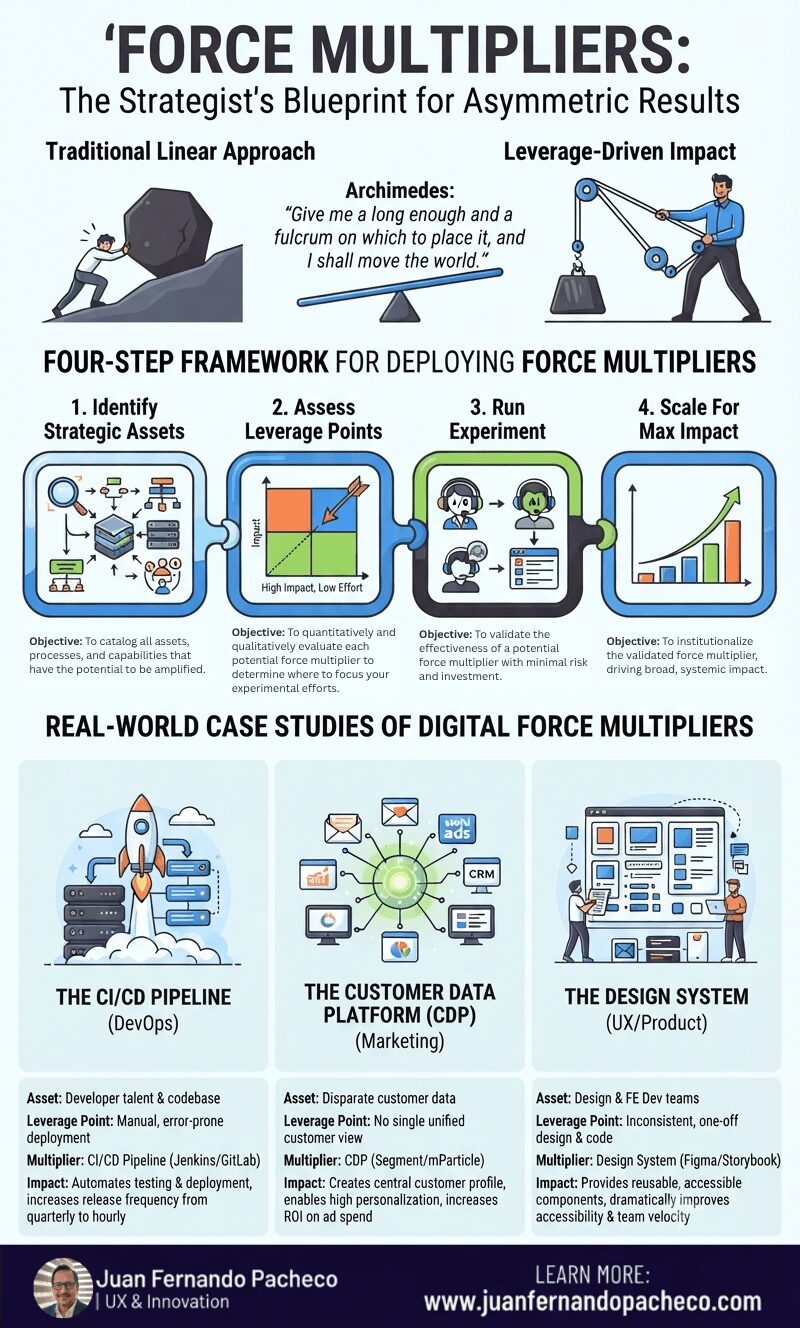
A vertical infographic titled "FORCE MULTIPLIERS: The Strategist's Blueprint for Asymmetric Results." It contrasts traditional effort with leverage-driven impact, outlines a four-step framework, and presents three real-world case studies with brand new illustrative icons.

Stop asking, “How can we do this task faster?” Start asking, “How can we make this task irrelevant?” or “How can we automate this outcome?” By systematically identifying your strategic assets, rigorously assessing their leverage points, courageously running experiments, and deliberately scaling successes, you embed a culture of amplification into your organization’s DNA.

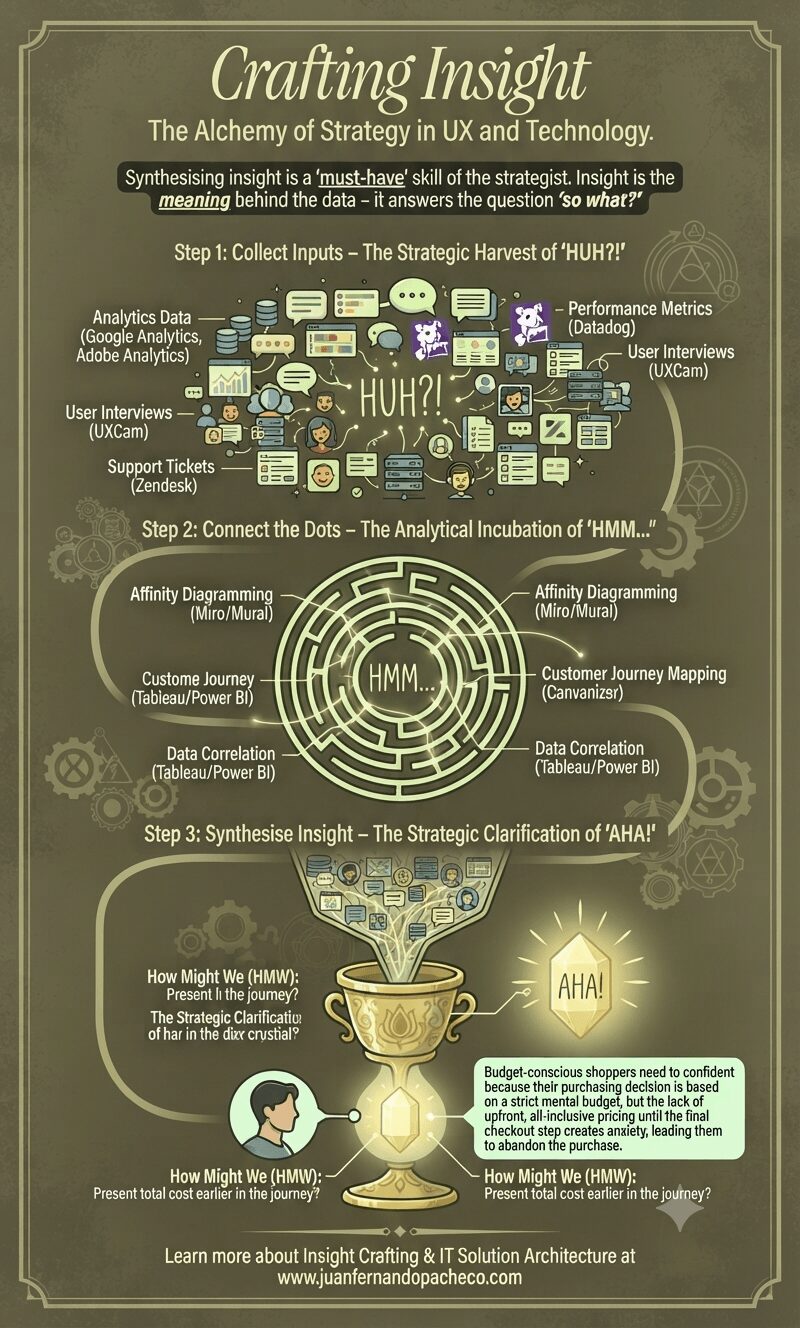
An infographic illustrating the three-step framework of crafting insight—Collect Inputs (HUH?!), Connect Dots (HMM...), and Synthesise Insight (AHA!)—featuring a glowing crystal alchemy design against a muted olive-tan background with references to www.juanfernandopacheco.com.

Crafting insight is not a linear, one-time event. It’s a continuous, iterative cycle. As you build and test solutions based on your insights, you generate new data, leading to new “HUH?!” moments, and the cycle begins anew.

Remember: quality insights will lead to quality strategy.

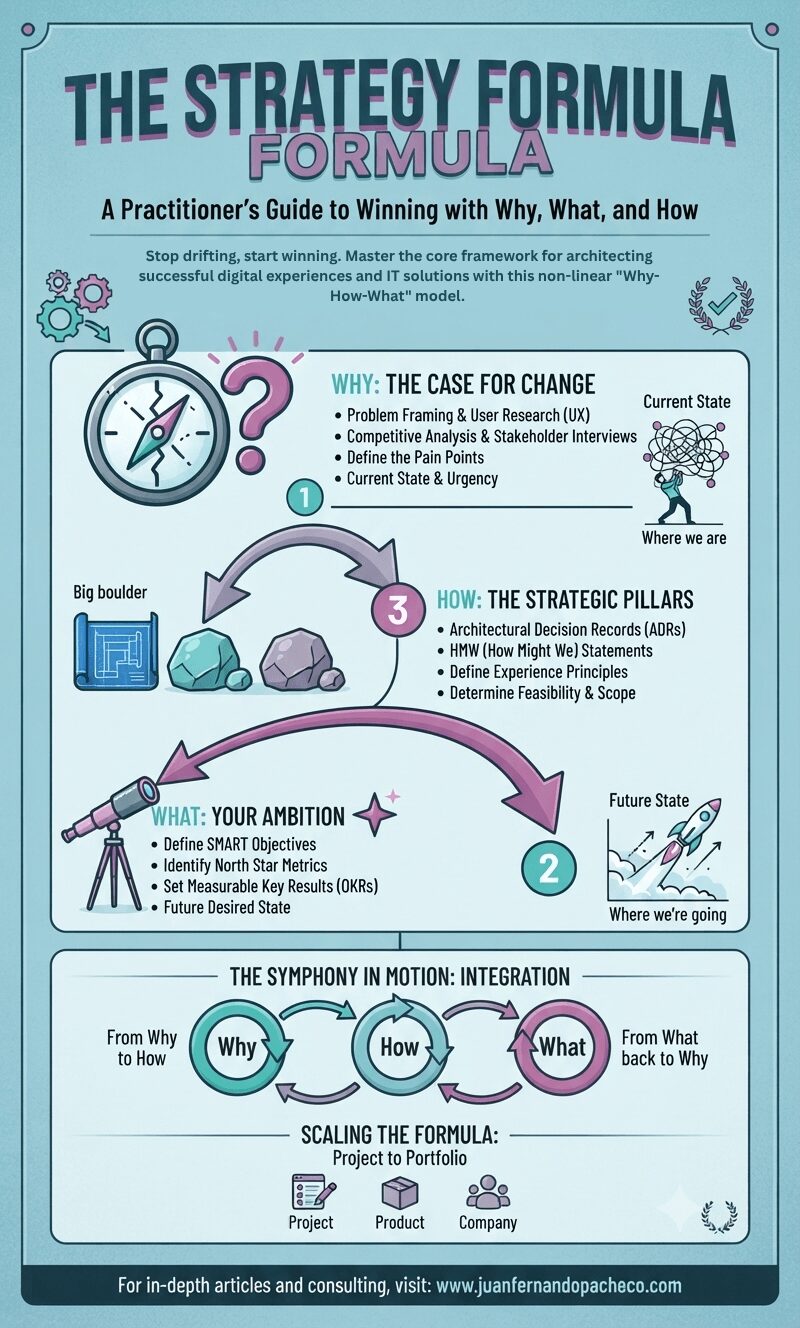
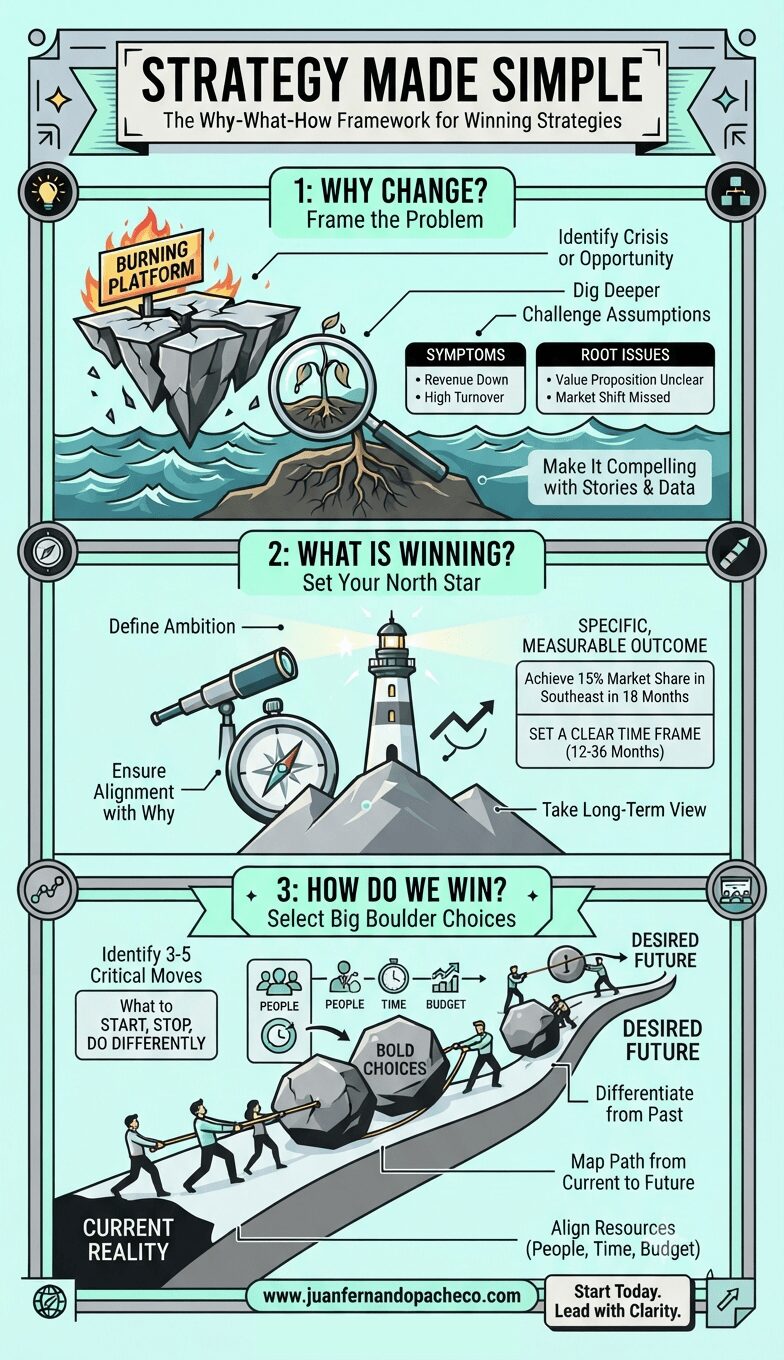
A tall vertical infographic in teal and purple tones, with the title "THE STRATEGY FORMULA". The image is divided into a three-part, non-sequential flow, clearly numbered 1, 3, and 2, with curved arrows showing the progression. Section 1, "WHY: THE CASE FOR CHANGE," features a cracked compass and a question mark. Section 3, "HOW: THE STRATEGIC PILLARS," shows three large boulders and a blueprint. Section 2, "WHAT: YOUR AMBITION," features a telescope. Below this, a section titled "THE SYMPHONY IN MOTION: INTEGRATION" shows the three components in a cycle. Finally, "SCALING THE FORMULA: Project to Portfolio" displays icons for a project, product, and company. The footer includes the URL "www.juanfernandopacheco.com".

In a world of infinite distractions and limited resources, clarity is your most significant competitive advantage. The Strategy Formula—Why, How, What—is the ultimate tool for achieving that clarity. It forces rigor, fosters alignment, and grounds your ambition in reality.

It prevents the all-too-common pitfalls: the solution in search of a problem, the activity mistaken for progress, and the vague goal that inspires no one.

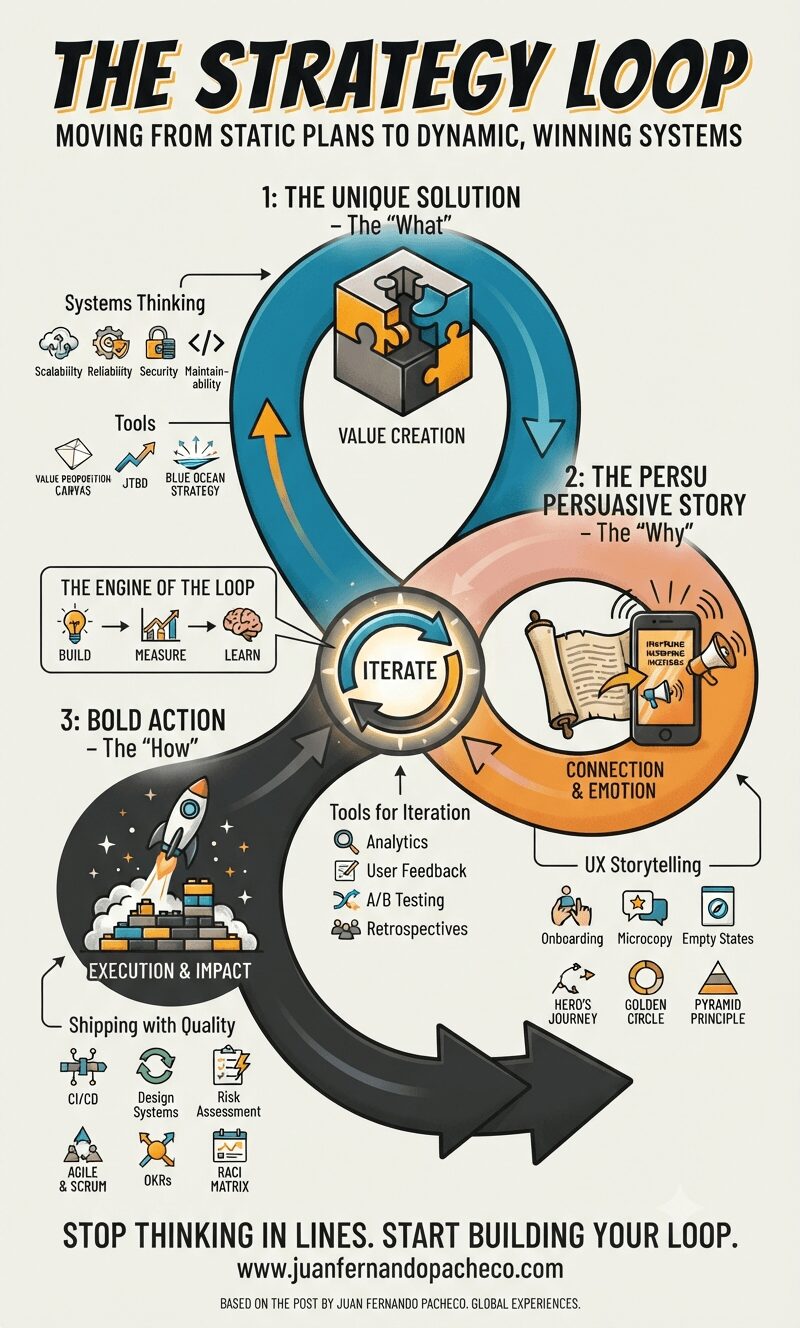
An infographic titled "The Strategy Loop" illustrating a dynamic, three-part cycle for business strategy. The teal loop at the top is "1: The Unique Solution - The What," showing puzzle pieces and value creation. The orange loop on the right is "2: The Persu Persuasive Story - The Why," showing a scroll, smartphone, and megaphone. The dark gray loop at the bottom is "3: Bold Action - The How," showing a rocket launching. In the center, a central hub labeled "Iterate" connects the cycle, supported by "The Engine of the Loop" (Build-Measure-Learn) and specific tools for each phase. The bottom text reads: "Stop thinking in lines. Start building your loop. www.juanfernandopacheco.com."

The Strategy Loop transforms strategy from a static document owned by a few executives into a dynamic, living system that empowers the entire organization. It aligns the logical rigor of the solutions architect with the empathetic, human-centered focus of the UX designer.

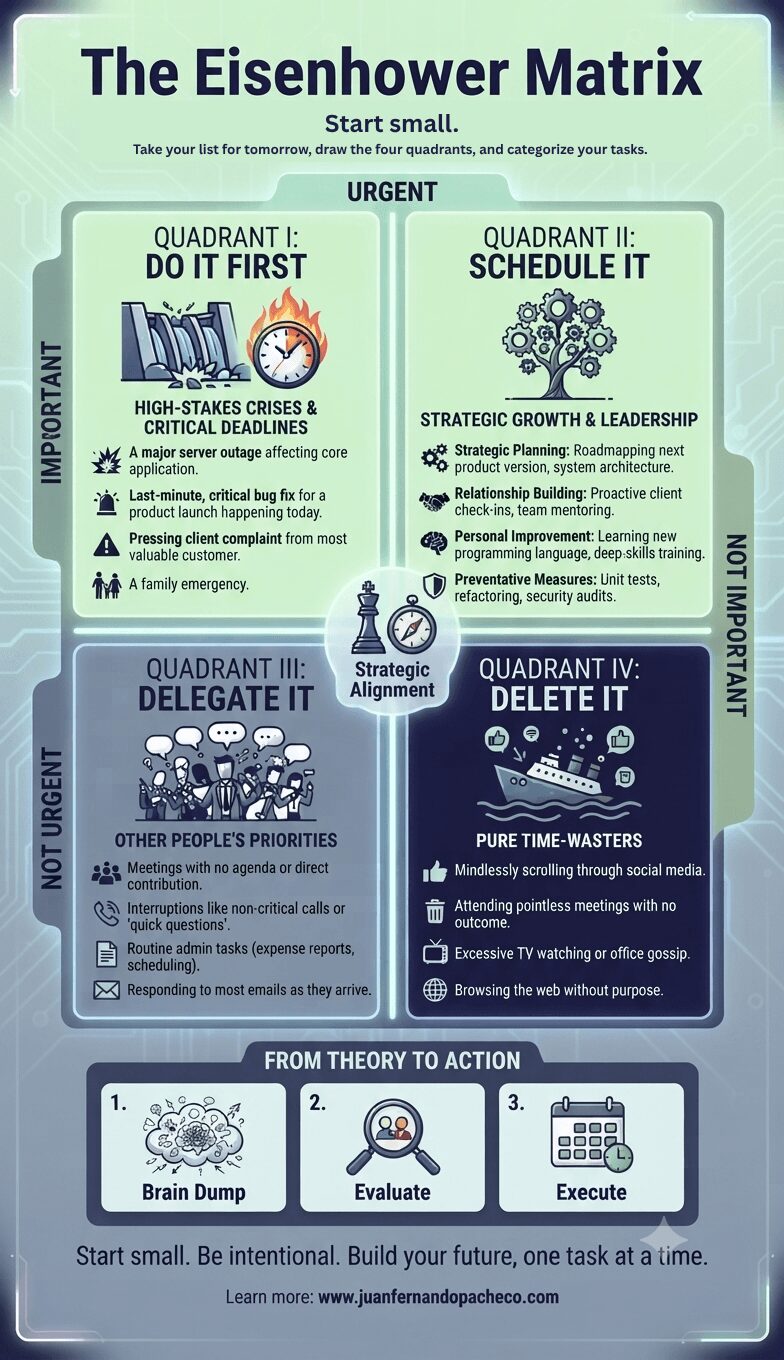
An infographic titled 'The Eisenhower Matrix' deconstructing a productivity framework. A large 2x2 grid is divided by axes labeled 'Urgent', 'Not Urgent', 'Important', and 'Not Important'. Quadrant I (Urgent/Important, top-left) is 'Do It First' with icons of a breaking dam and fire. Quadrant II (Not Urgent/Important, top-right) is 'Schedule It' with a growing tree and gears. Quadrant III (Urgent/Not Important, bottom-left) is 'Delegate It' with a group of people. Quadrant IV (Not Urgent/Not Important, bottom-right) is 'Delete It' with a sinking ship. Below the matrix, a three-step process ('Brain Dump', 'Evaluate', 'Execute') shows how to apply the method. The bottom of the image includes the URL www.juanfernandopacheco.com.

The Eisenhower Matrix is more than a productivity hack; it is a philosophy of intentional living. It teaches us to be the architects of our time rather than the tenants of other people’s urgency. By consistently asking, “Is this important?” we align our daily actions with our long-term vision.

The goal is not to achieve a perfect, static state where no emergencies exist. The goal is to cultivate the habit of discernment—to spend more of our precious time in Quadrant II, building a meaningful future, one scheduled, important task at a time.

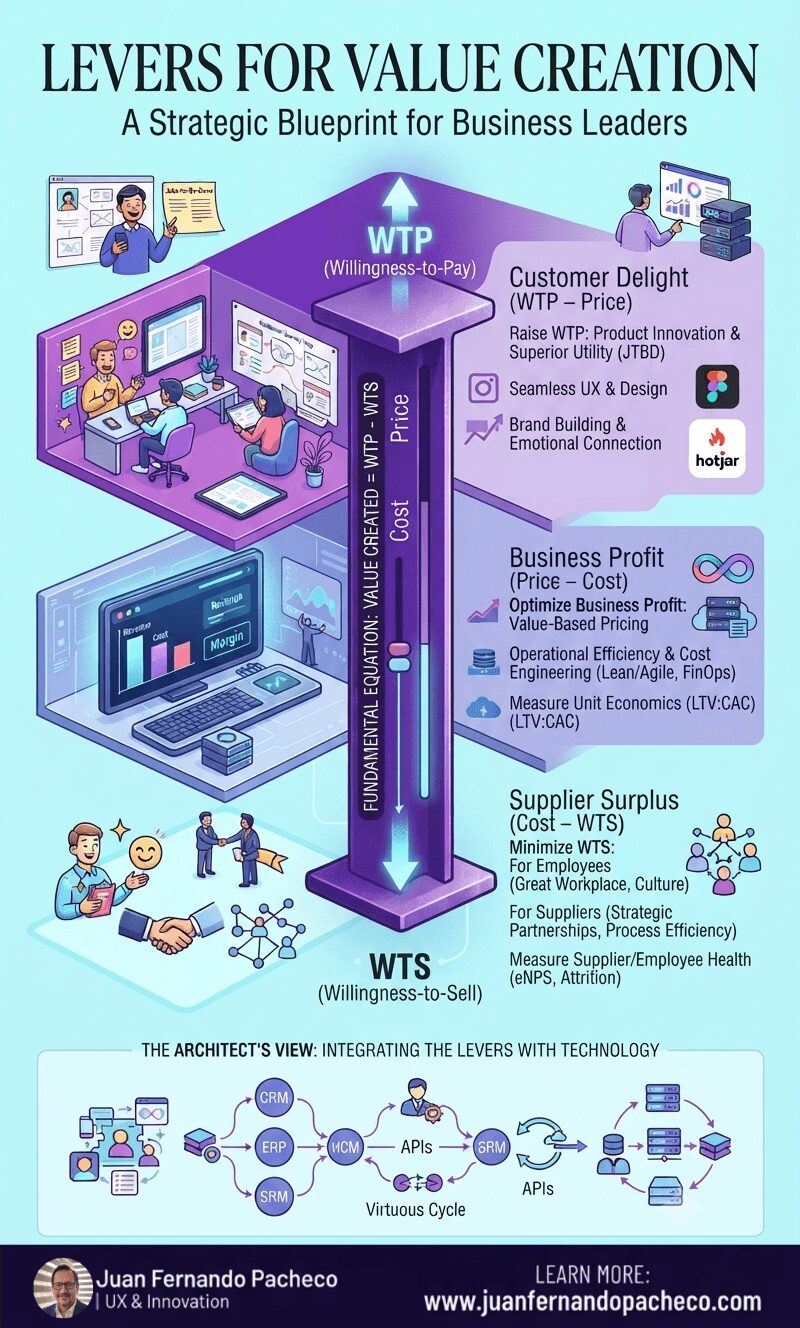
Infographic illustrating the "Levers for Value Creation" framework by Juan Fernando Pacheco, using a central "Value Stick" with WTP and WTS, surrounded by interconnected illustrated sections on Customer Delight, Business Profit, and Supplier Surplus, and an architectural view of technology integration.

The Value Stick is more than a diagram; it is a mindset. It forces a holistic view of your business ecosystem. You cannot win by delighting customers while exploiting employees. You cannot sustain profit by cutting costs without regard for the value you destroy.

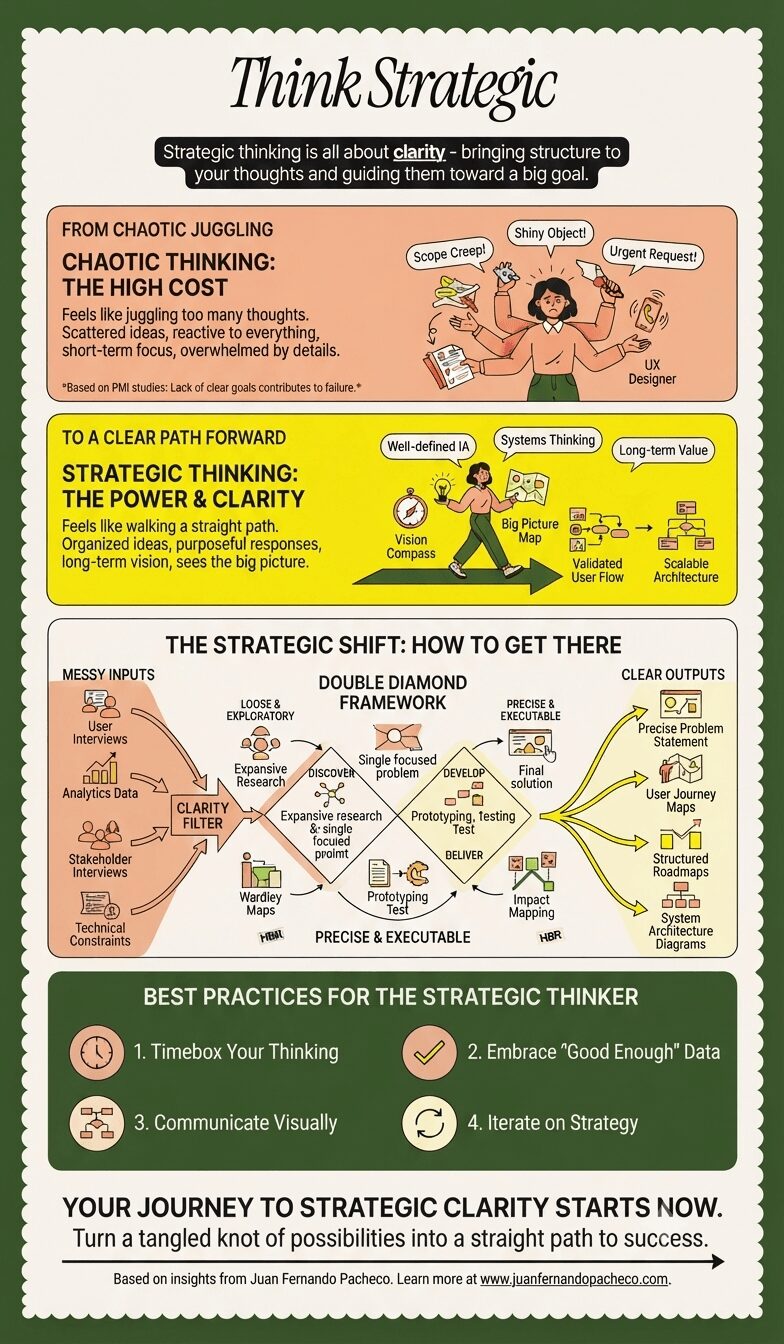
An infographic titled "Think Strategic" featuring an olive green background, illustrating the transition from messy, reactive thinking to structured strategic clarity using the Double Diamond framework and best practices for global digital products.

The journey from messy to clear thinking is a discipline. It’s a commitment to moving beyond the comfortable chaos of reaction and into the disciplined clarity of purpose. It’s the difference between juggling blindly and walking purposefully toward a known destination.

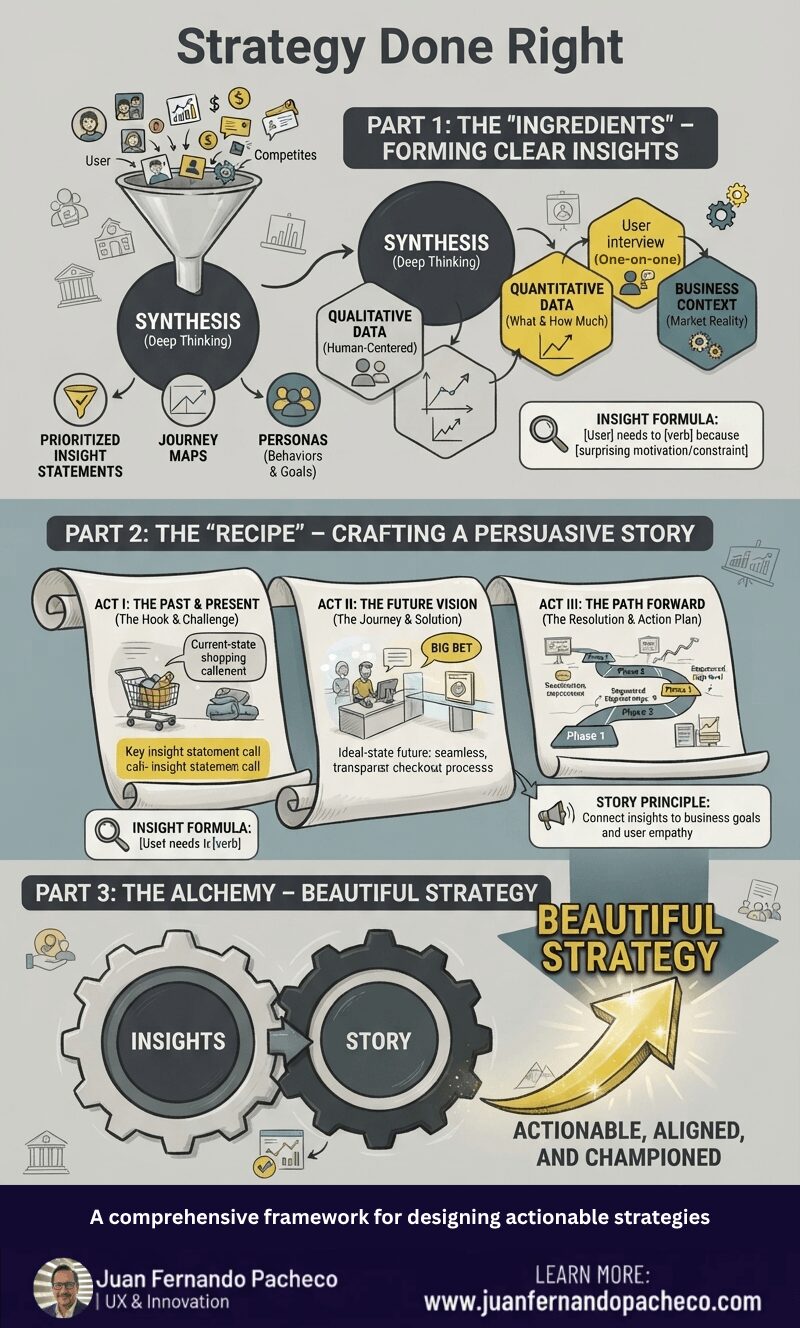
An infographic titled "Strategy Done Right," presented in three main sections on a grey background. Part 1: "The Ingredients" shows a funnel collecting data (user, competitors, analytics) leading to "Synthesis," resulting in insights, journey maps, and personas. Part 2: "The Recipe" displays three scroll icons representing Act I: The Past & Present, Act II: The Future Vision, and Act III: The Path Forward, detailing the narrative flow. Part 3: "The Alchemy" features interlocking gears labeled "Insights" and "Story," with an arrow pointing to "Beautiful Strategy" and the description "Actionable, Aligned, and Championed." The bottom banner reads "Strategy as a Craft" and "www.juanfernandopacheco.com."

Strategy is the compelling story that explains why those steps are necessary and how they lead to victory. It is the bridge between the current reality and a desired future.

The framework in this post encapsulates this perfectly:

Beautiful Strategy emerges from the alchemy of Clear Insights and a Persuasive Story.

Think of insights as your raw “ingredients” and the story as your “strategy recipe.”

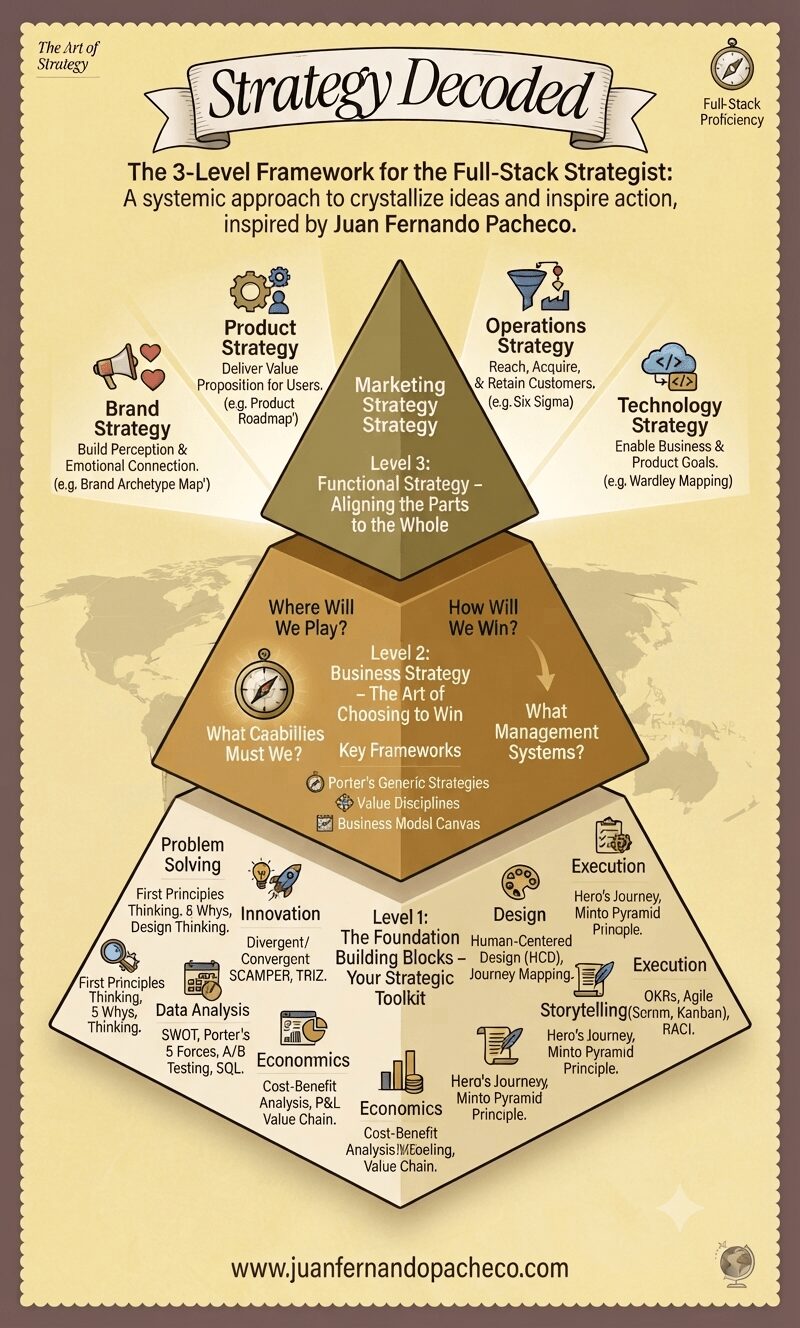
An infographic titled "Strategy Decoded" illustrating a 3-level framework for full-stack strategists, featuring Level 1 (Foundation Building Blocks), Level 2 (Business Strategy), and Level 3 (Functional Strategy) against a cream and warm earth-tone background with the URL www.juanfernandopacheco.com at the bottom.

Becoming a full-stack strategist is a journey.

Start by auditing your proficiency in the seven building blocks. Where are you strong? Where do you need improvement?
Then, practice articulating the business strategy for your team or company—even if it’s not your official job.
Finally, constantly scrutinize your functional work (whether in design, tech, product, or marketing) and ask: “Does this truly ladder up to how we’ve chosen to win?”

An educational infographic with a modern, illustrated aesthetic, structured into six sections with a teal and earth-tone color palette. It defines ecosystem thinking in UX design, dispels misconceptions, compares it to service design, provides a detailed home-buying example, outlines how to draw maps, lists strategic frameworks, and includes best practices and the website www.juanfernandopacheco.com.

The future of UX design is not in crafting perfect, isolated interactions. It is in designing intelligent, adaptive, and respectful nodes within a vast and complex human ecosystem. It requires us to be not just designers, but strategists, systems thinkers, and diplomats who can navigate the relationships between services, businesses, and most importantly, people.

By adopting ecosystem thinking, we move from creating products that people use to crafting environments that people live in. We stop building features and start building worlds. The map is the first step. It’s time to start charting.