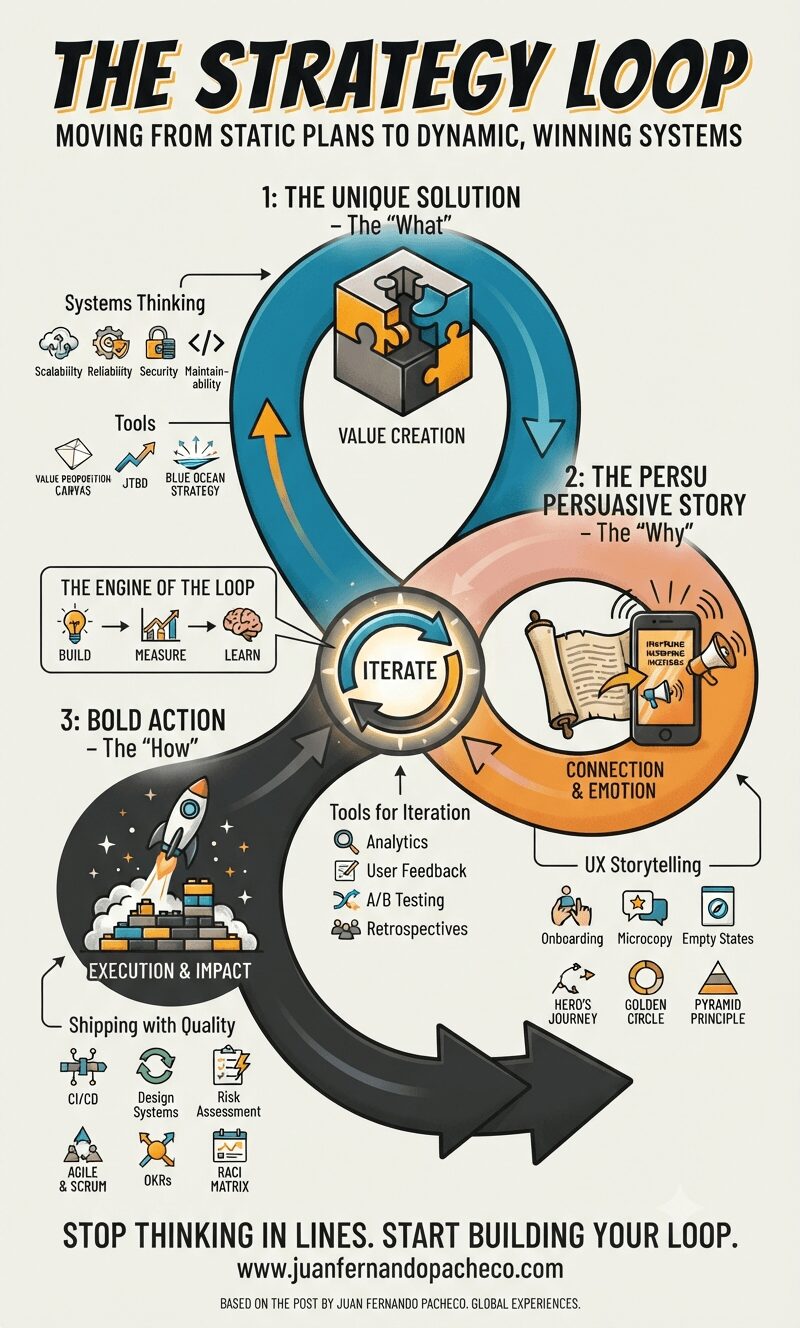
An infographic titled "The Strategy Loop" illustrating a dynamic, three-part cycle for business strategy. The teal loop at the top is "1: The Unique Solution - The What," showing puzzle pieces and value creation. The orange loop on the right is "2: The Persu Persuasive Story - The Why," showing a scroll, smartphone, and megaphone. The dark gray loop at the bottom is "3: Bold Action - The How," showing a rocket launching. In the center, a central hub labeled "Iterate" connects the cycle, supported by "The Engine of the Loop" (Build-Measure-Learn) and specific tools for each phase. The bottom text reads: "Stop thinking in lines. Start building your loop. www.juanfernandopacheco.com."

The Strategy Loop transforms strategy from a static document owned by a few executives into a dynamic, living system that empowers the entire organization. It aligns the logical rigor of the solutions architect with the empathetic, human-centered focus of the UX designer.

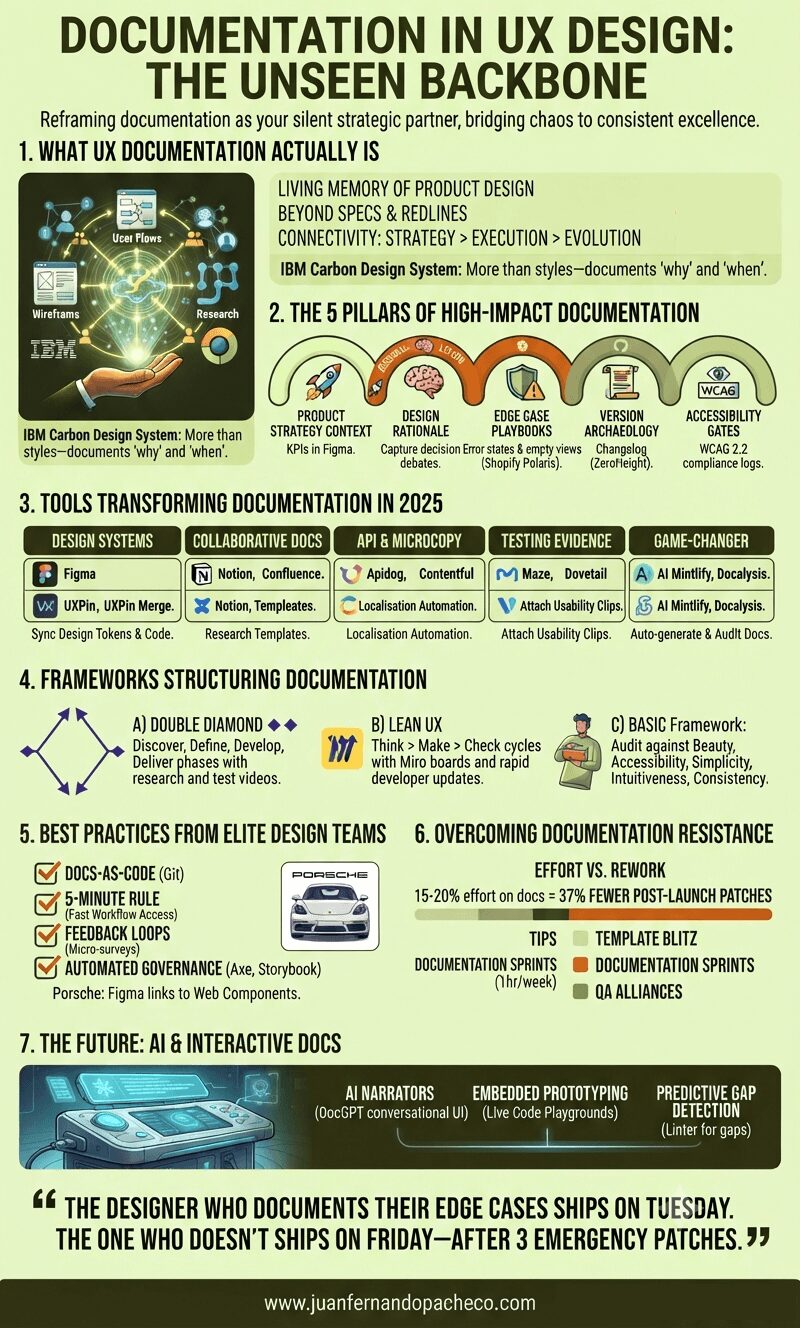
An infographic titled "Documentation in UX Design: The Unseen Backbone" is presented in a vertical format against a light-yellow background. It is structured into seven numbered sections that detail the components, pillars, tools, frameworks, best practices, overcoming resistance, and future of UX documentation, using a color palette of greens, orange, and white.

Treating documentation as a “task” misses its power. It’s the continuous act of design reasoning made visible. As Apple’s Human Interface Guidelines reveal, legendary products emerge when principles are documented, not memorized.

“The designer who documents their edge cases ships on Tuesday. The one who doesn’t ships on Friday—after 3 emergency patches.”

Start small: Document one decision today. Link a research insight to a button component. Your future self—and team—will thank you.