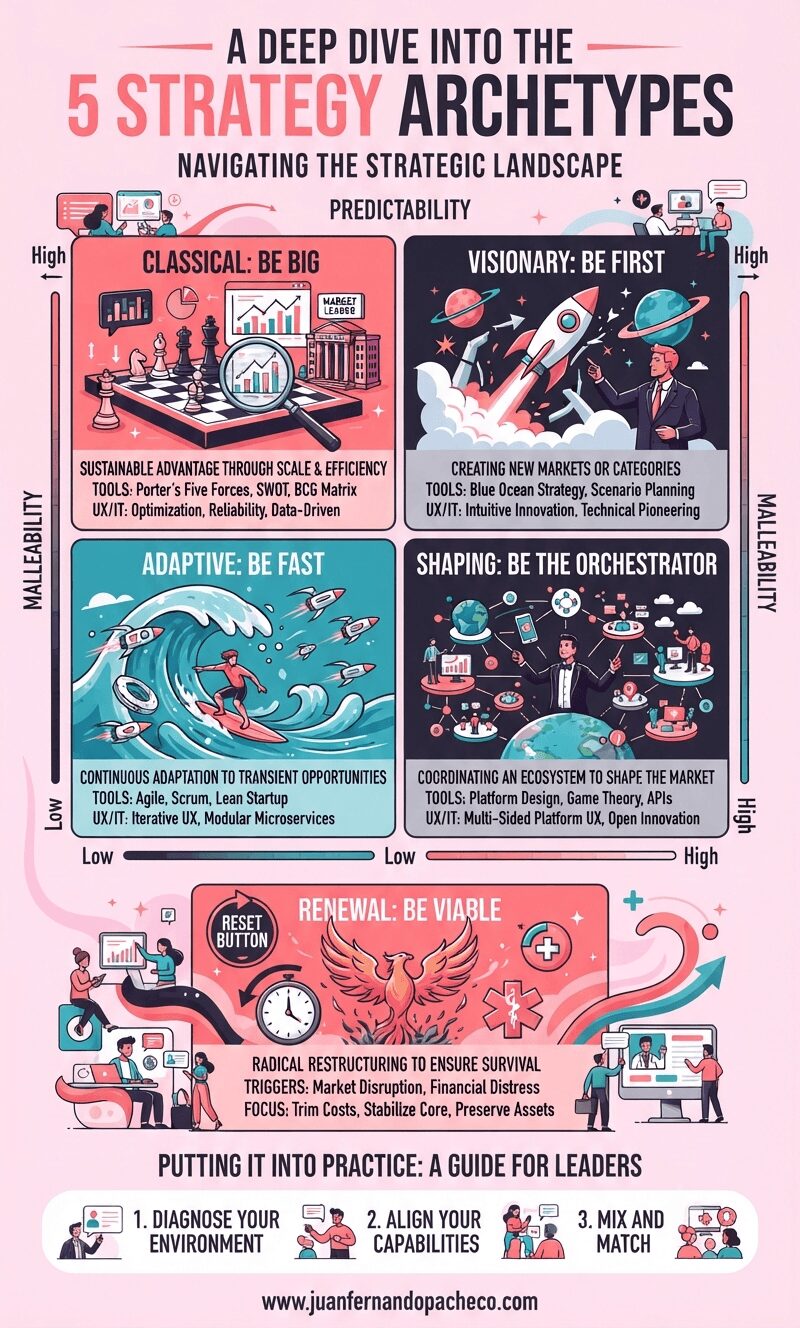
An infographic titled "A Deep Dive into the 5 Strategy Archetypes" visualizing five strategic approaches—Classical, Visionary, Adaptive, Shaping, and Renewal—mapped against the axes of Predictability and Malleability. The graphic uses a pink and blue color scheme with illustrations like a chessboard, a rocket ship, a surfer, a conductor, and a phoenix.

The greatest risk in strategy is complacency—the unconscious application of a default approach. The framework of the five archetypes empowers us to move from a reactive stance to a proactive one. It provides a language to debate not just what we are doing, but why we are doing it and how it matches the world we operate in.

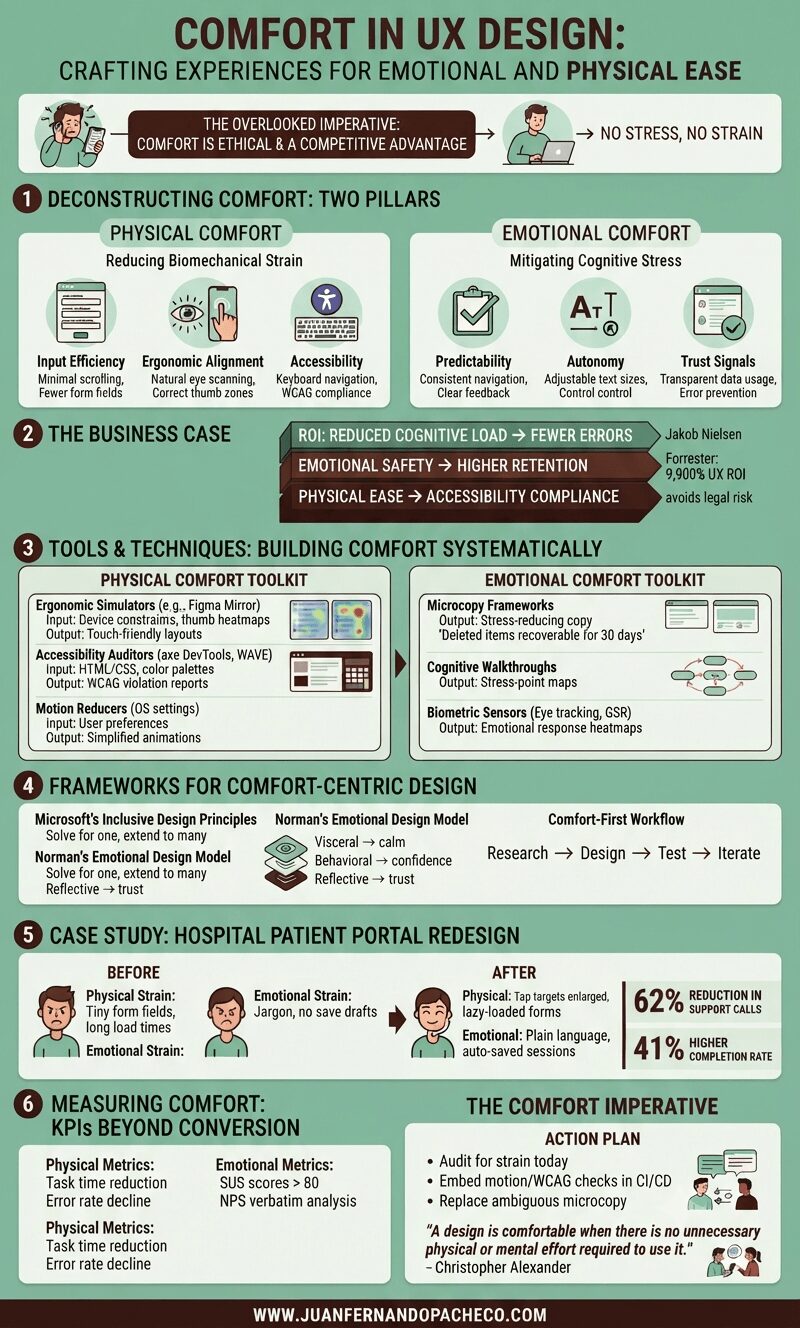
A detailed infographic titled "Comfort in UX Design" with a green background, broken into six main sections: Deconstructing Comfort, The Business Case, Tools & Techniques, Frameworks, a Case Study, and Measuring Comfort. It uses icons, charts, and text to explain how to design for physical and emotional ease, citing principles from Nielsen, Forrester, Microsoft, and Don Norman.

Comfort in UX design—defined as creating experiences with no stress, no strain—isn’t a luxury; it’s an ethical imperative and competitive advantage. Yet, it remains chronically undervalued.

As both a UX designer and solutions architect, I’ve seen how discomfort manifests: from RSI-inducing enterprise tools to anxiety-triggering checkout flows.