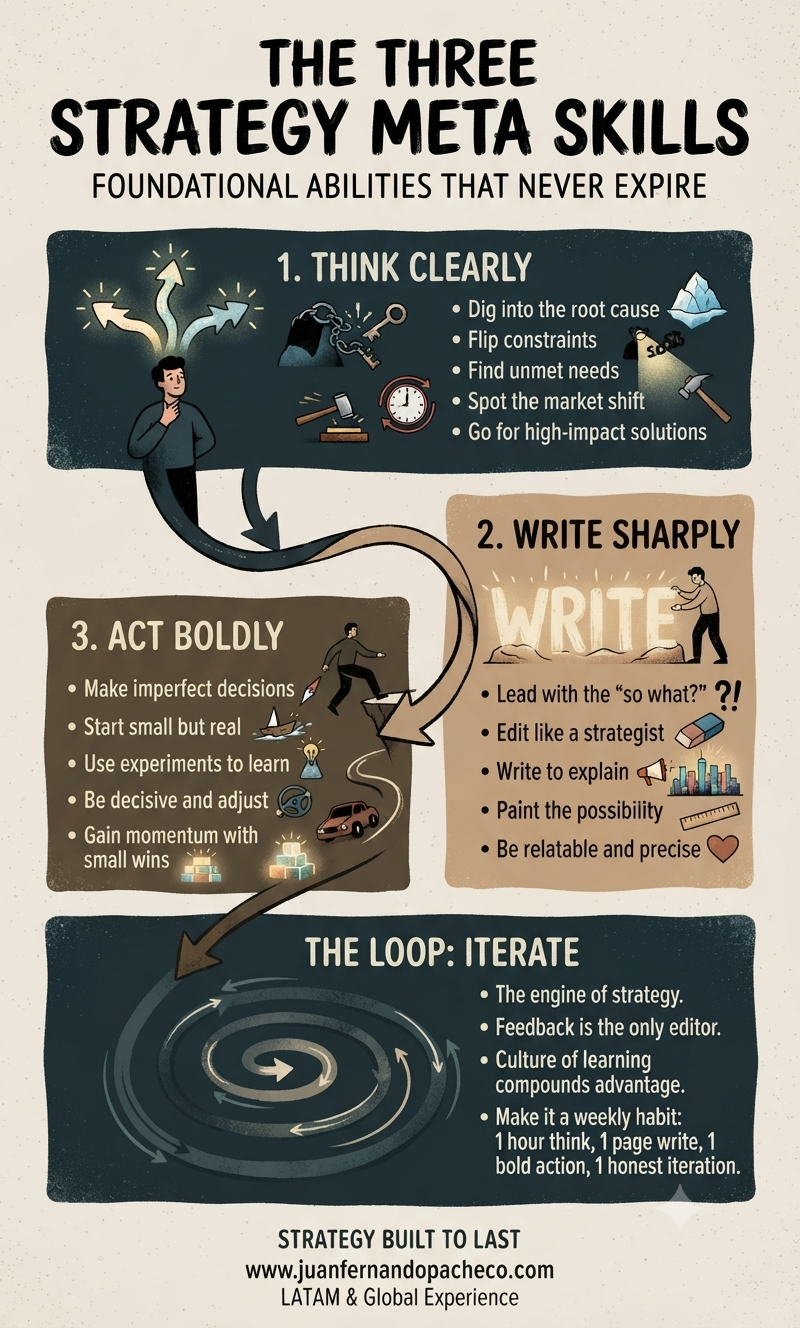
The three strategy meta skills that never expire
Every year, companies across Latin America and everywhere else spend thousands of hours on strategy. They build the decks, run the workshops, hire the consultants. And yet, most of that work dies quietly in a shared drive. The problem is rarely a lack of intelligence or effort.
The problem is that we treat strategy as an event instead of a discipline, and we invest in tools before we invest in the underlying abilities that make those tools useful.
After more than twenty years of designing products, architecting solutions, and leading complex deals in banking and finance across Latin America, I have come to believe that strategy boils down to a small set of foundational abilities.
Call them strategy meta skills.
A simple, quick guide I keep coming back to – think clearly, write sharply, act boldly, then iterate – captures this better than most textbooks. Everything else- the frameworks, the canvases, the market models- sits on top of these abilities. When they are strong, even simple frameworks produce good decisions. When they are weak, even the most sophisticated analysis produces noise.
The good news is that these skills do not expire.
Markets change, technologies change, organizations change, but the ability to think clearly, write sharply, and act boldly is as useful today as it will be in five or ten years. That is what makes them evergreen. Let me walk you through each one and how they connect into a loop that compounds.
Meta skill 1: think clearly, because strategy is the art of making choices
The first strategy meta skill is clear thinking, and its output is choices.
A strategy that does not force a choice is not a strategy; it is a wish list. If we say yes to everything – every segment, every feature, every client request – we have said yes to nothing in particular, and the organization spreads itself thin across too many fronts.
Clear thinking in strategy means asking a small number of uncomfortable questions until the real problem surfaces.
Dig into the root cause.
What is really going on here? In complex deals, clients rarely state their true constraint in the first meeting. A bank may ask for a cheaper platform when the real issue is regulatory exposure, or a retailer may request more features when the real pain is time to market. The same happens inside companies: declining revenue is usually a symptom, and the root cause may be an outdated value proposition. Until we separate symptom from cause, any solution we design will be aimed at the wrong target.
Look for constraints you can flip into strengths.
Every market has constraints – regulation, infrastructure, talent, budget. In Latin America, we live with constraints that outsiders see as obstacles: data sovereignty rules, local compliance policies, fragmented payment ecosystems. But a constraint understood deeply is a source of advantage, because it also limits your competitors. The team that designs for the constraint from day one wins against the team that treats it as an afterthought.
Look for unmet needs that competitors are ignoring.
Markets are full of served customers and underserved needs. The most durable openings appear where every competitor is fighting for the same obvious segment while a quieter group of users is being overlooked. In product work, some of the best opportunities I have seen came from listening to the users nobody designed for: the branch operator, the back-office analyst, the customer with an old phone and a slow connection.
Spot the shift.
What changed in the market that creates a new opening? Strategy is always played on a moving board. A regulatory change, a technology that became cheap enough, a competitor exiting a segment – these shifts redraw the map. The question is not whether the market changed; it is whether we noticed the change early enough to act on it.
Go for high-impact solutions, not incremental fixes.
Once the root cause is clear, resist the temptation to patch it with small tweaks. Incremental fixes feel safe, but they rarely change the trajectory of a business. A high-impact solution attacks the cause directly and creates a meaningful gap between you and the alternatives.
Notice what all five of these moves have in common
They force a choice.
- Choose the real problem,
- Choose the constraint to exploit,
- Choose the need to serve,
- Choose the shift to ride,
- Choose the bold solution.
Thinking clearly is not about having more information; it is about making better choices with the information you have.
Meta skill 2: write sharply, because writing reveals the gaps in your thinking
The second strategy meta skill is sharp writing.
Many leaders treat writing as packaging – something you do after the thinking is done. In practice, writing is the thinking. A strategy that cannot be written clearly has not been thought through clearly. The page is merciless: it exposes every gap, every circular argument, every assumption that nobody examined.
This is painfully visible in proposal work. An RFP response is a strategy document in disguise. It forces you to choose what to emphasize, what to concede, and what value you actually create. The teams that write sharply win more than their share of deals, not because they have better slides, but because their logic survives contact with a skeptical reader.
Lead with the “so what?”
Every reader, from a board member to a procurement officer, is silently asking one question: so what? Why does this matter to me? If the first page of a document does not answer it, the rest fights an uphill battle. Start with the conclusion, then support it. The context can come later; the relevance must come first.
Edit like a strategist.
Remove fluff, add precision. Every unnecessary sentence dilutes the ones that matter. Precision is a sign of respect for the reader and of confidence in the idea. Instead of “we will improve performance significantly,” write “we will cut response time from four seconds to under one.” Precise claims can be discussed, challenged, and believed. Vague claims can only be ignored.
Write to explain, not to impress.
Jargon and buzzwords are usually a mask for unclear thinking. If an idea cannot survive being translated into plain language, it is not strong enough to survive execution. The test I use is simple: would a smart colleague outside my industry understand this paragraph on the first read? If not, the paragraph needs another pass.
Paint the possibility
What does success look like, and what is it worth? People commit to strategies when they can see the destination. A sharp strategy document describes the future state in concrete terms – the uptime, the adoption rate, the resolution time, the revenue line – so that everyone can measure whether they are getting there.
Describe the value of your choices clearly, and make it relatable.
Every choice has a cost, and pretending otherwise destroys credibility. State what you will do, what you will deliberately not do, and why the trade-off is worth it. Then say it in clear outcomes and simple language, so that the person who approves the strategy and the person who executes it hear the same message.
Writing sharply is not a cosmetic skill
It is how a strategy becomes shareable, debatable, and executable. A clearly written strategy travels through an organization without losing its shape. A vaguely written one mutates into a different project in every department.
Meta skill 3: act boldly, because execution is the advantage
The third strategy meta skill is bold action.
Most organizations do not fail because they lack strategy; they fail because strategy and execution live in separate worlds. The plan is approved, the applause ends, and then nothing changes. The leaders who win treat execution as part of the strategy, not as the step after it.
Make a decision even when the data is not perfect
Waiting for complete information is a decision too – usually the decision to be late. In fast-moving markets, a good decision made today beats a perfect decision made next quarter. The discipline is to know which decisions are reversible and which are not. Reversible decisions should be made quickly and corrected in motion; only the truly irreversible ones deserve long deliberation.
Start small but real
Ship version one, not the perfect version. A small, live version of your strategy teaches you more than a large, hypothetical one. In product work, this is the difference between debating features for months and putting a minimum viable product in front of real users in weeks. The first version will be incomplete by design; its job is not to be perfect, but to be true.
Use experiments to learn fast and confirm your beliefs
Every strategy rests on assumptions – about customers, pricing, channels, capabilities. An experiment converts an assumption into evidence: a pilot with one branch, one client, one segment; a time-boxed proof of concept. In my own experience, streamlining how we build and run proofs of concept cut customer request resolution time by about thirty percent, not because the technology changed, but because the loop between hypothesis and evidence got shorter.
Do not wait for certainty; act decisively and adjust as you go
Certainty in a complex market is an illusion. The organizations that perform well are not the ones that predict the future best; they are the ones that detect error fastest and correct it cheapest. Decisiveness, followed by honest adjustment, beats hesitation followed by excuses.
Gain momentum with small wins
Bold does not mean reckless. A strategy that produces visible early wins earns the political and emotional capital it needs for the bigger moves. Small wins are not a compromise of ambition; they are the financing mechanism of ambition. They prove the direction, train the team, and quiet the skeptics long enough for the compounding to start.
Acting boldly, in short, is how a strategy becomes a fact on the ground. Thinking clearly chooses the direction. Writing sharply makes it shareable. Acting boldly makes it real.
The loop: iterate, because strategy is never finished
The three strategy meta skills do not run once in a straight line; they run in a loop. You think, you write, you act – and then you get real feedback, learn, adjust, and go again. Iteration is not a fourth skill; it is the rhythm that keeps the other three honest.
Feedback from the market is the only editor that never flatters you.
A choice that looked brilliant on paper can be wrong in practice, and the loop is what catches the error before it becomes a catastrophe. This is why strategy should be reviewed on a cadence – quarterly, monthly, or weekly depending on the speed of your business – not as a ritual of reporting, but as a ritual of learning. What did we believe? What did reality say? What will we change next?
Over years, this loop compounds.
Teams that iterate build a culture where being wrong early is cheap and being right gradually is normal. That culture, more than any single plan, is the durable advantage.
Making the strategy meta skills a weekly habit
Skills only matter if they become habits. A simple, evergreen weekly practice is enough to keep all three meta skills alive:
- One hour of clear thinking: pick the most important open question in your business and write down the root cause, the constraint you can flip, the unmet need, the shift, and one high-impact option.
- One page of sharp writing: summarize your current strategy in a single page that leads with the “so what?”, states the value in precise numbers, and names what you will not do.
- One bold action: take one reversible decision, ship one small version, or run one experiment this week.
- One honest iteration: compare last week’s belief with this week’s evidence, and adjust one thing.
That is the whole system. No new framework required, no expensive tooling, no seasonal trend to follow. That is exactly why it will still work when you reread this in five years.
Final thought: an advantage that never expires
Strategy will keep changing on its surfaces – the markets, the technologies, the channels. But its engine stays the same: choices made with clarity, expressed with precision, and executed with courage.
If you invest in the strategy meta-skills of thinking clearly, writing sharply, and acting boldly, and you close the loop with honest iteration, you own an advantage that no competitor can copy quickly, because it is built one decision, one page, and one experiment at a time.
That is the kind of advantage worth building. And it never expires.

![An infographic titled "The Point of View Strategy Formula" on a light green background, illustrating a three-step process of Insight, Action, and Outcome. The Insight section shows an iceberg labeled "HUMAN TRUTH," the Action section shows a gear mechanism, and the Outcome section shows an upward-trending graph with a rocket. Below the steps, the formula reads: "This [key insight] means we should do [action] and it will create [outcome]." It includes sections on "Common Shallow Traps to Avoid" and "Case Examples" for a Designer, Business Developer, and Career Manager. The footer contains the URL "www.juanfernandopacheco.com".](https://juanfernandopacheco.com/wp-content/uploads/2026/08/The-Point-of-View-POV-Strategy-Formula-Infographic.png)