Six fixes that work in any room
I have watched a senior solution architect freeze in front of an evaluation committee; he knew every number in a nine-figure proposal. Yet his voice shook when he stood to present it, and the committee never saw his expertise; what they saw was a nervous man reading slides.
That gap between what you know and what the room perceives is where the fear of public speaking lives. It follows competent people into bid defenses, product demos, design critiques, and board updates. This fear ignores your title, your tenure, and your track record.
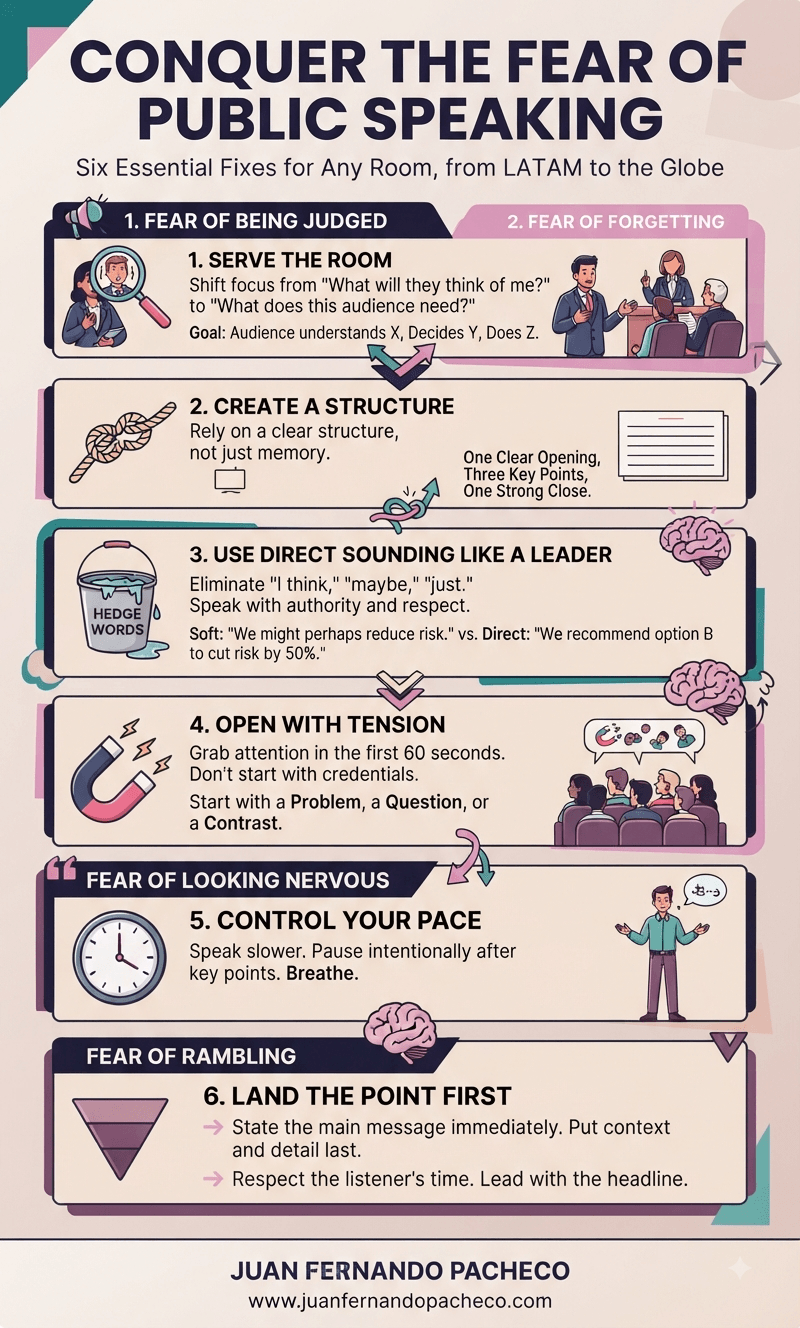
After two decades in product design and commercial leadership, I see the same pattern in every market I serve. People treat public speaking as one big monster, so they prepare with vague hope instead of a plan. The monster shrinks when you cut it into pieces, and a simple map does exactly that:
it names six specific fears and answers each one with a concrete fix.
Let me walk through all six the way I would coach a deal team the night before a high-stakes presentation.
The six fears behind one fear
Public speaking rarely fails for a single reason
Several small fears feed each other inside you, and one of them is that you worry about judgment, so you rush. Rushing makes you ramble. Rambling lets the room drift. Naming each fear breaks the loop.
Read the six sections in order the first time
After that first reading, jump straight to the fear you feel most often before a big talk. Each section ends with a two-minute drill, so the post works as a coaching tool, not just an essay.
Share it with your deal team, your design team, or your kids before a class presentation. The fixes hold up in any room.
1. Fear of being judged — fix: serve the room
Most speakers walk in asking the wrong question: “What will they think of me?” The room hears that question in every apologetic phrase; now flip it. Ask a better question:
“What does this audience need to understand, decide, or do next?”
Service kills self-consciousness.
This shift changed my career twice
As a young UX designer, I took design critiques as personal verdicts. However, my work improved the day I started presenting for the user instead of for my ego. The same logic runs through enterprise sales; an evaluation committee does not gather to grade your style. They gather to decide under pressure, and your job is to lower the cost of that decision.
Write one sentence before you build a single slide:
“After this talk, my audience will understand X, decide Y, and do Z.”
Read it aloud before you enter the room, and when anxiety spikes, return to that sentence. You are not the subject of the meeting; the audience is.
Field note: I opened a bid defense in Lima with “You are here to decide, and we built today to make that decision easy.” The room relaxed, and so did I.
Drill: rewrite your next opening line from “I am here to present” to “You are here to decide.” Feel the difference.
2. Fear of forgetting what to say — fix: create a structure
Memory is the first casualty of stress
Adrenaline narrows focus and blanks recall. So stop relying on memory and rely on structure instead; the fix to this is brutally simple:
Prepare one clear opening, three key points, and one closing line
Three points, not seven
Working memory holds only a handful of chunks, and a nervous speaker holds fewer. Three points give your audience a map and give you a rope, and if you lose your place mid-sentence, the structure catches you. You simply ask which of your three points comes next, and the answer is always obvious.
I force every deal presentation into this shape
I open with the business problem in the customer’s own words. Then I cover three things:
- What we will do,
- How we will de-risk it, and
- What it costs versus what it returns.
I close with the exact next step we want from the room. Everything else goes to the appendix.
Your closing line deserves the same care as your opening
Write it word for word and memorize it. A planned last sentence lets you finish strong even when the middle gets messy.
Field note: A colleague kept a structure card taped inside his laptop lid. Reviewers changed the agenda twice; the card never changed, and neither did his message.
Drill: summarize your next talk on one index card — opening line, three points, closing line. If it does not fit on the card, it does not fit in the room.
3. Fear of not sounding like a leader — fix: use direct language
Hedge words leak authority
Phrases like “I think,” “maybe,” “we feel,” and “just” each buy a gram of safety and cost a kilo of credibility. Listeners equate clarity with competence, and direct language is not aggression; it is respect: you state what matters and why, without making anyone dig for it.
Compare two sentences
- Soft version: “We feel option B might possible reduce risk a bit.”
- Direct version: “We recommend option B because it cuts delivery risk in half.”
Same information, opposite weight. The soft sentence protects the speaker, while the direct one serves the decision.
Direct language shaped my design years too
A plain claim like “this flow confuses new users” beats a soft guess about some users. In commercial work, the stakes rise. A CIO hears hedging as doubt about your own proposal, then discounts your price and your promises.
Audit your script before every important talk
Highlight every hedge word, delete half on the first pass, and delete half again on the second. Replace softeners with grounded statements: numbers, comparisons, recommendations, reasons. Keep the word “because” close to every claim.
Field note: We rewrote a proposal executive summary with zero hedges. The client’s procurement lead later quoted our own sentences back to us during the negotiation.
Drill: record yourself for two minutes and count the hedges. Repeat the take with zero hedges, and notice how much taller you sound.
4. Fear of losing the room — fix: open with tension
Attention does not arrive for free; the first sixty seconds earn it
A room drifts when it feels no stake in your story. Open with tension, and start with a problem, a question, or a contrast that makes people want the answer. Tension creates an open loop, and human brains hate open loops.
Three openings from real deal rooms
- Problem: “This project is six weeks behind, and the root cause hides in a contract clause nobody reads.”
- Question: “What would you cut first if your budget fell by thirty percent tomorrow?”
- Contrast: “You invited a vendor to this meeting; we came to ask for a partnership.”
Each hook lands before a single slide appears.
Stories obey the same rule
A story without tension is a report. Put the obstacle early, and the room leans in for the resolution.
Beware the classic mistake here. Speakers open with credentials, agenda slides, or an apology about time; all three spend tension instead of building it. Your title slide can wait thirty seconds; your hook cannot.
Field note: Some time ago, a client partner checked his phone during the agenda slide. The next session opened with “Your biggest competitor already runs this model,” and the phone never came out again.
Drill: draft three openings for your next talk — one problem, one question, one contrast. Test them on a colleague, and keep the one that produces the fastest “wait, what?”
5. Fear of looking nervous — fix: control your pace
Nervous energy hides fairly well until speed betrays it
Fast speech, fast clicks, fast pacing across the floor — the room reads all of it as anxiety. So control the pace. Slow down. Pause after important points, and let the silence work for you.
Silence feels like failure to the speaker and like weight to the audience
A two-second pause after a key number tells the room that the number mattered; it also gives you a breath and a moment to think. Audiences never complain that a speaker paused too much; they complain about speakers who sprint.
Pull three practical levers
Plant both feet before your first sentence, and breathe out slowly before you speak. Mark pause points in your notes with a big slash, and honor every slash. When a tough question lands, pause before answering; the pause reads as thought, not weakness.
I also coach deal teams to assign a pace keeper. One colleague watches the clock and signals “slow down” with a pen tap. The trick works under adrenaline because it outsources the monitoring.
Field note: A nervous presenter on my team rehearsed at half speed for a week. Executives later described his delivery as “calm and deliberate.” He felt like he was swimming in syrup.
Drill: rehearse your opening twice. Run it once at normal speed, then once at half speed. The half-speed run will feel absurdly slow, and to the room it will feel like command.
6. Fear of rambling — fix: land the point first
Rambling is fear with the volume up
You add context because the main point feels exposed, and yet context before the point forces listeners to hold loose threads while they guess your destination. Executives punish that habit quickly. Say the main message first, then give context or detail. Lead with the headline, then support it.
Three traditions land on the same rule
- Journalists call it the inverted pyramid
- Consultants call it top-down thinking
- Military planners call it bottom line up front
All of them respect the listener’s time, and when the point arrives first, everything after it sounds like evidence; arriving last makes everything before it sound like noise.
Watch this pattern in Q&A sessions too, and a long preamble before an answer signals evasion, even when none exists. Answer in one sentence, then add the reasoning.
Apply the habit at the slide level as well. Write each slide title as a full-sentence claim. Replace “Q3 update” with “Q3 pipeline grew twenty percent on two enterprise wins.” Claim-first slides remove rambling at the source, because the slide itself states the point.
Field note: Our last RFx executive summary led with the recommendation on page one. The evaluation chair thanked us for “the only proposal that said what it wanted.”
Drill: take any paragraph from your next script and move its last sentence to the front. Read both versions aloud, and keep the version that lands first.
A practice routine that stays with you
Fear never fully disappears, and it does not need to
Energy and fear share the same fuel, and structure converts one into the other. Here is the routine I have used for years; it works the same in any language or market.
- Three days out, finalize the structure card: opening, three points, closing line
- Two days out, rehearse aloud twice, standing, at half speed, with pauses marked
- One day out, rehearse once more, then stop
- On the morning of the talk, say the opening and the closing aloud once, and put the notes away.
Rehearse transitions more than content. Content fails rarely; transitions fail often. Say each bridge sentence aloud: “That covers cost, which brings us to risk.” Smooth bridges make the whole talk feel inevitable.
Why this skill compounds
Public speaking is a revenue skill, a design skill, and a leadership skill wearing a costume.
- A clear presenter makes a proposal look de-risked.
- Structured demos make products look simple.
- Direct answers make leaders look steady.
In relationship-driven markets across Latin America and everywhere else, the room reads clarity as credibility, and credibility closes.
Every fix above also improves your thinking, not just your delivery. Service framing sharpens strategy. The three-point rule sharpens proposals. Direct language sharpens negotiation. You are not learning to perform; you are learning to lead in real time.
Closing thought
You will probably feel nervous before your next important talk. Good. It means the room matters. Serve the room, trust your structure, speak directly, open with tension, control your pace, and land the point first. The fear stays, but it stops driving the car.
Web references
- Chris Anderson, “How to give a killer presentation,” Harvard Business Review
- “To overcome your fear of public speaking, stop thinking about yourself,” Harvard Business Review — https://hbr.org/2019/09/to-overcome-your-fear-of-public-speaking-stop-thinking-about-yourself
- Julian Treasure, “How to speak so that people want to listen,” TED — https://www.ted.com/talks/julian_treasure_how_to_speak_so_that_people_want_to_listen
- “Fear of public speaking: how can I overcome it?” Mayo Clinic — https://www.mayoclinic.org/diseases-conditions/specific-phobias/expert-answers/fear-of-public-speaking/faq-20058416
Books that reinforce this post
- Nancy Duarte, “Resonate“
- Carmine Gallo, “Talk like TED”
- Scott Berkun, “Confessions of a Public Speaker”
- Barbara Minto, “The Pyramid Principle“
- Dale Carnegie, “The quick and easy way to effective speaking“