Content marketing: an evergreen playbook
Buyers changed the rules long ago
They now research in private before calling any vendor. Most arrive at your sales team already half-decided, and that quiet research phase decides the deal. That shift turned content marketing into a core commercial skill, and it is not a side project for the social team. This is how a brand earns trust at scale.
I learned the lesson over twenty years in technology revenue. Deal shapes differed in every country, and the human behavior behind them stayed the same. Prospects reward the company that teaches something useful, and they also ignore the company that only shouts.
This guide is for founders, marketers, and commercial leaders. It assumes no budget for big agencies, and you only need one useful piece per week. Everything else is order and patience.
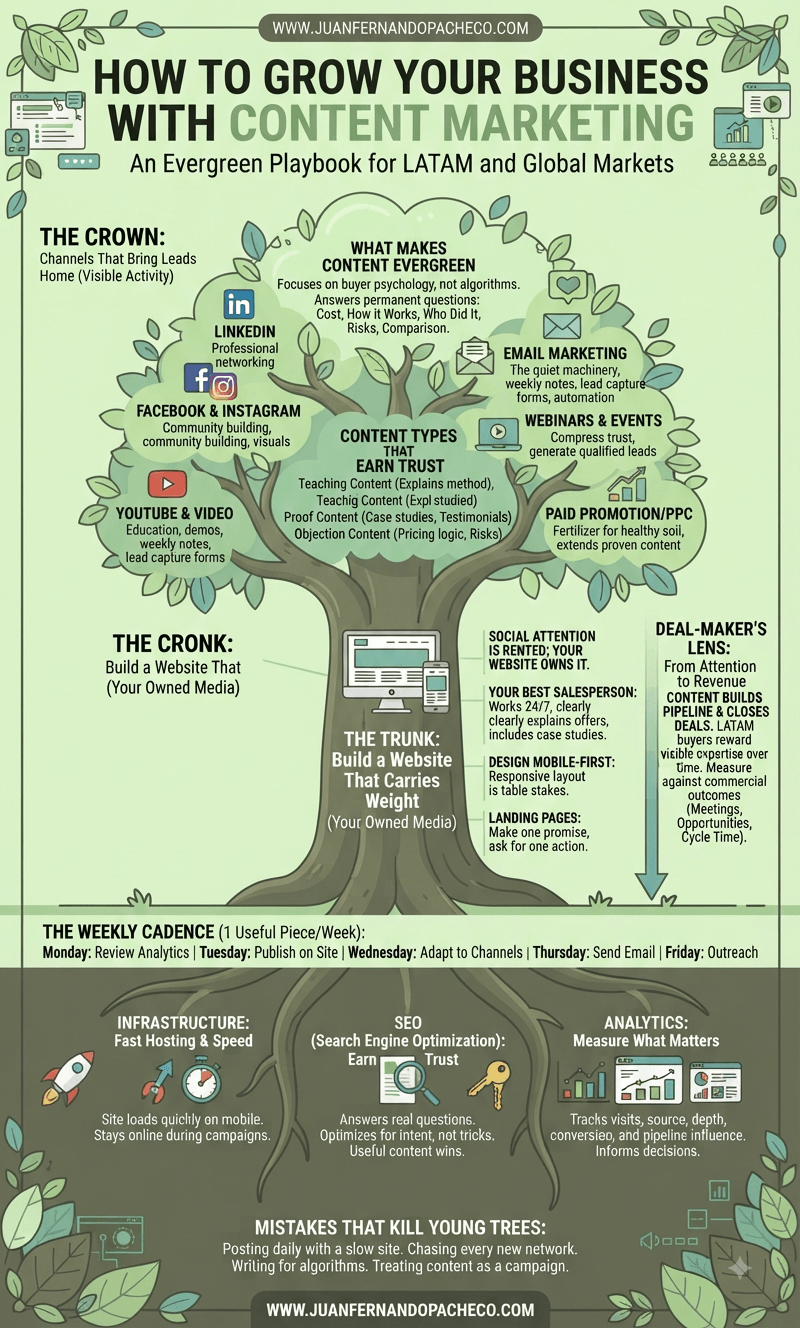
A simple picture explains the whole discipline: Picture a tree
- Its crown carries the visible activity.
- The trunk gives that activity a home.
- Deep roots feed everything and hold it upright.
Most failed strategies reverse that order, since most of the teams invest in loud leaves and starve the soil. This post walks the tree from roots to crown. You will leave with a system that works this quarter and in five years.
Why the tree model still works
Marketing platforms rise and fall
One of the major networks from the old infographic simply shut down. Channels changed; principles did not. A business still needs stable ground, a home base, and a visible crown. That is why the tree metaphor survives every algorithm update.
Look at the structure once more:
- Roots are your technical foundation: hosting, speed, SEO, and analytics.
- Your trunk is the website, the place all traffic should arrive.
- Its crown is every outward activity: social posts, webinars, email, ads, and partnerships.
Each part depends on the one below it.
Many teams invert the picture, and they publish daily on four networks while the site stays slow and unmeasured. Then they declare content marketing dead. The truth is quieter. Their tree starved below the soil line.
Roots first: the ground under everything
Let’s start underground
Roots rarely look impressive, yet they decide how tall you grow. Three roots matter most: infrastructure, SEO, and analytics.
- Infrastructure means fast hosting, solid uptime, and sensible security: Your site must load quickly on a mid-range phone. It must stay online during your biggest campaign. Visitors forgive many sins, but not a slow page. Speed is a commercial asset, not a technical detail.
- SEO helps strangers find you at the exact moment of curiosity: Nobody can buy that moment. You earn it by answering real questions in public. Write the guide you wish a client had sent you. Optimize for intent, not for tricks. Search engines reward usefulness, and humans reward clarity.
- Analytics closes the loop: Without numbers, every meeting becomes a debate about opinions. With numbers, you see which pages earn trust and which ones leak it. Watch a small set of signals: visits, source, depth, conversion, and pipeline influence. Review them on a fixed day each week.
Strong roots feel unglamorous. They are also the reason some competitors never catch you.
The trunk: build a website that carries weight
Social platforms rent you attention. Your website owns it
That difference decides who builds equity and who builds sandcastles. Every campaign, post, and ad should point home to your domain.
Treat the site as your best salesperson
It works every hour, in every market, with perfect consistency. Give it the tools a good salesperson would want. Clear pages explain what you sell and for whom. Case studies prove you have done it before. A simple contact path removes friction from the first hello.
Owned media also protects you from platform risk. Networks change their rules whenever they please. Your domain answers to you alone. That control is worth more than any viral moment.
Two trunk habits from the original tree still lead my checklist
Design mobile-first, because pockets carry your buyers. A responsive layout is table stakes, not a feature. Use landing pages for special offers and downloads. A landing page makes one promise and asks for one action. Remove the menu, remove the noise, and watch conversion climb.
Here is my commercial test for any website. Can a stranger understand your offer in ten seconds? Will that stranger act without hunting for a button? If either answer is no, fix the trunk before feeding the crown.
The crown: channels that bring leads home
Now the visible part. Your crown is where the market meets you
The infographic names Facebook, LinkedIn, Twitter, YouTube, Pinterest, and one ghost network. Read that list as a principle, not as dogma. Show up where your buyers already spend attention.
Each channel plays a distinct role
- LinkedIn manages professional relationships and opens doors to new prospects.
- Facebook builds community through updates, advice, and promotions.
Short updates keep you present between bigger moments. Video carries training, testimonials, and product demos. Visual boards organize ideas for audiences that think in pictures.
Do not staff them all at once.
Pick two channels that match your buyer’s habits. Master one format per channel before adding more. Consistency beats volume in every network I have seen.
Webinars deserve a special note, because they compress trust into one hour
A good seminar teaches a method, shows proof, and invites questions. Attendees self-identify as serious prospects, which makes follow-up easy. Press releases still add credibility when you have real news. Local search matters whenever feet must reach a door.
Email, automation, and the quiet machinery
Between trunk and crown sits the quiet machinery
Email remains the ultimate sales tool in the tree model, and I agree. Social decides who sees you; email decides who remembers you. A weekly note with one idea and one link outperforms a daily blast.
Capture leads with honest exchanges. Sign-up forms work when the offer carries real weight: a template, a checklist, a recording, a discount. Ask for the minimum data you need. Every extra field taxes your conversion rate.
Automation multiplies your effort once the basics work
Welcome sequences greet new subscribers while you sleep. Lead scoring tells sales who is ready for a call. Nurture tracks keep cold contacts warm for months. Start small, because complex automations break quietly. One good sequence today beats five imaginary ones.
Paid promotion also has a place. PPC targets potential customers with surgical intent. Boosting a proven post extends its life at a small cost. Think of paid media as fertilizer: helpful on healthy soil, toxic on weak roots.
What makes content evergreen
A post is evergreen when its value survives the calendar
This one avoids platform tricks and algorithm gossip. It focuses on buyer psychology, which changes slowly. Reread it in five years, and you can still act on it.
Write about permanent questions first. What does it cost? How does it work? Who has done it before? What can go wrong? How do I choose between vendors? Those five questions appear in every purchase, from software to cement. Answer them in public and you own the research phase.
Refresh instead of rewriting. Open your best ten pages once a quarter
Update numbers, swap one example, fix broken links. Search engines and humans both reward pages you maintain. Evergreen does not mean static. The core promise stays true while you prune the details.
Repurposing multiplies each idea. One article becomes a carousel, a short video, an email, and a webinar slide. The crown grows from a single trunk asset.
Content types that earn trust in any market
Buyers everywhere move through the same three doubts.
- Can you do it?
- Have you done it?
- Should I trust you?
Map your content to each doubt.
- Teaching content answers the first doubt. Explain your method in plain language. A firm that teaches well signals mastery without claiming it.
- Proof content answers the second doubt. Publish short case studies with a problem, a decision, and a measurable result. Testimonials and demos add texture.
- Objection content answers the hidden fears. Write the page your sales team wishes existed: pricing logic, implementation risks, migration plans, security answers. In formal tenders, such pages become quiet allies. Your champions cite them internally.
Notice what this list excludes. Gossip, trend commentary, and me-too posts earn attention without trust. Attention without trust rarely signs contracts.
From attention to revenue: a deal-maker’s lens
Here I add the view from my own career. Content marketing is not a vanity engine.
It exists to create pipeline and close revenue. In enterprise technology, buyers shortlist vendors long before any RFP appears. The shortlist goes to firms that taught them something first.
I saw this pattern across LATAM markets, from Mexico to Colombia and Ecuador. Large buyers distrust cold pitches. They trust visible expertise that shows up over time. A steady stream of useful content acts as proof of competence. When the formal tender arrives, your name already carries weight.
The same logic applies to public and private tenders
Evaluators score what they can verify. A documented history of useful content verifies expertise better than a slogan. In my RFx work, that archive often decided technical perception before the first question.
The tree even maps to a deal cycle. Roots give you data to forecast. Your trunk gives procurement a place to verify you. Its crown gives client champions arguments to defend you. Marketing stops being a cost center when it feeds that chain.
So measure content against commercial outcomes, not applause. Count meetings created, opportunities influenced, and cycle time saved. Ask sales which assets answer real objections. Then double the investment in what moves money.
A simple weekly cadence you can keep
Strategy needs a calendar, or it stays a wish. This cadence has survived every team I have led.
- Monday: review analytics for thirty minutes and note what changed.
- Tuesday: publish one substantial piece on your site.
- Wednesday: adapt that piece into channel-native posts.
- Thursday: send one email with a single idea.
- Friday: contact one partner, one client, and one prospect.
Protect the order. The site piece comes first, because you own it. Channel posts are simply trailers for the asset. Email is the reminder that you exist. Outreach turns distribution into relationships.
Scale only after twelve consistent weeks. Add a channel when the current two feel light. Bring in automation when manual follow-up hurts. Grow the tree the way gardeners grow trees: slowly, then all at once.
How to start in the next thirty days
- Spend week one auditing the roots: test speed, fix broken pages, install analytics and Search Console.
- Use week two to rebuild two core pages and one landing page with a real offer.
- Let week three launch your first teaching article across two channels and your email list.
- Reserve week four for a numbers review, keeping what worked and cutting what did not.
Momentum matters more than perfection. A shipped page today outruns a perfect page next month. Invite one customer story during week three, because proof compounds faster than opinion.
Mistakes that kill young trees
I will close the practical part with warnings. These errors repeat in every industry and every country.
Posting daily while the site stays slow and unmeasured. Chasing every new network instead of mastering two. Writing for algorithms instead of humans. Asking for ten fields of data on a first hello. Treating content as a campaign with an end date, not an asset you compound.
Notice the common thread. Each mistake prefers noise over structure. The tree model cures that bias. Build down before you build out.
Conclusion: plant once, harvest for years
Grow your business with content marketing by respecting the order of the tree. Feed the roots until the trunk stands firm. Let the crown earn attention only after the home base converts. Do that, and the strategy stays useful today, next year, and five years from now.
Your competitors will keep chasing the next shiny channel. You can afford a calmer path. Plant systems, not stunts.
References and further reading
- Dendrite Park, “how to grow your business using content marketing” (the wisdom-tree infographic that inspired this post) — https://dendritepark.com
- Content Marketing Institute, starter guides and research — https://contentmarketinginstitute.com
- HubSpot Academy, free courses on content and inbound marketing — https://academy.hubspot.com
- Google Search Central, evergreen SEO fundamentals — https://developers.google.com/search
- Google Analytics and Search Console, your measurement foundation — https://analytics.google.com and https://search.google.com/search-console
- “They Ask, You Answer” by Marcus Sheridan — turn buyer questions into trust-building content
- “Epic Content Marketing” by Joe Pulizzi — the strategic foundation for the whole tree
- “Content Inc.” by Joe Pulizzi — build the audience before the product
- “This is marketing” by Seth Godin — the mindset layer above all tactics
- “Building a StoryBrand” by Donald Miller — clarify the message on your trunk